Wachirathan Waterfall: Doi Inthanon's Most Impressive Cascade
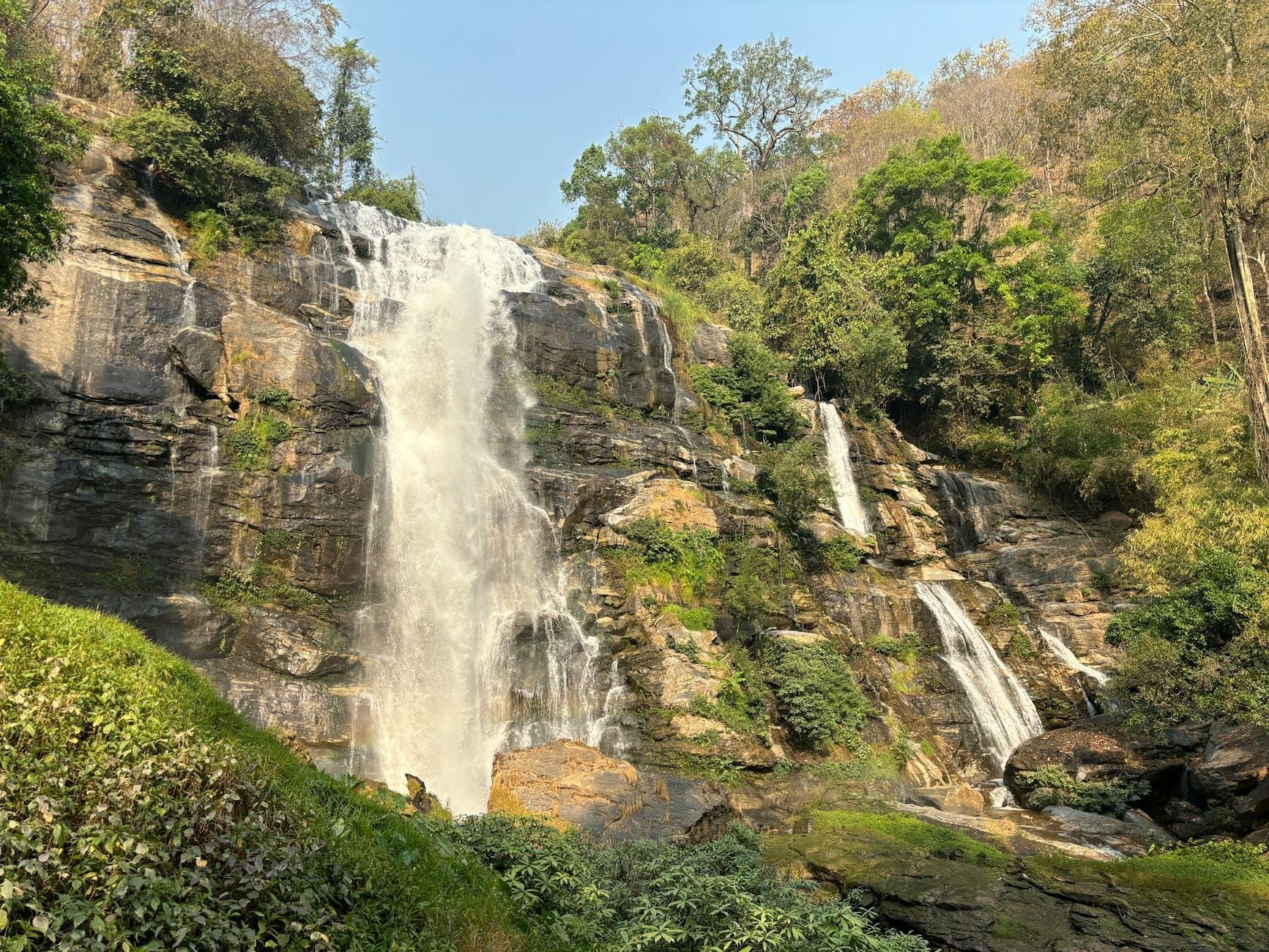
Wachirathan Waterfall is the largest and loudest waterfall in Doi Inthanon National Park, dropping over 80 metres in a wide curtain of white water that generates a constant cool mist. Set deep in montane forest roughly 21 kilometres from the park entrance, it rewards visitors with raw natural power rather than picture-perfect serenity.
Quick Facts
- Location
- Doi Inthanon National Park, ~21 km from the main entrance, Chiang Mai Province
- Getting There
- Private car or hired songthaew from Chom Thong district; no direct public bus to the falls
- Time Needed
- 45–90 minutes at the falls; allow half a day from Chiang Mai city
- Cost
- Included in Doi Inthanon National Park entry fee (foreigners: 300 THB adults, 150 THB children; Thais: 50 THB)
- Best for
- Nature lovers, photographers, families with older children, anyone visiting Doi Inthanon on a day trip
What Wachirathan Waterfall Actually Is
Wachirathan Waterfall is the signature cascade of Doi Inthanon National Park and arguably the most physically impressive waterfall in northern Thailand. Named using a Sanskrit-derived term often associated with royal names, the fall drops approximately 80 metres in a broad, thundering sheet over a dark granite face, sending spray far enough to soak clothing within seconds at close range. Unlike many Thai waterfalls that trickle to near-nothing in the dry season, Wachirathan retains enough volume year-round to feel genuinely dramatic — partly because the upper slopes of Doi Inthanon collect heavy orographic rainfall even when the lowlands are dry.
The viewing area is compact and well-maintained: a paved path leads from the car park to a wooden deck positioned roughly 30 metres from the base. There is no trail to the top or the plunge pool. What you get is a direct frontal view — and a drenching if the wind shifts. This is not a swimming waterfall, and park rules prohibit entering the water.
💡 Local tip
Bring a dry bag or a zip-lock bag for your phone. Even standing at the viewing deck, mist settles on everything within a few minutes. A light rain jacket doubles as spray protection.
The Sensory Experience: Sound, Mist, and Forest
You hear Wachirathan before you see it. The roar builds steadily as you walk the short path from the parking area through a fringe of tropical montane forest, the air noticeably cooler and damper than the road. At the deck, the sound is close to physical — a low-frequency rumble layered with the hiss of atomised water. Conversations at normal volume become impossible within 10 metres of the rail.
The mist creates a microclimate around the fall. Mosses and ferns colonise every surface near the base. The surrounding trees are draped in epiphytes, and in the morning, when sunlight angles through the forest canopy at roughly 45 degrees, small rainbows form intermittently in the spray. This is fleeting and depends on clear sky and time of day, typically between 9:00 and 11:00 in the morning when the sun is still low enough to catch the mist at the right angle.
The temperature at the falls sits several degrees below the surrounding park road, even at midday. In the cool season (November to February), bring a layer you can actually zip up — 15°C is not unusual when the spray reaches you.
Tickets & tours
Live prices and dates from our booking partner. If you book, we may earn a commission at no extra cost to you.
Chiang Mai private van day trip to Doi Suthep, Sticky Waterfall
From 146 €Instant confirmationFree cancellationPrivate van with driver to Flower Gardens and Dantewada Waterfall Park
From 146 €Instant confirmationFree cancellationHalf-day private tour with driver to Bua Thong Waterfall
From 101 €Instant confirmationFree cancellationChiang Mai private van tour with Wat Ban Den, Dantewada and Sticky Waterfall
From 132 €Instant confirmationFree cancellation
Best Time to Visit: Season and Time of Day
Wachirathan is one of the rare Chiang Mai-area waterfalls that genuinely delivers across most of the year, but there is a clear hierarchy. Peak volume and visual drama occur between August and October, when monsoon rains push the flow to its maximum width. The water takes on a grey-brown hue in heavy rain, which reduces the visual contrast against the rock face. Purists who want both high volume and blue-white water will find late October to early December the sweet spot: the rains have mostly passed, the water is still running strong, and the surrounding forest is deeply green.
The dry season (January to April) brings reduced but still respectable flow, cleaner water colour, and more reliable clear skies. March and April overlap with Chiang Mai's burning season, when smoke haze can flatten the light significantly and affect air quality on the mountain — something to weigh if respiratory health or photography are priorities.
For timing within the day, arrive before 10:00 for the lightest crowds and the best chance of rainbow light in the mist. Tour groups from Chiang Mai typically arrive between 10:30 and noon, and the car park can fill completely. Weekdays are considerably quieter than weekends. For a broader picture of conditions across the year, the Chiang Mai weather guide covers seasonal patterns in detail.
⚠️ What to skip
During the burning season (roughly February to April), smoke haze on Doi Inthanon can be significant. Check air quality readings before making the drive up, especially if you have breathing sensitivities.
Getting There: Logistics from Chiang Mai
Wachirathan sits inside Doi Inthanon National Park, about 70 kilometres southwest of Chiang Mai city. There is no public bus that goes directly to the falls. The practical options are: renting a car or motorbike and driving yourself, hiring a private driver or songthaew from Chom Thong town (the last major settlement before the park), or joining an organised day tour that includes the park.
Self-drivers follow Highway 108 south from Chiang Mai to Chom Thong, then turn onto Route 1009 which climbs into the park. The journey from Chiang Mai takes approximately 1.5 to 2 hours depending on traffic. The waterfall car park is clearly signposted in English on Route 1009, a few kilometres before the summit road junction. Parking is free.
If you are planning a full day on the mountain — which is the most efficient approach — Wachirathan pairs naturally with a drive to the Doi Inthanon summit and a stop at the Royal Twin Pagodas. Most visitors do Wachirathan on the way up or down, since it sits mid-mountain on the main road. A structured itinerary for this route is covered in the Doi Inthanon day trip guide.
ℹ️ Good to know
The national park entry fee covers all sites within the park, including Wachirathan, the summit, and the Royal Twin Pagodas. Pay at the main checkpoint on Route 1009. Keep your ticket — rangers occasionally check it at individual sites.
Photography: Making the Most of the Setting
The viewing deck offers a fixed frontal perspective. There is no elevated angle, no side trail, no way to get above the fall. What you can control is timing and settings. For sharp water texture showing individual threads of white water, use a fast shutter speed (1/500s or above) in good light. For the classic silky flow effect, you need a neutral density filter and a tripod — the railing on the deck is usable as a stabiliser in a pinch, though it vibrates slightly from the fall's percussion.
Morning light enters from the left (east), creating dramatic side-lighting on the rock face and catching the mist in visible beams if the sun is at the right angle. Midday light is flat and relatively uninteresting. Overcast days, counterintuitively, produce some of the most even and usable photography conditions, eliminating harsh shadows in the dark surrounding forest.
Lens choice matters: a wide angle captures the full height of the fall plus foreground, but the sheer width of the curtain can reduce apparent drama. A medium telephoto (85–135mm equivalent) isolates the central cascade and amplifies the sense of scale. For more practical shooting guidance across Chiang Mai's photogenic sites, see the Chiang Mai photography guide.
Practical Notes: Facilities, Accessibility, and What to Bring
The car park area has public toilets, a small vendor area with drinks and snacks, and a covered picnic shelter. The path to the viewing deck is paved and wide, but it includes a slope and some uneven sections. Wheelchair access is limited — the final approach to the deck involves steps that have no ramp alternative as of the most recent updates. Visitors with significant mobility limitations should be aware of this.
Footwear with grip is recommended. The path near the deck is continuously damp and can be slippery, particularly in the wet season. Flip-flops are genuinely inadvisable close to the fall itself. The temperature drop is real enough that a light layer in any season makes sense — the elevation here is around 800 metres, and the mist accelerates heat loss.
There is no food vendor directly at the falls, but the main park checkpoint area and some roadside spots along Route 1009 sell basic meals and coffee. If you are making a full day of Doi Inthanon, carry a packed lunch rather than relying on finding food at a specific hour.
Who This Waterfall Is Right For (and Who Might Be Disappointed)
Wachirathan delivers on volume and scale. It is the kind of waterfall that visually justifies the drive. That said, visitors expecting a serene jungle experience with a natural plunge pool for swimming, long forest trails, or complete solitude will find it falls short. The site is compact, the experience is essentially one fixed viewpoint, and on busy days — especially weekend mornings during the cool season — the deck fills with tour groups.
Families with children generally respond very well to Wachirathan precisely because the payoff is immediate and obvious. There is no long hike to earn the view. Older children in particular tend to find the sheer noise and spray genuinely exciting. Very young children and anyone sensitive to loud environments may find the sound level uncomfortable at close range.
Those who want a more remote or trail-based waterfall experience within Doi Inthanon should look at the Kew Mae Pan nature trail for a longer, more immersive forest walk, though that route has different seasonal access rules.
Insider Tips
- The mist from the fall drifts unpredictably based on wind. Stand to the left side of the deck (as you face the fall) for the most spray-free position, which also offers a better angle on the full curtain of water.
- Visit on a weekday if at all possible. Weekend tour group arrivals between 10:30 and 12:30 turn a peaceful observation into a crowded shuffle. The same waterfall on a Tuesday morning feels completely different.
- The vendor area near the car park sells hot coffee and corn — the corn is grilled on-site and genuinely good. It is one of the better roadside food stops on the mountain, worth a few minutes if you are between sites.
- If you are self-driving, combine the stop with Mae Klang Waterfall (near the park entrance) for a contrasting experience: Mae Klang is wider and more accessible, Wachirathan is taller and more powerful. Together they take about two hours.
- In the wet season, pack a complete change of clothes in the car if you plan to visit other sites afterward. At peak flow, standing at the viewing deck for more than five minutes results in thoroughly damp clothing — not dangerous, but uncomfortable for a long day.
Who Is Wachirathan Waterfall For?
- Day-trippers from Chiang Mai combining multiple Doi Inthanon sites in one trip
- Photographers working on landscape and long-exposure waterfall shots
- Families with children aged 6 and above who want a dramatic natural spectacle without a long hike
- Visitors who want a taste of northern Thailand's highland forest environment without overnight trekking
- Nature-focused travellers visiting during the late rainy or early cool season for peak conditions
Nearby Attractions
Other things to see while in Doi Inthanon National Park Area:
- Doi Inthanon Royal Twin Pagodas
Set high on the slopes of Thailand's tallest mountain, the Royal Twin Pagodas are two elaborately decorated chedis surrounded by manicured gardens and often wreathed in mist. Built to honor King Bhumibol Adulyadej and Queen Sirikit, they represent some of the finest contemporary Lanna Buddhist craftsmanship in northern Thailand.
- Doi Inthanon Summit
At 2,565 metres above sea level, the Doi Inthanon summit is the highest point in Thailand. The peak sits inside Doi Inthanon National Park, roughly 70 kilometres southwest of Chiang Mai, and draws visitors for its cloud forest ecology, dramatically cooler temperatures, and the sense of standing above everything else in the country.
- Kew Mae Pan Nature Trail
The Kew Mae Pan Nature Trail is a 3-kilometre loop at the summit zone of Doi Inthanon National Park, winding through cloud forest and open ridgelines above 2,200 metres. On clear days, the views stretch across layered mountain ranges into Myanmar. This is one of northern Thailand's finest short hikes, and one of the coldest places you will stand in the country.
Planning a trip? Discover personalized activities with the Nomado app.