Viking Cave (Tham Viking): Koh Phi Phi Leh's Mysterious Cliff Cave
Viking Cave, carved into the limestone cliffs of Koh Phi Phi Leh, is one of southern Thailand's more unusual and genuinely ancient sights. Viewed from the water, it combines prehistoric rock art, soaring cave chambers, and the centuries-old practice of swiftlet nest harvesting into a single stop that rewards curious travelers far more than the average island-hopping tick-box.
Quick Facts
- Location
- Koh Phi Phi Leh, Krabi Province, Thailand (Ao Nang, Mueang Krabi District)
- Getting There
- Boat only — typically included in Phi Phi island tours departing from Ao Nang, Krabi Town piers, or Phi Phi Don
- Time Needed
- 15–30 minutes at the cave itself; usually part of a full-day island tour (6–8 hours total)
- Cost
- No standalone ticket; included in tour prices which vary by operator — verify current rates before booking
- Best for
- History-minded travelers, photographers, those on Phi Phi island tours seeking more than beaches
- Official website
- portal.dnp.go.th/Content/nationalpark?contentId=930
What Viking Cave Actually Is
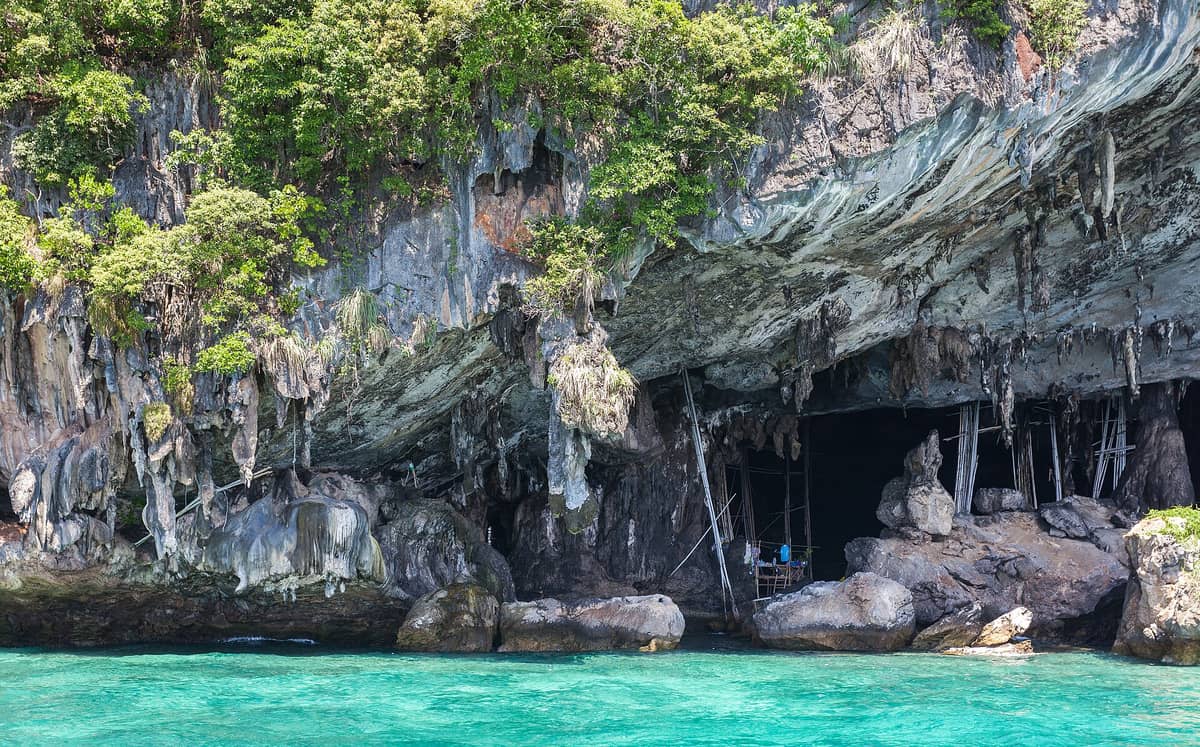
Viking Cave — known in Thai as ถ้ำไวกิ้ง (Tham Viking) or alternatively ถ้ำพญานาค (Tham Phaya Nak) — sits at the northeastern tip of Koh Phi Phi Leh, the uninhabited island in Krabi Province that most visitors know only as the location of Maya Bay. The cave opens directly onto the sea, its entrance framed by vertical limestone walls that rise roughly 80 metres above the waterline. You don't walk through it. You approach by longtail or speedboat, cut the engine, and drift close enough to look inside while the boat rocks in the gentle swell.
The name "Viking" is a misnomer that has stuck for decades. The paintings on the cave walls depict sailing vessels that some observers thought resembled Viking ships, and the label caught on. The images are not Viking at all — they are believed to be centuries-old paintings showing sailing vessels and at least one elephant, likely left by seafarers using the caves as a navigational landmark or shelter. King Bhumibol visited in 1972 and gave the cave its royal name, Tham Phaya Nak, after a stone resembling the mythical serpent, though the Viking nickname has remained dominant in tourism.
ℹ️ Good to know
Tourist entry into the cave interior is not permitted. All viewing is done from the boat. The cave is an active harvesting site for swiftlet nests, and workers with permits access the upper reaches via bamboo scaffolding.
The Swiftlet Nest Harvest: What You're Actually Looking At
The real reason Viking Cave has been important for centuries has nothing to do with art. The cave ceiling is home to vast colonies of swiftlets — small birds that build their nests entirely from saliva threads pressed against rock. These nests, once harvested, are the core ingredient of bird's nest soup, a delicacy traded across Southeast and East Asia for generations. The harvesting rights to caves like this one have historically been worth enormous sums, and the practice is tightly regulated.
If you look up when your boat drifts close, you can often see the bamboo pole scaffolding lashed together inside the cave — structures that harvesters climb without ropes to reach nests high on the cave walls. The scale of the bamboo framework is disorienting once you realize what it is. This is not a museum exhibit. It is an active, living industry operating inside a geological feature that also happens to contain rock art older than anyone's certain record.
Tickets & tours
Live prices and dates from our booking partner. If you book, we may earn a commission at no extra cost to you.
Jurassic Jungle Kayak and Phra Nang Cave Beach Tour from Krabi
From 742 €Instant confirmationFree cancellationFull-day Four Islands and Emerald Cave tour
From 42 €Instant confirmationFree cancellationDaily Cooking Class at Thai Cookery School in Krabi
From 42 €Instant confirmationFree cancellation7 islands speedboat excursion from Krabi
From 41 €Instant confirmationFree cancellation
The Rock Paintings and Their Uncertain History
The cave paintings are the detail that separates Viking Cave from a simple boat-past landmark. Visible on the rock face near the cave entrance are depictions of what appear to be sailing vessels — broad-hulled boats with oars or outriggers — along with an elephant figure. The style and subject matter suggest the work of maritime traders or sailors, possibly from centuries ago, using the sheltered bay as a waypoint.
The paintings are not well-lit, and from a rocking boat at water level, they require a moment to locate and interpret. Don't expect illuminated museum-quality displays. Expect faded ochre lines on dark limestone, more legible once your eyes adjust. If your guide doesn't point them out, you may miss them entirely — ask before you arrive at the cave entrance so you know where to look.
The cave falls within the boundaries of Hat Noppharat Thara–Mu Ko Phi Phi National Park, administered by the Department of National Parks.
How the Visit Works in Practice
Viking Cave is almost never sold as a standalone trip. It appears as one stop on Koh Phi Phi Leh island tours, usually combined with Maya Bay, Pileh Lagoon, and sometimes snorkeling sites. Tour boats typically circle the cave entrance, pause for 10 to 20 minutes, and then continue to the next stop. If the sea is calm, longtail boats can get quite close. If there is any swell, some operators skip the close approach or view from a greater distance.
Morning light hits the cave entrance from an angle that shows the paintings better than afternoon flat light. Tours departing early from Ao Nang or Phi Phi Don typically reach Viking Cave before the midday boat traffic builds up. By late morning, multiple tour boats can arrive simultaneously, which affects how long your boat lingers and how good your sightlines are.
💡 Local tip
Sit on the side of the boat facing the cave entrance before you arrive, not the open water side. On most tour boats, only one side has a clear view, and it goes quickly once the cave comes into sight.
Most tours to Viking Cave depart from Ao Nang or from Phi Phi Don itself. If you're already staying on Phi Phi, you can join a local tour that covers the cave as part of a shorter loop around Phi Phi Leh. Verify with your operator that Viking Cave is explicitly included — some budget tours skip it or pass it at speed without stopping.
Photography Conditions
Viking Cave rewards patient photographers who understand the constraints. The cave interior is dark, the boat is moving, and there's no option to get closer on foot. A telephoto lens or a phone with a strong zoom mode helps considerably for capturing the paintings. Wide shots of the cave entrance with the limestone walls above are easier and often more striking — the sheer scale of the cliff face framing the dark opening is the image most people come away with.
Visits are generally most popular during the November to April tourism season, though light and sea conditions vary. During the wetter months, overcast skies and waves can affect visibility and close approaches. The cave may still be viewable when conditions allow, but check with your operator before setting out.
Honest Assessment: Is It Worth the Stop?
If you're already on a Phi Phi Leh tour, Viking Cave adds genuine interest without costing any extra time or money. The combination of ancient rock art and an active traditional industry inside a cathedral-scale limestone cave is legitimately unusual. It's the kind of place that makes a full-day island tour feel like more than just a succession of snorkeling spots.
That said, travelers who come expecting a walkable cave, clear interpretive signage, or an immersive cultural experience will be underwhelmed. The visit is brief, conducted entirely from a boat, and the paintings require effort to see. If you have very limited time in the Phi Phi area and need to choose between stops, Maya Bay and Pileh Lagoon will photograph better and offer more immediate visual impact. Viking Cave appeals most to people who like context, history, and the sense that a place has been used by human beings for centuries before the first tourist showed up.
⚠️ What to skip
Viking Cave sits within a national park. No admission fee for the cave itself has been confirmed, but national park entrance fees for Mu Ko Phi Phi apply to visitors arriving by boat. Verify current park fee requirements with your tour operator before departure.
Getting There and Practical Notes
There is no independent access to Viking Cave. You need a boat, and the most practical approach is booking a guided tour. These run from multiple departure points across Krabi Province: Ao Nang, Krabi Town's Chao Fah pier, and the main pier on Koh Phi Phi Don. See the Krabi to Phi Phi day trip guide for full logistics on boat schedules and what to expect en route.
Bring sunscreen, water, and a hat. There is no shade at the cave and the boat ride across open water reflects significant UV. A dry bag is useful if there is any swell, as spray comes over the sides of longtail boats. Visitors with limited mobility should check with operators in advance — boarding and disembarking longtail boats involves stepping over low gunwales from a floating platform, which is not always easy on choppy water.
For a fuller picture of what Phi Phi Leh holds, including the beaches and lagoons surrounding Viking Cave, read through the Krabi island hopping guide before you book. Tour quality varies widely, and knowing what to ask about makes a real difference.
Insider Tips
- Ask your guide to name the paintings before you reach the cave — knowing what to look for (boat shapes, an elephant) dramatically improves what you'll actually see from the water.
- The bamboo scaffolding inside the cave is visible only if your boat gets close to the entrance. On rougher days or with larger boats, you may stay further back. Longtail boat tours generally get closer than speedboat tours.
- Early departure (before 8:30am from Ao Nang) means Viking Cave is typically reached before rival tour groups. The cave sees far less congestion than Maya Bay.
- If you want the cave wall paintings to show in photographs, set your camera or phone to a slightly longer exposure or higher ISO before arriving — the rock face is in shadow even in morning light.
- Viking Cave faces northeast, which means it catches soft morning light across the rock paintings. Afternoon visits in flat light make the art harder to see and photograph.
Who Is Viking Cave For?
- Curious travelers who want cultural and historical depth alongside Phi Phi's natural scenery
- Photographers interested in dramatic limestone cave entrances and unusual light conditions
- History and archaeology enthusiasts looking for genuine pre-modern human marks on the landscape
- Island-tour participants who want to understand what they're looking at, not just pass by
- Travelers already visiting Koh Phi Phi Leh who want to make the most of a full-day tour
Nearby Attractions
Other things to see while in Koh Phi Phi:
- Bamboo Island (Koh Mai Phai)
Bamboo Island, or Koh Mai Phai, is a small coral-fringed island in Hat Noppharat Thara–Mu Ko Phi Phi National Park, sitting just north of Phi Phi Don in the Andaman Sea. At roughly 0.5 km², it offers a long crescent of white sand and shallow turquoise water with noticeably fewer visitors than the Phi Phi main islands. Access is by boat only, making it a natural half-day escape for anyone already based in the Phi Phi area.
- Koh Phi Phi Don
Koh Phi Phi Don is the largest and only inhabited island in the Phi Phi group, sitting within Krabi Province roughly midway between the mainland and Phuket. It combines dramatic limestone cliffs, clear turquoise water, and a compact central village with a reputation that has grown considerably since the early 2000s. This guide tells you what the experience actually looks like, when to go, and whether it suits your style of travel.
- Koh Phi Phi Leh
Koh Phi Phi Leh is an uninhabited limestone island in Krabi Province, best known for Maya Bay. Striking from every angle and more controlled than you'd expect, it rewards visitors who understand what they're walking into.
- Maya Bay
Maya Bay on Koh Phi Phi Leh is one of Thailand's most photographed beaches, framed by sheer limestone cliffs and turquoise water. After a three-year ecological closure, it has reopened with strict visitor rules. Here is what the experience actually looks like today.
Planning a trip? Discover personalized activities with the Nomado app.