The Three Sisters, Echo Point: What to Expect Before You Go
The Three Sisters are three sandstone rock pillars rising above the Jamison Valley in the Blue Mountains, viewed from Echo Point in Katoomba. The lookout is free to visit, open around the clock, and accessible by train from Sydney — but the experience varies enormously depending on when you arrive.
Quick Facts
- Location
- Echo Point Road, Katoomba NSW 2780 — Blue Mountains National Park, approx. 100 km west of Sydney CBD
- Getting There
- Katoomba Station (Blue Mountains Line from Central Station, Sydney); Echo Point is a short taxi, rideshare, or bus ride from the station
- Time Needed
- 30 min for the lookout only; 1.5–2.5 hrs if you walk the Three Sisters track to Honeymoon Bridge and back
- Cost
- Free to enter the lookout. Paid parking applies at Echo Point (time limits enforced). No vehicle entry fee at this section of Blue Mountains National Park.
- Best for
- Scenic views, photography, day trips from Sydney, accessible sightseeing, Blue Mountains first-timers
What You're Actually Looking At
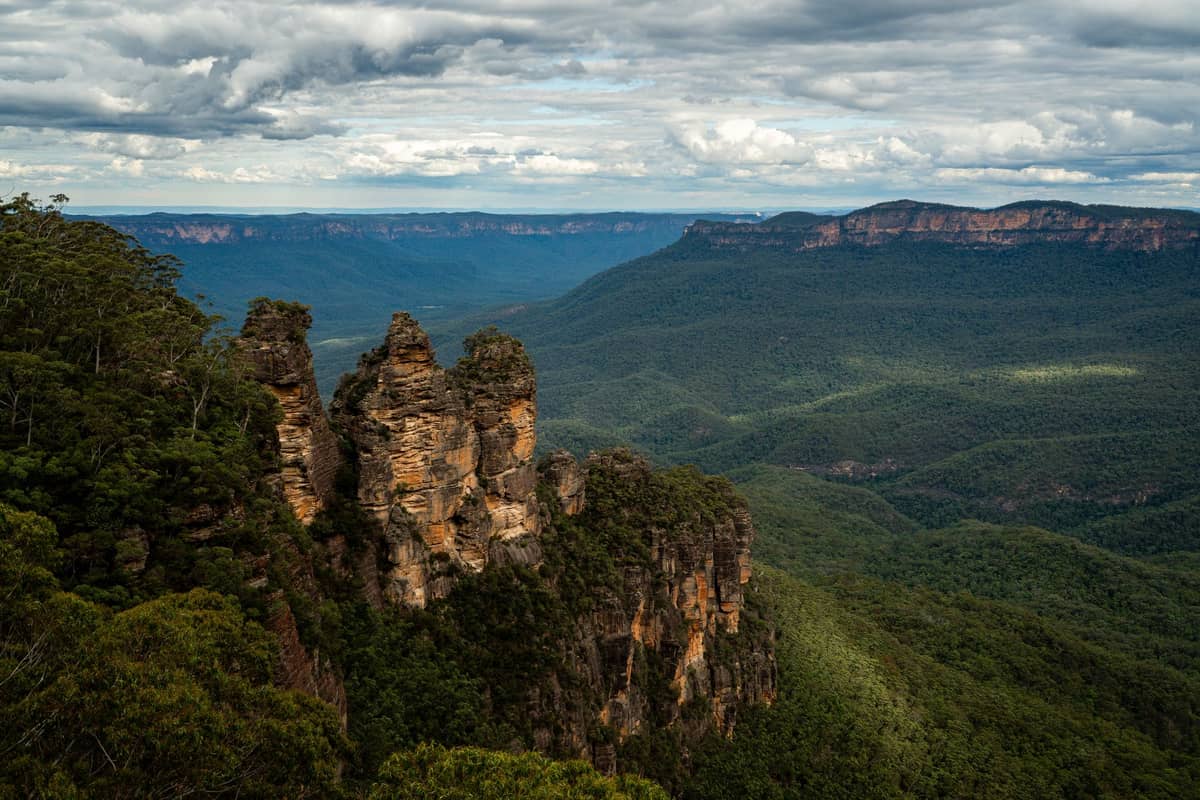
The Three Sisters are three separate sandstone columns standing at the edge of the Jamison Valley escarpment, their tops sitting at roughly 922m, 918m, and 906m above sea level. The rock is not smooth: it's striated with horizontal bands of orange, ochre, and grey, the compressed remains of ancient riverbeds and coastal dunes. From the main lookout platform at Echo Point, all three pillars align in a clear row, separated by narrow clefts that drop sharply away into dense eucalypt forest. On still mornings, when mist fills the valley below, the columns appear to float above a white sea — a photograph taken on almost any given winter morning will show you exactly why this is one of the most-photographed landforms in Australia.
The pillars were formed by a process of differential erosion over millions of years. The Blue Mountains plateau is built on Triassic-era Hawkesbury sandstone and Narrabeen shale. Where water, wind, and plant root growth found natural joints and weaknesses in the rock face, material eroded away faster, leaving isolated columns behind. The Three Sisters occupy a spur jutting from the plateau, which is why they appear so fully three-dimensional rather than flat-faced from the lookout.
The English name 'Three Sisters' postdates the renaming of Echo Point in 1890. The Gundungurra and Darug peoples are the Traditional Custodians of this Country, and the formation holds deep cultural significance to them. Visitors should be aware that the geological story and the cultural story of this landscape exist in parallel, not in competition.
How the Experience Changes by Time of Day
Arrive between 10am and 2pm on a school holiday or long weekend, and Echo Point will be packed. Tour coaches fill the car park, selfie sticks multiply along the railing, and the noise of the lookout competes with the wind. That said, the view itself is unchanged: the rock doesn't care how many people are looking at it. But if you want quiet, go early or late.
Sunrise is spectacular and nearly always uncrowded. The eastern-facing lookout platform catches the first light directly on the Three Sisters' west-facing rock faces, which glow amber and rust before the rest of the valley has woken up. By 7am on a clear autumn morning, a small number of photographers and early walkers are typically present — nothing like the midday crowd. The Visitor Centre will be closed, but the lookout itself is accessible at all hours.
Late afternoon (around 3–4pm on winter days, 5–6pm in summer) offers lower-angle light that deepens the colour of the sandstone. The valley below transitions from green to shadow early, which concentrates all the visual drama on the lit pillars above. Clouds building over the plateau can shift the atmosphere dramatically in minutes — a sunny lookout view can turn to a moody, mist-layered scene without warning. This unpredictability is part of what makes the Blue Mountains worth visiting rather than just reading about.
💡 Local tip
For the fewest crowds, arrive before 9am or after 3:30pm on weekdays. Weekends and NSW public school holidays are reliably the busiest times — avoid them if you can, or accept that the lookout will feel more like a viewpoint queue than a wilderness experience.
Tickets & tours
Live prices and dates from our booking partner. If you book, we may earn a commission at no extra cost to you.
The Rocks historic walking tour
From 20 €Instant confirmationFree cancellationBeginner surf lesson at Bondi Beach
From 79 €Instant confirmationFree cancellationSydney whale-watching cruise with breakfast or lunch
From 62 €Instant confirmationFree cancellationBlue Mountains Waterfalls Full-Day Tour with Lunch and Dinner
From 171 €Instant confirmationFree cancellation
Getting There from Sydney
The most straightforward public transport option is the Blue Mountains Line train from Central Station in Sydney to Katoomba Station. The journey takes roughly two hours; check Transport for NSW for current timetables and fares before you travel. From Katoomba Station, a short taxi or rideshare trip reaches Echo Point, or you can take a local bus. The Blue Mountains day trip guide covers transit options, timing, and how to combine Echo Point with other stops in the area.
By car, follow the Great Western Highway west from Sydney into Katoomba, then follow signs to Echo Point. The drive takes approximately 90 minutes from the Sydney CBD in normal traffic — allow extra time in peak periods or holiday weekends when the highway can back up significantly. Parking at Echo Point is paid and time-limited, with five accessible spaces available. During busy periods, the car park fills by mid-morning, so arriving early is practical rather than optional.
Many visitors combine Echo Point with Scenic World at Katoomba, which is a short drive or rideshare away. If you're arranging a guided tour from Sydney, most full-day Blue Mountains tours include a stop at Echo Point as a standard element.
The Lookout and the Walking Track
The main upper lookout at Echo Point is wide, paved, and step-free — gently sloping concrete paths lead to the lower lookout as well. This is one of the more accessible major viewpoints in the national park, and it works well for visitors with prams, wheelchairs, or mobility considerations. Five accessible parking spaces are located at the car park, and accessible toilets are available on site.
Beyond the Oreades Lookout, the track descends a series of steps to Honeymoon Bridge, which crosses a narrow gap between the plateau edge and the first of the three columns. This section is not wheelchair-accessible and involves some exposure on the edges. The steps are solid and handrailed, but they demand a basic level of fitness and sure footing. Sturdy shoes are strongly advised; the steps can be slippery after rain.
The walk down to Honeymoon Bridge and back takes most visitors between 60 and 90 minutes, depending on pace and photo stops. Climbing out from the bridge involves a sustained uphill return on the same steps — it's not technical, but it's tiring if you haven't walked much. The reward is a ground-level perspective on the rock face: you can see the scale of the columns in a way that no lookout platform conveys, and the forest closes in around you with the smell of wet eucalyptus and warm sandstone.
⚠️ What to skip
Do not attempt to walk beyond the designated tracks or climb on the rock formations. The sandstone is eroding and unstable in places. Blue Mountains National Park requires visitors to stay on formed trails, and this is enforced for safety, not bureaucratic convenience.
Photography: What Works and What Doesn't
The Three Sisters are extremely photogenic under the right conditions and surprisingly dull under others. Flat midday light in summer bleaches the colour out of the rock and creates heavy shadows in the valley — the photographs look washed out unless there is cloud cover. The best natural light falls in the golden hours, with early morning generally superior to evening because the eastern orientation of the lookout means the pillars receive direct morning light.
Mist and low cloud in the Jamison Valley, common in autumn and winter mornings, create layered-depth images that are difficult to replicate elsewhere. A wide-angle lens captures all three columns in frame from the main platform; a longer focal length isolates individual pillars and compresses the layers of ridgelines behind. Drone flight for recreational purposes is prohibited at Echo Point in Blue Mountains National Park — this catches some visitors off guard.
Vivid Sydney's light installations have occasionally extended to the Blue Mountains region; if you're visiting in late May or June, check the Vivid Sydney guide for any scheduled projections at Scenic World or Echo Point, which can offer an entirely different way to experience the formations after dark.
Weather and When to Go
The Blue Mountains sit at altitude and experience noticeably cooler and more variable weather than Sydney. Even in summer, afternoon temperatures at Katoomba may be 5–8°C lower than coastal Sydney, and the area receives more rainfall. In winter (June–August), temperatures can drop close to freezing overnight; morning frost on the lookout platform is not uncommon, and occasional snow dusts the upper reaches of the park. Bring layers regardless of the season.
Shoulder seasons (March to May and September to November) tend to offer the most balanced conditions: the mist events are more frequent than in summer, the crowds are thinner than school holidays, and the temperatures are comfortable. For a broader view of timing across Sydney's attractions, the best time to visit Sydney guide covers seasonal considerations across the city and region.
Fog and low cloud can completely obscure the view on any given day. This is not a rare edge case — it happens regularly, especially in the colder months. If you arrive and the valley is socked in with cloud, the Visitor Centre staff can often advise whether the cloud is likely to lift within an hour or two. Some visitors find that waiting 30–45 minutes for cloud to clear is worthwhile. Others encounter a solid grey wall that doesn't shift all day. That's the honest reality of visiting a mountain landscape.
Visitor Centre and Facilities
The Echo Point Visitor Centre, operated by the Blue Mountains City Council and NSW National Parks, opens daily from 9am to 4pm, except Christmas Day. Inside, you'll find trail maps, information about current track conditions, and exhibits covering the geology and natural history of the Blue Mountains. The centre also holds information relevant to the broader park, including walking track closures, which can be issued with little notice after heavy rain or fire risk.
The Three Sisters sit within Blue Mountains National Park, one of the anchor attractions of any Blue Mountains National Park visit. If you're making a full day of it, the park extends far beyond Echo Point, and options like the Grand Canyon walk or the Fairfax Heritage Track offer solitude that the Three Sisters lookout itself cannot.
Cafes and restaurants in Katoomba town centre are a 5-minute drive or 20-minute walk from Echo Point. The lookout itself has no food vendors. There are public toilets at the car park, including accessible facilities.
Who Should Consider Skipping This
If your primary interest is solitary wilderness rather than a managed viewpoint, the Three Sisters at peak times will disappoint. There are far quieter and equally dramatic walks within Blue Mountains National Park that don't appear in most tour itineraries. Similarly, visitors who have already explored the park extensively and are looking for something less touristy might find better value in destinations like Scenic World in Katoomba for a different kind of mountain experience, or in the park's less-visited southern and northern sections.
The Three Sisters are also poorly suited to visitors who dislike uncertainty: if you need a guaranteed clear view for a specific commitment (wedding photography, for example), the mountain weather makes this a risky call without a backup plan.
Insider Tips
- Arrive by 8am on a weekday for the cleanest photography conditions and almost no other visitors. The car park is often free of tour coaches at this hour, and the morning light hits the pillars directly.
- If you're driving, check Echo Point's parking situation on Google Maps in real time before you enter Katoomba — when the main lot is full, visitors circle endlessly. There is overflow parking further along Cliff Drive.
- The Visitor Centre staff know the daily cloud and mist patterns better than any forecast app. If it looks cloudy when you arrive, ask them before you leave — a 30-minute wait in the centre often sees the valley clear dramatically.
- Dress for a temperature 6–8°C colder than Sydney. Visitors in summer clothes on a clear winter morning at the lookout are visibly uncomfortable within minutes, especially when wind picks up off the valley.
- Track conditions after rain deteriorate quickly on the stepped descent to Honeymoon Bridge. If it has rained in the past 24 hours, assume the steps are slippery and wear footwear with grip accordingly.
Who Is Three Sisters For?
- First-time visitors to the Blue Mountains wanting the iconic panoramic view
- Day-trippers from Sydney with limited time who need a single landmark stop
- Accessible sightseeing: the upper and lower lookouts are step-free and suitable for wheelchairs and prams
- Photographers chasing mist, golden-hour rock colour, or winter frost conditions
- Families with children who want a dramatic view without committing to a full bushwalk
Nearby Attractions
Combine your visit with:
- Blue Mountains National Park
Blue Mountains National Park covers around 268,000 hectares of sandstone plateaus, deep gorges and temperate rainforest west of Sydney. It is a popular national park in New South Wales and one of the most rewarding day trips or overnight escapes from the city, provided you know where to go and when to arrive.
- Featherdale Wildlife Park
Featherdale Sydney Wildlife Park in Doonside is one of the few places near Sydney where you can get genuinely close to Australian wildlife, from koalas and wombats to Tasmanian devils and freshwater crocodiles. Open daily from 8:00 am, it suits families and animal lovers who want more than a glimpse through a fence.
- Figure Eight Pools
Figure Eight Pools are naturally formed rock pools on the coastal shelf of Royal National Park, south of Sydney. Reaching them requires a 6km return walk over steep terrain and careful timing around tides and surf. The reward is a striking geological curiosity in one of Australia's oldest national parks.
- Hunter Valley Wine Region
The Hunter Valley is Australia's oldest premium wine-producing region, sitting roughly two hours north of Sydney. Spread across 2,605 hectares of vineyard land near the village of Pokolbin, it rewards visitors with cellar door tastings, open countryside, and a pace that feels genuinely removed from city life. Whether you come for a single afternoon or a full weekend, understanding how the region works before you arrive makes a real difference.
Planning a trip? Discover personalized activities with the Nomado app.