Tekeli Mehmet Paşa Mosque: Ottoman Architecture in the Heart of Kaleiçi
Tucked inside Antalya's walled old quarter, Tekeli Mehmet Paşa Mosque is one of the finest Ottoman structures in the city. With its distinctive dome arrangement, intricate Koranic tilework, and a location steps from the Clock Tower, it offers a quiet moment of architectural and cultural depth amid the bustle of Kaleiçi.
Quick Facts
- Location
- Tuzcular Neighborhood, Kaleiçi old town, Antalya, Turkey
- Getting There
- Kalekapısı tram stop (AntRay), a short walk away
- Time Needed
- 20–40 minutes
- Cost
- Free entry
- Best for
- Architecture lovers, history seekers, and visitors exploring Kaleiçi on foot
What You're Actually Looking At
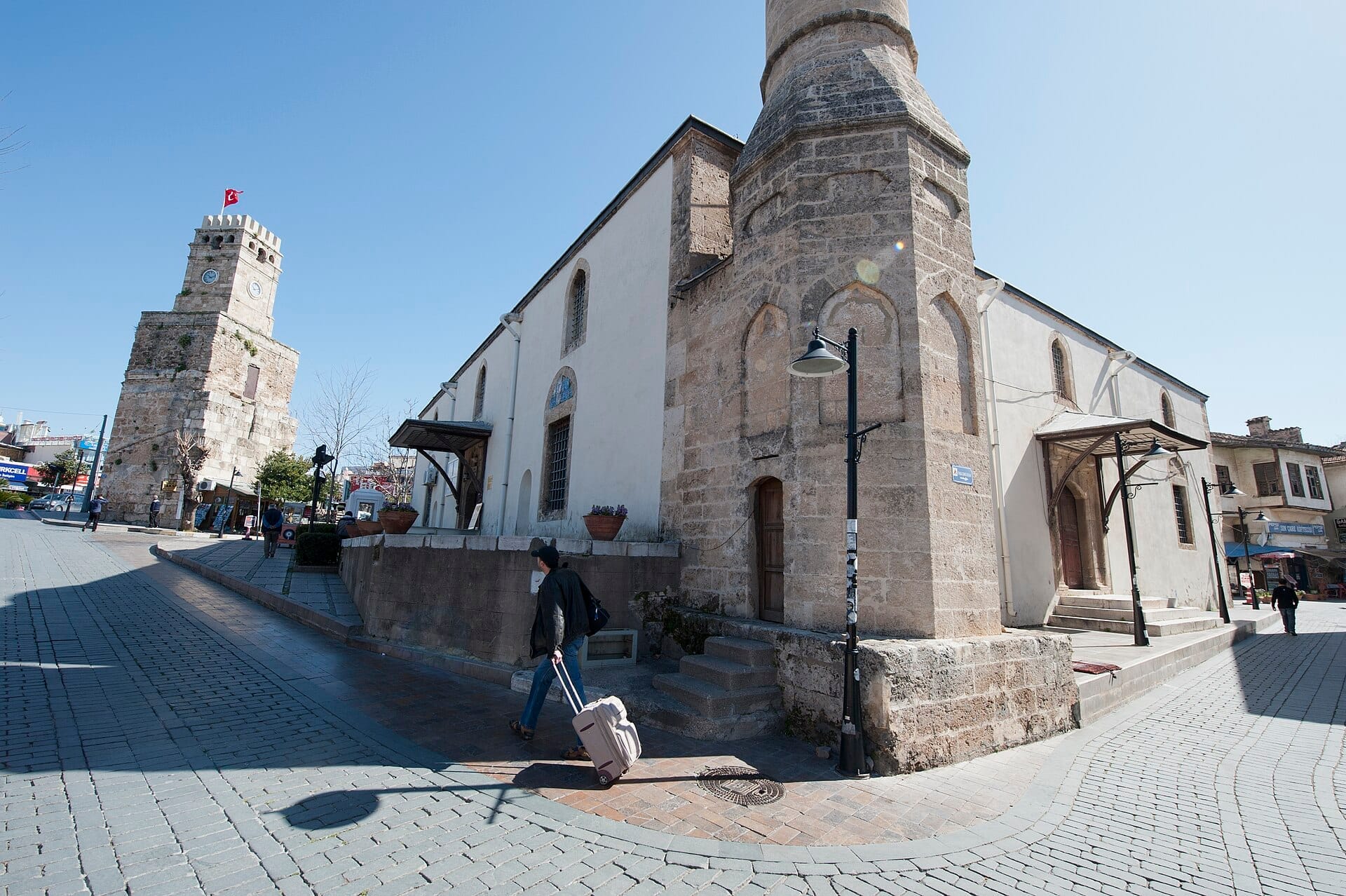
The Tekeli Mehmet Paşa Mosque sits in the Kalekapısı area of Kaleiçi, Antalya's preserved Ottoman and Roman-era old town. It isn't large by imperial mosque standards, but its proportions are precise and its architectural logic is clear once you know what to look for. A central dome rises on a high cylindrical drum and is supported on three sides by semi-domes to the east, west, and south. Three smaller domes cover the northern vestibule. The result is a compact but layered silhouette that reads differently depending on the angle from which you approach it.
Approaching from the street, the exterior stonework has the slightly worn authority of a building that has been repaired but not over-restored. Major renovation work took place in 1886 and again in 1926, which means the fabric you see today reflects layers of Ottoman and early Republican care rather than a single frozen moment. The minaret is slender and proportionate, and the courtyard entry is low-key enough that first-time visitors sometimes walk past without realizing they have arrived.
💡 Local tip
The mosque is an active place of worship. Visitors are welcome outside prayer times, but if the call to prayer begins while you are inside, step quietly to the side or exit. Remove shoes before entering and dress modestly: covered shoulders and knees for all genders, a headscarf for women.
The Interior: Tiles, Proportions, and a Prayer Clock
Step inside and the first thing you notice is the light. The dome admits a ring of windows that creates a diffused, even illumination across the prayer hall. The floor is covered with clean prayer rugs, and the walls carry Koranic inscriptions rendered in traditional calligraphic tilework. These panels, framed by geometric motifs, represent one of the more detailed decorative programs you will find in a mosque of this size in Antalya's old town.
One detail worth pausing on is the prayer clock mounted inside the mosque. These instruments, which were used to track the timing of the five daily prayers, are rare in smaller regional mosques and speak to the building's historical importance within the city's religious life. It is easy to overlook if you are moving quickly, so take a moment to look for it once your eyes have adjusted to the interior light.
The space is not enormous, which is part of what makes it absorbing. Unlike the grand imperatorial mosques of Istanbul, this one creates an intimacy that allows you to study the tilework and the dome geometry at close range without craning your neck or competing with crowds. On a quiet weekday morning, the interior can feel genuinely still.
Tickets & tours
Hand-picked options from our booking partner. Prices are indicative; availability and final rates are confirmed when you complete your booking.
Lake Beyşehir and Esrefoglu Mosque Tour from Antalya, Belek, Side
From 99 €Instant confirmationFree cancellationTazı Kanyon, Safari, Rafting, Buggy Safari, and Zipline in Turkey
From 65 €Instant confirmationFree cancellationAntalya guided city tour with lunch
From 45 €Instant confirmationFree cancellationTraditional Turkish bath experience in Antalya
From 45 €Instant confirmationFree cancellation
History and the Man Behind the Mosque
The mosque takes its name from Tekeli Mehmet Paşa, an Ottoman figure who served as governor and is associated with the mosque's original construction, dated to the late 16th or early 18th century. Scholarly sources differ on the precise date, and the building's history of repairs makes an exact founding date difficult to pin down with certainty. What is clear is that the mosque was built as a significant local endowment, the kind of civic-religious project that Ottoman administrators undertook to leave a lasting mark on a city.
Kaleiçi itself has been continuously inhabited since the Hellenistic period. By the time this mosque was built, the old town had already accumulated Roman gates, Byzantine walls, and Seljuk minarets. The Tekeli Mehmet Paşa Mosque added an Ottoman layer to that sequence, and it stands today as one of the cleaner examples of provincial Ottoman religious architecture on Turkey's southern coast. For context on how this mosque fits into the broader architectural history of the neighborhood, the area around it rewards slow exploration.
The mosque sits very close to several other significant structures in Kaleiçi. The Clock Tower is just a short walk away, and Hadrian's Gate is within comfortable walking distance. Together, these sites trace Antalya's layered history from Roman civic architecture through Seljuk and Ottoman religious building in a single unhurried walk.
How the Atmosphere Changes Through the Day
Early morning is the most rewarding time to visit. The surrounding streets of Kaleiçi are quiet, the light is soft and directional, and you can hear the birds in the courtyard trees without the background noise of tourist foot traffic. The mosque's stonework takes on a warm, golden tone in morning light, and shadows define the dome geometry with particular clarity.
By midday in summer, the area around Kalekapısı fills with visitors, and the contrast between the mosque's quiet interior and the street outside becomes more pronounced. The mosque offers genuine respite from the heat: thick stone walls and ventilation from the dome windows keep the interior noticeably cooler than the street. In summer, carry water and wear light layers that cover appropriately. In winter, Antalya's Mediterranean climate keeps conditions mild, but morning rain is possible.
Late afternoon brings good photographic light on the exterior, particularly if you position yourself to capture the dome against the sky from the side of the building. The narrow streets of Kaleiçi mean you won't get a wide architectural shot, but close-up studies of the tilework, the minaret, and the dome drum reward a careful photographer with a standard lens or a phone camera with portrait mode.
ℹ️ Good to know
The mosque is open for the five daily prayers and typically accessible to respectful visitors outside those windows. There are no posted tourist hours, no ticket desk, and no entrance fee. If you arrive and find the doors closed between prayers, a short wait usually resolves it.
Getting There and Fitting It Into Your Itinerary
The most practical approach is on foot from anywhere in central Antalya. The Kalekapısı tram stop on the AntRay line puts you within a short walk of the mosque, and the surrounding streets are pedestrian-friendly. If you are coming from the harbor area or the Roman marina, the walk uphill through Kaleiçi passes several other points of interest before arriving at the mosque.
This mosque works best as part of a structured walk through Kaleiçi rather than a standalone destination. A logical route might begin at Hadrian's Gate, move through the old bazaar streets toward the Yivli Minaret, stop at the Tekeli Mehmet Paşa Mosque, and end near the Antalya Marina. The full loop takes two to three hours at a relaxed pace. For a full suggested route, the Kaleiçi walking tour guide maps this out in detail.
Parking in Kaleiçi is limited and the streets are narrow. If you are arriving by car, use the public car parks near the old town perimeter and walk in. Taxis and ride-hailing services drop off conveniently near Kalekapısı.
Honest Assessment: Is It Worth Your Time?
If you are spending a full day in Kaleiçi, yes, absolutely. The Tekeli Mehmet Paşa Mosque takes twenty minutes and costs nothing, and the interior tilework and dome geometry are genuinely fine examples of provincial Ottoman craftsmanship. It is not in the same league as Istanbul's great imperial mosques, and visitors arriving with those expectations may find it modest.
Travelers who are rushing through Antalya on a half-day stop and prioritizing the big Roman landmarks may reasonably skip it. The mosque does not have the immediate dramatic impact of Hadrian's Gate or the panoramic draw of the Yivli Minaret seen from across the harbor. But for anyone with an interest in Ottoman architectural detail or in understanding how a Mediterranean port city accumulated its religious heritage, it offers more depth than its modest exterior suggests.
For a broader picture of Antalya's historical layers, the Antalya Museum holds significant artifacts from the region and complements a visit to the mosque with solid archaeological context.
Insider Tips
- Visit just after the Fajr (dawn) or Dhuhr (midday) prayer ends for the quietest access window. The interior will be calm and largely visitor-free.
- The tilework panels in the interior are best photographed without flash. Natural light from the dome windows is sufficient and gives more accurate color rendering.
- The courtyard outside the mosque has a small shaded area suitable for a short rest. It is a useful waypoint if you are doing a long walk through Kaleiçi in summer heat.
- Look up at the transition zone between the main dome and the semi-domes. The pendentives carry calligraphic roundels that are easy to miss at ground level but are among the most carefully executed details in the building.
- The narrow street leading to the mosque from the Kalekapısı side often has small tea sellers in the morning. A glass of tea here while the morning light hits the minaret is one of Kaleiçi's unhurried pleasures.
Who Is Tekeli Mehmet Paşa Mosque For?
- Architecture and design enthusiasts interested in Ottoman dome construction and tilework
- Travelers doing a walking tour of Kaleiçi who want to understand the neighborhood's full historical depth
- Photographers looking for detailed texture shots and morning light geometry
- Visitors seeking a free, uncrowded, and culturally meaningful stop in the old town
- Anyone wanting a cooler, quieter pause during a hot afternoon in Antalya
Nearby Attractions
Other things to see while in Kaleiçi (Old Town):
- Antalya Marina
Kaleiçi Yat Limanı, known to visitors as Antalya Marina, is a semi-circular harbor carved into the limestone cliffs of the old town. Built during the Hellenistic period and used continuously through Roman, Byzantine, Seljuk, and Ottoman times, it now anchors a strip of seafood restaurants, craft shops, and boat tour operators. Admission is free, and the harbor is open around the clock.
- Antalya Boat Tours
Departing from the ancient Kaleiçi Marina, Antalya boat tours take you along dramatic limestone cliffs and into clear turquoise bays. Whether you want a full-day swim-and-lunch cruise or a shorter evening sail, here is everything you need to decide if it is worth your time.
- Clock Tower
Standing at the edge of Antalya's ancient walls, the Saat Kulesi is a 14-metre Ottoman clock tower built in 1901 with a pentagonal stone base dating back to the 9th century. Free to visit at any hour, it marks the gateway between the modern city and the cobbled lanes of Kaleici's old quarter.
- Hadrian's Gate
Built in 130 CE to honor Emperor Hadrian's visit to the ancient city of Attaleia, Hadrian's Gate is a triple-arched Roman triumphal monument in white marble and granite. Free to enter at any hour, it marks the main threshold between Atatürk Boulevard and the winding lanes of Kaleiçi old town.