Sunny Jim Sea Cave: La Jolla's Underground Coastal Wonder
Sunny Jim Sea Cave is the only sea cave along the La Jolla coast accessible by land, reached through a hand-carved tunnel beneath a cliffside gift shop in La Jolla. Visitors descend 145 wooden steps into a cavern where the Pacific surges through a natural sandstone arch. It is compact, wet, and genuinely dramatic.
Quick Facts
- Location
- 1325 Coast Blvd, La Jolla, CA 92037 (inside The Cave Store)
- Getting There
- Drive or rideshare to La Jolla Cove area; limited street parking on Coast Blvd. There is no trolley stop directly at La Jolla Cove, so rideshare is often the most practical option.
- Time Needed
- 30–60 minutes including the store, descent, and cave viewing
- Cost
- Standard admission: Adults US$13 / Youth (3–17) US$7 / Under 3 free
- Best for
- Curious adults, older kids, photography, coastal geology enthusiasts
- Official website
- www.cavestore.com
What Is Sunny Jim Sea Cave?
Sunny Jim Sea Cave sits beneath the sandstone bluffs of La Jolla's coastline and holds the distinction of being the only sea cave on this stretch of California coast that can be entered from land. Seven sea caves line this stretch of cliff, but Sunny Jim is the largest, and the only one with a purpose-built tunnel connecting it to the surface. You access it through The Cave Store, a small gift shop perched on Coast Boulevard, by descending a hand-carved wooden staircase of 145 steps through a narrow tunnel drilled directly into the rock.
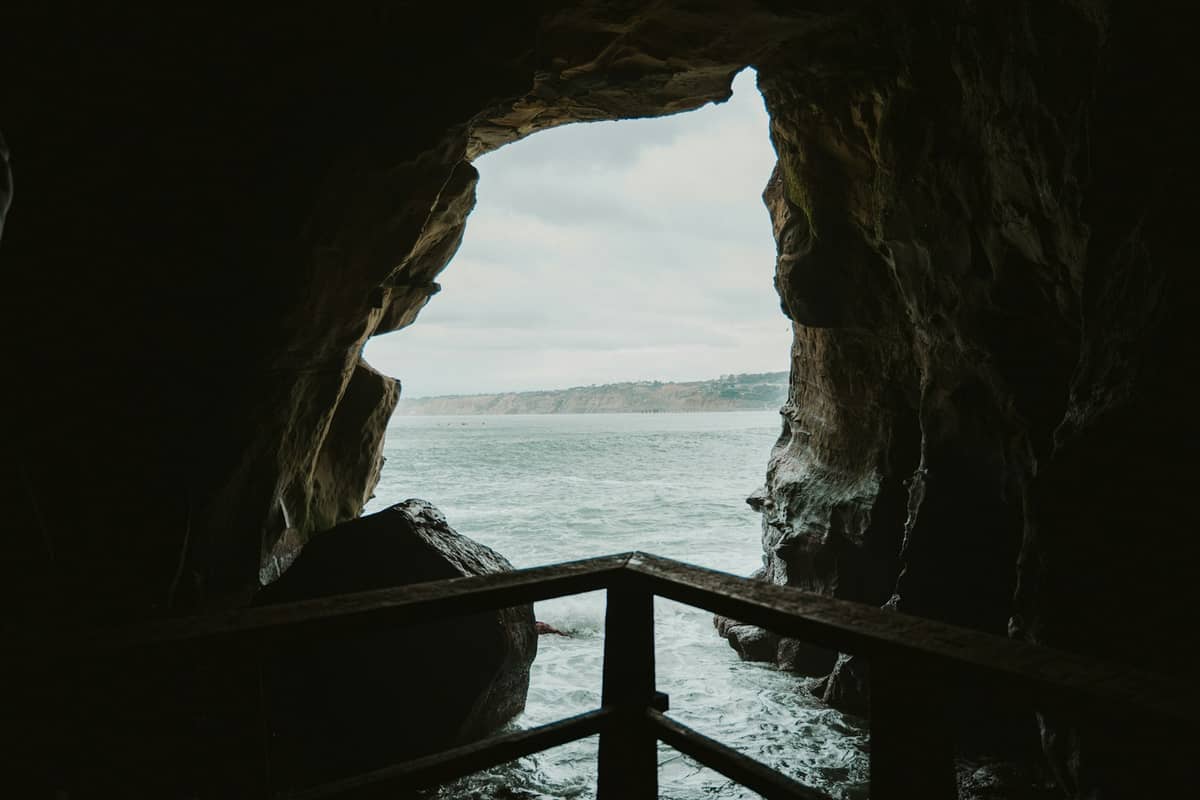
The experience is short in duration but memorable in character. At the bottom, the cave opens onto a ledge above churning Pacific water. The sandstone walls glow amber and rust where light catches them, the smell of salt and wet rock intensifies as you descend, and the sound shifts from street noise to a deep, rhythmic surge as waves push through the cave's ocean-facing arch. On calm days the water inside the cave is clear enough to see the rocky bottom; on rougher days it swells and crashes with enough force to feel the vibration through the walls.
ℹ️ Good to know
The Cave Store offers cave access daily from 9:00 AM to 4:30 PM. Admission is collected at the store before you descend. Bring exact change or a card — the shop is small and staffed by a single attendant during quieter hours.
The History Behind the Tunnel
The tunnel was not carved by the sea. It was dug by hand beginning in 1902 under the direction of German-born artist and entrepreneur Gustav Schultz, who wanted to create a commercial attraction at a time when La Jolla was just beginning to develop as a destination. Workers spent months chiseling through the soft sandstone bluff by hand and lantern light, a process that required removing roughly 145 steps' worth of rock from a steeply angled cliff face. The result was one of the earliest purpose-built tourist attractions in San Diego County.
The cave's name comes from L. Frank Baum, the author of 'The Wonderful Wizard of Oz,' who lived in La Jolla for a period and reportedly named the cave after the character Sunny Jim, a cartoon figure used in Force Foods cereal advertisements at the time. The silhouette of the cave's ocean arch, viewed from the water, was said to resemble the character's profile. The name stuck, while the character itself faded into obscurity.
The tunnel's other cultural footnote comes from the Prohibition era. Local accounts indicate the cave and its hidden tunnel were used for smuggling alcohol during the 1920s, a plausible claim given its discreet below-street location and direct ocean access. Whether or not the smuggling stories are embellished, the tunnel's age and isolation make them easy to believe.
The Descent: What to Expect Step by Step
You pay admission inside The Cave Store, which sells the usual coastal souvenirs and keeps the entrance to the tunnel at the back of the shop. The tunnel itself is narrow, low-ceilinged in sections, and lit by overhead fixtures that cast just enough light to see your footing. The wooden stairs are uneven in places, and the handrail is essential rather than decorative. Take your time going down.
At the bottom, a small platform overlooks the cave interior. The cave is roughly 30 feet wide at its broadest point and opens toward the ocean through a natural arch at water level. The platform gives you enough room for three or four people to stand comfortably; during peak times, there is a brief queue on the stairs as people wait their turn at the viewpoint. The cave ceiling is raw sandstone, eroded into rounded forms, and the walls show distinct horizontal bands of color where different mineral layers have been exposed by water and time.
⚠️ What to skip
The stairs are steep and the tunnel is not wide. There is no elevator and no workaround for the staircase. The cave is not suitable for visitors with limited mobility, strollers, or young children who cannot manage steep steps independently.
The return climb is harder than the descent, particularly for anyone with knee issues or who is not accustomed to stairs. Budget enough energy for the trip back up. The whole experience from store entrance to return to street level typically takes about 15 to 25 minutes.
How Time of Day and Season Affect the Visit
Morning visits, particularly between opening and 10:30 AM, offer the most peaceful experience. The cave platform is rarely crowded at that hour, the light entering through the ocean arch is at a low angle and catches the water surface directly, and the surrounding Coast Boulevard area is quiet. By midday on weekends, especially in summer, there can be a line of visitors waiting on the stairs.
La Jolla's coastal climate means the cave is visitable year-round, but the experience changes with surf conditions. Summer months tend to bring calmer seas, which makes the water inside the cave cleaner and more visually striking. Winter swells, which can arrive from the north Pacific between November and March, push more water into the cave and create louder, more dramatic surges. If you are visiting in winter and the surf is up, the cave is more powerful but also wetter at the viewing platform. For context on San Diego's seasonal patterns, the best time to visit San Diego guide covers what each season looks and feels like across the city.
June through August is when visitor volume peaks. Afternoon marine layer, common in early summer, can make the cave feel cooler and more atmospheric, with mist visible where humid air meets cold rock near the opening. September and October often bring the most pleasant conditions: warm air, calmer surf, and noticeably shorter queues.
Photography Inside the Cave
The cave is a rewarding subject for photography, but the lighting conditions require some adjustment. The tunnel itself is dim, so a phone camera will struggle without night mode. The real payoff is the cave interior, where the ocean arch frames the open Pacific. At low tide, when water levels drop inside the cave, the framing is cleanest. The contrast between the dark interior walls and the bright ocean beyond is extreme, so exposing for the exterior light will silhouette the rocks; exposing for the interior will blow out the arch. A manual exposure set somewhere between the two extremes, or HDR mode, gives the most balanced result.
Wide-angle lenses or phone cameras work better than telephoto in the tight space. A small tripod or leaning against the wall for stability helps with sharpness in lower light. The tunnel walls themselves, with their chisel marks still visible in the sandstone, are worth photographing before you even reach the bottom.
Fitting Sunny Jim Into a La Jolla Visit
The Cave Store sits on Coast Boulevard, which runs along the top of La Jolla's coastal bluffs. La Jolla Cove is a three-minute walk south along the same boulevard, making the two natural attractions an easy pairing. The cove's clear water, rocky shore, and resident sea lions occupy most visitors for 30 to 60 minutes on their own. From there, the cave adds another half-hour without requiring any additional driving.
For a longer half-day in the area, Birch Aquarium at Scripps is about a ten-minute drive north and offers a more in-depth look at the marine life that inhabits these same waters. Alternatively, La Jolla Shores to the north of the cove is a wide, calmer beach suitable for swimming and kayaking if you want to see the cave from the water side, where its arch is visible from a kayak or paddleboard on calm days.
Parking along Coast Boulevard and the adjacent streets is metered and fills quickly on weekends. Rideshare drop-off directly in front of The Cave Store is straightforward, and given the short duration of the visit, it is often the simplest option. For a broader look at what this neighborhood offers, the La Jolla neighborhood guide covers dining, beaches, and other attractions within walking range.
Is It Worth It? The Bottom Line
Sunny Jim Sea Cave is not a grand geological spectacle. It is a single cave, the viewing platform is small, and the time spent inside is brief. For visitors expecting the scale or variety of a show cave complex, it will feel underwhelming. The admission price, relative to the duration of the experience, is on the high side by that measure.
That said, the combination of the hand-carved Prohibition-era tunnel, the unusual land-access route, and the genuine drama of standing above open ocean in a sandstone cavern is legitimately distinctive. There is no equivalent experience on the California coast that is as easy to access. For curious travelers, geology enthusiasts, families with older children, or anyone who wants to see La Jolla's coastline from an angle most visitors never reach, it delivers something real. It is worth pairing with La Jolla Cove rather than treating as a standalone destination.
💡 Local tip
Check the surf report before visiting. On days when the swell exceeds 4–5 feet, the cave is louder, more atmospheric, and more spray-prone at the platform. On flat-water days, the cave is calmer and cleaner. Both conditions are worth seeing, but plan your clothing accordingly.
Insider Tips
- Visit within the first hour of opening (9:00–10:00 AM) to have the platform to yourself and get the best low-angle morning light through the ocean arch.
- The stairs are steep going back up. If you or anyone in your group has knee trouble, the descent is only half the workout — factor in the return climb before committing.
- Ask the Cave Store staff about current tide and swell conditions before you go down. They check conditions regularly and can tell you what to expect in the cave that day.
- The chisel marks left by the 1902 tunnel workers are still clearly visible in the sandstone walls. Look for them on the lower third of the tunnel where the rock surface is least finished — it is a detail most visitors walk past without noticing.
- Combining the cave with a kayak tour that passes the cave's ocean-facing arch gives you two completely different perspectives on the same geological feature. Several outfitters at La Jolla Shores offer guided sea cave kayak tours that include Sunny Jim as part of the route.
Who Is Sunny Jim Sea Cave For?
- Curious adults who want to experience La Jolla's coastline beyond the standard cove overlook
- Families with children aged roughly 7 and older who can manage steep stairs independently
- Photographers interested in coastal geology and natural light in confined spaces
- History enthusiasts interested in early San Diego tourism and Prohibition-era stories
- Travelers combining multiple La Jolla cove-area attractions into a single half-day itinerary
Nearby Attractions
Other things to see while in La Jolla:
- Birch Aquarium at Scripps
Perched on a bluff above the Pacific as part of UC San Diego's Scripps Institution of Oceanography, Birch Aquarium at Scripps is where serious marine research meets public exploration. It's smaller than big-name aquariums, but the depth of scientific context — and the view from the tide pool plaza — makes it stand out.
- Children's Pool
Children's Pool is a small, sheltered cove in La Jolla where a concrete breakwater built in 1931 now hosts one of San Diego's most accessible harbor seal colonies. Free to visit year-round for shoreline viewing, the beach itself closes each winter for seal pupping season, making timing essential.
- La Jolla Cove
La Jolla Cove is a small, protected ocean inlet framed by sandstone bluffs and home to one of Southern California's most accessible marine ecosystems. Free to enter and open year-round, it draws swimmers, snorkelers, wildlife watchers, and cliff walkers in equal measure.
- La Jolla Shores
La Jolla Shores is a one-mile stretch of sandy, sheltered coastline in La Jolla, San Diego, offering calm waves for swimmers, easy water entry for scuba divers, tide pool exploration, and a grassy park for picnics. Free to access year-round, it draws everyone from families with toddlers to certified divers heading out to the La Jolla Underwater Park.