Stanford University Campus: What to See, How to Get There, and Whether It's Worth the Trip
Founded in 1885 and spread across 8,180 acres in Silicon Valley, Stanford University welcomes visitors to its iconic sandstone architecture, world-class museums, and sweeping open grounds. Admission to the campus itself is free, and the roughly 35-mile journey from San Francisco makes it a compelling half-day or full-day excursion.
Quick Facts
- Location
- Stanford, California (Santa Clara County), roughly 35 miles south of San Francisco
- Getting There
- Caltrain to Palo Alto Station, then free Marguerite Shuttle to campus; or drive via US-101 or I-280
- Time Needed
- 3 to 5 hours for a thorough visit; half-day from San Francisco including travel
- Cost
- Campus grounds and self-guided walking: free. Some museums and venues have separate admission fees
- Best for
- Architecture enthusiasts, families, tech history fans, and anyone on a multi-day Bay Area trip
- Official website
- www.stanford.edu
What Stanford Actually Is (and Isn't) for Visitors
Stanford University, formally known as Leland Stanford Junior University, is one of the most recognizable private research universities in the world. Its campus in Stanford, California sits adjacent to Palo Alto in the heart of Silicon Valley, roughly 35 miles south of San Francisco. Covering approximately 8,180 acres, it ranks among the largest university campuses in the United States by land area.
This is not a tourist attraction in the conventional sense. There are no ticketed entrances, queues, or souvenir kiosks at the front gate. What you get instead is access to one of the most architecturally coherent and physically beautiful university campuses in North America, largely free of charge. Walking the grounds feels more like moving through a small planned city than visiting a single landmark.
That said, visitors who arrive without a plan often underestimate both the scale and the diversity of what is here. The campus contains multiple museums, a striking Romanesque church, a 285-foot observation tower, formal arcaded quadrangles, and miles of tree-lined paths connecting it all. Knowing where to focus before you arrive makes the difference between a memorable visit and an aimless afternoon in the California sun.
💡 Local tip
Check the Stanford Visitor Center's current hours and confirm which campus tours are operating before your visit at visit.stanford.edu. Hours and tour availability change seasonally and during academic breaks.
Getting There from San Francisco
The most convenient car-free route from San Francisco is Caltrain, the commuter rail service that departs from the 4th and King Street terminal (officially San Francisco Station) and stops at Palo Alto Station in around 60 minutes depending on the service. From Palo Alto Station, Stanford's free Marguerite Shuttle system connects directly to the main campus, running on multiple routes throughout the day. Check the Marguerite schedule in advance, as frequency varies by day and academic calendar.
Driving is also practical. Stanford is accessible via US-101 or the more scenic I-280, with campus parking available in designated visitor lots. Parking fees apply on weekdays. If you are building a broader Bay Area itinerary, planning your day trips from San Francisco in advance will help you decide whether to combine Stanford with other South Bay destinations or treat it as a standalone excursion.
Weather matters here more than some visitors expect. Stanford's inland Silicon Valley location means it runs warmer and sunnier than San Francisco itself, particularly in summer. September and October tend to be the most comfortable months for walking the extensive outdoor spaces. Midwinter weekdays can be grey and cool, while summer afternoons reach into the high 70s and 80s Fahrenheit (25 to 30°C). Wear comfortable walking shoes, since the distances between key landmarks are greater than they appear on maps.
Tickets & tours
Hand-picked options from our booking partner. Prices are indicative; availability and final rates are confirmed when you complete your booking.
Sonoma and Napa Valley wine tour from San Francisco
From 127 €Instant confirmationFree cancellationGo City | San Francisco Explorer Pass
From 76 €Instant confirmationFree cancellationMuir Woods and Sausalito guided tour with transportation
From 82 €Instant confirmationFree cancellationSan Francisco CityPASS
From 77 €Instant confirmationFree cancellation
The Main Quad and Memorial Church: The Heart of the Campus
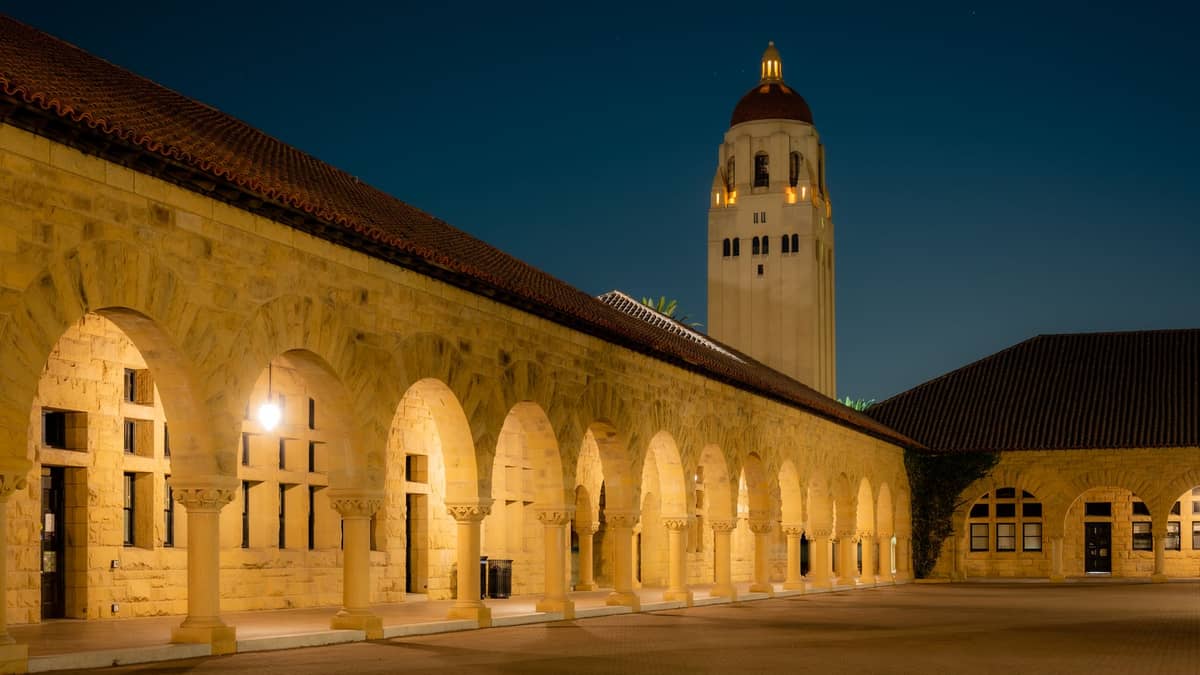
The Inner Quadrangle, commonly called the Main Quad, is where most visitors spend the first part of their visit, and for good reason. The quad is framed by sandstone arcaded buildings with red-tile roofs, a design influenced by Spanish Mission and Romanesque Revival architecture. The buildings were designed largely by Charles Coolidge of the firm Shepley, Rutan and Coolidge, following a master plan developed by Frederick Law Olmsted. The result is a visual coherence rare in American university design: each building belongs to the same family of materials and proportions.
At the east end of the Main Quad stands Memorial Church, completed in 1903 and significantly rebuilt after the 1906 earthquake. Its mosaic-covered facade is one of the most photographed surfaces on campus, depicting golden figures against deep blue tile. Step inside during open hours for the interior mosaics, the warm California light filtering through stained glass, and the quiet that persists even when the quad outside is busy with students. Morning visits, particularly on weekdays before 10 a.m., offer the best combination of soft light and low foot traffic for photography.
The quad itself changes character throughout the day. In early morning, it belongs to joggers and cyclists cutting through on their way to class. By mid-morning, students set up on the stone steps with laptops and coffee. On sunny weekend afternoons, tour groups move in loose clusters through the arcades while families let small children run across the stone paving. At dusk, when the sandstone picks up warm amber tones and the campus quiets, the Main Quad is at its most atmospheric.
Hoover Tower and the Views It Offers
The 285-foot Hoover Tower, completed in 1941 and named after Herbert Hoover (Stanford class of 1895), is the campus's most visible landmark from a distance and its best vantage point from above. The observation platform near the top offers panoramic views across the flat geometry of Silicon Valley, with the Santa Cruz Mountains to the southwest and, on clear days, the shimmer of the Bay to the northeast. Admission to the observation level is charged separately; confirm current pricing and hours before visiting.
The tower also houses part of the Hoover Institution, a public policy think tank with its own archive and library. Visitors primarily come for the views, but the building itself is architecturally interesting: its Venetian campanile form sits in deliberate visual dialogue with the Romanesque buildings of the Main Quad nearby. Morning visits offer the clearest sightlines before Bay Area haze builds through the afternoon.
The Cantor Arts Center and the Rodin Sculpture Garden
The Iris and B. Gerald Cantor Center for Visual Arts holds a substantial permanent collection spanning 5,000 years of human art-making, from ancient Mediterranean artifacts to contemporary works. For visitors with limited time, the most distinctive offering is the outdoor Rodin Sculpture Garden adjacent to the museum, which contains one of the largest collections of Auguste Rodin's work outside France. The Gates of Hell, The Thinker, and The Burghers of Calais are all represented here in cast bronze, positioned on open lawns where the California light plays across their surfaces in a way that enclosed European museums rarely allow.
Museum admission is generally free for the Cantor Arts Center, though this should be confirmed before visiting. The Rodin garden is accessible even when the museum interior is closed, making it a reliable stop regardless of timing. If you are building a broader appreciation of the Bay Area's exceptional museum landscape, compare what the Cantor offers with the best museums in San Francisco to decide how to allocate your time.
The Tech History Layer: Stanford and Silicon Valley
Stanford's relationship with Silicon Valley is more than geographical. The university's research programs, technology licensing policies, and the culture of its engineering and business schools directly shaped the emergence of the technology industry in the adjacent valley. Companies including Hewlett-Packard, Google, Yahoo, and Cisco have roots traceable to Stanford research or alumni. Walking the campus today, you encounter buildings named for tech industry donors: the Gates Computer Science Building (funded by Bill and Melinda Gates), the Huang Engineering Center, and others that make the commercial-academic connection unusually visible.
For visitors interested in this dimension of the campus, the d.school (Hasso Plattner Institute of Design) and the engineering quadrangle are worth locating on a campus map. Public access to building interiors varies, but the exteriors and surrounding landscape are always accessible. This aspect of Stanford is genuinely distinctive and not replicated at other Bay Area destinations.
Guided Tours, Self-Guided Walking, and Visitor Center Access
Stanford offers free student-led walking tours that depart from the Visitor Center, typically covering the Main Quad, Memorial Church, and several other key landmarks in around 60 minutes. These tours run on a schedule that varies by academic term and season; checking visit.stanford.edu before your trip is essential rather than optional. During summer and academic breaks, tour frequency and availability shift significantly.
Self-guided walking is a legitimate and often preferable alternative for visitors who want to move at their own pace. Stanford's visitor website provides downloadable campus maps and suggested walking routes. The campus is flat in its central areas, which makes walking straightforward, though distances between the Main Quad, the Cantor Arts Center, and the engineering area can add up to 2 to 3 miles depending on your route.
Accessibility across the main visitor areas is generally good, with paved paths and level surfaces through the central campus. For visitors with mobility considerations, the Visitor Center can provide specific guidance on accessible routes to key landmarks. Those planning a broader Bay Area trip might also look at a 3-day San Francisco itinerary to see how a Stanford half-day fits into a longer visit.
ℹ️ Good to know
Stanford's campus is an active, working university. Weekday visits between late September and mid-June reflect the fullest campus life. Summer and winter academic breaks mean a quieter, less populated environment, which some visitors prefer and others find underwhelming.
Who This Attracts, and Who Should Probably Skip It
Stanford rewards visitors who have genuine curiosity about architecture, academic environments, American history, or the origins of the technology industry. The campus is spacious and beautiful, but it is not designed as an entertainment destination. There are no rides, no theatrical experiences, no particularly dramatic natural scenery. If your travel priorities run toward sensory intensity, crowd energy, or tightly curated visitor experiences, a day at Stanford will feel underwhelming.
Families with young children can find open spaces and visually striking architecture to explore, though the campus offers little specifically designed for children. Travelers who are primarily interested in San Francisco's urban landscape, food culture, and neighborhoods will find the roughly 35-mile journey a significant time commitment for what is, ultimately, a very peaceful campus walk. For those, free things to do in San Francisco may deliver more variety per hour than the trip south.
For architecture enthusiasts, first-time visitors to California, travelers with a tech industry interest, and anyone spending more than three days in the Bay Area, Stanford is well worth the Caltrain ride. The scale and coherence of the campus make it unlike anything in San Francisco proper, and the quality of what is here, from the Rodin garden to Memorial Church's mosaics, is genuinely high.
Insider Tips
- The free Marguerite Shuttle runs multiple routes across campus and into adjacent Palo Alto Monday through Friday. Route X connects directly to Palo Alto Transit Center (Caltrain) and is one of the most useful lines for visitors arriving by train. Check the current schedule at transportation.stanford.edu before departing San Francisco.
- Hoover Tower's observation deck is most worth the climb on clear days from October through February, when Bay Area haze is typically lowest and the views extend furthest. Summer afternoons often produce a grey-white layer that dulls the panorama considerably.
- The Rodin Sculpture Garden remains accessible even when the Cantor Arts Center is closed. Early morning visits, before 9 a.m., mean the garden is often entirely empty, which is the best possible way to experience bronzes of this scale without other visitors in your frame.
- Avoid visiting during major campus events, move-in weekends in September, and graduation week in June. Parking is effectively unavailable, and the Marguerite Shuttle runs at reduced capacity relative to demand during these periods.
- The Palm Drive entrance, lined with Canary Island date palms, is the most photographed approach to the campus and the best first view. If arriving by car or rideshare, ask to be dropped at the Palm Drive entrance rather than a side gate.
Who Is Stanford University Campus For?
- Architecture and design enthusiasts interested in Romanesque Revival and Mission-influenced American campus design
- Travelers curious about Silicon Valley's origins and the university-to-industry pipeline that shaped it
- Museum visitors who want to see Rodin bronzes at outdoor scale without buying a plane ticket to Paris
- Multi-day Bay Area visitors looking for a half-day excursion that contrasts sharply with San Francisco's urban character
- Families with older children or teenagers interested in university life and American higher education
Nearby Attractions
Combine your visit with:
- 16th Avenue Tiled Steps
The 16th Avenue Tiled Steps Project is a community-made mosaic staircase of 163 steps stretching through San Francisco's Golden Gate Heights neighborhood (a sub-area of the Inner Sunset), depicting a journey from the ocean floor to the night sky. It's free, photogenic, and connects to one of the city's best lesser-known hilltop viewpoints.
- Angel Island State Park
Angel Island State Park sits in the middle of San Francisco Bay, offering miles of hiking trails, layers of military and immigration history, and 360-degree views of the city skyline, Marin headlands, and beyond. Getting there requires a ferry, which is part of the appeal — the island feels removed from city life, even though San Francisco is visible the entire time.
- Asian Art Museum of San Francisco
One of the largest Asian art collections in the Western world, housed in a transformed Beaux-Arts landmark at Civic Center. From ancient Chinese bronzes to contemporary Southeast Asian installations, the museum rewards careful visitors who know what to look for.
- UC Berkeley Campus
The University of California, Berkeley sits on a hillside above San Francisco Bay, offering free access to striking Beaux-Arts architecture, landmark museums, and open green spaces. A short BART ride from San Francisco, it rewards curious visitors with history, intellectual energy, and some of the best campus scenery in the country.