St Peter's Cathedral: North Adelaide's Gothic Landmark Worth Knowing
St Peter's Cathedral is North Adelaide's most commanding heritage building, a Gothic Revival church that took more than three decades to complete. Whether you're drawn by the architecture, the acoustics, or the history, this guide tells you what to expect before you arrive.
Quick Facts
- Location
- 27 King William Road, North Adelaide SA 5006
- Getting There
- Buses on King William Road; stops AO25/AO26 nearby
- Time Needed
- 30–60 minutes for a self-guided visit
- Cost
- General entry is free; free public tours are offered Wednesdays at 11am, while group-tour fees vary — verify details with the cathedral before visiting
- Best for
- Architecture lovers, history enthusiasts, quiet reflection
- Official website
- www.stpeters-cathedral.org.au
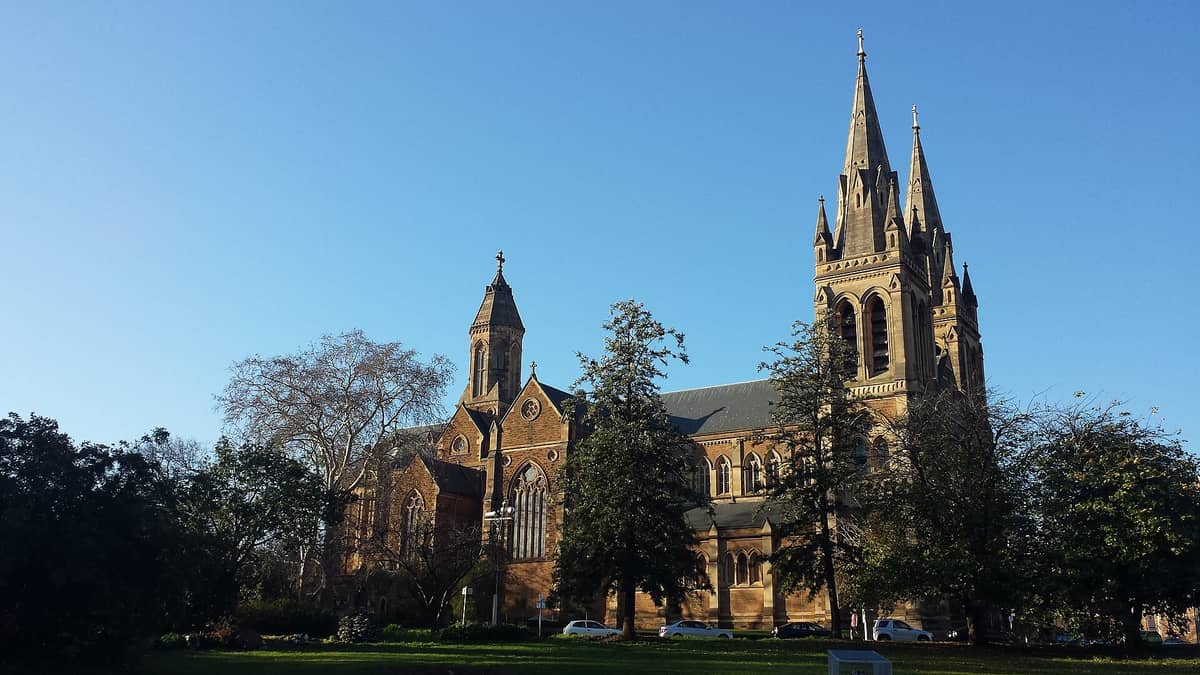
What St Peter's Cathedral Actually Is
St Peter's Cathedral is the mother church of the Anglican Diocese of Adelaide, and it sits at the northern end of King William Road in a way that makes it impossible to miss as you cross the River Torrens from the city centre. The building is a textbook example of Gothic Revival ecclesiastical architecture: pointed arches, dressed stone, a prominent twin-tower west facade, and a nave that draws the eye upward the moment you step inside.
Construction began in 1869, the first service was held in 1876, and the exterior was not completed until 1904. That long building timeline is reflected in the layered quality of the interior: different sections feel subtly different in age and finish, which gives the space a depth that newer church buildings rarely achieve. Internally, the nave measures approximately 61.9 metres in length and 18 metres across.
ℹ️ Good to know
The cathedral publishes weekly visiting times online, and hours vary by day. Check the official website before visiting, as services and events may affect access.
Arriving and Entering
King William Road buses stop within easy walking distance, at stops AO25 and AO26. If you are coming from the Adelaide CBD, walking north across the Torrens takes roughly 10 to 15 minutes on foot, passing through Elder Park and across one of the footbridges. The cathedral is clearly visible from the bridge.
The main entrance faces King William Road and involves stone steps. If you need step-free access, there is a flat entrance from the car park at the side of the building. Accessible parking is available by arrangement, and drop-off can be organised near the door. For specific accessibility needs, the North Terrace cultural precinct institutions have comprehensive accessibility information, but for St Peter's it is worth contacting the cathedral directly.
First-time visitors sometimes arrive at a side door and miss the full impact of the west entrance. If the front doors are open, enter from King William Road: the view down the nave from the threshold is the best first impression the building offers.
Tickets & tours
Live prices and dates from our booking partner. If you book, we may earn a commission at no extra cost to you.
Ultimate Adelaide and Hahndorf full-day tour
From 94 €Instant confirmationFree cancellationHalf-day Lofty Descents tour by bike
From 89 €Instant confirmationFree cancellationAdelaide kayak tour with expert instructors
From 51 €Instant confirmationFree cancellationTrue Crime Tour in Adelaide
From 21 €Instant confirmationFree cancellation
Inside the Cathedral: What You See
The Nave and Light
The nave is long and relatively narrow, which amplifies the sense of height. Stone columns line both sides, and the clerestory windows above them bring in light that shifts in colour and angle depending on the time of day. Morning visits, when the sun is to the east, produce the warmest light on the northern side of the nave. By mid-afternoon, the quality of light has changed considerably, and the interior feels cooler and more austere. Neither is wrong; they are simply different visits.
The stained glass throughout the building deserves unhurried attention. Individual windows carry memorial dedications, many of them dated to South Australia's colonial history, and reading them gives a quiet sketch of the Anglican community's development in the state across the late nineteenth and early twentieth centuries.
The Organ and Acoustics
The cathedral's pipe organ is one of the finer instruments in South Australia, and the building's stone construction gives it exceptional natural reverb. If you arrive when an organist is practising, the sound fills the space in a way that is genuinely difficult to describe without hearing it. The Adelaide Symphony Orchestra uses the cathedral as a performance venue, which is itself a signal of the room's acoustic quality. If you want to experience the space at its most affecting, attending a choral service or a concert is worth considering alongside a daytime visit.
Time of Day and Crowd Behaviour
Weekday mornings, particularly Tuesday to Thursday, tend to be quietest for casual visitors. There is usually a settled, almost library-like atmosphere: the occasional local sitting quietly in a pew, perhaps a photographer working along the aisles. Weekend mornings bring services, which means the building may be closed to general visitors or partially restricted, so checking in advance matters more on Saturdays and Sundays.
The exterior is worth photographing from across King William Road in the early morning or late afternoon, when the stone facade takes on warmer tones and the shadows from the towers fall across the lawn. At midday the light is flat and the facade reads as grey. Photography inside is generally tolerated for personal use during quiet visiting hours, though you should be respectful of anyone using the space for prayer.
💡 Local tip
For the best exterior photograph, cross to the western pavement on King William Road and shoot in the late afternoon. The twin towers are symmetrical and the stonework responds well to low-angle light.
Historical and Cultural Context
Adelaide was founded in 1836, and the Anglican community moved relatively quickly to establish a permanent cathedral presence in the city. The site on King William Road was chosen deliberately: North Adelaide was conceived as a residential complement to the commercial CBD, and a cathedral at this northern approach to the city carried civic as well as religious symbolism. The North Adelaide streetscape that surrounds the cathedral today, with its Victorian terraces and wide tree-lined streets, preserves much of the character that existed when the building was under construction.
The more than three decades it took to complete the exterior were not unusual for ambitious Gothic Revival projects of this era. The style itself was a deliberate choice: Gothic Revival was the dominant idiom for Anglican churches in the nineteenth century British world, carrying associations with medieval English Christianity that gave colonial congregations a sense of continuity with a distant tradition. The Adelaide example is competent and serious rather than spectacular: it does not rival the grandeur of the great English cathedrals, and being honest about that matters.
If the history of religious and colonial Adelaide interests you beyond a single visit, the Migration Museum nearby offers a more critical examination of how settler communities shaped the city.
Practical Walkthrough
A focused visit takes about 30 to 45 minutes. That is enough to walk the full length of the nave, look at the stained glass in detail, sit briefly in the choir area, and examine the organ. If you are genuinely interested in the memorials and iconography, allow closer to an hour.
Free public tours are offered Wednesdays at 11am. Community and commercial group tours are listed at A$6 per person; contact the cathedral to arrange group visits and confirm current details.
⚠️ What to skip
Do not rely on third-party tour pricing or visiting hours without confirming with the cathedral. Check the cathedral’s published visiting times and confirm tour details before visiting, as schedules may change around services and events. and schedules change around services and events.
The immediate surroundings repay a short walk after your visit. O'Connell Street, a short distance to the north, is North Adelaide's main eating and coffee strip. Elder Park is a few minutes' walk south, and the River Torrens Linear Park running east from there makes a pleasant return to the CBD on foot.
Who Will and Won't Get Much from This Visit
Visitors with a genuine interest in heritage architecture, ecclesiastical history, or acoustic performance spaces will find the cathedral worthwhile. It is also a genuinely peaceful space for anyone wanting ten or fifteen minutes of quiet in the middle of a busy day in the city.
Visitors expecting something comparable to a major European cathedral may find the scale modest and the interior less ornamented than they anticipated. St Peter's is a serious regional cathedral, not a world-class one, and it is better appreciated for what it actually is. If grand religious architecture is your primary interest, it is worth also spending time at the Art Gallery of South Australia and the South Australian Museum on North Terrace, both of which offer substantial experiences that travel well regardless of personal interest in religion or the Anglican tradition.
Young children may find a quiet visit here less engaging than more interactive attractions around Adelaide. Families with children might consider the cathedral as a brief stop within a broader North Adelaide walk, rather than as a destination in its own right.
Insider Tips
- Check whether there is a choral evensong or orchestral rehearsal scheduled during your visit. Hearing the organ or choir in this room is a substantially different experience from a quiet daytime visit, and some events are open to the public.
- The lawn on the King William Road side of the cathedral provides one of the quieter sitting spots in North Adelaide on a weekday, particularly in the morning shade of the towers.
- If you want to photograph the stained glass without other visitors in the frame, check the cathedral’s published visiting times and aim for a quieter weekday visit. Light from the east windows is at its best before 11am. Light from the east windows is at its best before 11am.
- The accessible car park entrance is also the most convenient for visitors arriving by car, and it places you directly alongside the nave rather than at the distant front porch.
- North Adelaide's O'Connell Street, roughly a five-minute walk north, has several good cafes for a post-visit coffee. The neighbourhood is calm and navigable on foot, making the cathedral a natural starting point for a longer North Adelaide walk.
Who Is St Peter's Cathedral For?
- Architecture and heritage enthusiasts interested in Gothic Revival buildings
- Visitors seeking a quiet space for reflection away from the city centre
- Classical music and choral concert-goers attending ASO or choir performances
- Photographers working on Adelaide heritage projects
- Travellers with a general interest in colonial South Australian history
Planning a trip? Discover personalized activities with the Nomado app.