St Patrick's Cathedral Auckland: A Gothic Landmark in the City Centre
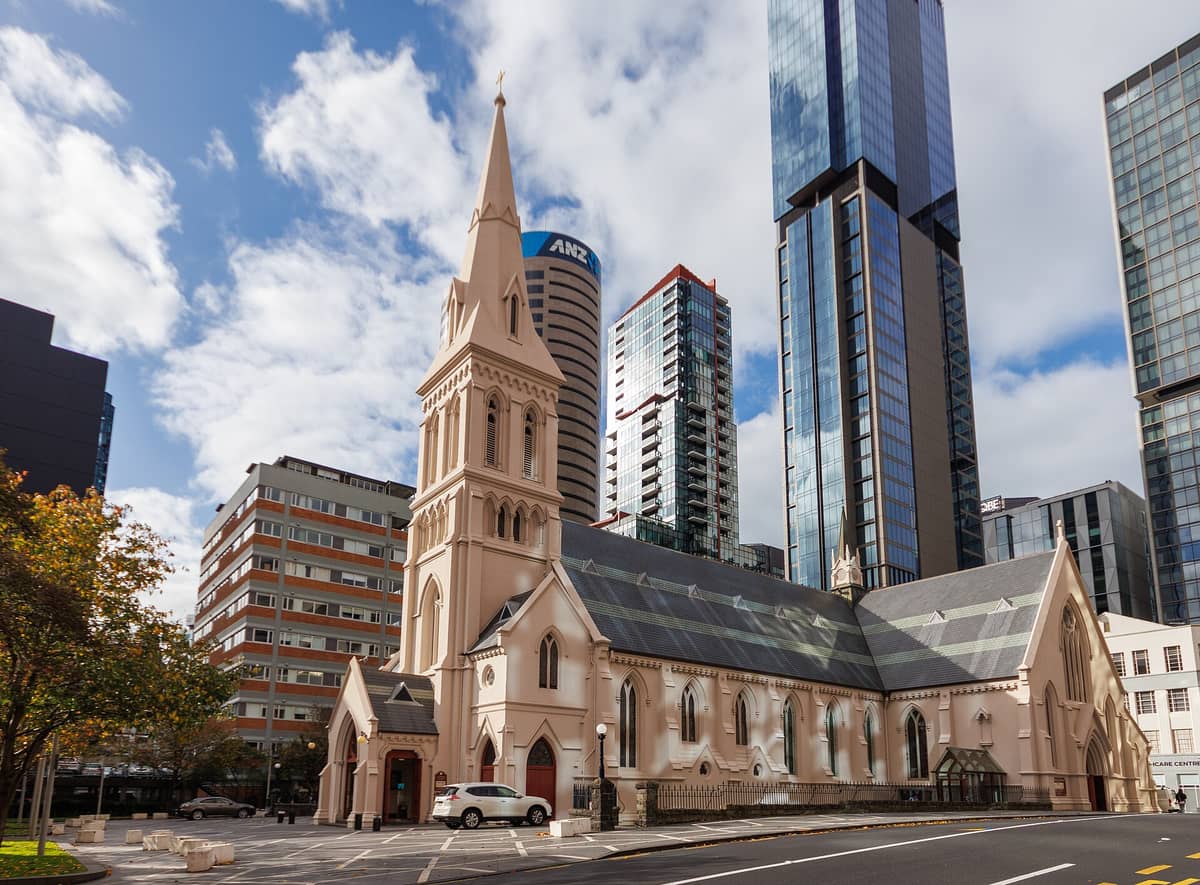
The Cathedral of St Patrick and St Joseph is Auckland's principal Catholic cathedral, a Gothic Revival brick church rising above Wyndham Street in the CBD. Built across two phases between 1884 and 1908, it offers a quiet counterpoint to the commercial city around it — worth a visit for its architecture, stained glass, and sense of continuity in a rapidly changing neighbourhood.
Quick Facts
- Location
- 43 Wyndham Street, Auckland Central 1010 (Auckland CBD)
- Getting There
- Bus stops on Hobson St and Albert St/Wyndham St; downtown ferry terminal approx. 10-min walk
- Time Needed
- 20–45 minutes for a self-guided visit
- Cost
- Free entry (no admission charge confirmed); donations welcome
- Best for
- Architecture enthusiasts, those seeking quiet in the city, history travellers
- Official website
- stpatricks.org.nz
What Is St Patrick's Cathedral?
The Cathedral of St Patrick and St Joseph — most Aucklanders simply call it St Patrick's Cathedral — stands on Wyndham Street in Auckland's CBD, on the Hobson Street ridge. It is the mother church of the Roman Catholic Diocese of Auckland, and one of the older religious buildings still in active use in central Auckland. In a city known for constant redevelopment, the site's Catholic presence since 1841 is itself a kind of statement.
What you encounter from the street is a confident piece of Gothic Revival architecture: a brick facade with pointed arches, a prominent corner tower, and lancet windows that catch light differently depending on the angle and time of day. It is not the largest cathedral you will ever visit, but it is proportioned in a way that feels exactly right for its urban setting — tall enough to stand out, but not so monumental that it overwhelms the surrounding streetscape.
ℹ️ Good to know
Office hours are listed as Tuesday–Friday, 9 am–3 pm, but these refer to administrative staff. The cathedral itself is generally open to visitors outside of services — confirm current hours by contacting the cathedral directly before making a special trip.
History: From Mission Site to Consecrated Cathedral
The Catholic site dates to 1841, when Bishop Pompallier was granted land for a religious centre. The current cathedral building is the result of two distinct construction phases: the first ran from 1884 to 1885, and the second from 1906 to 1907. The cathedral was formally dedicated in 1908 and consecrated in 1963. That gap between dedication and consecration — more than half a century — reflects the long process by which Catholic institutions of this era grew, fundraised, and completed their buildings in stages.
Heritage New Zealand has classified the building as a Category 1 Historic Place, recognising its architectural and historical significance. The site's continuity across nearly 180 years makes it one of the anchor points of Auckland's Catholic community and one of the longer-standing buildings in the central city.
For travellers curious about Auckland's broader religious and cultural heritage, the Holy Trinity Cathedral in Parnell offers a useful counterpoint — it is the seat of the Anglican Diocese of Auckland and sits within a very different neighbourhood context. Comparing the two gives a fuller picture of how European religious institutions shaped the early colonial city.
Tickets & tours
Live prices and dates from our booking partner. If you book, we may earn a commission at no extra cost to you.
Luggage Storage in Auckland
From 5 €Instant confirmationFree cancellation13,000ft skydiving experience in Auckland
From 195 €Instant confirmationFree cancellationDiscover Auckland City Tour
From 88 €Instant confirmationFree cancellationAuckland to Rotorua via Hobbiton movie set tour
From 205 €Instant confirmationFree cancellation
The Architecture Up Close
The exterior stonework rewards a slow look. The Gothic Revival style, popular for ecclesiastical construction throughout the British Empire in the late 19th century, is applied here with restraint. The corner tower anchors the building at street level and gives it a clear visual focal point from multiple directions. The pointed arches above the doorways and windows follow the structural logic of the style — drawing the eye upward while managing the load of the facade.
Inside, the nave runs toward a sanctuary lit by stained glass windows. The quality and age of the glass varies across different sections of the building, reflecting the phased construction. Light in the morning hours comes through at an angle that brings the colours of the east-facing windows to life; by afternoon the interior shifts to a cooler, more even tone. If you have a choice, a morning visit is preferable for the visual effect.
The acoustic quality of the space is worth noting. Even during quieter periods, the cathedral carries sound in the way that stone-vaulted interiors do — not completely silent, but absorptive in a way that feels distinct from street-level noise. On weekdays, you may share the space with a few others in quiet reflection; on weekends, depending on service times, visitor access may be more limited.
💡 Local tip
Photography tip: The stained glass windows photograph best with a slightly underexposed setting to retain colour saturation. Avoid using flash inside — it flattens the depth of the interior and is generally discouraged in active places of worship.
When to Visit and What to Expect at Different Times
Weekday mornings, particularly mid-week, tend to be the quietest for visitor access. The streets outside are active with commuters and office workers, but the interior of the cathedral maintains a different rhythm. If you arrive between services, you are likely to find the space almost empty — a genuine contrast to the foot traffic on Queen Street three minutes away.
Weekend mornings typically coincide with Mass schedules, which means visitor access may be restricted during services. If you plan to visit on a Saturday or Sunday, check the service timetable on the cathedral's official website in advance. Turning up mid-service and trying to browse is not appropriate, and the cathedral staff politely redirect visitors who arrive at those times.
The exterior is accessible any time of day and is worth seeing in the early evening when low-angle light hits the stone facade from the west. Wyndham Street is a relatively quiet CBD street, which makes pausing to look at the building from across the road straightforward without feeling rushed by foot traffic.
Getting There and Combining with Nearby Attractions
The cathedral sits within easy walking distance of several central Auckland landmarks. Auckland Art Gallery Toi o Tāmaki is about a 5-minute walk east through Albert Park. The Sky Tower is a similar distance to the south. If you are spending a day in the CBD, the cathedral fits naturally into a walking loop rather than a dedicated trip.
Bus services run along Hobson Street and Albert Street, both within a short walk. The downtown ferry terminal on the waterfront is roughly 10 minutes on foot, making it easy to combine a cathedral visit with a morning arrival from Devonport or a return ferry to Waiheke Island.
For travellers building a broader itinerary across the city centre, the 3-day Auckland itinerary includes several CBD stops that pair well with a cathedral visit.
⚠️ What to skip
Accessibility: The official sources do not confirm step-free access or accessible facilities at the cathedral. If this is a requirement, contact the cathedral directly at stpatricks.org.nz/contact/ before visiting.
Honest Assessment: Is It Worth Your Time?
St Patrick's Cathedral is not Auckland's most spectacular interior. Travellers arriving directly from European Gothic cathedrals or major Pacific basilicas may find the scale modest. The building is meaningful in the context of Auckland's history and genuinely beautiful in its proportions, but it is not the kind of destination you would travel specifically to Auckland to see.
What it offers is something harder to quantify in a city that moves quickly: a place that is genuinely old by local standards, architecturally coherent, and free to enter. For travellers who find that a few minutes of stillness in a well-built interior resets the rhythm of a busy travel day, this is one of the better places in the CBD to do that.
Visitors who are looking for interactive exhibits, extensive guided tours, or religious heritage comparable to major European cathedrals are likely to come away with modest impressions. This is an active parish church that also happens to be architecturally significant — not a purpose-built tourist attraction. Approach it on those terms and it delivers well.
Insider Tips
- Check the Mass schedule on the official website before visiting on weekends — services run regularly and the interior is not accessible to casual visitors during them.
- The corner of Wyndham Street and Albert Street offers the best unobstructed view of the tower and facade together. Cross to the opposite footpath for a proper look at the full exterior.
- Visiting on a quiet Tuesday or Wednesday morning gives you the best chance of having the interior largely to yourself, which significantly improves the acoustic and visual experience.
- The cathedral's full official name — the Cathedral of St Patrick and St Joseph — is sometimes needed when searching for the official website or contact details, as generic searches return mixed results.
- If you are visiting during a major Catholic feast day or Auckland's Christmas period, expect the area around the cathedral to be considerably busier than usual, with services running at additional times.
Who Is St Patrick's Cathedral For?
- Architecture and heritage travellers with an interest in Gothic Revival design
- Travellers wanting a few minutes of quiet away from Queen Street's commercial energy
- Those building a walking day through the CBD who want to cover multiple landmarks efficiently
- Visitors interested in Auckland's colonial-era Catholic history dating to 1841
- Photographers looking for interior light conditions and exterior stone detail in a compact urban setting
Nearby Attractions
Other things to see while in Auckland CBD:
- Albert Park
Albert Park is a free, 24-hour public park at the edge of Auckland's CBD, occupying land once held by colonial barracks. With formal Victorian gardens, mature trees, and a location flanked by the University of Auckland and the Auckland Art Gallery, it rewards a slow wander any time of day.
- Auckland Art Gallery Toi o Tāmaki
Auckland Art Gallery Toi o Tāmaki is New Zealand's largest art gallery, housing more than 18,000 works across historic French-château architecture and a striking contemporary addition. General collection entry is free, and the building itself is as worth examining as anything on the walls.
- Auckland Civic Theatre
The Civic is Auckland's most architecturally dramatic performance venue, a 2,379-seat Moorish fantasy built in 1929 at the corner of Queen and Wellesley Streets. Whether you're catching a touring musical, a film festival screening, or an Auckland Arts Festival production, the building itself is half the experience.
- Auckland Harbour Bridge
The Auckland Harbour Bridge is the city's most recognisable structure, stretching 1.2 km across the Waitematā Harbour since 1959. You can't walk across it, but you can climb over its arch or take a bungy jump from its underside. This guide covers the experience, the history, and how to make the most of your visit.
Planning a trip? Discover personalized activities with the Nomado app.