Holy Trinity Cathedral: Auckland's Gothic Heart in Parnell
Holy Trinity Cathedral on Parnell Road is one of Auckland's most architecturally significant religious buildings, a Gothic Revival complex that has been taking shape for over a century. Entry is free, the atmosphere is genuinely calm, and the site tells a layered story about the city's Anglican heritage and its ongoing relationship with craft and faith.
Quick Facts
- Location
- 446 Parnell Road, Parnell, Auckland 1052
- Getting There
- Parnell Road is accessible by bus from central Auckland; check Auckland Transport journey planner for current routes
- Time Needed
- 45–90 minutes
- Cost
- Free entry; donations welcomed
- Best for
- Architecture lovers, quiet reflection, heritage walks
- Official website
- www.holy-trinity.org.nz
What You're Actually Visiting
Holy Trinity Cathedral is not a single building but a precinct comprising the cathedral, the adjacent St Mary's-in-Holy Trinity, the Bishop Selwyn Chapel, and the John Wilson Gallery. Most visitors arrive expecting one church and leave having wandered through several centuries of Anglican building history, from Victorian timber to mid-century stone. That layered complexity is the real draw.
The cathedral occupies a ridge on Parnell Road, and its silhouette is visible from some distance as you walk up from the village. The cathedral's chancel is built in a neo-Gothic style, and the nave was completed in 1995. The chancel's foundation stone was laid in 1957 and the chancel itself came into use in 1973, which means the building you see today represents decades of patient construction rather than a single grand gesture.
ℹ️ Good to know
Visiting hours: Monday–Thursday and Saturday 10am–3pm; Sunday noon–3pm. Hours may change around services or special events, so check the cathedral's website for any closure notices before making a specific trip.
St Mary's-in-Holy Trinity: The Older Soul of the Site
If the cathedral is the formal statement, St Mary's is the one that tends to stop people in their tracks. The timber church alongside the main cathedral is considered one of the finest examples of Gothic timber architecture in the Southern Hemisphere. It was moved to this site from its original location across Parnell Road in 1982, and the relocation itself became a celebrated feat of engineering.
Inside, the craftsmanship is immediately apparent. The kauri and rimu construction creates an interior that smells faintly of old timber and beeswax polish. Light filters differently here than in the stone cathedral: softer, warmer, slightly amber. The pews are narrow and well-worn. This is a building where the material age of everything around you is tangible, not just mentioned on a placard.
For visitors who appreciate historic timber construction, this building alone justifies the walk up Parnell Road. It is easy to spend twenty minutes simply sitting in the pews and looking upward at the roof structure.
Tickets & tours
Live prices and dates from our booking partner. If you book, we may earn a commission at no extra cost to you.
Luggage Storage in Auckland
From 5 €Instant confirmationFree cancellation13,000ft skydiving experience in Auckland
From 195 €Instant confirmationFree cancellationDiscover Auckland City Tour
From 88 €Instant confirmationFree cancellationAuckland to Rotorua via Hobbiton movie set tour
From 205 €Instant confirmationFree cancellation
The Cathedral Interior: Scale, Light, and Unfinished Ambition
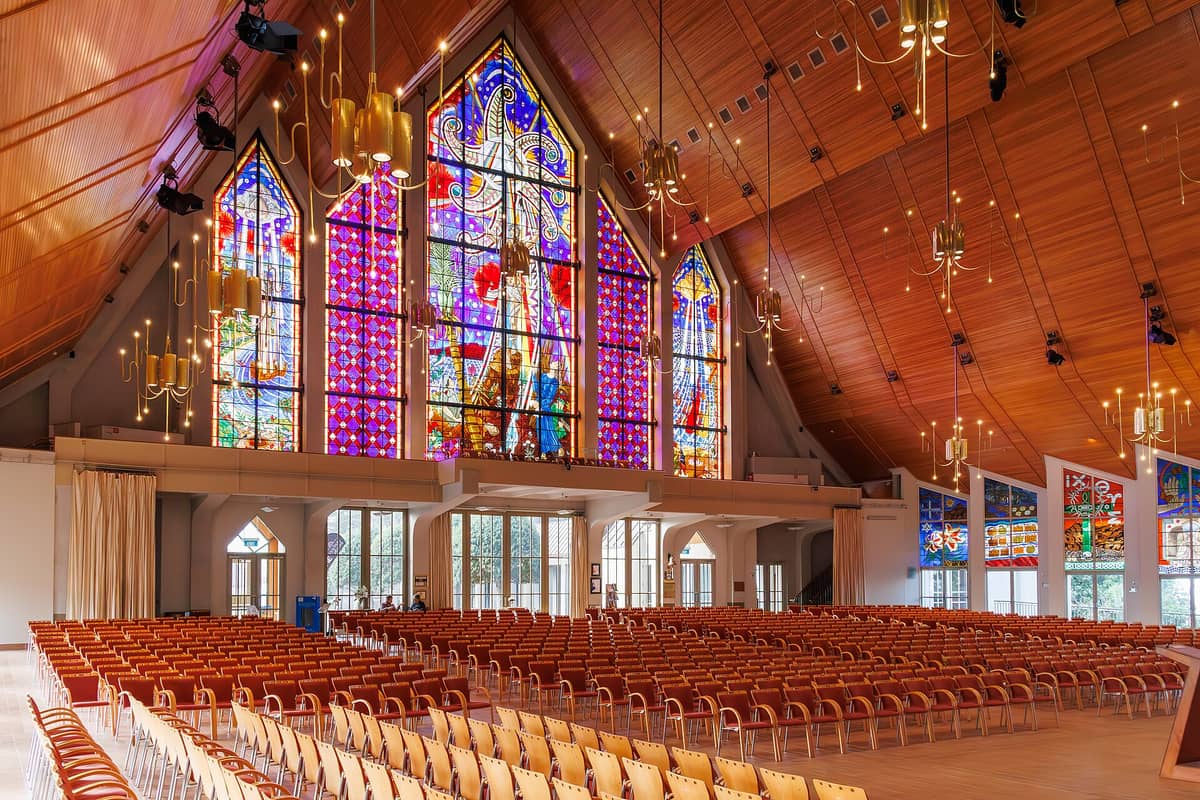
Stepping into the main cathedral from the Parnell Road entrance, the first thing you notice is the height. The nave draws the eye upward through a sequence of stone arches, and the light through the stained glass shifts character depending on the time of day. Morning visits produce cooler, more diffuse light across the stone floor. Afternoon visits, particularly in summer, bring warmer tones through the west-facing windows.
The stained glass throughout the cathedral rewards close attention. Several windows were created by different artists and studios across different decades, which gives the interior a quietly eclectic quality if you look carefully enough. Some panels are representational and figurative; others are more abstract and geometric. This is not the uniform aesthetic of a cathedral built in a single campaign.
The stone work in the chancel area shows the care that went into the post-war construction phase. Unlike older European cathedrals where centuries of accumulated donation and patronage produced a richly ornate interior, Holy Trinity has a more restrained character, reflective of mid-century Anglican sensibility in New Zealand. There is space to think here, not just to look.
💡 Local tip
Photography is generally permitted inside the cathedral when services are not in progress. The best interior light for photography falls in the late morning, before midday, when natural light enters from multiple angles without harsh glare.
The Bishop Selwyn Chapel and John Wilson Gallery
The Bishop Selwyn Chapel, named for George Augustus Selwyn, the first Anglican Bishop of New Zealand, is a smaller, more intimate space within the compound. It is used for regular services and quiet prayer, and its scale makes it feel more immediately devotional than the main cathedral. On weekday mornings, when the precinct is nearly empty, this chapel has a stillness that the larger building cannot quite replicate.
The John Wilson Gallery is in the cathedral undercroft and features artworks on rotating loan from the Arts House Trust. The quality varies by exhibition, but it adds an extra dimension to the visit for those interested in the applied arts. Check the cathedral's website or ask at the entrance to see what is currently showing.
When to Visit and What to Expect
Weekday mornings between 10am and noon are the quietest window. The precinct is largely empty, the interiors are cool, and there is no competition for space in front of any particular window or feature. If you want to sit undisturbed and take in the architecture at your own pace, this is the time.
Saturday mornings bring a modest increase in visitors, partly because Parnell village attracts weekend foot traffic. Sunday visits are limited to the afternoon opening from noon, and services may affect access to parts of the building. If you are visiting specifically for the architecture rather than worship, a weekday morning is the cleaner option.
Auckland's weather is genuinely variable year-round, and the cathedral offers something most outdoor attractions in the city cannot: it is entirely weather-independent. A rainy Tuesday in June is actually a reasonable time to visit, when the stone interior is at its most atmospheric and the grounds outside are empty.
The cathedral sits in Parnell, one of Auckland's more walkable inner suburbs. Combining a visit here with a walk down Parnell Road, a stop at the Auckland Domain nearby, or a visit to the Auckland War Memorial Museum a short distance away makes for a full and rewarding half-day without needing a car.
Getting There and Accessibility
The cathedral is at 446 Parnell Road, Parnell, Auckland 1052. A car park is accessed directly from Parnell Road, with designated disabled parking spaces available both in front of the cathedral and in the main car park. For further accessibility information, contact the venue.
Public transport is available along the Parnell Road corridor. Check the Auckland Transport journey planner for current bus routes and stops closest to the cathedral, as service details and stop positions can change. From the city centre, the walk up to Parnell is manageable in good weather for those comfortable on hills, roughly 20–25 minutes from the waterfront area.
If you are exploring more of Parnell's heritage on foot, the neighbourhood pairs naturally with a broader look at Parnell's historic streetscape and connects easily to the Domain's rose gardens and open parkland.
Who Will and Won't Get the Most From This Visit
This site rewards people who are genuinely curious about architecture, religious history, or the applied arts. If you move slowly through spaces and notice details like joinery, glass texture, or the relationship between structural and decorative elements, you will find plenty to hold your attention for well over an hour.
Visitors primarily interested in Māori heritage, volcanic landscapes, or Auckland's contemporary food and arts scene will find this less relevant to their interests. The cathedral is part of Auckland's British colonial religious history, which is a legitimate and important strand of the city's story, but it operates in a different register from, say, the
Visitors primarily interested in Māori heritage, contemporary art, or Auckland's volcanic landscape may find this less central to their priorities, though it pairs well with the broader museum and heritage circuit across the inner city. Families with young children may find the cathedral's atmosphere better suited to older children who can manage quiet indoor spaces with patience.
Insider Tips
- Walk the full perimeter of the precinct before going inside. The exterior reveals the relationship between the different buildings and building phases far more clearly than interior signage does.
- The organ is occasionally played during mid-week practice sessions. If you hear music as you approach, the acoustic inside the stone cathedral is worth pausing to appreciate for a few minutes.
- The grounds between St Mary's and the main cathedral contain some mature trees that provide shade in summer and a pleasant place to sit between exploring the two interiors.
- Donations are accepted but not pressured. There is usually a box near the entrance to the main cathedral. Given that entry is free, a small contribution is a reasonable gesture for a building that depends on community support to remain open to visitors.
- If you are visiting on a Sunday, confirm access before arriving. The noon opening is later than on other days, and active services mean some areas may be restricted during your visit.
Who Is Holy Trinity Cathedral For?
- Architecture enthusiasts interested in Gothic Revival and historic timber construction
- Travellers seeking a quiet, reflective space away from the city's outdoor pace
- Heritage walkers combining multiple Parnell sites in a half-day loop
- Rainy-day visitors who need a weather-independent cultural stop
- Anyone interested in New Zealand's Anglican and colonial heritage
Nearby Attractions
Other things to see while in Parnell:
- Auckland Domain
Occupying the remnant of an ancient volcano in Parnell, Auckland Domain is the city's oldest public park — 75 hectares of open lawns, formal gardens, and native bush. Entry is free, and it rewards visitors who give it more than a passing glance.
- Auckland War Memorial Museum
One of New Zealand's most significant cultural institutions, Tāmaki Paenga Hira Auckland War Memorial Museum sits at the top of the Auckland Domain in Parnell, housing world-class Māori taonga, natural history collections, and moving war memorials under a grand Greek Revival facade. It rewards several hours of careful exploration, and rewards repeat visitors too.
Planning a trip? Discover personalized activities with the Nomado app.