South Pointe Park & Pier: Miami Beach's Best Free Waterfront
Perched at the very southern tip of Miami Beach, South Pointe Park offers 17 acres of open green space, a renovated 450-foot fishing pier, and unobstructed views of Government Cut channel and the Atlantic. There's no admission charge, and the experience shifts dramatically depending on when you show up.
Quick Facts
- Location
- 1 Washington Avenue, Miami Beach, FL 33139 (southern tip of South Beach)
- Getting There
- No direct Metrorail stop; take Miami Beach's South Beach Local bus or ride-share to Washington Ave & 1st St. Metered street parking and a nearby garage available.
- Time Needed
- 45 minutes to 2 hours depending on pace
- Cost
- Free entry. Paid parking only (fees vary).
- Best for
- Sunrise walks, ship-watching, fishing, picnics, photography
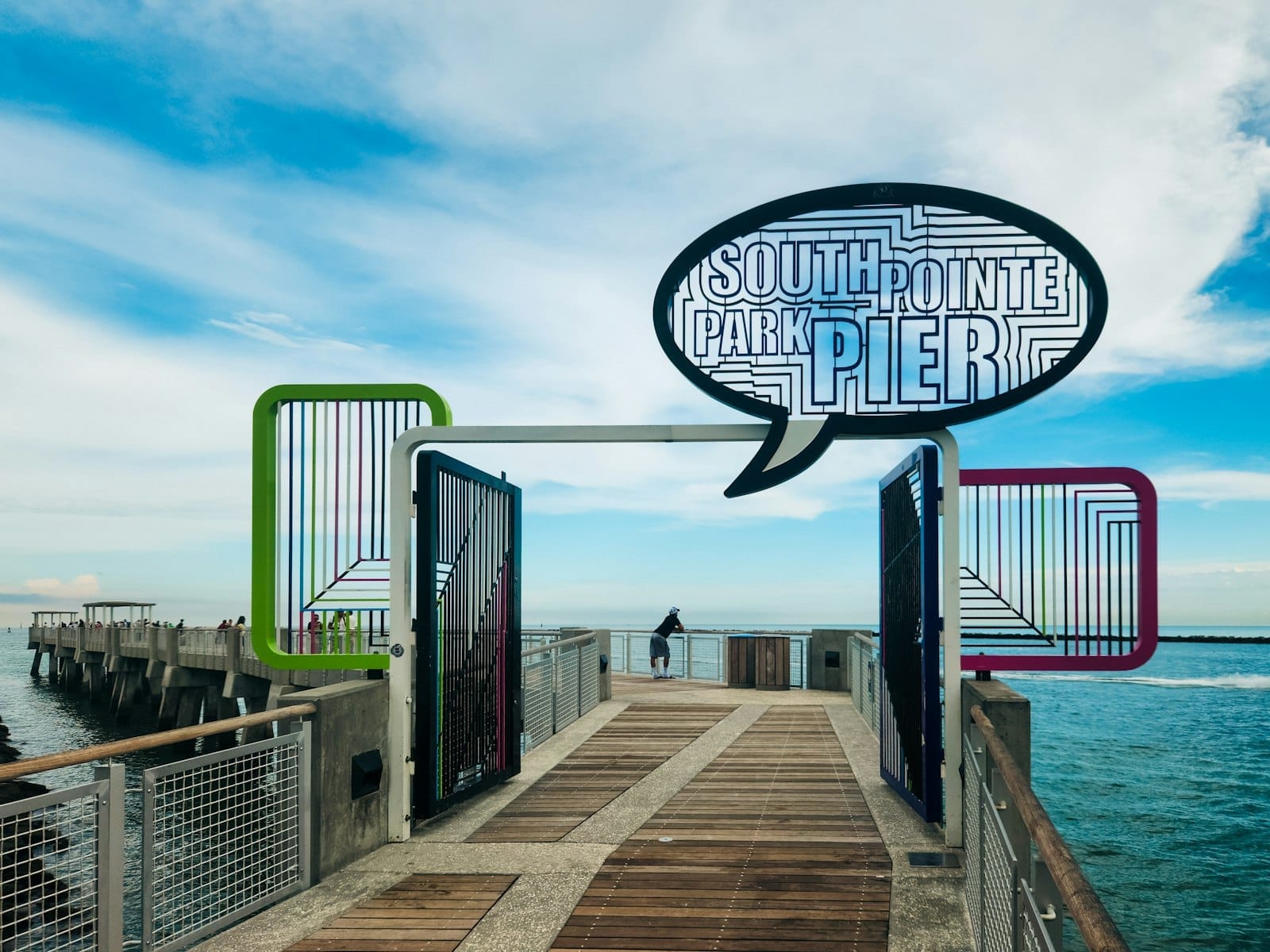
What South Pointe Park Actually Is
South Pointe Park occupies the southernmost 17 acres of Miami Beach, where the island tapers to a point between Government Cut channel and the open Atlantic. The park was first established in 1985, and the original pier built later served anglers and strollers for years before deteriorating past its useful life. A replacement pier, costing about $4.8 million and stretching roughly 450 feet over the water, opened in 2014 after construction began in February 2013.
What makes this park unusual within Miami Beach is its lack of commercial clutter. There are no beach clubs, no lounge-chair rentals, no cover charges. The landscaping is deliberately low-key: grassy mounds, shade trees, paved walking paths, and a sliver of public beach. The focus is entirely outward, toward the water, the ships, and the skyline of Miami proper rising across the bay.
ℹ️ Good to know
Park hours: sunrise to sunset daily. The pier is generally open from early morning to sunset, with gates closed at night. Both are free to enter.
The View: Why People Come Back
The pier puts you directly over Government Cut, the deep-water shipping channel that slices between Miami Beach and Fisher Island. From here, cargo ships, cruise liners departing Port Miami, and private yachts pass close enough that you can feel the displacement of water as they move through. On mornings when a large cruise ship clears the channel, the scale is genuinely surprising. The white hull fills your entire field of view before the vessel eases into open water.
To the north, the South Beach skyline frames the scene. To the northwest, downtown Miami's towers are visible across Biscayne Bay, particularly at night when the buildings are lit. If you're interested in exploring that skyline from ground level, the Miami Riverwalk offers a comparable waterfront perspective on the mainland side.
The water color itself shifts through the day. Early morning light turns Government Cut a pale aquamarine. By midday in summer, the chop picks up and the hue deepens to a dark blue-green. Late afternoon, when the sun drops behind the Miami skyline to the west, the channel takes on a copper-orange cast that photographers work hard to catch.
Tickets & tours
Hand-picked options from our booking partner. Prices are indicative; availability and final rates are confirmed when you complete your booking.
Round-trip transfer to Key West from South Beach Miami
From 52 €Instant confirmationFree cancellationMiami besides South Beach walking tour of history & architecture
From 11 €Instant confirmationMiami half-day bus tour with South Beach cruise
From 33 €Instant confirmationFree cancellationSnorkelling adventure off a secluded island from South Beach
From 51 €Instant confirmationFree cancellation
How the Experience Changes by Time of Day
Sunrise is the single best time to visit, and it is not a close contest. South Pointe faces east-southeast, which means the sun rises almost directly over the pier. There's a consistent early crowd of joggers, dog walkers, and a handful of photographers with tripods, but the pier itself is rarely crowded before 8 a.m. The air smells of salt and cut grass. The only sounds are gulls, the slap of water against the pier pilings, and the occasional low horn from a departing vessel.
Midday on weekends brings families with strollers, fitness groups using the outdoor exercise stations, and tourists who've walked south from the main Ocean Drive strip. The beach section fills with a mixed crowd. Shade is limited along the pier, so the combination of direct sun and reflected glare off the water makes a hat and sunscreen non-negotiable from roughly 10 a.m. onward.
Evenings offer their own reward. As the park empties and the light softens, the ship traffic continues, and the distant Miami skyline begins to glow. Couples and small groups tend to linger on the benches at the pier's end. Weekday evenings are noticeably quieter than weekends.
💡 Local tip
Arrive 15-20 minutes before official sunrise for the best light on the pier. Check the Miami sunrise time for the specific date before you go, as it varies by about 40 minutes between winter and summer.
The Pier: Fishing, Walking, and Watching
The current pier, opened after the 2013 rebuild, is a clean concrete and steel structure with safety railings, benches along both sides, and fish-cleaning stations near the far end. It is open daily during park hours, from early morning to sunset. Anglers fish for snook, tarpon, and various jack species in the channel; the moving water and deep cut make this a productive spot, particularly during dawn and dusk when fish are active near the surface.
No fishing license is required to fish from a public pier in Florida, which is a meaningful practical advantage. You do not need to bring elaborate gear. Plenty of people fish with simple hand lines or basic rods. Just be aware that the pier can get crowded with fishing lines on weekend mornings, which requires some coordination if you're walking to the end.
💡 Local tip
Florida residents and visitors do not need a fishing license when fishing from a public pier. All other standard Florida fishing regulations (size limits, bag limits) still apply.
The Park Beyond the Pier
The 17-acre park is more varied than a quick glance suggests. The northern section closer to Washington Avenue has a children's playground with poured-in-place rubber surfacing, an outdoor fitness area, water fountains, and public restrooms. These are maintained facilities, not afterthoughts. The playground is designed for accessibility, and the park as a whole is listed as accessible in the City of Miami Beach's parks directory.
A narrow public beach runs along the eastern edge of the park. It's less developed and less crowded than the famous stretches further north along South Beach. The sand is the same fine white variety, but you're sharing it with locals rather than the dense tourist concentration found near Lummus Park. The beach section connects to the broader South Beach shoreline, which continues north.
For a fuller South Beach experience, the stretch along Lummus Park Beach about ten blocks north offers more services and the famous lifeguard towers. The contrast between the two areas is worth experiencing back to back.
Practical Details: Getting There, Parking, and What to Bring
South Pointe Park sits at 1 Washington Avenue, Miami Beach, at the southern end of the South Beach neighborhood. There is no Metrorail station on Miami Beach; the island is not served by heavy rail. The most practical transit option is the free Miami Beach Trolley (South Beach Loop), which runs along Washington Avenue and stops near the park entrance. Ride-share drop-off along Washington Avenue works well, and is often the simplest option given the parking constraints.
Parking in this area is metered or paid garage only. The closest garage is on Washington Avenue north of the park. On weekend mornings, spaces fill quickly. If you're visiting at sunrise, parking is generally easier before 8 a.m. Cycling is a realistic option: the park sits at the southern end of the Miami Beach Boardwalk path, and bike rentals are available nearby.
South Pointe connects directly to the southern end of the Miami Beach Boardwalk, which extends north for miles along the oceanfront. Walking or cycling the boardwalk from South Pointe northward is a natural extension of the visit.
What to bring: sunscreen and a hat are essential from spring through fall, when UV levels are high. Water is available at fountains in the park, but carrying your own bottle is advisable on hot days. If you're fishing, bring your own gear. The park does not have a cafe or food vendor, so plan accordingly for longer visits. Restrooms are available on site.
⚠️ What to skip
Miami's wet season runs May through October with frequent afternoon thunderstorms. Check the forecast before a late-afternoon visit. The pier is an exposed structure and should be vacated during lightning activity.
Honest Assessment: What This Park Does Not Offer
South Pointe Park is a genuine outdoor park, not an entertainment venue. There is no food service, no bar, no ticketed event infrastructure, and no organized programming on a typical day. Travelers looking for the energy of the Ocean Drive strip or the dense social atmosphere of South Beach's main beach section will find this too quiet. The park functions best as a counterpoint to Miami Beach's commercial intensity, not an addition to it.
If you're expecting an elaborately designed civic space comparable to, say, a major urban waterfront development, this won't fully satisfy that expectation either. The design is functional rather than spectacular. The value here is natural, driven by the location and the water views. For a sense of Miami Beach's architectural and cultural history, the Art Deco Historic District a few blocks north provides a very different but equally worthwhile experience.
Insider Tips
- The pier faces east-southeast, making it one of the best spots in Miami Beach for an unobstructed ocean sunrise. Set an alarm and arrive 15 minutes before the published sunrise time.
- Large cruise ships depart Port Miami through Government Cut throughout the day, but peak departures tend to cluster in the late afternoon and early evening. Check Port Miami's schedule online to time your visit around a departure.
- No fishing license is required to fish from this public pier in Florida, but all standard Florida size and bag limits apply. Bring your own gear; nothing is available for rent at the park.
- Parking becomes genuinely difficult on weekend mornings from about 9 a.m. onward. Either arrive before 8 a.m. or use ride-share and avoid the frustration entirely.
- The southern beach section of the park is noticeably less crowded than the main South Beach strips. It's a practical alternative for anyone wanting a quieter patch of sand without walking far from the tourist core.
Who Is South Pointe Park & Pier For?
- Early risers and sunrise photographers who want an eastern-facing waterfront without crowds
- Anglers looking for a no-license-required pier with access to Government Cut's productive fish species
- Families with young children who need restrooms, accessible playground equipment, and open green space
- Walkers and cyclists using the park as the southern anchor of a Miami Beach Boardwalk route
- Travelers who want a free, low-key alternative to Miami Beach's commercial waterfront scene
Nearby Attractions
Other things to see while in South Beach:
- Art Deco Historic District
The Miami Beach Art Deco Historic District preserves more than 800 historic buildings along Ocean Drive, Collins Avenue, and Washington Avenue, making it one of the world's largest concentrations of Art Deco architecture. Listed on the National Register of Historic Places in 1979, the district is free to explore on foot and rewards visitors at every hour of the day.
- Española Way
Conceived in the early 1920s as an artists' colony and largely completed by 1925, Española Way is a roughly two-block pedestrian stretch in South Beach where Spanish Revival architecture, open-air restaurants, and a quieter pace of life offer a genuine contrast to the Ocean Drive scene. Admission is free and the street is open around the clock.
- Jewish Museum of Florida–FIU
Occupying two landmark synagogue buildings from 1929 and 1936 at 301 and 311 Washington Avenue, the Jewish Museum of Florida–FIU tells the story of Jewish life in Florida across more than 250 years. The 1936 building alone, designed by Art Deco master Henry Hohauser, is worth the visit for its copper dome and 80 stained-glass windows.
- Lincoln Road Mall
Lincoln Road Mall is an eight-block pedestrian promenade running through the heart of Miami Beach, flanked by over 200 shops, restaurants, galleries, and cafés. Redesigned in the late 1950s by architect Morris Lapidus, it is often cited as one of the earliest open-air pedestrian malls in the United States. Free to enter and open around the clock, it offers a very different experience at 9 a.m. than it does at 10 p.m.