Son Tra Night Market (Chợ Đêm Sơn Trà): Da Nang's East-Bank Evening Scene
Son Tra Night Market, known locally as Chợ Đêm Sơn Trà, is a free-entry pedestrian market spread across nearly 200 stalls on the east bank of the Han River, minutes from the Dragon Bridge. It runs nightly from around 5:30 PM and draws a mix of locals shopping for produce, tourists hunting for souvenirs, and visitors eating their way through Vietnamese street food. It is unpretentious, affordable, and genuinely lively after dark.
Quick Facts
- Location
- Intersection of Mai Hắc Đế and Lý Nam Đế streets, Son Tra District, Da Nang (east bank of Han River, near Dragon Bridge)
- Getting There
- Grab or taxi from city centre; under 5-minute walk from Dragon Bridge east end
- Time Needed
- 45–90 minutes for a full wander; longer if you eat
- Cost
- Free entry; food and goods priced in VND (budget-friendly)
- Best for
- Street food lovers, souvenir shoppers, evening strollers
What Son Tra Night Market Actually Is
Son Tra Night Market (Chợ Đêm Sơn Trà) occupies a stretch of pedestrianised streets along Mai Hắc Đế and Lý Nam Đế in Da Nang's Son Tra District, on the east bank of the Han River. Nearly 200 stalls spread across covered pavilions and open walkways, selling a combination of cooked food, fresh produce, clothing, handicrafts, and tourist souvenirs. Entry is free at all times.
The market is also commonly called the Dragon Bridge Night Market, since it sits within easy walking distance of the Dragon Bridge's eastern approach. That proximity makes it a logical stop for visitors who come to watch the bridge's weekend fire and water show, and who then drift east looking for food and something to browse.
💡 Local tip
The market has multiple entrances along its perimeter. If you're arriving from the Dragon Bridge on foot, follow the east bank promenade south for around five minutes — you'll see vendor lighting and smell grilled skewers before you see the stalls.
The market is not a tourist-only construction. It functions as a genuine neighbourhood evening market that serves local residents of the surrounding Son Tra wards, which means pricing is generally honest and the food reflects what people actually eat. If you want context on how this sits within Da Nang's broader food and entertainment scene, the Da Nang nightlife guide covers the full picture across the city.
The Experience by Time of Evening
Between 5:30 PM and 7:00 PM, the market is in transition. Vendors are still arranging stock, grills are just coming to temperature, and the lighting is being switched on as dusk falls. The atmosphere during this window is more workmanlike than festive, and crowds are thin. This is actually a useful time to arrive if you want a clear look at the full range of stalls without shouldering through groups.
By 7:30 PM, the market reaches its proper rhythm. The smell of grilled meat, fresh herbs, and deep-frying oil rises from every food section. Plastic stools fill up at the low tables. Local families arrive with children, and motorbikes park three-deep along the perimeter. The noise level climbs — vendors calling out, music from a few stalls, and the constant background hum of the city. This is when the market is most atmospheric and most photographable.
After 10:00 PM, stalls begin closing in sequence — produce vendors and fresh food sellers typically pack up first, followed by clothing and souvenir stalls. Cooked food sections tend to run latest, often past 11:00 PM. Exact closing times vary by the day of the week and by season; rainy-season evenings can see earlier closures if weather turns bad.
⚠️ What to skip
During Da Nang's wet season (roughly September through January), evening rain showers can arrive quickly. Covered sections of the market offer some shelter, but outdoor stalls close fast when heavy rain hits. Bring a small packable rain jacket if you're visiting October through December.
Tickets & tours
Live prices and dates from our booking partner. If you book, we may earn a commission at no extra cost to you.
Son Tra Peninsula snorkeling
From 15 €Instant confirmationMy Son Sanctuary half-day private transfer from Da Nang
From 66 €Instant confirmationFree cancellationPrivate Return Transfer from Da Nang to My Son and Hoi An City
From 85 €Instant confirmationFree cancellationThe Son Tra green journey from forest to sea
From 60 €Instant confirmationFree cancellation
What to Eat and Buy
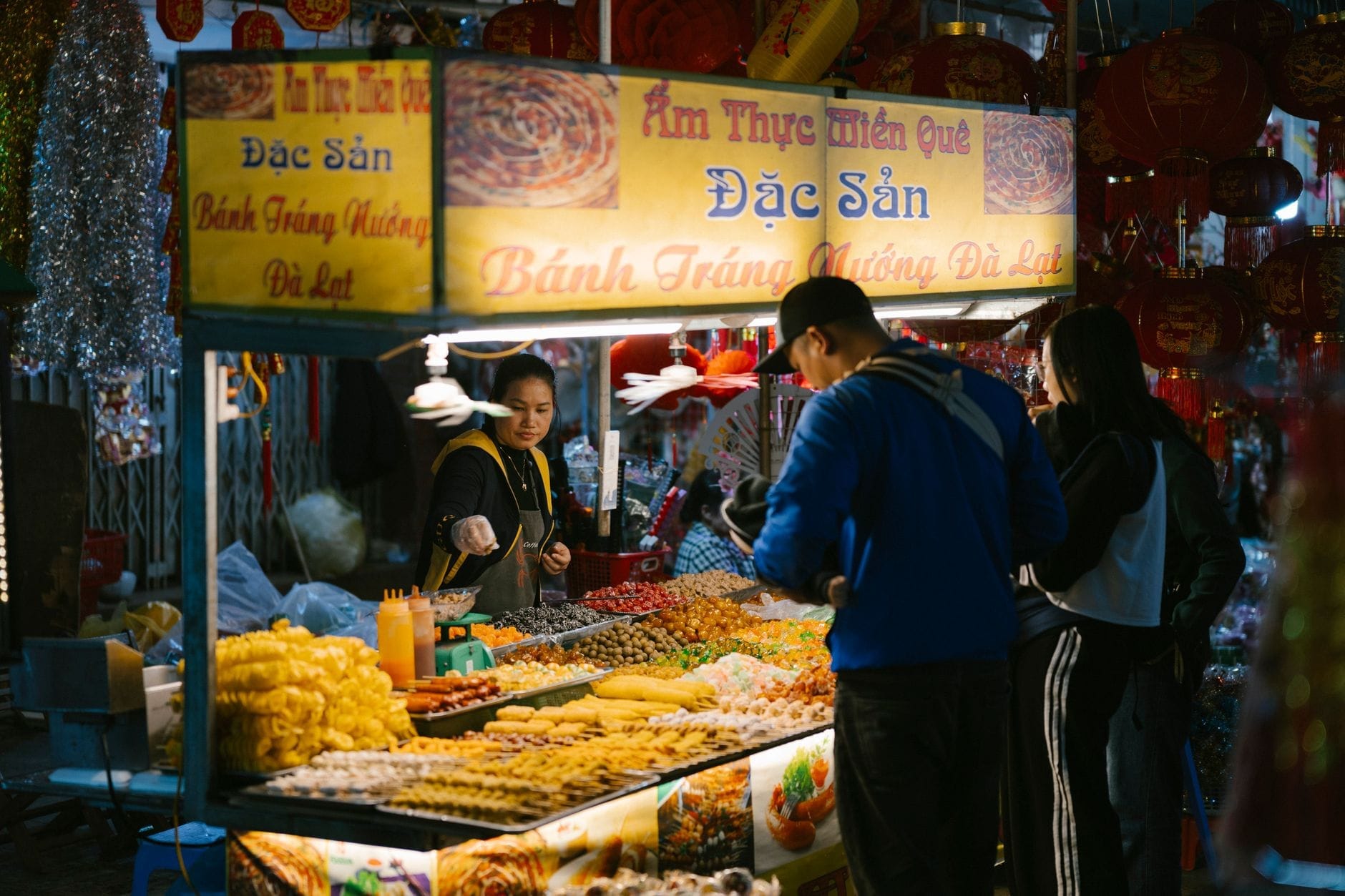
The food section is the strongest reason to visit. Look for grilled seafood sold by weight — squid, shellfish, and whole fish are cooked over charcoal and eaten at tables right beside the stall. Bánh mì vendors do fast business here, as do stalls selling bún bò Huế (Hue-style spicy beef noodle soup), bánh xèo (sizzling rice crepes), and chè (sweet dessert soups in cups layered with beans, jelly, and coconut milk). Prices are in Vietnamese đồng and most items are inexpensive by any standard.
For context on what central Vietnamese food looks and tastes like before you visit, the guide to eating in Da Nang explains the regional dishes worth seeking out.
The non-food stalls cover a familiar range: lacquerware, ao dai fabric, silk scarves, printed T-shirts, fridge magnets, hand-painted ceramics, and woven bags. Quality varies considerably from stall to stall. If you're interested in craft items with genuine regional character, the stone carvings and marble goods here are lower in quality than what you'd find directly at the source. Save that purchase for Non Nuoc village, which is worth a separate visit.
Fresh produce occupies part of the market as well, including herbs, tropical fruit, and dried goods like fish sauce and dried shrimp. This section is primarily used by local shoppers rather than tourists, but it gives the place a functional, non-theatrical quality that most purpose-built tourist markets lack.
Getting There and Getting Around the Market
The easiest approach from central Da Nang is by Grab (Vietnam's dominant ride-hailing app) or by taxi. A ride from the Han River downtown area or from hotels near My Khe Beach takes around five to fifteen minutes depending on traffic. If you're already at or near the Dragon Bridge for the weekend fire show, the market is a logical on-foot extension — cross to the east bank and follow the river south for a few minutes.
Visitors staying on the Son Tra peninsula — near the beaches on the east side — will find the market one of the closest evening destinations. The Son Tra Peninsula area guide outlines where accommodation sits relative to the market and other peninsula attractions.
Inside the market, movement is on foot along pedestrian lanes between the stalls. The layout is navigable — multiple entrances mean you can loop through the whole site without retracing your steps. The ground surface is paved and generally flat, making it manageable for pushchairs, though peak-hour crowds can make narrow sections between stalls uncomfortable for anything wider than a standard frame.
ℹ️ Good to know
No detailed wheelchair accessibility information is available for this market. The paved walkways and flat terrain suggest reasonable access, but tight vendor spacing during busy hours may create obstacles. Check conditions at the entrance before navigating further.
Photography and Sensory Notes
The market photographs well between 7:30 PM and 9:00 PM, when the overhead lights are fully on but ambient dusk still provides some colour in the sky above the stalls. The food section gives the richest images: charcoal glow, steam rising from soup pots, towers of tropical fruit under yellow lighting. A lens that handles moderate low-light without flash will serve better than a wide-angle setup here — stalls are close together and flashlight tends to flatten the atmosphere.
The sound environment is a useful indicator of market health. A fully active market carries vendor calls in Vietnamese, the sizzle and pop of grilling, children running between tables, and motorbikes idling at the edge. If it sounds quiet when you arrive, check the time — you may be early, or it may be a slow weekday.
Practical Assessment: Is It Worth Your Time?
Son Tra Night Market is not Da Nang's most spectacular evening destination. It won't compete with the visual drama of the Dragon Bridge fire show or the scale of Helio Night Market. What it offers is a less performative, more everyday version of Vietnamese market life, combined with straightforward access to good street food at local prices.
If you've already spent an evening at Helio Night Market, Son Tra offers a different register — smaller, more neighbourhood-oriented, less geared toward entertainment. Both are worth experiencing if you have more than two or three nights in Da Nang.
Visitors looking for high-end shopping, curated craft experiences, or air-conditioned comfort will find the market underwhelming. It is an outdoor, open-air space with variable hygiene standards across food stalls — the usual due diligence around cooked-food choices applies. Travellers who are uncomfortable with crowded, dimly lit pedestrian markets, or who need guaranteed accessibility features, should plan accordingly.
For those spending several evenings in the city, pairing the market with a walk along the east bank toward the Dragon Bridge makes for a coherent two-hour evening itinerary that requires no transport once you're in the area.
Insider Tips
- Arrive around 7:00 PM to get a full circuit of the stalls before the densest crowds arrive — you'll have easier access to the food tables and can claim a seat at the grilled seafood section without waiting.
- The chè (dessert soup) stalls toward the back of the market are popular with local families and usually signal quality — look for the ones with queues of Vietnamese customers rather than the ones positioned at the main entrance facing tourist foot traffic.
- If you're visiting on a Saturday or Sunday, the Dragon Bridge fire and water show runs at 9:00 PM. Time your market visit to finish eating by 8:45 PM, then walk five minutes west to the bridge for the show.
- Bargaining is expected at clothing and souvenir stalls, but not at food stalls. Starting at roughly 60–70% of the first asking price is a reasonable opening position for goods.
- Carry small denomination VND notes. Many stalls do not have change for large bills, and card payment is rarely accepted at market vendors.
Who Is Son Tra Night Market For?
- Travellers who want to eat Vietnamese street food alongside locals rather than in a tourist-facing setting
- Evening walkers looking for something to do after the Dragon Bridge show without crossing back to the west bank
- Families with children comfortable in crowded, informal outdoor environments
- Budget travellers wanting a free evening activity with inexpensive food
- First-time visitors to Da Nang who want a low-pressure introduction to local market culture before exploring further
Nearby Attractions
Other things to see while in Son Tra Peninsula:
- Lady Buddha Statue (Linh Ung Bai But Pagoda)
Standing 67 metres above the coastline of Son Tra Peninsula, the Lady Buddha statue at Linh Ung Bai But Pagoda is Da Nang's most recognisable landmark. The pagoda grounds are free to enter, beautifully maintained, and open daily from 06:00 to 21:00, making them one of the most accessible spiritual and scenic sites in central Vietnam.
- Son Tra Mountain & Ban Co Peak
Rising to 696 metres above the East Sea (South China Sea), Son Tra Mountain (Núi Sơn Trà) anchors the Son Tra Peninsula northeast of Da Nang. Its highest point, Ban Co Peak (Đỉnh Bàn Cờ), rewards the climb with sweeping coastal panoramas, dense tropical forest, and surprisingly close encounters with rare Red-shanked Douc langurs. Entry is free.
- Son Tra Peninsula Beaches
The beaches of Son Tra Peninsula sit inside a protected nature reserve on the northeastern edge of Da Nang, roughly 10 km from the city center. Unlike the wide resort strips of My Khe, these coves are compact, largely undeveloped, and backed by dense jungle rather than hotel towers. Entry is free, and the water is generally clear outside of storm season.
Planning a trip? Discover personalized activities with the Nomado app.