Sea Cliff Bridge: The Coastal Drive That Earns Its Reputation
Sea Cliff Bridge on Lawrence Hargrave Drive is a 665-metre curved road bridge that cantilevers over the Tasman Sea cliffs south of Sydney. Free to visit and dramatic at any hour, it rewards those willing to drive past the city limits.
Quick Facts
- Location
- Lawrence Hargrave Drive, Coalcliff NSW 2508 (Grand Pacific Drive)
- Getting There
- Coalcliff Station (train), then approx. 15-min walk with steep incline; or Premier Illawarra Route 2 bus (Mon–Sat, excl. public holidays — verify current timetables)
- Time Needed
- 30–60 minutes at the bridge; allow 90 minutes+ for the full drive and lookout stops
- Cost
- Free
- Best for
- Scenic drives, coastal photography, road trips along the Grand Pacific Drive
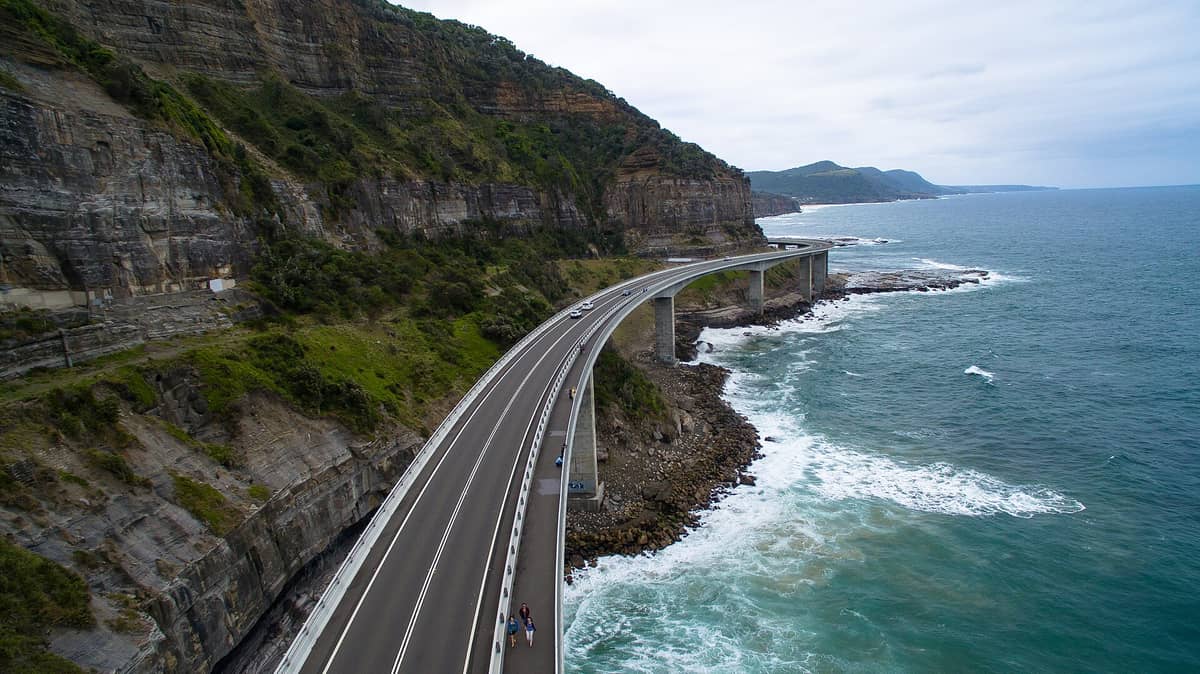
What Sea Cliff Bridge Actually Is
Sea Cliff Bridge is a 665-metre curved road bridge that carries Lawrence Hargrave Drive along the base of the Illawarra Escarpment, suspended over the rocky Tasman Sea shoreline between the suburbs of Coalcliff and Clifton. It opened in December 2005, replacing a section of road that was repeatedly damaged by cliff rockfalls and was eventually deemed too dangerous to maintain. The engineering solution, rather than a tunnel or a route further inland, was to build outward over the ocean.
That decision is what makes it worth visiting. The bridge does not cross a river or connect two shores. It simply follows the coastline where the land has run out, with the cliff face on one side and open water on the other. From a passenger window or from the pedestrian lookout areas, the effect is immediate: you are looking straight down at surf breaking on black rock, and looking south along a coastline that curves away toward Wollongong.
ℹ️ Good to know
The bridge is a functioning public road with no set opening hours, but temporary closures do occur — often due to rockfall clearing or weather events. Check Transport for NSW or the NSW Government website for any closures before making the trip.
Getting There from Sydney
Sea Cliff Bridge sits roughly 75 kilometres south of the Sydney CBD, accessed via the Grand Pacific Drive — a designated scenic route running from Royal National Park through the Illawarra and Shoalhaven.. Most visitors drive, and for good reason: the bridge is the centrepiece of a route that also passes the Sea Cliff Bridge lookout above Coalcliff, the Lawrence Hargrave Lookout above Bald Hill, and a coastline largely free of development. Allow at least 90 minutes from the city just for the drive each way, more if you stop.
For those without a car, Coalcliff train station sits on the South Coast Line and is served by NSW TrainLink services from Central Station. The train from Central to Coalcliff is on the South Coast Line. If you are combining the bridge with a visit to Wollongong, this route makes sense as a day trip.
For a broader look at day trips that include this stretch of coast, the day trips from Sydney guide covers the Grand Pacific Drive route alongside other options south and north of the city.
Tickets & tours
Live prices and dates from our booking partner. If you book, we may earn a commission at no extra cost to you.
Sea Life Sydney Aquarium Tickets
From 23 €Instant confirmationFree cancellationThe Rocks historic walking tour
From 20 €Instant confirmationFree cancellationBeginner surf lesson at Bondi Beach
From 79 €Instant confirmationFree cancellationSydney whale-watching cruise with breakfast or lunch
From 62 €Instant confirmationFree cancellation
What the Visit Feels Like
If you are driving, the bridge announces itself gradually. You come around a bend on Lawrence Hargrave Drive, the cliff drops away to your left, and suddenly the road is floating. The crash of water below is audible with windows down. The bridge curves gently, so you never see the far end directly ahead — you follow the arc, with the Tasman Sea filling the driver's side view for the full 665 metres.
Most people stop at one of the two dedicated parking and lookout areas, one at each end of the bridge. The southern lookout at Clifton gives a straight-on view of the bridge curving northward. The northern end near Coalcliff sits closer to sea level and lets you walk to a railed platform directly over the water. On a swell day, you feel a faint vibration through the metal railing as waves hit the cliff below — not concerning structurally, but enough to remind you how exposed the site is.
The smell is pure salt air, concentrated by the cliff walls. In winter, a southerly wind makes the exposed lookout platforms cold enough to need a jacket. In summer, the sea breeze is a relief after the drive. The light is best in the morning when the sun comes from the east over the ocean and hits the bridge face-on rather than silhouetting it.
Best Time of Day and Season
Morning visits, particularly in the two hours after sunrise, produce the best photographic light and the fewest other visitors. The sun rises over the ocean directly to the east, which means it backlights the cliff and illuminates the bridge structure cleanly. By mid-morning on weekends, the lookout carparks fill up quickly, particularly in summer.
Weekday afternoons are among the quietest times. The light turns golden in late afternoon looking south, and the sea colour shifts from grey-green to deep blue depending on cloud cover. Avoid arriving in the hour before sunset if you are hoping to drive the full Grand Pacific Drive — the return to Sydney in peak-hour traffic on a Friday afternoon can add significant time to the journey.
Seasonally, the bridge is photogenic year-round but presents differently. Autumn and spring (March–May and September–November) offer mild temperatures and, on average, lower rainfall than late summer. Winter swells from the south produce the most dramatic wave action below the bridge. Summer brings more visitors but also clearer, bluer water.
⚠️ What to skip
Strong winds can make the open lookout platforms genuinely uncomfortable and can affect smaller vehicles on the bridge itself. If conditions look rough, the drive across is still worthwhile, but exposed standing areas may not be enjoyable for long.
Photography Tips
The bridge's curve is its defining visual feature, and capturing it requires elevation. The best static viewpoint is from the upper lookout area above the Clifton end, which gives a sweeping view of the full arc with the cliff face behind it. From this angle, the bridge appears to float against the ocean with no land visible below it in the frame.
From the Coalcliff end at road level, you get a longer perspective looking up the coastline, with the bridge foreground and escarpment rising behind. A wide-angle lens captures the scale better than a telephoto. Drone photography is subject to Australian Civil Aviation Safety Authority (CASA) regulations — check airspace restrictions before flying, as coastal areas near infrastructure can have limitations.
The Sea Cliff Bridge is consistently listed among Sydney's top coastal viewpoints. For other high-impact photo locations across the region, the best views in Sydney guide covers everything from harbour vantage points to clifftop lookouts.
Combining Sea Cliff Bridge with Other Stops
The bridge works best as part of a day out rather than a sole destination. The Grand Pacific Drive runs south from Sydney through Royal National Park before hitting the coast at Otford and continuing to Wollongong. Bald Hill Lookout at Stanwell Park, about 10 minutes north of the bridge by car, offers paragliding launches and panoramic views over the coastline — on the right day, you will see gliders circling overhead from the bridge lookout.
Royal National Park, immediately north along the route, is one of the oldest national parks in the world and has its own walking tracks and coastal scenery. The Royal National Park entry covers what to do within the park if you want to build a longer day trip.
If you are driving the Grand Pacific Drive as a full-day route, it pairs naturally with a stop at Wollongong further south. For those building a longer coastal itinerary from Sydney, the Sydney coastal walks guide includes other stretches of the NSW coast worth considering.
Accessibility and Practical Notes
The NSW Government's official listing states the bridge welcomes visitors with access needs but does not specify step-free routes or detailed accessibility facilities. The lookout areas involve some uneven ground and, in the case of Coalcliff, a steep path from the train station. Visitors with limited mobility who are driving can access the bridge by car and stop briefly at the roadside viewing areas, which are relatively flat and paved.
There are no cafes, shops or public toilets at the bridge itself. The nearest facilities are in Coalcliff or Clifton, both of which are small residential areas with limited services. If you are driving from Sydney, bring water and snacks, particularly if you plan to walk any of the surrounding tracks. Fuel up before leaving the city — service stations become less frequent south of the Royal National Park boundary.
💡 Local tip
The carparks at both ends of the bridge have limited spaces. Arriving before 9am on weekends or on any weekday avoids the worst of the congestion. If both lots are full, there is roadside parking further along Lawrence Hargrave Drive, but be aware of marked no-stopping zones near the cliff edge.
Who Should Skip It
Sea Cliff Bridge is a road and a viewpoint, not a walk trail, a museum, or an interactive experience. Visitors expecting activities beyond looking at a coastal engineering structure and photographing it will find the attraction brief. If you do not have a car, the public transport journey involves careful timetable planning and a steep walk — for a 30-minute stop, that is a significant commitment.
Travellers on a tight schedule in Sydney who have not yet seen the harbour, the Opera House, or the Bondi to Coogee walk should prioritise those first. The bridge is free and dramatic, but it requires 90 minutes minimum from the CBD each way by car. For first-time visitors with only two or three days in Sydney, it is an optional addition rather than a core stop.
If you are working out how to structure a short trip, the 3 days in Sydney itinerary helps identify which attractions deserve priority on a limited schedule.
Insider Tips
- Pull into the Clifton lookout first if you are driving north to south — it gives you the full panoramic view of the bridge before you drive across it, which is the more satisfying order of experience.
- The train option from Central to Coalcliff is underused by visitors and genuinely comfortable on a clear day. The South Coast Line passes through the escarpment and emerges above the sea near Otford before descending to Coalcliff — the train journey itself is part of the appeal.
- Rockfall closures happen without much warning. Before a weekend trip, do a quick search for 'Sea Cliff Bridge closure' or check the NSW Government website to confirm the road is open.
- If you are there on a morning with good swell, walk to the railed platform at the Coalcliff end and look straight down. The wave action against the cliff is most visible from here and adds context to why the original road could not be maintained.
- The bridge is a popular spot for cyclists doing the Grand Pacific Drive. If you are driving on a weekend, expect to share the road with road cyclists, particularly on Sunday mornings — overtake with care on the narrow bridge section.
Who Is Sea Cliff Bridge For?
- Road trippers driving the Grand Pacific Drive between Sydney and Wollongong
- Photographers looking for coastal architecture and seascape shots with minimal gear required
- Day-trippers from Sydney wanting a coastal destination outside the city limits
- Cyclists tackling the Illawarra coast on two wheels
- Travellers pairing a coastal stop with Royal National Park on a longer southern loop
Nearby Attractions
Combine your visit with:
- Blue Mountains National Park
Blue Mountains National Park covers around 268,000 hectares of sandstone plateaus, deep gorges and temperate rainforest west of Sydney. It is a popular national park in New South Wales and one of the most rewarding day trips or overnight escapes from the city, provided you know where to go and when to arrive.
- Featherdale Wildlife Park
Featherdale Sydney Wildlife Park in Doonside is one of the few places near Sydney where you can get genuinely close to Australian wildlife, from koalas and wombats to Tasmanian devils and freshwater crocodiles. Open daily from 8:00 am, it suits families and animal lovers who want more than a glimpse through a fence.
- Figure Eight Pools
Figure Eight Pools are naturally formed rock pools on the coastal shelf of Royal National Park, south of Sydney. Reaching them requires a 6km return walk over steep terrain and careful timing around tides and surf. The reward is a striking geological curiosity in one of Australia's oldest national parks.
- Hunter Valley Wine Region
The Hunter Valley is Australia's oldest premium wine-producing region, sitting roughly two hours north of Sydney. Spread across 2,605 hectares of vineyard land near the village of Pokolbin, it rewards visitors with cellar door tastings, open countryside, and a pace that feels genuinely removed from city life. Whether you come for a single afternoon or a full weekend, understanding how the region works before you arrive makes a real difference.
Planning a trip? Discover personalized activities with the Nomado app.