San Diego Air & Space Museum: Everything You Need to Know Before You Visit
Housed in a striking circular building at the southwest corner of Balboa Park, the San Diego Air & Space Museum holds one of the most significant aviation and space collections on the West Coast. From World War I biplanes to Apollo-era capsules, this is a serious museum for serious curiosity.
Quick Facts
- Location
- 2001 Pan American Plaza, Balboa Park, San Diego, CA (southwest corner of the park)
- Getting There
- City College Station, Blue Line Trolley, then Route 7, Route 215, or a Balboa Park tram into the park
- Time Needed
- 2 to 3.5 hours for a thorough visit; 90 minutes if you move quickly
- Cost
- Adults (12+): $35. Children under 2: free. Free admission for San Diego County residents, students, active duty military, and military dependents on the second Tuesday of each month (except December and January)
- Best for
- Aviation enthusiasts, families with older kids, history buffs, and anyone curious about space exploration
- Official website
- sandiegoairandspace.org
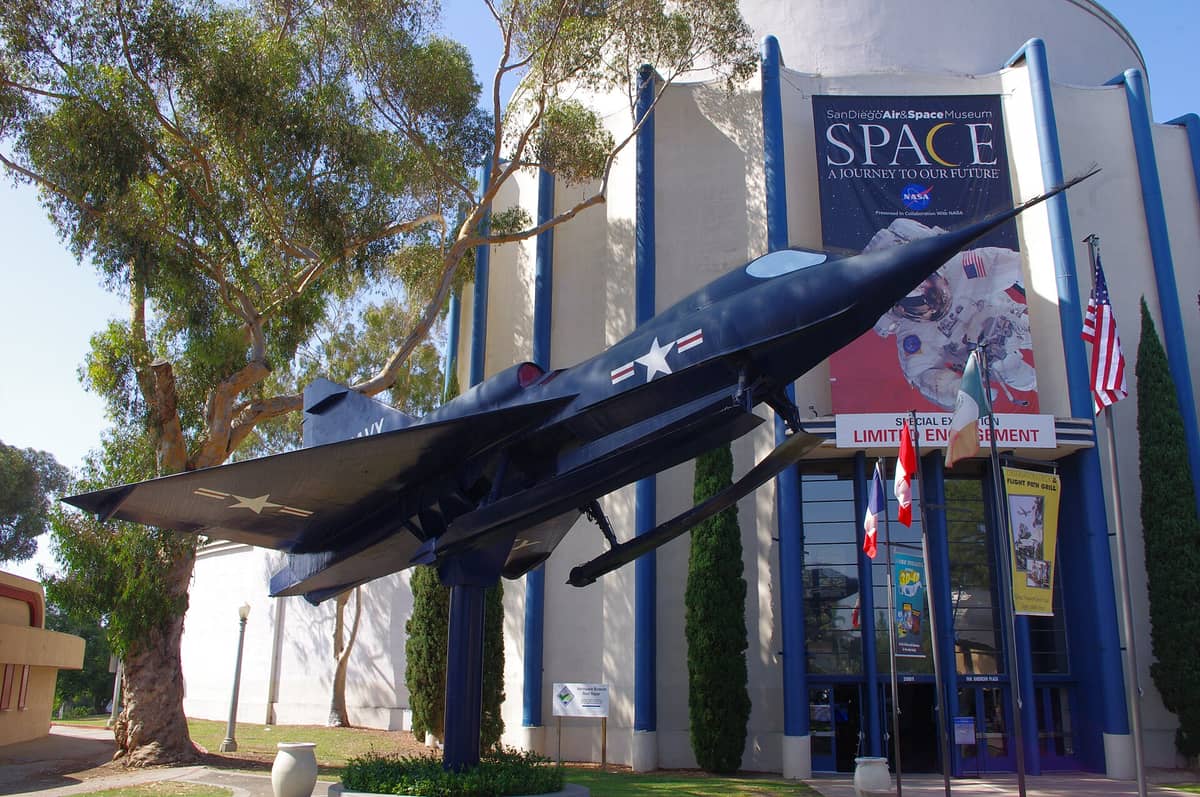
What the San Diego Air & Space Museum Actually Is
The San Diego Air & Space Museum is a Smithsonian-affiliated institution that traces the full arc of powered flight, from early wood-and-fabric biplanes through the Space Age. It sits inside the Ford Building, a circular, colonnaded structure built for the 1935 California Pacific International Exposition, at 2001 Pan American Plaza in Balboa Park. The architecture alone is worth a moment outside before you enter: the building's rounded white facade and art deco detailing look deliberately monumental, and its position at the edge of Pan American Plaza gives it a calm, ceremonial quality that most aviation museums lack.
The museum was founded in 1961 and first opened as the San Diego Aerospace Museum on February 15, 1963. A fire in 1978 destroyed much of the original collection. Rather than retreat, the institution rebuilt and reopened in its current permanent home on June 28, 1980. That history of loss and reconstruction gives the place a quiet seriousness that comes through in how its curators approach the artifacts.
ℹ️ Good to know
The museum is open seven days a week, normally 10:00 a.m. to 5:00 p.m. (last ticket sold at 4:30 p.m.; some sources list 4:30 p.m. as the last ticket time). It closes on Thanksgiving Day and Christmas Day.
The Collection: What You Will Actually See
Walking in, the scale hits you immediately. Full-size aircraft are suspended overhead or positioned at floor level throughout the rotunda, with replicas and originals mixed together in a way the interpretive panels clarify clearly. The collection includes more than 100 aircraft and spacecraft, covering the period from the Wright Brothers through the modern era of unmanned flight.
The World War I and World War II galleries carry particular weight. San Diego's identity as a Navy and Marine Corps city gives the military aviation exhibits a local resonance you do not find in inland museums. Specific aircraft, pilot records, and tactical histories are presented with enough detail to satisfy people who already know this material, without losing visitors who do not. The docents stationed near key exhibits are a genuine asset: many have personal or professional ties to aviation and answer questions with specificity, not script.
The space section covers the full sweep of the U.S. space program, with Apollo-era hardware, mission artifacts, and interactive displays that work well for both adults and older children. The original flown Apollo 9 Command Module, Gumdrop, is among the more affecting pieces: it is smaller than most people expect, and that compression of space makes the achievement feel more, not less, remarkable.
If you plan to spend real time here, visit the Fleet Science Center the same day. It sits nearby in Balboa Park and complements the Air & Space Museum well, covering broader scientific themes that overlap naturally with aviation and space content.
How the Experience Changes by Time of Day
The museum opens at 10:00 a.m. and the first hour is consistently the quietest. Lighting inside the Ford Building is controlled and largely artificial, so the experience does not shift dramatically with outdoor conditions the way a rooftop or garden does. That said, arriving early means you can stand beneath suspended aircraft without crowds obscuring sightlines or ambient noise muddying audio guides.
By midday on weekends and during summer, school groups and families with young children fill the floor-level exhibits. The indoor simulators and interactive stations develop queues. If you are primarily interested in reading exhibit text and taking close-range photographs of aircraft, mid-morning weekday visits are noticeably better.
💡 Local tip
San Diego County residents, students, active duty military, and military dependents get free admission on the second Tuesday of each month, except December and January. This is the museum's busiest free day. If you qualify, go early. If you do not qualify, avoid that Tuesday entirely.
Late afternoon, in the hour before closing, the museum thins out again. The quality of the visit is good, but you will be watching the clock. Plan your arrival so you have at least two hours before closing if you want to see the full collection without rushing.
Getting There: Transit, Driving, and Parking
The museum sits at 2001 Pan American Plaza in the southwest corner of Balboa Park. Driving is straightforward, but Balboa Park parking is shared across multiple museums and the San Diego Zoo, and on weekends the lots fill quickly by mid-morning.
By public transit, the nearest trolley stop is City College on the Blue Line. From there, Route 7, Route 215, or the Balboa Park tram can take you the rest of the way into the park. The guide to getting around San Diego covers MTS options in more detail, including day pass pricing and route planning.
Rideshare drop-off near Pan American Plaza is the most practical option for most visitors arriving without a car. The drop point is close to the museum entrance and avoids the zoo-adjacent parking frustration entirely.
The Ford Building: Architecture Worth Noticing
The Ford Building was designed by Walter Dorwin Teague for the 1935 California Pacific International Exposition and constructed for Ford Motor Company's exhibit. Its circular plan and colonnade are Streamline Moderne. After the exposition, the city repurposed the structure multiple times before the Aerospace Museum adopted it as its permanent home in 1980.
The building fits naturally within Balboa Park's overall architectural character. If you are spending a full day in the park, Balboa Park holds a dozen other museums and the Botanical Building within a compact, walkable area. The Air & Space Museum anchors the southern end of the park's museum cluster.
Inside, the circular floor plan creates a continuous gallery loop, which helps with navigation. There are no dead ends or confusing branching corridors. You move around the outer ring of exhibits with the aircraft overhead, and the spatial logic is immediately legible. This matters more than it sounds when you are managing children or trying to cover a lot of ground efficiently.
Practical Details: What to Know Before You Arrive
Adult admission is $35 for visitors 12 and older. Children 2 and under enter free. There are no steep stairs or significant grade changes inside the museum, and the institution states it is fully wheelchair accessible. Wheelchairs are available at no cost at the admissions desk on a first-come, first-served basis, with a photo ID held while in use.
Photography is permitted throughout the general exhibit areas. The aircraft are large and often partially backlit, so consider shooting from lower angles to use floor-level light sources. Wide-angle lenses are more useful here than telephoto. The museum's interior does not allow tripods in high-traffic areas, though this is not prominently posted.
⚠️ What to skip
Opening hours vary slightly depending on the source. The visit page lists normal hours as 10:00 a.m. to 4:30 p.m. (last ticket sold at 4:30 p.m.), while the FAQ page notes 10:00 a.m. to 5:00 p.m. Hours are subject to change. Always check the official website before visiting: sandiegoairandspace.org.
There is a gift shop near the exit with a reasonable selection of aviation and space-themed merchandise, including items for children that are more focused than the typical museum store. There is also a cafe on site, though the food options are limited. If you are spending a full afternoon in Balboa Park, the park has other dining options worth considering before committing to museum cafe prices.
The museum fits naturally into a broader Balboa Park day. If aviation history is a primary interest, a San Diego trip built around military and maritime history works well: the USS Midway Museum on the downtown waterfront is the obvious companion, offering the carrier-based perspective to complement what the Air & Space Museum covers in terms of aircraft development and space history.
Who Should Think Twice
This is not a drop-in attraction for casual browsers. Visitors who are not genuinely interested in aviation, aerospace history, or military technology will find the exhibits dense and the content narrow. The museum commits deeply to its subject rather than broadening appeal with interactive spectacle, which is a strength for its audience and a limitation for those outside it.
Families with toddlers and young children under 6 will find the exhibit format difficult. The aircraft are impressive visually but not touchable, and the interpretive material is written for readers. The Fleet Science Center next door is better suited to very young children. At $35 per adult, the value proposition depends almost entirely on genuine interest in the subject matter.
Insider Tips
- The second Tuesday of each month (except December and January) offers free admission for San Diego County residents. If you live locally, this is the obvious time to go. If you do not, avoid that day as crowds will be significantly higher than normal.
- The docents near the World War II section tend to be the most knowledgeable and the most willing to engage in extended conversation. If you have specific questions about aircraft history, seek them out rather than relying on the panel text alone.
- The museum's library and research archive is one of the largest aviation research collections on the West Coast. It is not typically promoted to general visitors, but enthusiasts with specific research needs can contact the museum in advance to arrange access.
- Parking near the museum fills faster than near the zoo on busy weekends. If you plan to arrive between 10:00 a.m. and noon on a Saturday, consider rideshare drop-off at Pan American Plaza rather than circling for a space.
- If you want unobstructed photographs of suspended aircraft, the first 45 minutes after opening on a weekday morning offers the lowest foot traffic of the day. The overhead lighting remains consistent regardless of outdoor conditions, so overcast San Diego mornings do not affect interior photography quality.
Who Is San Diego Air & Space Museum For?
- Aviation and aerospace history enthusiasts who want depth over spectacle
- Families with school-age children who have already developed an interest in flight or space
- Military history readers, particularly those focused on 20th-century air power
- Architecture-aware visitors interested in the 1935 California Pacific International Exposition legacy
- San Diego County residents looking for a quality free-admission day out
Nearby Attractions
Other things to see while in Balboa Park:
- Botanical Building and Lily Pond
Built for the 1915 Panama-California Exposition, the Botanical Building and Lily Pond is one of Balboa Park's most photographed landmarks and one of San Diego's few genuinely free indoor plant experiences. The structure, historically billed as one of the largest wood lath buildings in the world, shelters over 2,100 plant varieties beneath a domed roof that filters light into something close to dusk at midday.
- Comic-Con Museum
Opened in November 2021, the Comic-Con Museum brings the legendary San Diego convention to life year-round in Balboa Park. Rotating exhibitions, interactive experiences, and deep dives into comics, film, and sci-fi make it a serious destination for pop culture fans, not just Comic-Con regulars.
- Fleet Science Center
The Fleet Science Center anchors the eastern edge of Balboa Park's museum row with interactive science exhibits, a giant-dome theater, and monthly planetarium evenings. It draws curious visitors of all ages, from toddlers tackling discovery stations to adults catching an IMAX-style documentary under a five-story screen.
- Japanese Friendship Garden
Tucked into about 12 acres of Balboa Park, the Japanese Friendship Garden & Museum is San Diego's dedicated space for Japanese landscape design, cultural art, and quiet reflection. Symbolizing the bond between San Diego and its sister city Yokohama, the garden rewards visitors with stone lanterns, koi ponds, a centuries-old bronze Kannon statue, and rotating museum exhibitions.