Sa Dragonera: Mallorca's Wild Island Nature Reserve
Sa Dragonera is an uninhabited island nature park off the southwest coast of Mallorca, accessible only by boat from Sant Elm or Port d'Andratx. With rugged hiking trails, two 16th-century watchtowers, and some of the best undisturbed wildlife in the Balearics, it rewards travelers willing to put in the effort.
Quick Facts
- Location
- Southwest Mallorca, off the coast of Sant Elm (municipality of Andratx)
- Getting There
- Boat only — ferries depart from Sant Elm and Port d'Andratx; no cars permitted on the island
- Time Needed
- Half day minimum; full day for summit hike (Route 4: 8.4 km return)
- Cost
- Park entry is free; boat crossing charged separately (verify current rates with operators in Sant Elm)
- Best for
- Nature lovers, hikers, birdwatchers, and travelers wanting to escape the crowds
What Is Sa Dragonera?
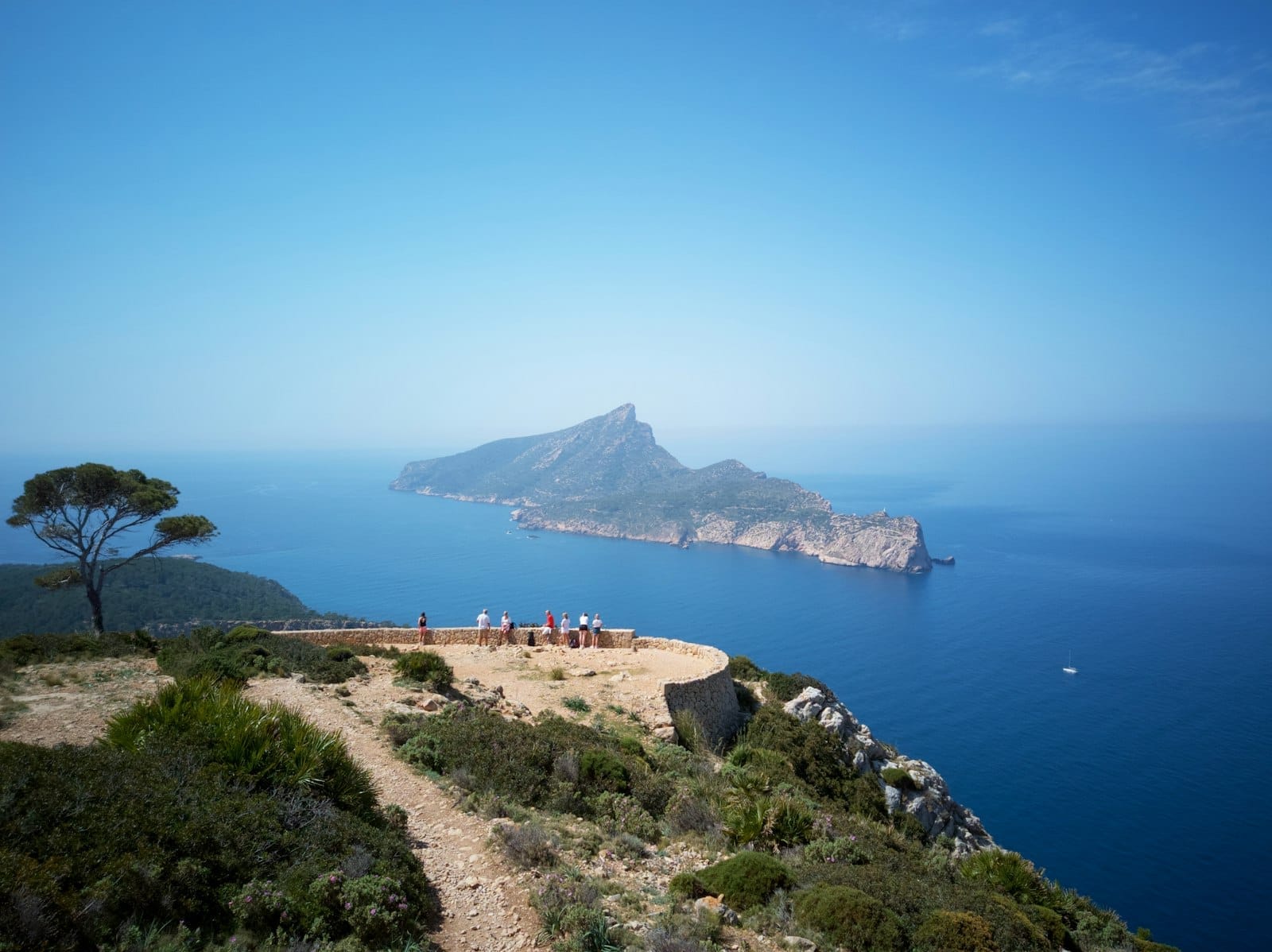
Sa Dragonera is a narrow, uninhabited island sitting roughly one kilometer off the westernmost tip of Mallorca. It stretches about 4.2 km in length but rarely exceeds one kilometer in width, giving it a long, lizard-like silhouette that is said to have inspired its name — "dragonera" derives from the Catalan word for dragon. Whether viewed from the mainland cliffs above Sant Elm or approached by boat across the short channel, the island has an unmistakably prehistoric quality: sheer rock faces dropping into clear water, a ridgeline of dark scrubland, and two stone watchtowers standing against the sky.
Parc Natural Sa Dragonera was declared a protected natural park by the Balearic government in 1995, following the Consell Insular de Mallorca's purchase of the island in 1987. Before protection, the site faced development pressure — today it forms part of the European Union's Natura 2000 network of protected habitats. There are no roads, no hotels, no permanent residents, and no cars. What you find instead is a ranger station at the harbor, a small exhibition about the island's ecology, and a handful of marked trails.
ℹ️ Good to know
Sa Dragonera is car-free and boat-access only. Boats depart from Sant Elm (the closer and more popular option) and Port d'Andratx. The crossing from Sant Elm takes around 15 minutes. Confirm current schedules and prices with the operators at Sant Elm harbor before you travel, as services are weather-dependent and seasonal.
Getting There: The Boat from Sant Elm
Sant Elm is a small, quiet coastal village at the far southwestern end of Mallorca. It has the feel of a resort town that never quite grew up — a handful of seafront restaurants, a narrow beach, and the kind of slow pace that signals you are near the end of the road. The boat pier sits at the edge of the village, and in summer the waiting area fills with hikers with daypacks and families carrying snorkels.
To reach Sant Elm by public transport, take the bus from Andratx, which is connected by bus from Palma. For more detail on navigating the island independently, the getting around Mallorca guide covers routes and timings across the southwest. If you are driving, parking in Sant Elm fills up quickly in July and August — arrive before 9am or consider leaving the car at Andratx and taking the local bus.
The short channel crossing delivers you into Cala Lladó, sometimes called Pirate's Cove or Robber's Cove, a sheltered natural harbor on the island's eastern side. The name is not merely decorative: Sa Dragonera served as a base for Barbary corsairs raiding the Mallorcan coast during the 16th and 17th centuries, which is precisely why the Spanish Crown ordered the construction of defensive watchtowers.
Tickets & tours
Hand-picked options from our booking partner. Prices are indicative; availability and final rates are confirmed when you complete your booking.
Boat trip from Sant Elm to Dragonera Island Natural Park
From 20 €Instant confirmationFree cancellationSunset boat tour Andratx and Dragonera with snorkel
From 49 €Instant confirmationFree cancellationSa Dragonera Island tour 90-minute jet ski Andratx
From 199 €Instant confirmationFree cancellationDragonera Island and Sant Elm village boat trip from Puerto de Andratx
From 40 €Instant confirmationFree cancellation
History Written in Stone: The Watchtowers
Two defensive towers survive on Sa Dragonera, and both are reachable on foot. The Torre de Llebeig, built in 1585 and restored in 2004, stands at the southern tip of the island and is the more accessible of the two. The Talaia de na Pòpia (also called Talaia de la Guinavera), constructed earlier in 1580, crowns the island's highest point, Na Pòpia, at 353 meters above sea level.
Standing at either tower, you quickly understand why this location was chosen. The watchtowers have unobstructed sightlines across the channel to Mallorca, south toward the open Mediterranean, and west to the smaller islets of Pantaleu and Mitjana. From Na Pòpia on a clear day, you can see the outline of Ibiza on the horizon. These were not just lookout posts — they were part of a coordinated coastal defense system that stretched across the entire Balearic coast.
💡 Local tip
The restored Torre de Llebeig at the southern tip is a worthwhile short walk from the harbor, even if you are not planning the full summit route. The views back across to Sant Elm and the Mallorcan coastline are excellent with minimal effort.
Hiking the Island: Route 4 and the Summit
The most demanding trail on Sa Dragonera is Route 4, the path to the summit of Na Pòpia at 353 meters. The return distance is approximately 8.4 km, and the trail involves genuine elevation gain over uneven, rocky terrain. It is not technically difficult, but it is relentless: the path climbs steadily through dense Mediterranean scrub, with sections of loose stone and little shade. In summer, the heat amplifies the effort considerably.
The payoff at the top is real. The ridgeline walk along the upper section of the trail is one of the most dramatic in southwest Mallorca — the island drops away on both sides, the sea is intensely blue below, and on a calm day the silence is complete apart from the wind and the calls of Eleonora's falcons, a species that breeds here in significant numbers during summer. Sa Dragonera hosts one of the largest Eleonora's falcon colonies in the western Mediterranean, along with populations of Audouin's gulls, shearwaters, and the Lilford's wall lizard (Podarcis lilfordi), a subspecies found only on Balearic islets without ground predators.
For context on hiking difficulty and trail quality elsewhere in the region, the hiking in Mallorca guide provides a broader overview of what to expect across different areas. Sa Dragonera is more exposed and less forgiving than many mainland trails.
Wear proper footwear with grip. Bring more water than you think you need: there is no fresh water on the island and the ranger station does not sell drinks. A hat and sunscreen are essential from April through October. The trail is unsuitable for young children and entirely inaccessible for wheelchair users — the terrain is simply too rugged.
Wildlife and Ecology
The absence of land-based predators on Sa Dragonera has made it a refuge for species that have been eliminated from the Mallorcan mainland. The Lilford's wall lizard is perhaps the most visible of these: small, dark, and completely unafraid of humans, the lizards emerge immediately when visitors stop to rest and will approach within centimeters, apparently accustomed to the presence of people and the possibility of crumbs. Do not feed them.
The surrounding waters are equally rich. The channel between Sa Dragonera and Sant Elm is popular with snorkelers and divers, and the clarity of the water around the island's rocky base is notable even from the boat. Sea grass meadows (Posidonia oceanica), a protected habitat under Natura 2000 rules, cover significant areas of the seabed around the island.
The broader southwest coast has a concentration of natural sites worth exploring together. Southwest Mallorca covers the full range of what the area offers, from coastal villages to mountain scenery.
What the Experience Actually Feels Like
The morning boat from Sant Elm tends to carry a mix of committed hikers and day-trippers who simply want a change of scene. Once the boat docks at Cala Lladó and the group disperses along the island's trails, Sa Dragonera absorbs people quickly. Within fifteen minutes of arriving, you can feel genuinely alone. The silence in the middle of the island, away from the harbor, is striking for somewhere a tourist boat docks several times a day.
In July and August, the island receives its highest visitor numbers. The harbor area around the ranger station can feel crowded during the midday hours when multiple boats have arrived. The practical solution is straightforward: take an early boat, walk immediately toward the trails, and plan to be back at the harbor before the midday rush. By late afternoon, as the last boats prepare to return, the pace settles again.
Spring and early autumn offer a noticeably different experience. In April and May, the scrub vegetation along the trails is green and flowering, temperatures are comfortable for sustained hiking, and bird activity is high as migrants pass through. September and October bring cooler conditions, fewer visitors, and the spectacle of Eleonora's falcons beginning to depart for their wintering grounds in Madagascar. Winter access depends entirely on weather: the channel can become rough, and boats may not run for several days at a stretch.
⚠️ What to skip
Sa Dragonera is not a suitable day out for travelers with limited mobility, very young children, or anyone unprepared for significant sun exposure with no shade or facilities beyond the basic ranger station at the harbor. If the weather is unsettled, the boat may not run at all.
Who Should Consider Skipping It
Sa Dragonera is a real nature reserve, not a polished tourist attraction. If you are looking for a comfortable beach day, a boat trip with facilities and shade, or a short outing that requires minimal exertion, this island will likely disappoint. The terrain is rough, the sun is unrelenting in summer, and there are no cafes, no sunbeds, and no services beyond the ranger station. Travelers who arrive expecting scenic ease sometimes find the reality demanding. That said, for those who come prepared, the reward is an island that feels genuinely remote despite being fifteen minutes from the Mallorcan coast.
If you want wild coastline with less physical commitment, Formentor Peninsula offers dramatic scenery that is more accessible by road. For a structured boat trip with snorkeling, the Mallorca boat trips guide outlines the options across the island.
Insider Tips
- Take the first boat of the day from Sant Elm to get ahead of the midday crowds at the harbor. The early crossing also gives you the best light for photography along the ridgeline.
- The lizards at the ranger station area will approach you without encouragement. If you want photographs of Podarcis lilfordi up close, simply stop moving and wait.
- Carry a minimum of two liters of water per person for the Route 4 summit hike. There is no resupply on the island, and dehydration is a genuine risk in summer.
- The Torre de Llebeig at the southern tip is largely overlooked by visitors who head straight for the summit trail. It is a shorter walk and has equally good sea views south toward the open Mediterranean.
- If you visit in late summer (August to October), bring binoculars: Eleonora's falcons are highly active and visible from the upper trails as they hunt migrating passerines passing through the island.
Who Is Sa Dragonera For?
- Hikers and trail walkers who want genuine wilderness within reach of Mallorca's southwest coast
- Birdwatchers targeting Eleonora's falcons, Audouin's gulls, and Balearic shearwaters
- Wildlife photographers seeking close encounters with Lilford's wall lizards in their natural habitat
- Travelers wanting a car-free, crowd-light day away from Mallorca's main resorts
- History enthusiasts interested in 16th-century Balearic coastal defense architecture
Nearby Attractions
Other things to see while in Southwest Mallorca:
- Magaluf
Magaluf sits on the western edge of Palma Bay, about 15 km from the capital, where a genuinely beautiful kilometre of white sand meets one of the Mediterranean's most misunderstood resort towns. Once synonymous with cheap package holidays and tabloid headlines, the area has been methodically repositioned since 2015 into something more layered. The beach is real, the water is clear, and knowing what to expect makes all the difference.
- Port d'Andratx
Port d'Andratx sits at Mallorca's southwestern tip, where a centuries-old fishing harbour has evolved into one of the island's most photogenic and upscale marina towns. With dramatic cliff-framed water, small swimming coves, and boat access to Sa Dragonera island, it rewards visitors who come for atmosphere rather than a beach holiday.
- Puerto Portals
Puerto Portals is southwest Mallorca's most refined waterfront destination, combining 680 moorings for superyachts up to 60 metres with a curated promenade of high-end restaurants, boutiques, and jewellers. Whether you arrive by sea or by car, the atmosphere is unmistakably Balearic luxury without the Palma crowds.
- Western Water Park
Western Water Park is a Wild West-themed water park on the southwest coast of Mallorca, near Magaluf. With 20 slides including one of the world's tallest, four children's zones, and a full day's worth of rides and pools, it draws families and thrill-seekers throughout the summer season. Here is everything you need to plan your visit well.