Rummu Quarry: The Submerged Soviet Prison Quarry Near Tallinn
Rummu Quarry is a flooded limestone quarry in Harju County, Estonia, roughly 50 km from Tallinn. Once worked by Soviet-era prison inmates, the site now draws visitors for swimming in turquoise water, cliff jumping, scuba diving, and visits to the adjacent prison area. It is one of the most visually striking and historically layered day trip destinations within reach of Tallinn.
Quick Facts
- Location
- Haapsalu mnt 13, Rummu alevik, Lääne-Harju vald, Harju County, Estonia — approx. 50 km west/southwest of Tallinn
- Getting There
- Best reached by car via Haapsalu road (km 13 marker); parking available at the entrance gate. Public transit is indirect — check current bus schedules from Tallinn's Balti jaam station to nearby Vasalemma or Rummu village
- Time Needed
- 2–4 hours for a relaxed visit; half a day if you include the prison museum and a swim
- Cost
- Verify current prices at rummu.ee/en
- Best for
- Swimmers, history buffs, photographers, divers, and day-trippers from Tallinn
- Official website
- rummu.ee/en
What Rummu Quarry Actually Is
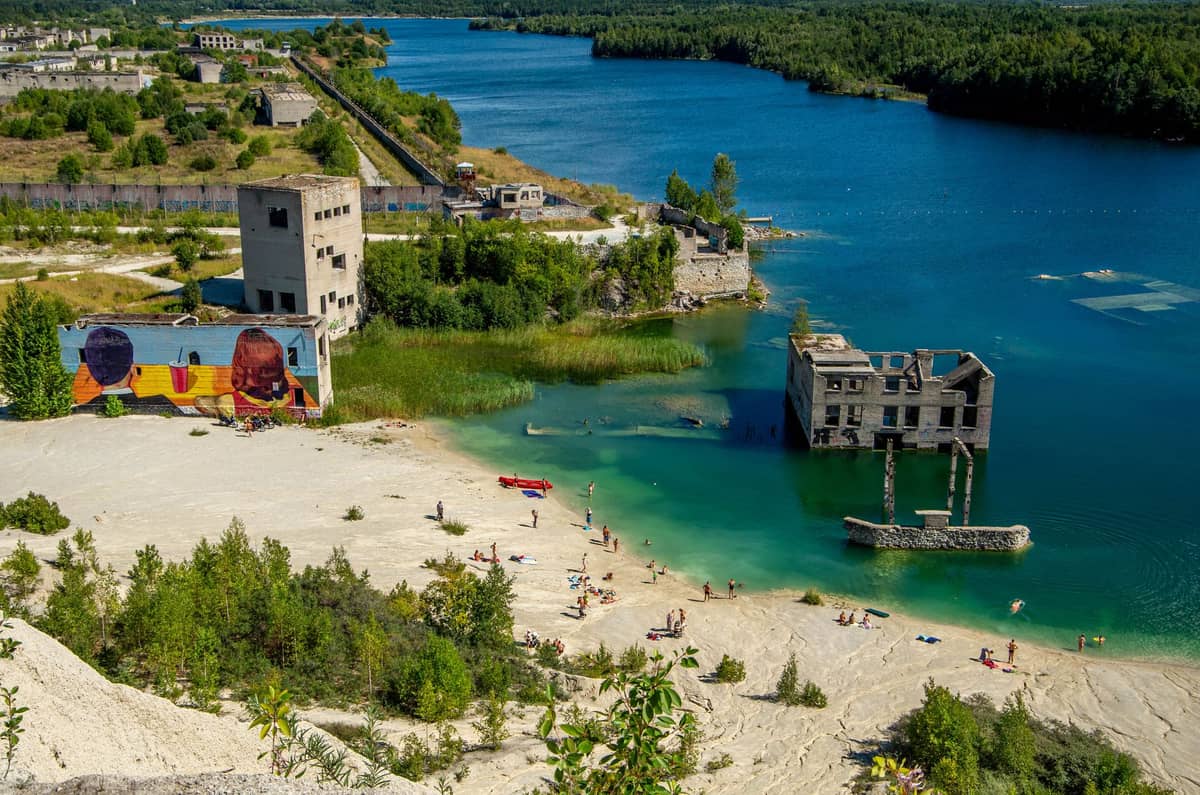
Rummu Quarry is a submerged limestone quarry in Rummu village, about 50 kilometres west of Tallinn in Harju County. The quarry was mined for decades using inmate labour from the adjacent Murru Prison, a Soviet-era correctional facility. When mining stopped and the dewatering pumps were switched off, groundwater flooded the excavation pit. The result is a surreal body of water with a turquoise tint caused by limestone particles suspended in the water, partially submerged Soviet-era mining structures still visible beneath the surface, and steep pale rock walls rising on three sides.
The site officially operates as RUMMU Quarry | Prison (the name used on the attraction's own website), combining recreational access to the quarry with a prison museum on the same grounds. It is open every day, including public holidays, from 10:00 to 20:00. Tickets are sold at a kiosk near the entrance gate.
ℹ️ Good to know
Ticket prices (verify at rummu.ee/en before your visit): Ticket prices: verify at rummu.ee/en before your visit.
The Landscape: What You See When You Arrive
The first view from the rim is the one most photographs try to capture and few fully convey. The water below is an unnatural shade of aquamarine, not the grey-green of most Estonian bodies of water. On calm mornings, the surface is still enough to mirror the limestone cliffs on the opposite bank. Corroded metal structures and the tops of old buildings poke above the waterline at the far end of the flooded pit, giving the scene a post-apocalyptic quality that feels entirely accidental rather than staged.
The cliffs are made of pale Ordovician limestone, the same rock that forms the famous Glint escarpment running along Estonia's northern coast. The quarrying exposed clean cross-sections of this rock, and the walls drop steeply into the water. At certain angles and in strong midday light, the contrast between the white rock, the blue sky, and the turquoise water is startling. In overcast conditions the colour of the water is more muted, shifting toward grey-blue, though the atmosphere becomes more atmospheric and easier to photograph without harsh shadows.
Summer weekends draw large numbers of visitors, particularly Estonian families and young adults from Tallinn. Arrive before noon to get reasonable access to the cliff edges and the sandy beach areas. By mid-afternoon on a warm Saturday in July, the site is crowded and parking can be difficult. Midweek mornings in June or August offer the quarry at its quietest and most photogenic.
Tickets & tours
Hand-picked options from our booking partner. Prices are indicative; availability and final rates are confirmed when you complete your booking.
Self-guided Discovery Walk of Tallinn city contrasts beyond the medieval walls
From 26 €Instant confirmationFree cancellationTallinn's art and culture tour with a local
From 62 €Instant confirmationFree cancellationHistorical walking tour of Tallinn with a local
From 599 €Instant confirmationFree cancellationIntroductory walking tour of Tallinn with a local guide
From 109 €Instant confirmationFree cancellation
Swimming, Diving, and the Water
Swimming is the main draw for most visitors during warmer months. The water temperature follows seasonal patterns consistent with Estonian summer conditions — cool in early June, reaching more comfortable levels through July and August. The limestone particles that give the water its colour are harmless but the water is not crystal-clear below the surface in the way of some alpine lakes; visibility for divers varies by season and depth.
The submerged structures are the main attraction for divers. Rusted mining equipment, the frames of old buildings, and sections of equipment left behind when the site flooded create an underwater landscape that is unusual anywhere in the world and unique in Estonia. Diving requires its own equipment and certification; there is no dive operation on site, so bring your own gear or arrange a guided dive through one of the Estonian dive clubs that run organised trips to Rummu.
Cliff jumping is popular and practised at the site, though it is inherently a matter of personal risk assessment. The water depth below the main jumping points is adequate for the heights involved, but conditions should be evaluated on the day. Children and non-swimmers should be supervised carefully near the cliff edges, as the drop to water is abrupt and fencing is not comprehensive throughout the site.
⚠️ What to skip
The water remains cold even in summer by most visitors' standards. If you are sensitive to cold water, plan for a short swim or bring a wetsuit. Keep children away from cliff edges at the rim; the drops are steep and some sections have no barriers.
The Prison Museum: The Historical Layer Most Visitors Miss
The prison museum occupies part of the old Murru Prison complex adjacent to the quarry. Murru was a functioning Soviet corrective labour colony, and the building fabric, security infrastructure, and some original fittings remain. The museum contextualises the quarry as a site of forced labour, explaining the conditions under which inmates extracted limestone and the broader system of Soviet penal institutions in Estonia.
Compared to a standard history museum, the experience here is deliberately raw. The cells, corridors, and exercise yards are not heavily curated. Much of what you encounter is simply the building as it was left. For visitors with an interest in Soviet history, this honesty makes it more affecting than polished exhibits would. For visitors arriving primarily for the swimming, the museum is easy to skip — the quarry and prison museum tickets are sold separately for exactly this reason.
If Soviet-era history is a particular interest, Tallinn itself has several sites worth combining with a Rummu day trip. The KGB Prison Cells in central Tallinn offers a complementary indoor museum experience examining the Soviet security apparatus from a different angle. Together, they form a coherent half-day-and-day itinerary for visitors following Estonia's twentieth-century history.
For broader context on Estonia's Soviet period, the Vabamu Museum of Occupations and Freedom in Tallinn's Old Town provides the most thorough narrative account, and is best visited before or after Rummu rather than on the same day.
Getting There from Tallinn
Rummu Quarry is located at Haapsalu mnt 13, Rummu alevik, approximately 50 kilometres west of central Tallinn. By car, follow the Haapsalu road westward; the quarry entrance is signposted from the road. Parking is available at the site entrance and is included with the visit. Drive time from Tallinn city centre is typically 30 to 45 minutes depending on traffic.
Public transport options exist but require planning. Regional buses or train-and-bus connections from Tallinn can get you to nearby stops; check current timetables at peatus.ee, as schedules change seasonally. A rental car or a shared taxi from Tallinn is the most practical option for most visitors, particularly in a group where the cost can be split.
For day trip planning from Tallinn, the day trips from Tallinn guide covers several routes in the Harju County area and can help combine Rummu with other stops on the same drive.
💡 Local tip
Combine Rummu Quarry with Keila-Joa waterfall on the same day — both are southwest of Tallinn along a similar route, and together they make a full day out of the city without significant backtracking.
Photography, Light, and Practical Advice
The quarry photographs well in the two hours after opening (around 10:00 to 12:00) when the sun is at an angle that catches the water colour without creating harsh overhead glare. The pale limestone cliffs reflect light well, so even slightly overcast conditions can produce attractive results. Bring a wide lens if you want to capture the full scale of the pit from the rim; the depth and width of the excavation are difficult to convey in a tight frame.
Drone photography is popular at the quarry and the aerial perspective reveals the submerged structures most clearly. Check current Estonian Civil Aviation Authority rules before flying, as restrictions apply in some areas and rules change. From ground level, the concrete and metal structures protruding above the water are best captured in early morning light when the water is still.
Bring water and food. There is no café or substantial food vendor at the site, though basic snacks may be available near the entrance. Wear shoes with grip if you plan to walk along the quarry rim, as the rock surfaces can be uneven and slippery near the water's edge. Sunscreen is important on clear days — the pale limestone and open water reflect UV significantly.
The Verdict: Is It Worth the Trip?
Rummu Quarry is not a polished tourist attraction. The facilities are basic, the experience is largely self-directed, and on busy summer days the atmosphere can feel more like a local swimming hole than a curated destination. For visitors expecting dramatic walking paths, interpretive signage throughout the site, or a beach club experience, it will feel underdeveloped.
For the right kind of traveller, however, this is exactly what makes it compelling. The combination of Soviet industrial history, a genuinely unusual landscape, and an active outdoor recreation scene produces something that is hard to find elsewhere in Northern Europe. The submerged structures alone are worth the 50-kilometre drive from Tallinn, and the prison museum adds genuine historical weight to what could otherwise be just an attractive swimming spot.
Travellers who prefer air-conditioned museums, confirmed accessibility infrastructure, or structured guided experiences may find the site frustrating. Wheelchair access around the quarry rim and into the prison museum is not straightforwardly available across the full site — contact the attraction directly at rummu.ee/en before visiting if mobility is a consideration. Similarly, travellers visiting Tallinn for only one or two days may find the time investment difficult to justify against the concentration of excellent attractions in the city itself.
If you are planning a longer visit to Estonia, the 3 days in Tallinn itinerary provides a practical framework that leaves room for a half-day excursion to Rummu without rushing the city's core attractions.
Insider Tips
- The turnstile gate accepts payment when the ticket kiosk is closed, so arriving right at 10:00 or later in the evening is possible even without staff present. Bring a card, as cash-only kiosks can be inconsistent.
- The submerged building tops are most visible on calm, windless days when the water surface is undisturbed. If the surface is choppy from wind, the underwater structures are much harder to see from above.
- Locals bring inflatable paddleboards and kayaks for a different perspective on the quarry. There is no rental on site, but a packable inflatable fits in a car boot and dramatically changes the experience.
- The prison museum is significantly less visited than the quarry itself, meaning you often have the cells and corridors almost to yourself even when the water's edge is crowded. Allow 40 to 60 minutes for the museum alone.
- In winter, when the quarry freezes over, the site takes on a completely different character. Ice forms over the turquoise water and the submerged structures create shadowy shapes below. Pedestrian access remains open year-round, but verify ice safety conditions before walking on the surface.
Who Is Rummu Quarry For?
- Photographers wanting a visually unusual landscape within easy reach of Tallinn
- Swimmers and outdoor swimmers comfortable with cool, fresh water
- History-focused travellers interested in Soviet-era Estonia and forced labour sites
- Scuba divers seeking a distinctive inland dive site with submerged industrial structures
- Day-trippers from Tallinn looking for a half-day excursion combining nature and history
Nearby Attractions
Combine your visit with:
- Aegna Island
Aegna Island sits 14 km off the Tallinn coast in the Bay of Tallinn, reachable in about 30 minutes by boat. The entire island is a protected landscape conservation area, covered in dense forest, glacial boulders, and coastal meadows. Entry to the island is free, making it one of the most rewarding half-day escapes from the city.
- Estonian Open Air Museum
Spread across 72 hectares of coastal forest in Tallinn's Haabersti district, the Estonian Open Air Museum (Eesti Vabaõhumuuseum) reconstructs rural and fishing life from the 18th and 19th centuries. Twelve farmyards, a working tavern, a church, mills, a schoolhouse, a fire station, and net sheds make this Estonia's largest and most immersive open-air history experience.
- Glehn Park
Glehn Park is a free, forested public park in Tallinn's suburban Nõmme district, built around a 19th-century castle by the eccentric Baron Nikolai von Glehn. With natural woodland trails, stone carvings, and a refreshing distance from the Old Town crowds, it rewards visitors who want something genuinely different from the medieval core.
- Jägala Waterfall
Standing 8 metres tall and stretching over 50 metres wide, Jägala Waterfall is Estonia's largest natural waterfall. Located just 25 kilometres east of Tallinn on the Jägala River, it is free to visit year-round and rewards visitors differently in every season, from frozen curtains of ice in winter to a thundering torrent in spring snowmelt.