Rockport Harbor: Cape Ann's Most Painterly Working Waterfront
Rockport Harbor occupies a sheltered cove on Sandy Bay at the tip of Cape Ann, about 30 miles northeast of Boston. Free to visit and walkable from the commuter rail station, it combines an active fishing and boating harbor with some of the most photographed coastal scenery in New England.
Quick Facts
- Location
- Sandy Bay, Rockport, MA 01966 — about 30 miles northeast of Boston
- Getting There
- MBTA Newburyport/Rockport Line from North Station to Rockport station; harbor is walkable from the platform
- Time Needed
- 1.5 to 3 hours, including Bearskin Neck and the breakwater walk
- Cost
- Free to walk and view; no admission charge for the public waterfront
- Best for
- Landscape photographers, day-trippers from Boston, families, and anyone who likes a scenic coastal walk without the crowds of the Cape
- Official website
- rockportusa.com
What Rockport Harbor Actually Is
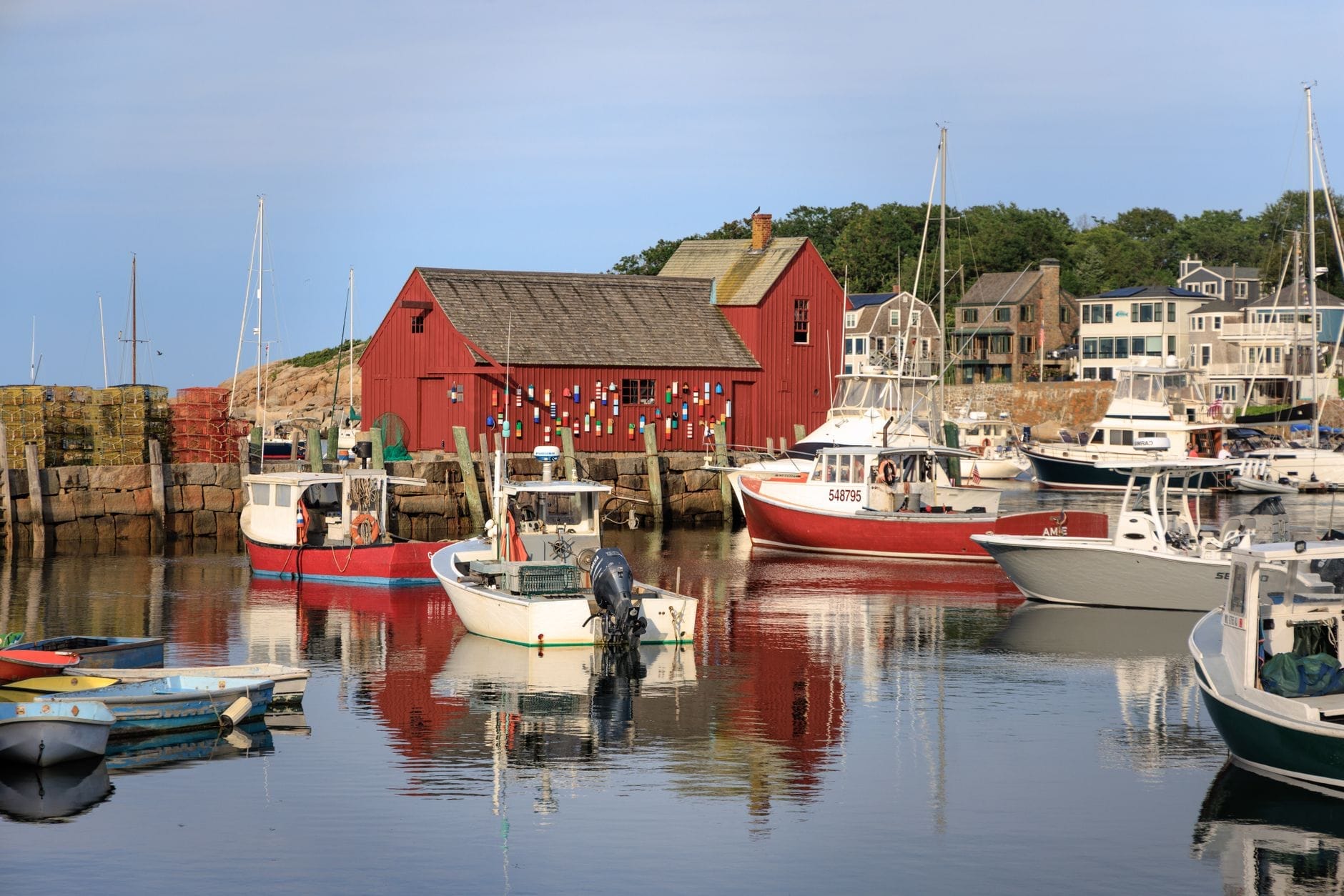
Rockport Harbor is a working coastal harbor set within Sandy Bay on the northeastern tip of Cape Ann in Essex County, Massachusetts. It is not a park, not a ticketed attraction, and not a marina in the polished resort sense. It is a active harbor where lobster boats and charter fishing vessels tie up alongside recreational sailboats, and where the smell of salt water and low-tide seaweed is part of the experience. The harbor is framed by Bearskin Neck to the north, a narrow granite-cobble peninsula lined with former fishing shacks that now house studios, galleries, and small restaurants, and by Norwoods Head to the south.
The harbor's two breakwaters have defined its shape since the late 19th and early 20th centuries, when major U.S. Army Corps of Engineers projects constructed and later raised them to protect vessels in Sandy Bay. The northern breakwater at Bearskin Neck runs about 900 feet into the bay; the southern one at Norwoods Head is around 200 feet long, and both remain federal navigation infrastructure today.
ℹ️ Good to know
The harbor is open to the public with no admission fee. Harbormaster-managed seasonal infrastructure, including floating docks, is generally in the water from May through mid-October. Outside that window the harbor is still fully visible and walkable, just quieter.
Getting Here from Boston
The easiest way to reach Rockport from Boston without a car is the MBTA Newburyport/Rockport Line commuter rail, departing from North Station. The ride takes roughly one hour depending on the service, and Rockport is the terminal stop, so there is no risk of missing it. From Rockport station, the harbor and Bearskin Neck are a short flat walk downhill. Trains run multiple times daily but the schedule thins considerably in the evening, so check departure times before you go or you may be waiting considerably longer than planned.
If you are driving, take I-95/MA-128 north toward Gloucester, then follow MA-127 north into Rockport town center. Parking in summer is limited and the streets around the harbor are narrow. Arriving by train in July or August is not just convenient, it is practically the better choice. For more on getting around the greater Boston area, the getting around Boston guide covers commuter rail logistics in useful detail.
⚠️ What to skip
Summer weekend parking near the harbor fills up fast, often before 10am. If you drive, consider parking at the MBTA lot near Rockport station and walking down rather than circling for harborside spaces.
Tickets & tours
Hand-picked options from our booking partner. Prices are indicative; availability and final rates are confirmed when you complete your booking.
Boston Harbor Historic Sightseeing Cruise
From 38 €Instant confirmationScenic Cape Ann Self-Driving Audio Tour in Gloucester and Rockport
From 14 €Instant confirmationFree cancellationHarborwalk and tea party self-guided audio tour in Boston
From 7 €Instant confirmationFree cancellationGuided tour of Boston revolutionary sites with harbour cruise
From 144 €Instant confirmationFree cancellation
The Experience: Time of Day and Season
Early morning at Rockport Harbor is categorically different from midday. Before 9am, the light comes in low and golden off Sandy Bay, the lobster boats are moving, and you can hear halyards tapping against aluminum masts across the harbor. The smell is sharper, salt and diesel and something faintly fishy that dissipates as the day warms. This is the version of the harbor that has made it one of the most painted and photographed places on the North Shore for well over a century.
By late morning in summer, Bearskin Neck fills with day visitors. The galleries and shops open, the café lines form, and the character shifts from working waterfront to a pleasant but considerably busier coastal destination. The views do not diminish, but the contemplative quality does. On weekday mornings outside of July and August, you can have most of the breakwater to yourself.
Fall is arguably the most rewarding season. September and October bring cooler air, lower humidity, and intense light. The summer crowds have thinned but most businesses remain open through Columbus Day weekend. Winter visits are possible and the harbor takes on a spare, unadorned quality, but some Bearskin Neck shops close from November through April, and the commuter rail schedule reduces further.
Rockport fits naturally into a broader exploration of the North Shore coast. If you are planning a day trip from the city, the day trips from Boston guide puts Rockport alongside other coastal and historical options worth considering.
Walking the Harbor: A Practical Route
Start at Dock Square, the small open area at the top of Bearskin Neck where the peninsula begins. From here you get an orienting view of the full harbor layout. Walk out along Bearskin Neck itself, a narrow strip barely wide enough for two people to pass comfortably side by side. The pavement is uneven in places, with granite curbing and wooden planks over low sections. Wear flat, rubber-soled shoes.
At the end of Bearskin Neck, the northern breakwater extends roughly 900 feet into Sandy Bay. On calm days it is walkable for much of its length, though the surface is rough granite blocks with gaps and no railing. The view back toward the harbor from the breakwater tip, with the white wooden Motif No. 1 fishing shack in the foreground and the Cape Ann hills behind, is the composition that made Rockport famous among American plein air painters in the early 20th century.
Plan at least 90 minutes for the full Bearskin Neck circuit and breakwater walk. If you are also browsing galleries or stopping for lunch, budget closer to three hours. The southern side of the harbor near Norwoods Head is quieter and worth a look for anyone who wants to see working boat infrastructure with fewer other visitors around.
💡 Local tip
The breakwater walk is not recommended in wet or windy conditions. The granite blocks are slippery when damp, and there is no railing for the full length. Check the forecast before planning to walk to the end.
Photography at Rockport Harbor
The harbor has been depicted in paintings and photographs for so long that there is a near-mythological structure to the ideal composition: Motif No. 1 in the left third of the frame, lobster traps stacked nearby, the breakwater curving into the bay, and some cloud interest in the upper right. That image is real and achievable, but it requires either early morning light or a willingness to work around the summer crowd.
For something less postcard-predictable, look at the harbor from the southern approach near T-Wharf, where the working boat moorings and gear create a denser, more textured foreground. The blue and white lobster buoys hanging from the sheds on Bearskin Neck also make for close-up detail shots that capture the working character of the place more honestly than the wide-angle panorama.
Golden hour in September or October, when the foliage on the hillside behind town starts to turn and the boat traffic is lighter, produces consistently strong results with very ordinary camera equipment. A polarizing filter helps reduce surface glare on the water between 10am and 2pm.
Rockport in Context: Art Colony and Working Harbor
Rockport developed as an artists' colony in the early 20th century, attracting painters drawn to the quality of light on Cape Ann and the picturesque character of a harbor that had not yet been commercialized. The Rockport Art Association, still active today, was founded in 1921. Motif No. 1, the red fishing shack on Bradley Wharf that appears in countless paintings, earned its nickname from the claim that it was the single most painted building in the United States. The current structure is a 1978 reconstruction of the original, which was destroyed in the Blizzard of 1978.
The town is also technically dry, meaning the sale of alcohol has historically been restricted in Rockport proper, though restaurant licensing has evolved in recent years. Check current rules locally if this matters to your visit. For those interested in connecting the Cape Ann stop with a broader historical itinerary, the Boston history guide provides regional context that extends well beyond the city limits.
The harbor itself sits within a broader ecosystem of the Gulf of Maine, and the rocky shoreline at the harbor edges supports tidal pools with periwinkles, barnacles, and green crabs visible at low tide. Kids with any interest in marine life will find the exposed rock shelves on the outer breakwater and the south side of the harbor more interesting than they expect.
Who Should Reconsider This Trip
Rockport Harbor rewards slow, attentive visitors. If your priority is a full-day itinerary packed with museums, dining options, or nightlife, Rockport is probably too small and too quiet to hold that kind of attention, and the limited evening train service makes a late-night return to Boston impractical. The town is small: Bearskin Neck takes about 10 minutes to walk end-to-end without stopping.
Visitors with significant mobility challenges should also check directly with the Town of Rockport Harbormaster's office before making the trip, as specific ADA-compliant pathway documentation for harbor walkways and breakwater access is not widely published. The breakwater itself is unsuitable for wheelchairs or strollers given the rough granite surface.
Insider Tips
- The last commuter rail departure back to Boston in the evening can be surprisingly early, especially on weekends outside peak season. Screenshot your return train time before you lose cell signal near the outer breakwater.
- The harbor floats and dinghy docks are active from May to mid-October. If you are visiting to watch boat activity, late May or early June gives you the full working harbor scene with a fraction of summer's visitor traffic.
- For the classic Motif No. 1 painting composition, position yourself at the end of T-Wharf or near the inner breakwater on the Bearskin Neck side at low tide, around 7 to 8am. You will have the shot nearly to yourself.
- Rockport's downtown galleries are concentrated on Main Street and Bearskin Neck. The Rockport Art Association gallery on Main Street shows rotating exhibitions and is worth 20 minutes if you want context for why painters kept coming back here.
- There is almost no cell coverage on the outer breakwater. Download the MBTA commuter rail schedule and any maps before you leave town.
Who Is Rockport Harbor For?
- Day-trippers from Boston looking for coastal scenery without driving to Cape Cod
- Landscape and street photographers, especially in early morning or fall light
- Families with children interested in tidal pools and working boats
- Travelers who want to combine art galleries with an outdoor waterfront walk
- Anyone making a multi-stop North Shore day using the MBTA commuter rail
Nearby Attractions
Combine your visit with:
- Arnold Arboretum
Founded in 1872, the Arnold Arboretum is the oldest public arboretum in North America — a free, 281-acre landscape in Jamaica Plain managed by Harvard University. With over 15,000 accessioned plants and sweeping hillside views, it draws botanists, dog walkers, and curious visitors in equal measure across all four seasons.
- Blue Hills Reservation
Ten miles south of downtown Boston, Blue Hills Reservation spreads across more than 7,000 acres of forested hills, rocky ridgelines, and glacial wetlands. Free to enter and open year-round from dawn to dusk, it offers 125 miles of trails ranging from easy pond-side loops to a genuine summit climb at 635-foot Great Blue Hill.
- Boston Duck Tours
Boston Duck Tours puts you aboard a replica World War II DUKW amphibious vehicle for an 80-minute circuit of the city's most historic landmarks, finishing with a splash into the Charles River. Running seasonally from late March through late November, it's one of the few tours in Boston that covers both street-level sights and a Charles River perspective in a single trip.
- Boston Harbor Islands
Boston Harbor Islands National and State Park puts 34 islands and peninsulas within easy ferry reach of downtown Boston. From Civil War earthworks on Georges Island to the oldest lighthouse station in the United States on Little Brewster, the park rewards visitors who are willing to trade the city's brick sidewalks for salt air and open water.