Putra Mosque: Putrajaya's Pink Granite Icon
Rising at the edge of Putrajaya Lake, Putra Mosque is Malaysia's most photographed place of worship. Its rose-tinted granite facade, Persian-influenced dome, and vast marble courtyard make it a striking architectural landmark — and an active, working mosque open to respectful visitors.
Quick Facts
- Location
- Persiaran Perdana, Presint 1, Putrajaya, Malaysia
- Getting There
- Putrajaya & Cyberjaya station (KCIA Ekspres), then taxi or Grab
- Time Needed
- 45 minutes to 1.5 hours
- Cost
- Free entry (non-Muslim visitors, robe rental may apply)
- Best for
- Architecture lovers, photography, cultural and religious interest
What Is Putra Mosque?
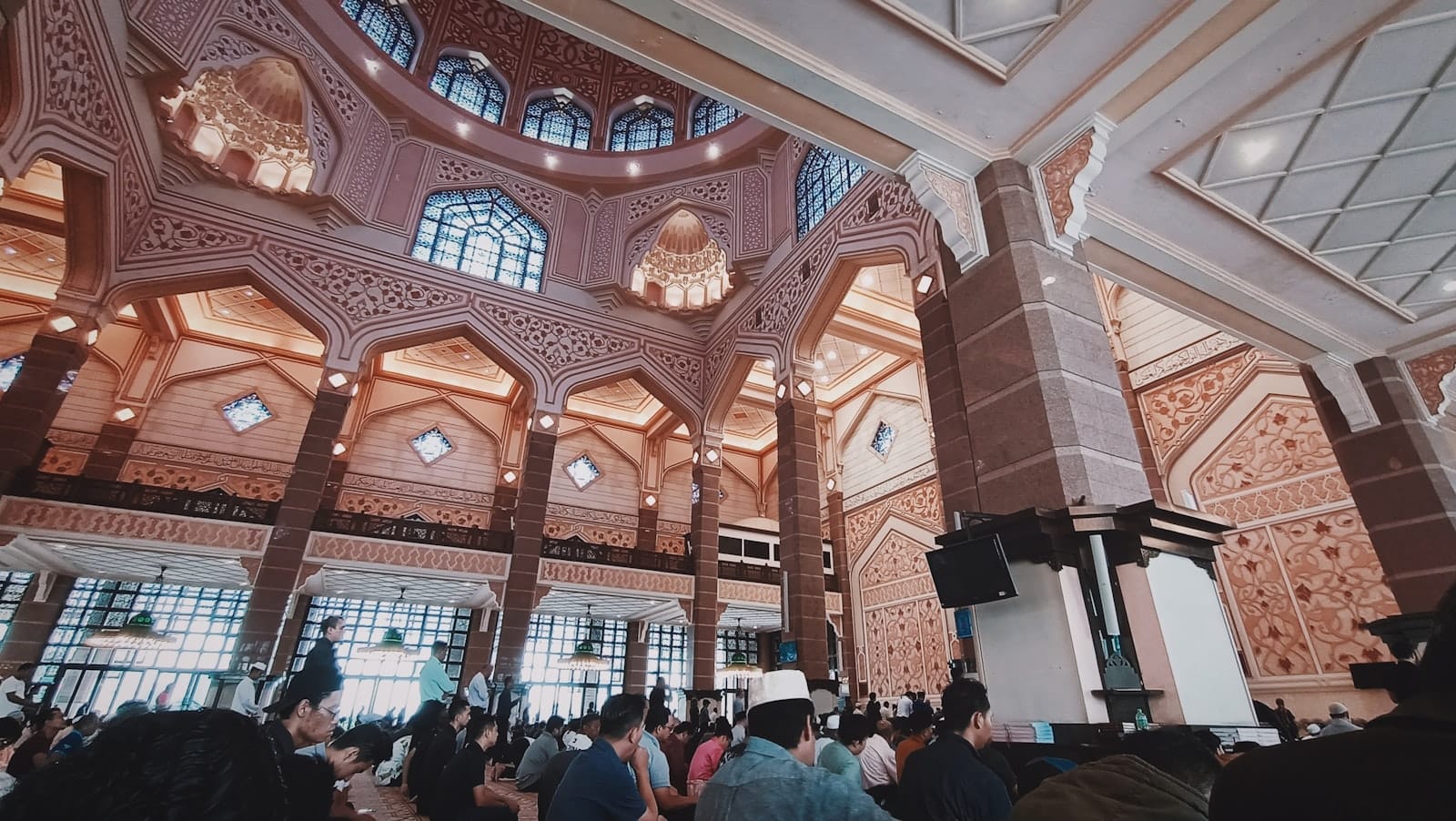
Putra Mosque, or Masjid Putra in Malay, is the principal mosque of Malaysia's federal administrative capital, Putrajaya. Completed in September 1999, it was built as a centerpiece of the city's grand master plan, designed to reflect the aspirations of a modern Islamic nation without abandoning classical architectural heritage. It seats up to 15,000 worshippers and functions as an active place of congregational prayer, making it both a living religious site and one of the country's most compelling architectural statements.
The mosque's most distinctive feature is its exterior cladding of pink granite sourced from the southern Indian state of Rajasthan. Under direct sunlight, the stone takes on a warm, almost copper tone. In the softer light of early morning or late afternoon, it shifts to a deeper rose. This quality is what has made the building an obsession for architectural photographers across Southeast Asia.
💡 Local tip
Visit between 9:00 AM and 6:00 PM for the best light and the fewest visitors. The mosque faces east toward Putrajaya Lake, so morning sun hits the facade directly and the water catches its reflection.
Architecture and Design: A Closer Look
The design draws primarily from Persian and Malay architectural traditions. The main dome, is a ribbed structure modelled after the Imam Mosque in Isfahan, Iran. Five smaller domes flank it, corresponding to the five pillars of Islam, a detail that is subtle but intentional. The minaret, which stands at 116 metres and is detached slightly from the main prayer hall, takes its proportional cues from traditional Malay mosque towers while incorporating ornate Arabic calligraphic bands near the crown.
The interior of the main prayer hall, accessible to non-Muslim visitors outside of prayer times, is finished in pale marble with hand-carved plasterwork panels. Stained glass in muted amber and green filters light across the floor during midday hours. The overall effect is one of measured calm rather than theatrical grandeur, which distinguishes it from more overtly decorative mosques in the region.
The courtyard is equally worth your attention. Its vast expanse of polished marble, cooled by the lake breeze, draws small groups of local visitors throughout the day. The colonnaded walkway that borders the courtyard casts sharp geometric shadows by midmorning, making it a compelling space for photography even when the mosque interior is closed to visitors during prayer.
For broader architectural context in Kuala Lumpur and Putrajaya, the National Mosque in the city centre offers a useful point of comparison: it represents Malaysia's 1960s modernist approach to mosque design, while Putra Mosque shows the shift toward historical Islamic reference that defined the 1990s Putrajaya project.
Tickets & tours
Hand-picked options from our booking partner. Prices are indicative; availability and final rates are confirmed when you complete your booking.
Private day trip to Putrajaya, KL City, Batu Caves and fireflies tour
From 109 €Instant confirmationFree cancellationPrivate half-day Putrajaya tour
From 74 €Instant confirmationFree cancellationGrand Kuala Lumpur and Batu Caves with Putrajaya Combo tour
From 73 €Instant confirmationFree cancellationPetronas Twin Towers and Kuala Lumpur Tower observation deck tickets
From 34 €
How the Experience Changes Through the Day
Early morning, before 9:00 AM, is when Putra Mosque earns its reputation. The crowds are thin, the light is golden, and the lake surface is often still enough to throw back a clean mirror image of the dome and minaret. Local worshippers arrive for Fajr prayer before sunrise and mostly depart by 6:30 AM, leaving the courtyard briefly quiet. By 8:00 AM, a handful of local families and the first tour groups begin to arrive.
Midday, particularly between 12:00 PM and 2:00 PM on Fridays, is the busiest period. Friday congregational prayer draws thousands of worshippers, and non-Muslim visitors are not permitted inside during this time. The main road alongside the mosque is also heavily congested on Friday lunchtimes. If your visit coincides with a Friday, arrive by 10:00 AM or plan to return after 2:30 PM.
Late afternoon, from around 4:30 PM onward, brings a different quality of light. The sun moves to the west, illuminating the lake and giving the granite facade a warmer, more saturated hue. Cruise boats on Putrajaya Lake begin operating during this window, and it is possible to view the mosque from the water on a short lake cruise, a perspective that significantly changes how you read the building's proportions.
⚠️ What to skip
The mosque is closed to non-Muslim visitors during all five daily prayer times: Fajr (before sunrise), Dhuhr (midday), Asr (mid-afternoon), Maghrib (sunset), and Isha (night). Each closure lasts approximately 30-45 minutes. Check local prayer times on the day of your visit, as they shift by several minutes each week.
Visiting as a Non-Muslim: What to Expect
Non-Muslim visitors are welcomed at Putra Mosque, provided dress code requirements are observed. For women, this means covering the hair, arms, and legs fully. For men, shorts are not permitted. Robes and headscarves are available at the entrance for visitors who arrive without appropriate clothing, typically at no charge, though a small deposit may be requested. Shoes are removed before entering the prayer hall.
A guide is usually available at the visitor entrance to offer a brief orientation. The guided portion of the visit typically covers the function of the main prayer hall, the significance of the architectural elements, and basic Islamic practices. It takes around 20 minutes and is offered at no extra cost. While the guide is not mandatory, first-time visitors to a mosque will find it useful for understanding what they are looking at and what behavior is appropriate inside.
Photography is permitted in most areas of the mosque and courtyard. Flash photography inside the prayer hall should be avoided out of respect for worshippers. Drone photography over the mosque grounds is restricted and requires advance permission from mosque management.
ℹ️ Good to know
There is a designated non-Muslim visitor entrance, separate from the main worshipper entrance. Follow signage from the car park to the visitor reception area, which is located on the north side of the complex.
Getting There: Practical Transit Guide
Putrajaya is not served by the Kuala Lumpur Rapid Transit (LRT or MRT) network. The nearest rail connection is Putrajaya & Cyberjaya station on the KLIA Transit line, which runs between KL Sentral and Kuala Lumpur International Airport. From this station, the mosque is approximately 10 kilometres by road, and the only practical options are Grab, a metered taxi, or the Nadi Putra bus service that operates within Putrajaya.
Most visitors combine Putra Mosque with a broader half-day or full-day excursion to the administrative district. The Perdana Putra complex (the Prime Minister's office) is a 10-minute walk along the lakefront, and the Putrajaya Botanical Garden is reachable by a short taxi ride. Planning these together makes the transit cost worthwhile.
If you are organizing the Putrajaya trip from Kuala Lumpur, the practical logistics and recommended itinerary are covered in detail in this day trip guide from Kuala Lumpur.
Photography Tips and Best Angles
The most reproduced angle of Putra Mosque is taken from the bridge that spans the northern end of Putrajaya Lake, looking south toward the mosque with the dome and minaret framed by water on both sides. This view works best in the morning when the sun is behind the photographer. A telephoto lens at around 70-100mm compresses the perspective and fills the frame with the dome.
Inside the courtyard, the colonnaded walkway offers strong compositional geometry: the repeating arches lead the eye toward the minaret. This works at virtually any time of day, though harsh midday light creates unflattering flat shadows in the arch recesses. Overcast days, while less dramatic for exterior shots, are actually preferable for interior and courtyard photography where even light reduces contrast problems.
If you are on the lake cruise, the telephoto setting on a smartphone (3x or 5x optical) gives you enough reach to isolate the dome against the sky. The cruise typically runs a loop that brings the boat within 200-300 metres of the mosque's water-facing facade.
Who Will Enjoy This, and Who Might Not
Putra Mosque rewards visitors with a genuine interest in Islamic architecture, Malaysian political history, or urban planning at scale. Putrajaya itself is a purpose-built capital, completed in stages from the late 1990s, and the mosque is its symbolic anchor. Understanding this context adds considerable depth to what might otherwise feel like a distant suburban detour.
Visitors traveling primarily for street food, night markets, or compact city-center exploration may find the trip to Putrajaya less rewarding unless they pair it with the broader Putrajaya experience. The district has no walkable commercial area, no street food culture to speak of, and limited shade between monuments on hot afternoons. If your itinerary is tight, you need at least half a day to justify the transit time from central Kuala Lumpur.
For travelers who want religious and architectural sites closer to the city center, Masjid Jamek at the confluence of the Klang and Gombak rivers is a 19th-century Moorish mosque in a dramatically different urban setting, and is accessible directly from the LRT network.
Insider Tips
- Request the guided tour at the visitor reception even if you think you don't need it. Guides often point out calligraphic inscriptions and structural details that most visitors walk past without noticing.
- The small pontoon area at the base of the mosque's lakeside terrace occasionally has paddleboats or small cruise boarding points. Ask at the mosque reception whether lake cruises are running on the day of your visit — schedules are irregular.
- If you visit on a public holiday or during Ramadan, expect significantly larger crowds but also a more atmospheric experience. The mosque is decorated with additional lighting during Ramadan evenings, and the late-night atmosphere after Tarawih prayer is unlike anything you'll see at a typical tourist visit.
- Bring water and a hat. The marble courtyard reflects heat intensely between 11:00 AM and 3:00 PM, and there is limited shade outside the colonnaded walkway. A 500ml bottle will not be enough on a hot day.
- The view from the Putra Bridge looking toward the mosque is often better than the view from the mosque grounds themselves. Walk the full length of the bridge before entering the complex to get your bearings and your establishing shots.
Who Is Putra Mosque For?
- Architecture and design enthusiasts interested in contemporary Islamic building traditions
- Photographers working with landmark structures and reflective water compositions
- Travelers curious about Malaysia's modern political identity and planned-city urbanism
- Families looking for a calm, visually distinctive half-day excursion outside the city center
- Visitors wanting to combine religious cultural exposure with an open-air lakeside walk
Nearby Attractions
Other things to see while in Putrajaya:
- Perdana Putra
Perdana Putra is the official office complex of Malaysia's Prime Minister, rising above Putrajaya Lake in a striking blend of Moorish, Islamic, and Malay architectural styles. While the interior is not open to the general public, the building's exterior and surrounding grounds draw visitors for its architectural drama, lakeside position, and symbolic role at the heart of Malaysia's purpose-built federal capital.
- Putrajaya Botanical Garden
Spanning 92 hectares at the heart of Malaysia's planned federal capital, Putrajaya Botanical Garden is the country's most ambitious horticultural project. With dozens of themed plant collections, lakeside walkways, and a climate that keeps things green year-round, it offers a genuinely different perspective on Putrajaya beyond its mosques and government towers.
- Putrajaya Lake
Putrajaya Lake is a 650-hectare man-made reservoir built as the centrepiece of Malaysia's federal administrative capital. Ringed by grand government buildings, mosques, and ornate bridges, it offers boat tours, cycling paths, and some of the most photogenic skylines in the country.