Pak Tai Temple (Taipa): Macau's Ancient Sea God Shrine in the Heart of the Village
Standing at Largo Camões since around 1843, Pak Tai Temple is one of Taipa's oldest places of worship, dedicated to the Taoist deity Pak Tai (the God of the North). Free to enter, easy to reach by bus, and surrounded by some of Taipa Village's best street food and colonial architecture, it rewards visitors who take time to look beyond the obvious.
Quick Facts
- Location
- Largo Camões, Taipa Village, Macao
- Getting There
- Buses 11, 15, 22, 28A, 30, 33, 34 to Taipa Old Village
- Time Needed
- 20–40 minutes (allow longer during festivals)
- Cost
- Free admission
- Best for
- History seekers, cultural explorers, photography, temple architecture
- Official website
- www.taipavillagemacau.com/directory/pak-tai-temple
What Is Pak Tai Temple?
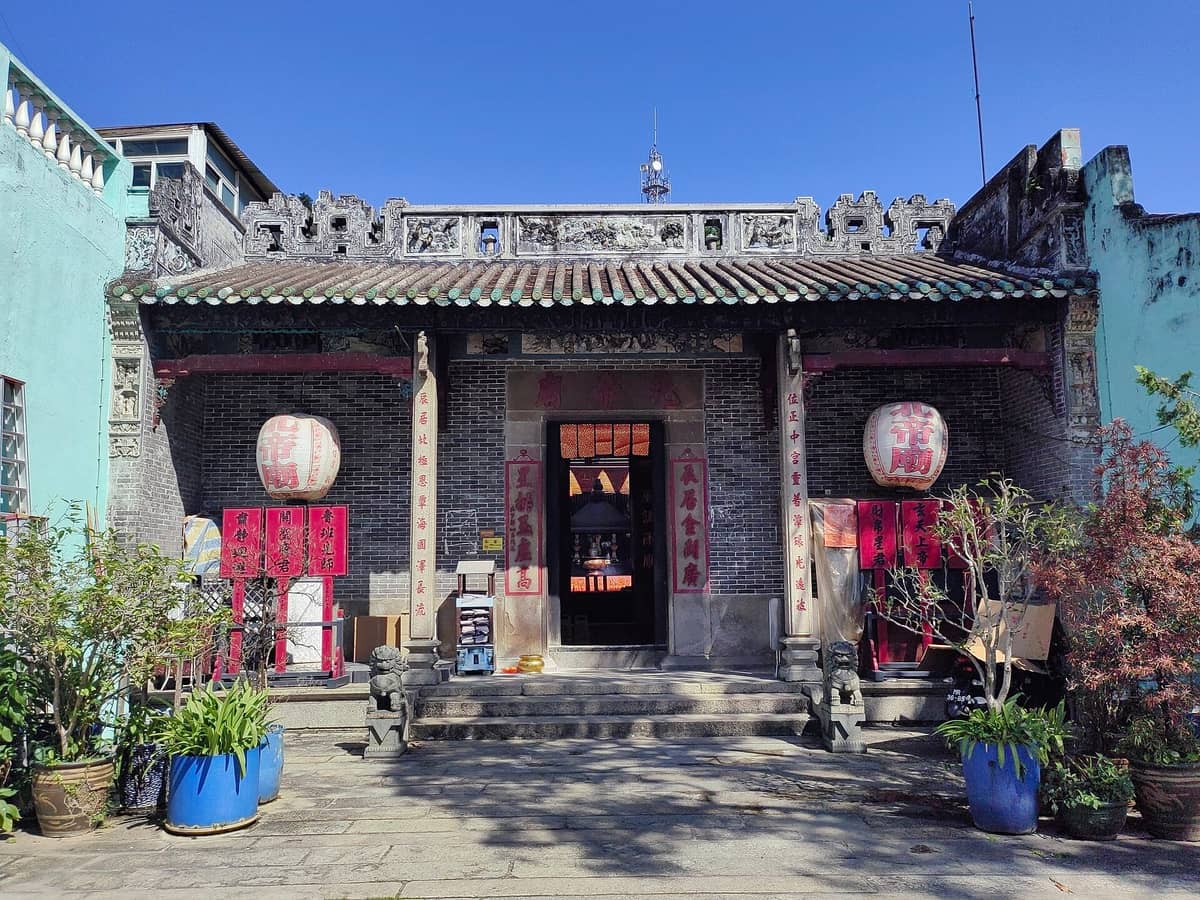
Pak Tai Temple (北帝廟, Pak Tai Miu) sits at Largo Camões in Taipa Village, occupying one of the most characterful corners of a neighborhood that already rewards slow walkers. Built around 1844 during the 23rd year of the Daoguang reign of the Qing Dynasty, it is one of the oldest temples on Taipa island and one of the principal temples in Macau dedicated to Pak Tai, the Taoist deity of the north, venerated across coastal southern China as a protector of seafarers and a controller of water.
The temple is compact by the standards of major Chinese religious monuments, but what it lacks in scale it compensates for in atmosphere and historical layering. The incense smoke clings to the ornamental roof beams, devotees arrive throughout the morning to light offerings at the main altar, and the carved stone facade catches the late afternoon sun in a way that makes the gilded details glow. For a traveler moving through Taipa Village on foot, the temple arrives as a natural pause point rather than a detour.
ℹ️ Good to know
Opening hours are listed as 08:30–17:00 by the official Taipa Village directory. Verify locally before visiting, especially if you plan to arrive at opening or closing time.
The Deity and the Cultural Significance
Pak Tai (also transliterated as Pei Ti or Hei Di, meaning 'Northern King' or 'Emperor of the North') holds an important place in the Taoist pantheon across Guangdong and Hong Kong. He is associated with the element water and with the protection of fishermen and coastal communities. For Taipa's historically fishing-based population, his veneration was not incidental but central to community life in the nineteenth century. The temple's placement near what would have been the village's social heart reflects this.
The annual Feast of Pak Tai, observed on the third day of the third lunar month, draws local worshippers and curious visitors alike. During this period the square in front of the temple fills with incense smoke, ceremonial offerings, and traditional lion dance performances. If your visit coincides with the festival calendar, the atmosphere shifts from quiet reverence to communal celebration. The noise, the color, and the compressed crowd are worth experiencing once, but the temple is equally interesting outside festival season when you can read the interior details without distraction.
Pak Tai Temple's significance sits within a broader tradition of Taoist and Buddhist temple-keeping across Macau's islands. For context on how this fits into the wider religious landscape of the territory, the Macau temples guide offers a useful comparison of the major shrines across the peninsula and islands.
What You See Inside and Outside
The temple's exterior is a clear statement of Qing-era Cantonese religious architecture: a symmetrical facade with decorative ceramic figurines running along the roof ridge, ceramic flowers and dragons pressed into the eave details, and carved stone panels flanking the entrance. The craftsmanship is restrained but precise. Look closely at the ridge line and you will find miniature scenes of classical Chinese mythology rendered in brightly glazed ceramic, a technique called shiwan pottery that was common in high-quality Guangdong temple construction.
Inside, the main hall is arranged around a central altar where the statue of Pak Tai presides. He is typically depicted in warrior form, armored and seated on a throne. Flanking altars honor secondary deities. Large coiled incense spirals hang overhead from the ceiling, burning slowly over days or weeks, dropping ash on protective metal cups below. The air is thick with sandalwood and the low sound of recorded chanting or devotional music. Brass offering bowls, red candles, and fresh fruit arrangements signal active, daily use.
Photographers will find the most visually striking angles in the interior when natural light filters in through the entrance during morning hours, illuminating the incense smoke against the darker altar backdrop. Midday light is flatter and less interesting. If you are visiting purely for architecture and photography, aim for the hour after opening.
💡 Local tip
Photography is generally tolerated inside the temple, but be discreet when worshippers are actively praying. Lower your camera when someone approaches the main altar, and avoid using flash near ceremonial objects.
How the Temple Changes by Time of Day
Early mornings, especially on weekdays, bring the most concentrated devotional activity. Local worshippers arrive before 10:00 to burn paper offerings and incense, pray at the altar, and leave quickly. The temple at this hour is genuinely busy in a purposeful, non-tourist way. The smoke is denser, the sounds are more layered, and the contrast between the quiet residential lanes outside and the activity inside is striking.
By midday the tempo slows noticeably. A few visitors may pass through, but the worshipper flow diminishes. This is the best window for unhurried observation of the architectural detail. Afternoons bring a mild uptick again as local residents pass by on their way through the village square. By late afternoon the light on the exterior facade becomes warm and directional, good for exterior photographs.
The square in front of the temple, Largo Camões, functions as a social space throughout the day. Elderly residents play cards, children cut through on their way home from school, and food vendors operate nearby. The temple is best understood as part of this square rather than as a standalone monument. Sitting in the square for twenty minutes before entering gives you a sense of how the building operates within the neighborhood.
Getting There and Getting Around
Pak Tai Temple is reachable from the Macau Peninsula by a range of public buses. Routes 11, 15, 22, 28A, 30, 33, and 34 all serve the Taipa Old Village area. Alight near the Museum of Taipa and Coloane History and walk toward Rua do Meio into the village core. The temple at Largo Camões is a short walk from there, and the lanes themselves are worth exploring.
The Macau Light Rapid Transit (Taipa Line) also serves the Taipa island area, with connections to Cotai and the airport. From LRT stations, a short taxi or bus ride completes the journey to the village. If you are visiting from the Cotai Strip resorts, the same bus options apply. For a full orientation to getting around Taipa and the rest of Macau, the getting around Macau guide covers public transit, taxis, and casino shuttles in practical detail.
The temple is reached through the pedestrian lanes of Taipa Village, which are narrow and uneven in places. There is no verified information about step-free access, ramps, or wheelchair facilities. Visitors with significant mobility constraints should contact the Macau Government Tourism Office in advance or check locally.
💡 Local tip
Comfortable flat shoes matter here. The lanes of Taipa Village are paved with small stones and can be slippery when wet. Skip sandals if rain is forecast.
The Surrounding Area: Taipa Village Context
The temple sits inside one of Macau's most coherent historic neighborhoods. Taipa Village (Avenida de Cinco de Outubro and the lanes branching off it) is lined with Portuguese-era two-story shophouses painted in pastel yellows and greens, family-run restaurants serving pork chop buns and peanut ice cream rolls, and small shops selling dried goods, incense, and religious paraphernalia. The density of atmosphere here is higher than in many of Macau's more visited spots on the peninsula.
For context on the broader neighborhood, the Taipa Village overview covers the key streets, food stops, and walking routes. The Taipa Houses Museum is a short walk away and offers structured insight into how Portuguese colonial families and wealthy Macanese lived on the island in the early twentieth century. Combining both in a single morning walk is straightforward and worthwhile.
The contrast between Pak Tai Temple and the Cotai Strip resorts a short bus ride away is worth noting. Within fifteen minutes of leaving the temple's incense-filled interior you can be standing in the lobby of a mega-casino resort. That juxtaposition is, in many ways, what makes Macau genuinely interesting as a travel destination. The temple is not a relic left behind by development but an active place of worship maintained by a local community that exists alongside and independent of the gaming economy.
If you are spending a full day in the area, Macau's heritage walk routes include several stops across the peninsula that pair well with a morning in Taipa Village before crossing back by bus in the afternoon.
Who This Is For and Who Might Skip It
Pak Tai Temple is a genuinely interesting site for travelers who care about religious architecture, local social life, or the texture of Chinese community culture in a Portuguese-influenced setting. The building is historically significant, the setting is atmospheric, and the entry cost is zero. These facts together make it an easy recommendation to include in a Taipa Village walk.
It is not, however, a monument that demands its own dedicated trip across the city. If you are not already planning to spend time in Taipa Village for other reasons, the temple alone would not justify a standalone journey. Treat it as an anchor point within a broader neighborhood exploration rather than a destination in isolation.
Travelers who have already visited major Taoist and Buddhist temples in Hong Kong, Guangzhou, or elsewhere in Macau may find the scale modest by comparison. The A-Ma Temple on the peninsula, for instance, is larger and arguably more dramatic in setting. But Pak Tai Temple in Taipa has a quieter, more neighborhood-embedded quality that some visitors will actually prefer.
Insider Tips
- Visit on a weekday morning between 08:30 and 10:00 to see genuine devotional activity, not tourist-oriented ritual. The temple is most alive before the village fills with visitors.
- Stand at the back of Largo Camões square and look toward the temple facade in the late afternoon, around 16:00. The light hits the ceramic roof decorations at an angle that makes them visually distinct from any other time of day.
- The Feast of Pak Tai on the third day of the third lunar month is the best single date to visit, but book nearby restaurants early. Taipa Village fills up quickly during festival periods.
- The narrow lane directly to the left of the temple entrance leads to a small cluster of local incense and offering shops. Watching vendors prepare ceremonial goods is itself a window into active religious practice.
- Combine the temple visit with a stop at Rua do Cunha, Taipa Village's main food street, a five-minute walk away. The pork chop bun shops there open early and the queues are manageable before noon.
Who Is Pak Tai Temple (Taipa) For?
- Travelers interested in Taoist religious practice and Chinese temple architecture
- First-time visitors to Macau who want to balance casino sightseeing with genuine local culture
- Photographers looking for atmospheric interiors with incense smoke and natural light
- Anyone doing a Taipa Village walking itinerary who wants a meaningful anchor point
- Budget travelers: free entry, easily reached by public bus, no minimum spend required
Nearby Attractions
Other things to see while in Taipa Village:
- Iec Long Firecracker Factory Heritage Site
The Iec Long Firecracker Factory Heritage Site in Taipa preserves one of Macau's most unusual industrial chapters. A free wooden walkway winds through crumbling cannon rooms, waterways, and warehouses where firecrackers were once manufactured at scale, with an on-site exhibition bringing the story to life.
- Taipa Houses-Museum
The Taipa Houses-Museum is a complex of five pale-green Portuguese colonial villas built in 1921 along the Taipa waterfront. Free to enter and rarely overcrowded, it offers one of Macau's most intimate looks at the domestic life, architecture, and cultural overlap that defined the territory before the casino era reshaped everything.