Iec Long Firecracker Factory Heritage Site: Taipa's Forgotten Industrial Past
The Iec Long Firecracker Factory Heritage Site in Taipa preserves one of Macau's most unusual industrial chapters. A free wooden walkway winds through crumbling cannon rooms, waterways, and warehouses where firecrackers were once manufactured at scale, with an on-site exhibition bringing the story to life.
Quick Facts
- Location
- Rua de Fernão Mendes Pinto, Taipa, Macau (enter via Chun Su Mei car park)
- Getting There
- Bus MT4 from Border Gate to Taipa Yin King Garden stop, then approx. 5-min walk to the Chun Su Mei car park entrance
- Time Needed
- 45–90 minutes
- Cost
- Free admission (walkway, exhibition hall, and souvenir shop)
- Best for
- History enthusiasts, photographers, and visitors wanting a quiet break from Taipa Village
- Official website
- www.icm.gov.mo/en/ieclong
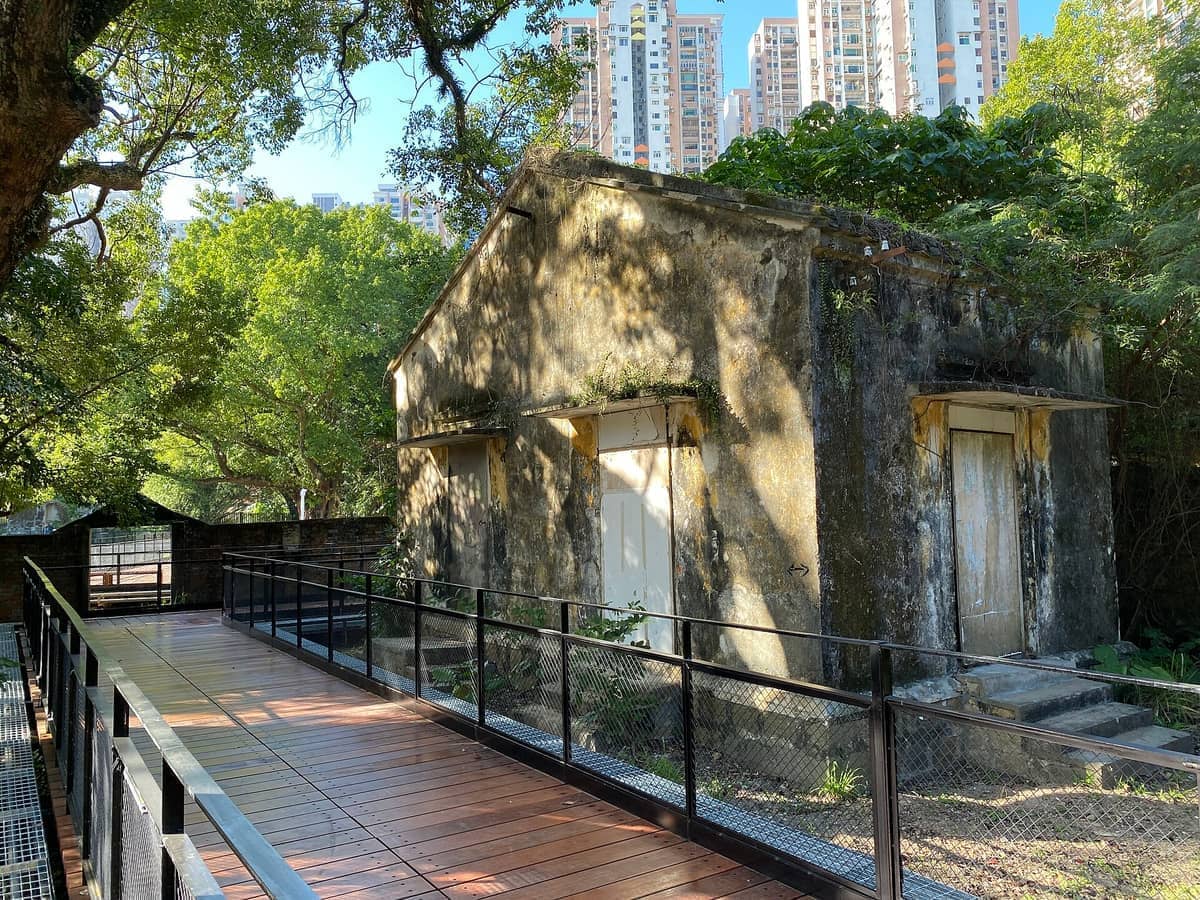
What Is the Iec Long Firecracker Factory?
The Iec Long Firecracker Factory Heritage Site (益隆炮竹廠) sits on Rua de Fernão Mendes Pinto in Taipa, a short walk from the cobblestone lanes of Taipa Village. For most of the twentieth century, this complex was one of the key firecracker manufacturing operations in Macau, a territory that once supplied firecrackers across Asia and to Chinese diaspora communities worldwide. The factory closed, as most of its kind did, when industrial economics shifted and safety regulations tightened. What remains is an unusually complete industrial ruin: cannon rooms, pulp introduction areas, waterways, a pond, and warehouses — all now preserved under the management of Macau's Cultural Affairs Bureau.
It was reopened to the public as a free heritage attraction and is one of the few places in Macau where you can read an entire industrial story in brick, water, and wood without paying a single pataca. The site does not try to recreate its past artificially. The peeling walls and aging timber are part of the experience.
ℹ️ Good to know
Opening hours: Walkway and grounds open 06:00–19:00 daily. Exhibition hall and souvenir shop open 10:00–19:00 daily. On Wednesdays, all facilities close at 15:00 and remain closed for the rest of the day. A maximum of 200 visitors is permitted on site at any one time.
Walking the Factory Grounds
Access to the site runs through a wooden walkway roughly 400 metres long. The path is well-maintained and loops through the key production zones of the old factory, passing structures that would have been loud, chemical-scented, and intensely busy during peak operation. Today the dominant sounds are birds and the occasional plane making its approach to Macau International Airport a few kilometres away.
The cannon rooms (the chambers where firecrackers were assembled and dried) are the most atmospheric stops. The walls carry a texture of time rather than polish: exposed brick, weathered plaster, and in some areas the dark residue of decades of compressed powder work. Interpretation panels are placed at regular intervals and explain each zone's role in the production chain, from raw pulp preparation through to the warehouse stages where finished product was stored before shipment.
The central pond and waterway system is a quieter revelation. Water management was essential to firecracker production, both for the pulp-mixing stages and as a fire-suppression measure during drying. The pond still holds water and attracts small waterfowl, giving the grounds an unexpectedly calm, almost garden-like quality in contrast to the ruined industrial structures surrounding it.
💡 Local tip
Photography tip: The cannon rooms photograph best in the morning when angled light comes through broken windows and gaps in the roof. The pond reflects the surrounding foliage well in the hour after opening. Avoid midday in summer — the humidity is intense and the light flattens everything.
The Exhibition: The Echo of Firecrackers
Inside the exhibition hall, 'The Echo of Firecrackers: Exhibition of the History of Macao Firecracker Industry' traces the full arc of this trade. Display panels, archival photographs, tools, and documentary materials explain how the firecracker industry developed in Macau, who worked in it (often entire family units, with women doing much of the detailed assembly work), and why it eventually declined. The exhibition is compact but informative, and offers context that makes the outdoor walkway considerably more meaningful. If you visit the grounds first and the hall second, the sequence works well: you see the physical spaces, then learn what actually happened in them. For anyone interested in Macau's economic history beyond the casinos, this is a genuinely useful hour. You can also read more about the broader heritage landscape in our Macau heritage walk guide.
How the Experience Changes by Time of Day
Early morning, between 06:00 and 09:00, the site is at its most atmospheric. The grounds open before the exhibition hall does, so you can walk the factory pathway in near-solitude. The air is cooler, the shadows are long, and the only company tends to be a handful of locals using the adjacent park for morning exercise. This is the window for serious photography.
Mid-morning to early afternoon sees the site's peak visitor traffic, particularly on weekends when Taipa Village draws large crowds. The 200-person limit means entry can be briefly managed at busy periods, though in practice the grounds are large enough that the space rarely feels crowded. Weekday mornings are noticeably quieter than weekends.
Late afternoon is worth avoiding on Wednesdays, when all facilities close at 15:00. On other days, the hour before 19:00 closing offers a softer light and fewer visitors than midday, though the exhibition hall can feel rushed if you arrive after 17:30 and want to read everything carefully.
⚠️ What to skip
In summer (June–September), the Taipa humidity can be significant by 10:00. Bring water, wear breathable clothing, and consider the early morning window seriously. The walkway is mostly uncovered.
Historical and Cultural Context
Macau's firecracker industry was not a minor local curiosity. Through the late nineteenth and much of the twentieth century, the territory was one of the principal global suppliers of firecrackers to Chinese communities across Southeast Asia, the Americas, and beyond. Taipa's position as an island with waterfront access made it practical for both manufacturing and export. Factories like Iec Long employed large numbers of workers, often from the same extended families across generations. The work was skilled but dangerous: firecracker production required precise handling of combustible materials, and workplace incidents were part of the industry's history.
The gradual closure of Macau's firecracker factories through the latter half of the twentieth century was driven by a combination of tightening safety legislation, rising labour costs, and competition from mainland Chinese manufacturers. By the time Macau's gaming industry began its major expansion in the early 2000s, the firecracker trade had largely disappeared. The Iec Long site survived partly by chance and partly through deliberate conservation effort. It now sits within walking distance of the Taipa Houses Museum, making this corner of Taipa one of the more historically layered areas in Macau outside the UNESCO-listed Peninsula zones.
Getting There and Getting Around
The most straightforward public transport approach is bus MT4 from the Border Gate, alighting at the Taipa Yin King Garden stop and walking approximately five minutes to the factory entrance. The Macau LRT's Taipa Line also provides useful access to the broader Taipa area; check the current station map against your starting point. Taxis are widely available throughout Taipa and can drop you at the Chun Su Mei car park entrance directly. For those combining this stop with a wider day out, the site pairs naturally with a walk through Taipa Village, which is within comfortable walking distance. The village's food stalls, Portuguese-era shophouses, and local restaurants make a logical next stop after the factory.
Accessibility information for visitors with mobility requirements is not explicitly detailed in official materials. The wooden walkway is approximately 400 metres and runs through uneven heritage terrain. Visitors with mobility concerns are advised to contact the Cultural Affairs Bureau directly before visiting to confirm current conditions.
Is It Worth Your Time?
The Iec Long Firecracker Factory is not the kind of attraction that generates immediate excitement. There are no sweeping views, no interactive displays, and no dramatic set pieces. What it offers instead is specificity: a detailed, well-preserved window into one chapter of Macau's working industrial past that is almost entirely absent from the casino-and-heritage-church narrative that dominates most visitor itineraries. If you are already in Taipa Village and have an hour to spare, it is an easy yes. If you are crossing Taipa solely for this, the effort is low given the free admission and good public transport access, but adjust expectations accordingly. Those looking for a more dramatic historical site may find the Fortaleza do Monte or the Ruins of St. Paul's more visually rewarding.
Visitors who find Macau's casino district exhausting will appreciate that this site sits entirely outside that world. There is no background noise of slot machines, no branded shopping, and no hard sell. It is, by Macau standards, remarkably quiet.
Those travelling on a tight budget will appreciate that this attraction is completely free, making it one of several worthwhile free things to do in Macau that rarely appear in mainstream itineraries.
Insider Tips
- The grounds open at 06:00, a full four hours before the exhibition hall. If you are a photographer or simply want solitude, arriving before 08:00 gives you the factory almost entirely to yourself with the best natural light.
- Wednesday is the one day to plan carefully: everything closes at 15:00 instead of 19:00. If your Macau schedule only allows a weekday afternoon visit, avoid Wednesday.
- The entrance via the Chun Su Mei car park is not prominently signposted from the main road. If you are approaching on foot from Taipa Village, look for the car park first rather than searching for a formal gateway.
- Combine this visit with the Taipa Houses Museum nearby to get a full picture of pre-casino Taipa: one shows the domestic life of the Portuguese colonial period, the other shows the working-class industrial economy that existed alongside it.
- The souvenir shop inside the exhibition hall stocks items related to the firecracker heritage theme and makes for a more distinctive purchase than the standard Macau souvenir fare. Worth a browse before you leave.
Who Is Iec Long Firecracker Factory Heritage Site For?
- History and industrial heritage enthusiasts who want context beyond Macau's UNESCO colonial sites
- Photographers looking for textured, decay-aesthetic subjects in good natural light
- Budget travellers: entirely free, with no upsell once inside
- Visitors who want a genuinely quiet, uncrowded experience in a territory that can feel overwhelming
- Those combining a Taipa Village afternoon with a culturally substantive first stop
Nearby Attractions
Other things to see while in Taipa Village:
- Pak Tai Temple (Taipa)
Standing at Largo Camões since around 1843, Pak Tai Temple is one of Taipa's oldest places of worship, dedicated to the Taoist deity Pak Tai (the God of the North). Free to enter, easy to reach by bus, and surrounded by some of Taipa Village's best street food and colonial architecture, it rewards visitors who take time to look beyond the obvious.
- Taipa Houses-Museum
The Taipa Houses-Museum is a complex of five pale-green Portuguese colonial villas built in 1921 along the Taipa waterfront. Free to enter and rarely overcrowded, it offers one of Macau's most intimate looks at the domestic life, architecture, and cultural overlap that defined the territory before the casino era reshaped everything.