Paestum Greek Temples: Three Temples, 2,500 Years, and Almost No Crowds
The Paestum Archaeological Park contains three of the best-preserved ancient Greek temples in the world, older than the Parthenon and far less visited. Located about 100 km south of Naples near the Gulf of Salerno, Paestum is one of southern Italy's most rewarding day trips for anyone with even a passing interest in antiquity.
Quick Facts
- Location
- Via Magna Graecia 917, 84047 Capaccio (SA), Campania — approx. 100 km south of Naples
- Getting There
- Train from Naples Centrale to Paestum station (Trenitalia, ~1 hr 20 min), then 1 km walk to site entrance
- Time Needed
- Half day minimum (3–4 hrs for site + museum); full day if you linger or combine with beach
- Cost
- Check current admission on official ticketing site; museum and archaeological park often combined
- Best for
- History lovers, architecture enthusiasts, photographers, families with curious older children
- Official website
- www.paestumtickets.com
What You're Actually Looking At
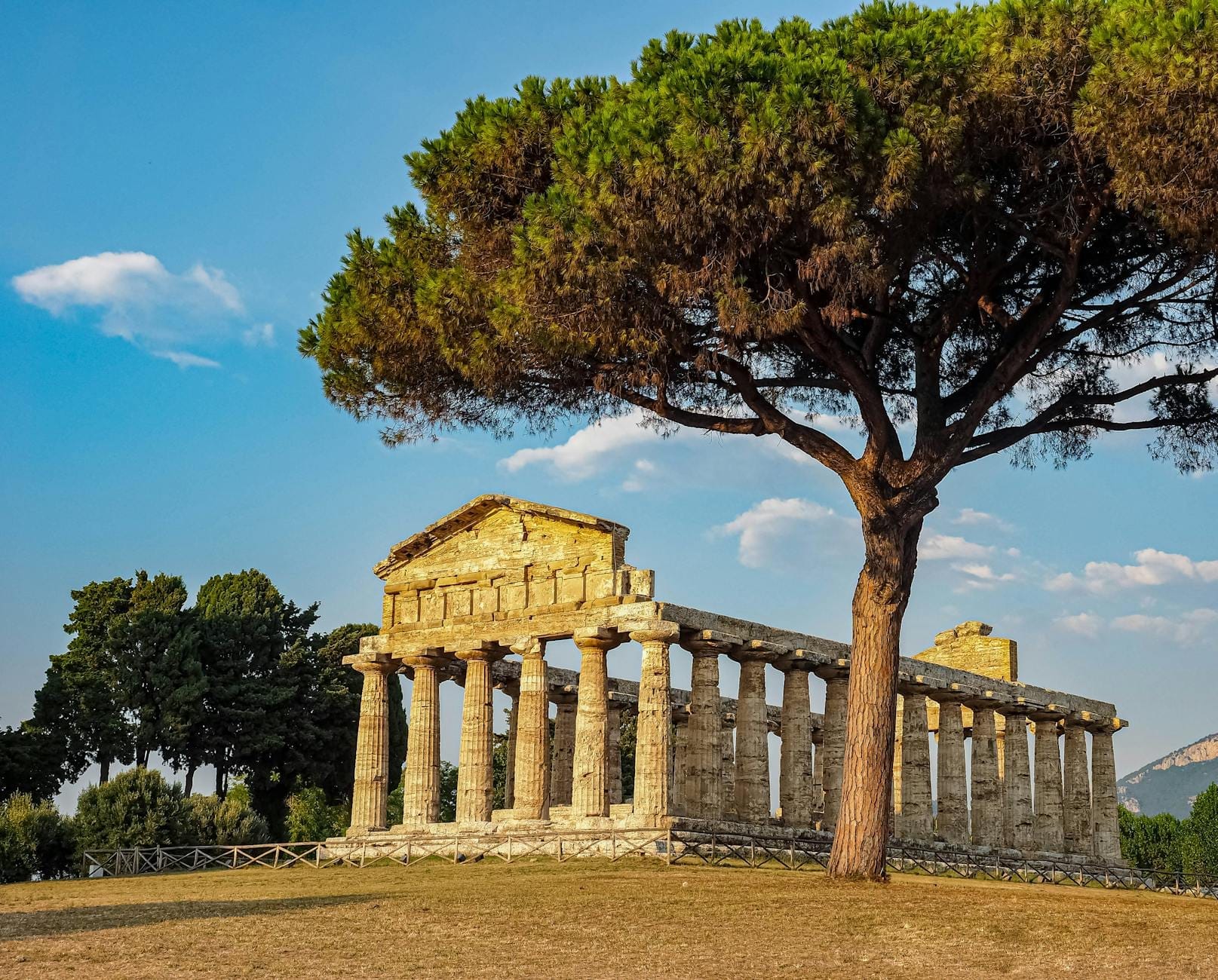
The Paestum Greek Temples are not ruins in the fragmented sense that word usually implies. These are near-complete Doric temples, standing to their full height with colonnades intact, rising out of a flat coastal plain with almost nothing else around them. That emptiness is part of what makes the experience so striking: there are no adjacent buildings to calibrate scale, no modern skyline, just honey-colored limestone columns against the sky.
The site contains three temples. The Temple of Hera I, commonly called the Basilica, dates to around 550 BCE and is the oldest. It has nine columns across its front and eighteen along each side, an unusual ratio reflecting archaic Greek design conventions. The Temple of Hera II, often labeled Neptune or Poseidon on older maps, was built around 450 BCE and is the most architecturally complete of the three: its columns, architrave, and pediment are almost entirely preserved. The Temple of Athena, sometimes called the Temple of Ceres, sits slightly apart from the other two and dates to around 500 BCE.
To put this in context: these temples predate the Parthenon in Athens, which was completed in 432 BCE. The reason they have survived so well is largely geographic. Paestum was abandoned in the early medieval period due to malaria and coastal flooding, and the site was gradually swallowed by vegetation. This isolation preserved the structures until they were rediscovered by European travelers in the 18th century.
The History Behind the Stone
The city was founded around 600 BCE by Greek colonists from Sybaris, a powerful city in the arch of Italy's boot, and named Poseidonia after the god of the sea. It was a prosperous trading settlement on the Tyrrhenian coast, and the scale of its temples reflects that wealth. At its peak, Poseidonia was a significant city in Magna Graecia, the network of Greek colonies that stretched across southern Italy and Sicily.
In 273 BCE, Rome established a Latin colony here, renamed it Paestum, and the city gradually became Romanized. The forum, amphitheater, and some road infrastructure visible on the site today are Roman-era additions, layered over the Greek urban plan. After the fall of Rome, repeated Saracen raids and the encroachment of marshland drove the population away, and the city was essentially erased from European consciousness for nearly a thousand years.
When Grand Tour travelers began visiting in the 1740s, the temples caused a minor sensation. The German scholar Johann Joachim Winckelmann wrote about them influentially, and painters from across Europe traveled south to sketch the columns. Paestum entered the western architectural imagination precisely because it looked ancient in a way that Rome, with its later restorations and medieval layering, did not.
ℹ️ Good to know
The on-site Museo Archeologico Nazionale di Paestum houses the famous Tomb of the Diver frescoes (480 BCE), considered the only example of Greek figurative painting with a narrative scene to survive from the classical period. Do not skip the museum.
Tickets & tours
Live prices and dates from our booking partner. If you book, we may earn a commission at no extra cost to you.
2-hour guided tour in Paestum
From 275 €Instant confirmationFree cancellationPompeii and Mount Vesuvius tour with transportation
From 110 €Instant confirmationFree cancellationOrigins and legends of Naples walking tour
From 28 €Instant confirmationFree cancellationGuided walking tour of Naples city and Naples underground
From 45 €Instant confirmationFree cancellation
How the Site Changes Through the Day
Arriving at opening (8:30 AM) gives you the best combination of light and solitude. The morning sun hits the travertine columns from the east, turning them a warm amber that photographers chase. By 11 AM, organized tour groups begin arriving from Naples, Salerno, and Pompeii, and the paths between the temples get crowded enough that you have to wait for clear sightlines.
Midday in summer is genuinely uncomfortable. The site is almost entirely unshaded. Temperatures regularly exceed 33°C from June through August, and there is nowhere to retreat except the museum, which is air-conditioned. If you are visiting in peak summer, plan to be inside the museum between noon and 2 PM and return to the temples in late afternoon when the angle of light becomes dramatic again.
Late afternoon light, particularly in spring and autumn, produces extraordinary photography conditions. The columns cast long shadows across the grass, and the sky over the plain takes on a deep clarity. The site is notably quieter after 4 PM as day-trippers leave. The grounds remain open until 7:30 PM, and the last hour can feel almost private.
⚠️ What to skip
There is almost no natural shade on the archaeological site. Bring water, a hat, and sunscreen regardless of season. In summer, this is not optional.
Getting There from Naples
The most practical option for most visitors is the regional train from Naples Centrale (Piazza Garibaldi). Trenitalia operates direct services to Paestum station on the Salerno-Reggio Calabria line. Journey time is roughly 1.5 hours. From Paestum station, the entrance to the archaeological park is about a 1 km walk south along Via Magna Graecia, a flat and straightforward route.
By car, Paestum is accessed via the A3 Autostrada with an exit at Battipaglia, then a short drive south on SS18. Parking is available near the site entrance. If you are combining Paestum with other stops on the day trips from Naples circuit, a car gives you the most flexibility, particularly if you want to continue south to the Cilento coast.
Organized day tours from Naples also operate regularly and include transport, a guide, and sometimes entry. These are worth considering if you prefer context delivered in real time, since the site itself has minimal explanatory signage in English.
💡 Local tip
Check Trenitalia's website for current schedules before travel. Direct services are more limited on Sundays. Allow at least 30 minutes of buffer at Naples Centrale, which is a large and occasionally chaotic station.
The Museum: Why You Cannot Skip It
The Museo Archeologico Nazionale di Paestum sits directly opposite the main temple zone and is included in the combined ticket. Its most significant holding is the Tomb of the Diver, a set of painted limestone slabs from around 480 BCE that formed the walls and lid of a burial chamber. The paintings show a symposium scene on the interior walls and, on the lid, a solitary male figure mid-dive above a body of water. Scholars interpret the dive as a metaphor for the passage from life to death.
What makes these frescoes extraordinary is their rarity. Greek painting from the classical period is almost entirely lost: what we know of it comes from later Roman copies and literary descriptions. The Tomb of the Diver is a direct survival. The colors remain legible: terracotta red, black, and ochre on a white ground. Standing in front of them, you are looking at something almost no other ancient site can offer.
The museum also holds architectural fragments, votive objects, bronze armor recovered from local tombs, and a collection of painted pottery that shows the full evolution of Paestum's artistic production from Greek through Lucanian and Roman periods. Allow 45 to 60 minutes to give it adequate attention.
Who This Suits and Who It Does Not
Paestum rewards visitors who arrive with some basic interest in ancient history or architecture. The site is large and mostly unlabeled, and without context, it is possible to walk through it in under an hour feeling only that you have seen some old columns. A pocket guide or a downloaded audio tour changes the experience considerably.
Families with children over about ten years old typically do well here, particularly if they have already visited Pompeii or Herculaneum and have some reference point for what ancient sites look like. Younger children may find the open terrain enjoyable to run around but are unlikely to engage with the monuments themselves.
Visitors primarily interested in urban atmosphere, food, or nightlife will find little here to sustain them. The surrounding town of Capaccio Paestum is small and quiet. There are a few restaurants near the site entrance that serve solid Campanian cooking, but this is not a destination for dining experiences. The appeal is almost entirely archaeological.
People with significant mobility limitations should be aware that the site terrain is uneven. Ancient stone pathways, grass-covered ground between structures, and the general unevenness of excavated land make wheelchair navigation difficult in places, though the main paths are manageable. The museum is fully accessible.
Photography and Practical Details
The temples photograph well at any time of day, but the quality of light at golden hour in spring and autumn is exceptional. The Temple of Hera II is the most photogenic for exterior shots due to its completeness. Shooting from the northwest corner in late afternoon puts the sun behind you and illuminates the full colonnade. There are no restrictions on personal photography with standard cameras or phones.
Paestum also sits within driving distance of the Cilento coast, making it a natural pairing with a beach afternoon if you have a car. The area around Agropoli and Castellabate to the south offers clean water and far fewer visitors than the Amalfi Coast. If you are planning a longer circuit south from Naples, the Naples to Amalfi Coast guide covers the broader coastal options in the region.
Wear comfortable, closed-toe shoes. The ground is not paved, and sandals become irritating quickly. Bring more water than you think you need. The site has a cafe near the museum entrance, but it is often crowded midday and the selection is limited.
Insider Tips
- Arrive at opening time (8:45 AM) on a weekday. You will often have the Temple of Hera II entirely to yourself for the first 30 to 45 minutes, which is genuinely rare for a UNESCO-caliber site.
- Visit the museum before the temples rather than after. Understanding the chronology and seeing the votive objects first makes the temples read as living religious spaces rather than architectural abstractions.
- The Tomb of the Diver panels are small and often overlooked by visitors who rush past. Stand in front of them for at least five minutes. They are among the most significant surviving artifacts of ancient Greek painting in existence.
- If you are visiting in April or May, the surrounding fields are often still in agricultural use and the wildflowers along the site perimeter add an unexpected visual layer to the monuments.
- The last train back to Naples from Paestum can be early on some days. Check the return schedule before you leave Naples, not when you are ready to leave Paestum.
Who Is Paestum Greek Temples For?
- History and archaeology enthusiasts who want ancient Greek architecture without the Athens crowds
- Photographers seeking dramatic ancient monuments in open, photogenic landscapes
- Day-trippers from Naples looking for something genuinely different from Pompeii
- Architecture students or anyone with interest in Doric order temples in their original setting
- Travelers who want to combine an ancient site with a quiet Cilento coastline afternoon
Nearby Attractions
Combine your visit with:
- Amalfi Coast
The Amalfi Coast stretches 40 kilometres along one of Italy's most dramatic shorelines, linking 13 cliff-side towns between Vietri sul Mare and Positano. A UNESCO World Heritage Site since 1997, it rewards visitors with layered history, vertiginous views, and some of the most photographed coastline in the Mediterranean. Getting there from Naples takes planning, but the payoff is considerable.
- Capri
Capri is one of the most recognized islands in the Mediterranean, sitting at the southern edge of the Gulf of Naples. It offers dramatic limestone cliffs, the famous Blue Grotto, elegant piazzas, and views that justify the journey. But it comes with crowds, costs, and logistical quirks that every visitor should understand before boarding the ferry.
- Cimitero delle Fontanelle
Carved into volcanic tuff in the Sanità district, the Cimitero delle Fontanelle holds the remains of roughly 40,000 people, many of them victims of the 1656 plague. Reopened in April 2026 after a five-year closure, it is one of the most historically dense and atmospheric places in all of southern Italy.
- Città della Scienza
Città della Scienza is Naples' premier interactive science museum, set on a former industrial waterfront in the Bagnoli district. With hands-on exhibits spanning the human body, sea life, insects, and space, plus a full planetarium, it delivers a genuinely engaging half-day for families, curious adults, and school groups alike.
Planning a trip? Discover personalized activities with the Nomado app.