Pabellón de la Navegación: Seville's Overlooked Expo '92 Legacy on Isla de la Cartuja
Built for the 1992 World's Fair and reopened as a permanent exhibition centre in 2012, the Pabellón de la Navegación traces Spain's age of maritime exploration across interactive galleries and a 65-metre lookout tower. It sits on the Guadalquivir riverbank at Isla de la Cartuja, an easy bus ride from the historic centre, and general admission is €4.90.
Quick Facts
- Location
- Camino de los Descubrimientos 2, Isla de la Cartuja, 41092 Seville
- Getting There
- Bus lines C1 and C2 along Camino de los Descubrimientos (Isla de la Cartuja circular services)
- Time Needed
- 1.5 to 2.5 hours
- Cost
- General €4.90 / Reduced €3.50 / Under 5 free (entry includes museum and Torre Schindler)
- Best for
- History enthusiasts, families with children, and visitors wanting panoramic city views on a budget
- Official website
- http://www.pabellondelanavegacion.com
What Is the Pabellón de la Navegación?
The Pabellón de la Navegación, or Navigation Pavilion, is a permanent exhibition centre on Isla de la Cartuja dedicated to the history of Spanish maritime exploration. Its origins are inseparable from one of the most ambitious events in modern Seville history: Expo '92, the Universal Exposition held to mark the 500th anniversary of Columbus's first transatlantic voyage. The pavilion was one of the signature structures built for that event, and when the fairground transformed into the mixed-use Cartuja science and technology park, this building found a second life as a public museum focused on the sea.
After years of dormancy following the exposition, the site reopened to the public in January 2012 under the management of EPGASA (Empresa Pública de Gestión de Activos, S.A.). Today it functions as a mid-size interactive exhibition space aimed at a broad audience, from school groups in the mornings to curious adult visitors in the afternoon. It sits directly on the western bank of the Guadalquivir, a short walk from the Puente del Cachorro bridge, and the site is visually striking from the riverside promenade even before you go inside.
ℹ️ Good to know
The Pabellón de la Navegación is officially known as the 'Centro expositivo Pabellón de la Navegación.' Ticket price includes both the indoor exhibition and access to the Torre Schindler lookout tower.
The Expo '92 Context: Why This Building Exists
To understand the Pabellón de la Navegación, it helps to understand Expo '92 itself. In 1992, Seville hosted one of the largest World's Fairs of the 20th century, drawing more than 40 million visitors over six months to Isla de la Cartuja, a formerly underdeveloped river island northwest of the historic centre. The entire island was transformed: new bridges were constructed, infrastructure was laid from scratch, and pavilions from over 100 countries rose across its grounds.
Spain's central thematic contribution to that exposition was the age of exploration, particularly the voyages that departed from Andalusian ports in the late 15th and early 16th centuries. The Pabellón de la Navegación was designed as a permanent record of that maritime heritage, meant to outlast the temporary spectacle of the exposition itself. When most Expo '92 pavilions were demolished or repurposed beyond recognition, this one retained its identity, eventually becoming the exhibition space it is today.
The island as a whole carries an unusual dual character: part tech park, part cultural zone, part lingering fairground ghost. The Monasterio de la Cartuja sits nearby and houses the contemporary art museum, while the broader La Cartuja district offers a fascinating counterpoint to the medieval city across the river.
Tickets & tours
Live prices and dates from our booking partner. If you book, we may earn a commission at no extra cost to you.
Guided tour of the white villages of Andalusia: Ronda, Grazalema and Zahara
From 79 €Instant confirmationFree cancellationSevilla FC Ramon Sanchez-Pizjuan Stadium tour
From 10 €Instant confirmationSevilla Alcazar and cathedral guided tour with priority access tickets
From 59 €Instant confirmationFree cancellationSevilla Alcazar guided tour with priority access tickets
From 32 €Instant confirmationFree cancellation
Inside the Pavilion: What the Exhibitions Cover
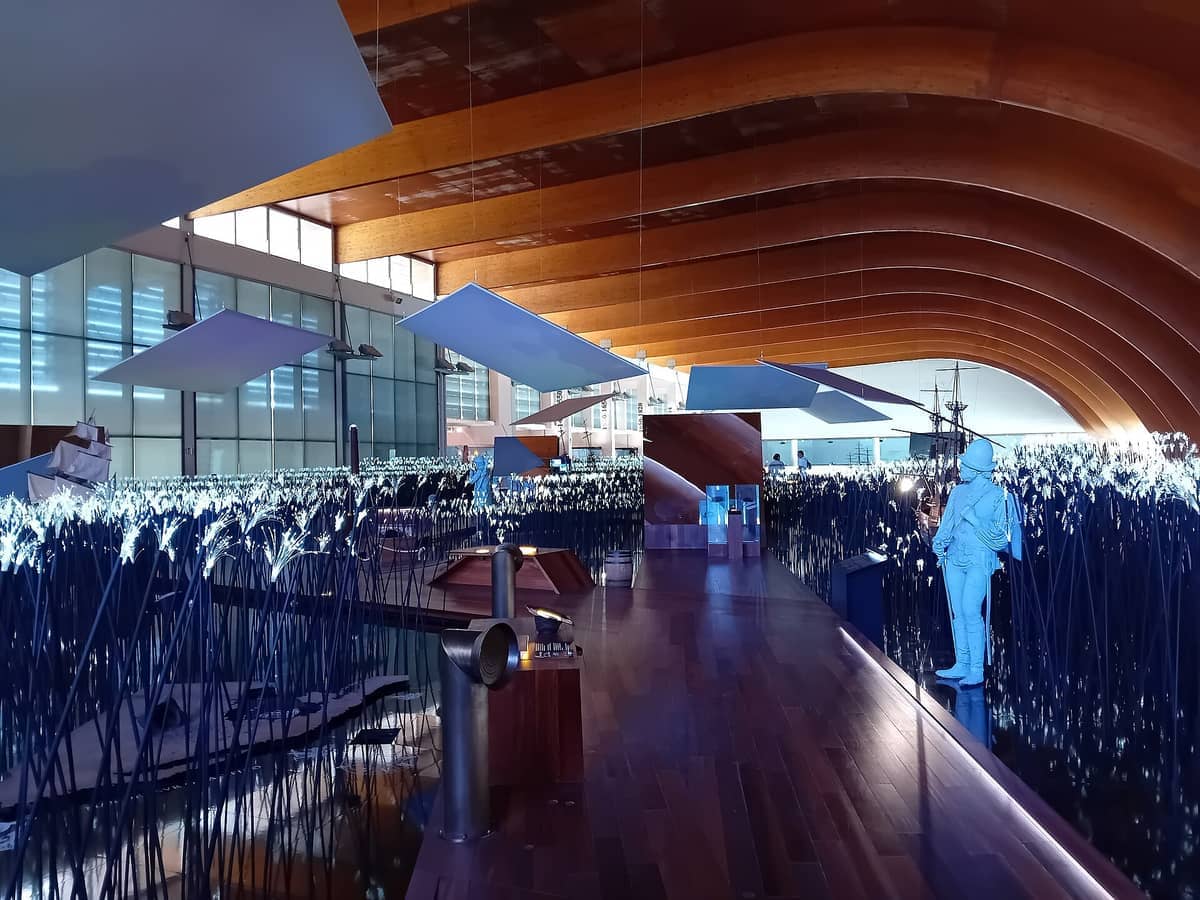
The permanent collection moves through several thematic zones that trace the development of Spanish navigation from the medieval period through the great voyages of discovery. Exhibits cover shipbuilding techniques, navigational instruments such as astrolabes and compasses, cartography, and the daily realities of life aboard vessels crossing unknown oceans. The presentation blends physical artefacts with scale models and interactive digital panels.
The tone is accessible rather than academic, which makes it work well for families but occasionally feels thin for visitors with deeper knowledge of the period. The replica sections of period ships are among the most visually engaging parts of the visit, conveying the cramped conditions and fragile construction of vessels that crossed the Atlantic. Placards are available in both Spanish and English, though the Spanish versions are generally more detailed.
One section addresses the role of the Guadalquivir River and the port of Seville specifically. For centuries, Seville held a royal monopoly on trade with the Americas, and the Casa de la Contratación regulated all transatlantic commerce from within the city. This context gives the pavilion a local anchor that pure naval history museums sometimes lack. If you have already visited the Archivo General de Indias, the documentary record of that trade era, the Navigation Pavilion provides a useful physical and material complement.
For the broader story of Seville's role in Spain's imperial expansion, the Archivo General de Indias holds millions of original documents from that period and is worth pairing with this visit.
The Torre Schindler: Panoramic Views at No Extra Cost
Included in the standard admission ticket is access to the Torre Schindler, a slender lookout tower rising approximately 65 metres above the island. The name comes from the lift manufacturer that equipped it during Expo '92, a small piece of industrial heritage that has stuck. The ascent is by elevator, and the observation platform at the top offers an unobstructed 360-degree view across the city.
From up here the Guadalquivir traces its curve through the city with unusual clarity. You can identify the Torre del Oro, the cathedral's Giralda tower, the dome of the Plaza de España pavilions, and the industrial waterfronts on both banks. On clear days the Sierra Norte hills to the north are visible. The height is modest compared to some European city towers, but for Seville, where the skyline is deliberately low, 65 metres feels genuinely elevated.
💡 Local tip
The tower is most rewarding in the late afternoon, roughly an hour before closing, when the angle of the sun catches the golden stone of the cathedral and Alcázar across the river. Mornings work well for clearer visibility but the light is flatter for photography.
If panoramic views across Seville are a priority, the Mirador de la Torre de los Perdigones and the Setas de Sevilla are two other elevated platforms worth comparing.
How the Visit Changes by Time of Day
Mornings, particularly Tuesday through Friday, attract school groups. Between roughly 10:00 and 12:30, the exhibition halls can be lively with children moving through in guided clusters. The audio levels rise noticeably, and some of the interactive panels have queue waits. If you prefer a quieter experience, arriving after 14:00 typically finds the pavilion considerably calmer.
On summer Sundays the pavilion closes at 15:00, which limits afternoon visits significantly in July and August. During those months the special reduced hours (10:00 to 15:30 Tuesday through Sunday) also mean the building stays relatively cool inside for morning visitors, which is a genuine practical advantage when Seville's summer temperatures frequently surpass 35 degrees Celsius outdoors.
The surrounding area on Isla de la Cartuja is quieter than the historic centre at all hours. The riverside path alongside the pavilion sees joggers and cyclists in the mornings, then empties in the midday heat. On weekend evenings, the broader Cartuja zone picks up with local families, but the museum itself will be closed by then.
Getting There: Practical Transport Details
The pavilion is on Camino de los Descubrimientos on Isla de la Cartuja, across the Guadalquivir from the historic district. Bus lines C1 and C2, which form circular routes connecting key riverbank areas, stop along Camino de los Descubrimientos and are the most direct public transport option from the centre. Journey time from the area around the Torre del Oro is typically 10 to 15 minutes depending on stops.
By bicycle, the island is accessible via several bridges and the flat riverside cycling path, making it a practical option for those using Seville's public bike hire. On foot from the historic centre, crossing the Puente del Cachorro or the Puente de la Barqueta and walking along the riverbank takes roughly 20 to 25 minutes and is straightforward on a cooler day.
⚠️ What to skip
The Pabellón de la Navegación is closed on Mondays. Always check the official website at www.pabellondelanavegacion.com before visiting, as seasonal hours vary significantly between winter (Oct–Mar), summer (Mar–Oct), and the July–mid‑August reduced schedule (currently 10:00–15:00).
Who Will Enjoy This, and Who Should Consider Skipping It
The Navigation Pavilion rewards visitors who have a genuine interest in the history of maritime exploration, Spanish colonialism, or the story of Expo '92. Families with children aged roughly 6 to 14 generally find the interactive format engaging, and the tower ascent provides a natural reward at the end of the visit. At under €5 per adult, it is also one of the more affordable indoor cultural experiences in Seville.
Visitors whose primary interest is purely art, religious architecture, or Moorish history may find the subject matter peripheral to their core itinerary. The exhibition depth, while solid for a general audience, does not match the scholarly density of a major maritime museum. If you are working through Seville in two days or fewer and prioritising the cathedral, Alcázar, and Triana, this pavilion is easy to leave out without regret.
For a fuller sense of what Seville offers across all its neighbourhoods and attractions, the guide to things to do in Seville provides a useful comparative overview.
Insider Tips
- Combine the pavilion with the nearby Monasterio de la Cartuja on the same afternoon. Both are on the island, the monastery closes later, and together they tell a complementary story about the island's layered history from medieval religious house to Expo '92 showcase.
- The ticket price covers the tower as well as the museum, but staff sometimes forget to mention this at the entrance. When you collect your ticket, specifically ask about the Torre Schindler to ensure you get the wristband or stamp that grants tower access.
- In July and August the pavilion operates on reduced hours (currently 10:00 to 15:00, Tuesday through Sunday). Plan accordingly if visiting in summer, and consider arriving at opening time to beat the heat and any morning school groups.
- The riverside path directly outside the pavilion offers one of the quieter Guadalquivir walking stretches in the city. Walking north along the bank toward the Puente de la Barqueta after your visit adds almost no extra time and gives a completely different perspective on the river compared to the Triana or Arenal waterfronts.
- Photography from the Torre Schindler is most productive with a wide-angle lens or a smartphone in panorama mode. The railing gives a clear sightline in all directions, but the platform is not large, so visiting when the tower is uncrowded, typically late morning on a weekday, gives you more time to compose shots.
Who Is Pabellón de la Navegación For?
- Families with school-age children looking for an interactive, affordable indoor activity
- History enthusiasts interested in Spain's age of exploration and the role of Seville as a colonial trade hub
- Architecture or urban history fans curious about the Expo '92 legacy and Isla de la Cartuja's transformation
- Visitors wanting a panoramic city view without the crowds or cost of more prominent viewpoints
- Travellers combining the Navigation Pavilion with the Monasterio de la Cartuja for a half-day island itinerary
Nearby Attractions
Other things to see while in La Cartuja (Isla de la Cartuja):
- Monasterio de la Cartuja
The Monasterio de la Cartuja de Santa María de las Cuevas is one of Seville's most layered sites: a 15th-century Carthusian monastery on Isla de la Cartuja that now houses the Centro Andaluz de Arte Contemporáneo (CAAC). Entry costs as little as €3, and large stretches of the week are entirely free.
Planning a trip? Discover personalized activities with the Nomado app.