Monasterio de la Cartuja: Seville's Monastery Turned Contemporary Art Centre
The Monasterio de la Cartuja de Santa María de las Cuevas is one of Seville's most layered sites: a 15th-century Carthusian monastery on Isla de la Cartuja that now houses the Centro Andaluz de Arte Contemporáneo (CAAC). Entry costs as little as €3, and large stretches of the week are entirely free.
Quick Facts
- Location
- Avenida Américo Vespucio 2, Isla de la Cartuja, 41092 Seville
- Getting There
- City bus from central Seville; roughly 20–30 min walk across the river bridges from the historic centre
- Time Needed
- 1.5 to 3 hours depending on how deeply you explore the monastery and current exhibitions
- Cost
- Full visit €3.01 (officially listed as €3,01); free Tue–Fri 19:00–21:00 and all day Saturday
- Best for
- History and architecture lovers, contemporary art fans, budget-conscious visitors
- Official website
- http://www.caac.es
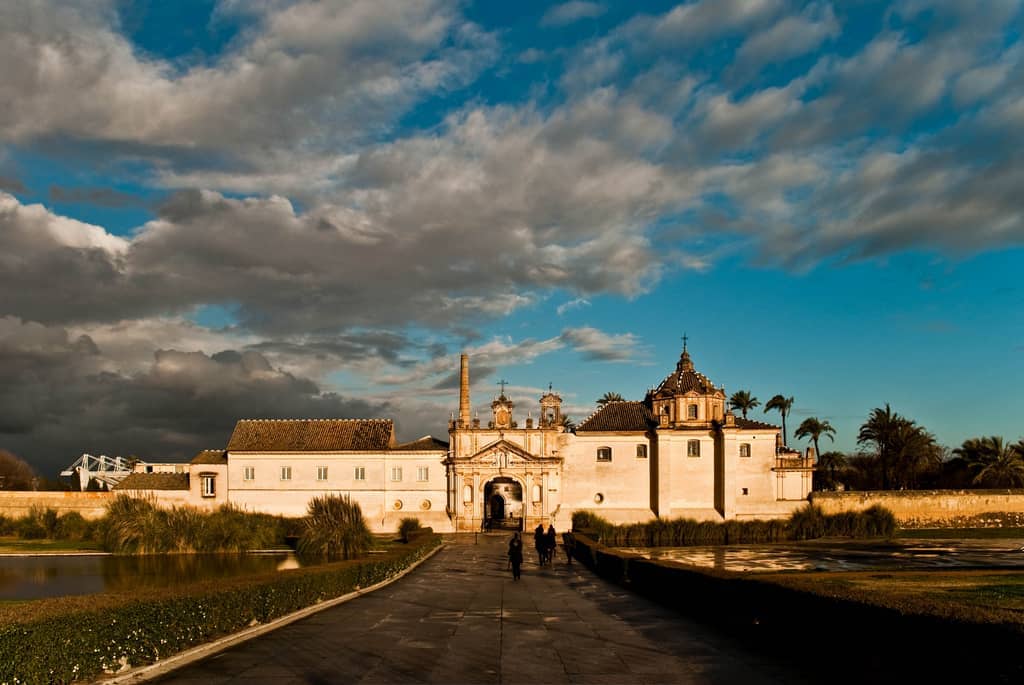
What the Monasterio de la Cartuja Actually Is
The Monasterio de la Cartuja de Santa María de las Cuevas sits on Isla de la Cartuja, a tongue of land separated from the historic city by a branch of the Guadalquivir River. It is one of the few major monuments in Seville that most short-stay visitors never reach, which is exactly what makes it worth the effort. The complex is vast, quieter than the cathedral quarter, and carries a history that stretches from 15th-century Carthusian monks through Christopher Columbus to a 19th-century English ceramics factory, and on to its current role as the Centro Andaluz de Arte Contemporáneo (CAAC), the Andalusian regional government's principal contemporary art institution.
What you encounter here is genuinely unusual: Gothic cloisters and a Mudejar chapel existing comfortably alongside site-specific installations and rotating contemporary exhibitions. The architecture is the permanent collection in a sense, and the art responds to it in ways that rarely feel forced. This is not the kind of attraction where you rush from room to room ticking off highlights. It rewards slower attention.
ℹ️ Good to know
Free entry applies Tuesday to Friday from 19:00 to 21:00, and all day Saturday from 11:00 to 21:00. If your schedule is flexible, the Saturday morning opening is an excellent way to explore at no cost. Ticket sales stop 30 minutes before closing.
A Brief History Worth Knowing Before You Go
The monastery was founded in 1400, in the early 15th century, by Gonzalo de Mena, the Archbishop of Seville, on land that had previously been used as cave dwellings and kilns, which explains the name "de las Cuevas" (of the caves). The Carthusian order, known for silence and strict enclosure, expanded the complex considerably over the following century, adding cloisters, a church, a chapter house, and significant tile work in the Mudejar tradition.
Christopher Columbus had a documented relationship with this monastery. He lodged here during preparations for his voyages, and after his death in 1506, his remains were interred in the church for about thirty years before being transferred to the Americas. A cenotaph in the chapel still marks the connection. Standing in that space, it is one of the more tangible Columbus links in a city that trades heavily on his legacy without always making it feel real.
In the 19th century, the monastery was acquired by Charles Pickman, a British entrepreneur, and converted into a ceramics factory. The tall brick kilns that still punctuate the complex date from this industrial period. Rather than erasing the monastic character, the Pickman factory layers add another chapter to the site's story. The whole ensemble was extensively restored for Expo '92, the world's fair hosted on Isla de la Cartuja. Understanding this sequence of uses makes walking through the complex considerably more interesting. For broader context on what surrounds the island today, the guide to La Cartuja neighbourhood explains how the former Expo grounds have evolved.
Tickets & tours
Live prices and dates from our booking partner. If you book, we may earn a commission at no extra cost to you.
Guided tour of the white villages of Andalusia: Ronda, Grazalema and Zahara
From 79 €Instant confirmationFree cancellationSevilla FC Ramon Sanchez-Pizjuan Stadium tour
From 10 €Instant confirmationSevilla Alcazar and cathedral guided tour with priority access tickets
From 59 €Instant confirmationFree cancellationSevilla Alcazar guided tour with priority access tickets
From 32 €Instant confirmationFree cancellation
What You Actually See: The Monastery Walk-Through
Entry is from Avenida Américo Vespucio, and the approach feels more institutional than monastic at first. Once through the ticket gate, the scale of the grounds opens up. The exterior of the church is sober brick and stone, typical of Sevillian Gothic, but the interior contains a series of chapels with azulejo tilework and carved stone details that stop you in your tracks. The light inside is cool and still, a noticeable contrast to the heat outside in warmer months.
The Mudejar chapel, often cited as the most architecturally striking part of the complex, features ceramic tile decoration applied in the 15th and 16th centuries. The geometric patterns and colour palette are distinctly Andalusian. If you have already visited the Real Alcázar or spent time in Triana, you will recognize the visual language immediately, but the scale and the monastic setting give it a different quality.
The contemporary art installations and galleries occupy rooms throughout the monastery, including converted conventual spaces and former industrial buildings from the Pickman period. Some of the most effective works are those that use the architecture directly: a piece positioned in a vaulted chapter house reads completely differently than it would in a white-cube gallery. Not every exhibition will land for every visitor, and the CAAC's programming tends toward serious contemporary practice rather than accessible crowd-pleasers. Go with open expectations rather than fixed tastes.
The outdoor spaces, including cloisters and garden zones, are worth taking slowly. In the mornings, light falls at sharp angles through narrow openings and across worn stone floors. In the late afternoon, the cloisters take on a warmer, amber tone. Bring water in summer: the outdoor sections expose you to direct sun, and there is little shade in the central courtyard areas during midday.
When to Visit and How It Changes by Time of Day
Mornings, particularly on weekdays, are when the monastery feels closest to what it must have been as a working religious house. Visitor numbers are low, and the quietness in the church and chapter house is genuine. Bring a jacket in winter months: the stone interior holds cold. By midday, especially on Saturdays, groups begin to arrive and the character shifts toward something more museum-like.
The free evening slot on weekdays (19:00 to 21:00) draws a different crowd: Sevillians using the space as a cultural resource rather than tourists on a sightseeing circuit. The quality of light through the narrow church windows at this hour is noticeably different, more horizontal and dramatic, which is useful for photography. The tradeoff is that two hours is tight for the full complex, so if you plan to use the free evening entry, focus on the monument section rather than trying to cover every exhibition room.
💡 Local tip
For photography, the early morning light in the cloisters (particularly in spring and autumn when the sun angle is lower) produces sharper shadows and richer detail in the tilework. Summer midday light bleaches the stonework and creates harsh contrast in the outdoor spaces.
Seville's climate means the experience varies significantly by season. The best time to visit Seville from a climate perspective is spring (March to May) or autumn (late September to October), when temperatures are mild and the outdoor sections of the monastery are comfortable to walk. In July and August, daytime highs regularly exceed 35°C; the indoor galleries become something of a refuge, but the walk from central Seville to Isla de la Cartuja in that heat is genuinely demanding.
Getting to Isla de la Cartuja
The monastery sits on Isla de la Cartuja, separated from the historic centre by the Guadalquivir and the smaller Canal Alfonso XIII. On foot from the Santa Cruz area or the Cathedral, the walk takes roughly 25 to 35 minutes, crossing one of the pedestrian bridges. The route along the riverbank is straightforward and pleasant in cooler weather. In summer heat, consider a bus instead.
TUSSAM city buses serve the island and connect it to central points including Plaza de Armas and Plaza de Cuba. Check current route numbers before travelling, as urban bus schedules can be adjusted. The ride from central Seville takes around 15 minutes. There is no Metro de Sevilla stop directly serving Isla de la Cartuja.
Taxis and ride-hailing apps (Uber and Cabify both operate in Seville) are straightforward for reaching the monastery, particularly useful in summer or with children. For general orientation around the city's transport options, the guide to getting around Seville covers the main choices in detail.
⚠️ What to skip
The monastery address (Avenida Américo Vespucio 2) is on the western side of Isla de la Cartuja. If navigating by map app, confirm the pin location before you walk: some mapping services show the general island area rather than the precise entrance, and the complex is large enough that arriving at the wrong gate wastes time.
Admission, Accessibility, and Practical Details
The full visit costs €3.01 (officially listed as €3,01), and a ticket for only the monument or only a temporary exhibition is €1.80. An annual pass is available at €12.02 (€12,02), which makes sense if you plan to return for multiple exhibitions. The free periods are generous: Tuesday to Friday from 19:00 to 21:00, and all day Saturday. For a well-funded Andalusian public institution, this is a notably accessible pricing structure.
Opening hours are Tuesday to Saturday 11:00 to 21:00, and Sunday plus public holidays 10:00 to 15:30. The CAAC is closed on Mondays. Ticket sales end 30 minutes before closing. Always verify current hours on the official site (caac.es) before visiting, as seasonal adjustments have been noted in past years. If you are planning a broader day out in the area, the Pabellón de la Navegación is a short distance away on the same island and covers Seville's maritime history.
For visitors with mobility requirements, the centre operates as a public museum and the site has been adapted since its Expo '92 restoration. That said, the monastery is a historic complex with uneven stone floors in some sections and narrow passages in older parts of the building. Visitors with specific accessibility needs are advised to contact the CAAC directly at +34 955 037 070 before visiting to confirm which areas are step-free and whether any temporary exhibition spaces have access limitations.
There is no café inside the monastery complex itself, so plan accordingly. The surrounding Isla de la Cartuja area is largely commercial and not particularly rich in independent food options. If you are combining the visit with a walk along the river, the Mercado Lonja del Barranco on the opposite bank is a reasonable option for a meal before or after.
Who Should Skip This, and an Honest Assessment
The Monasterio de la Cartuja is not for everyone. Visitors with only two or three days in Seville who are focused on the cathedral, Alcázar, and Triana are probably right to leave it off the list: the journey across the island takes time, and the experience is more reflective and architectural than spectacular. It does not deliver the immediate visual payoff of somewhere like the Plaza de España.
Visitors who are primarily interested in contemporary art but indifferent to architecture may also find the balance skewed: the CAAC's programming is strong but uneven, and some visits will coincide with exhibition changeovers or works that require significant prior knowledge to engage with. Conversely, anyone who has already covered the major sites and wants something quieter and more layered will find this one of the more rewarding options in the city. It fits naturally into a broader exploration of Seville's less-obvious cultural offers, which the guide to Seville's lesser-known attractions covers in more detail.
Insider Tips
- The free Saturday entry is the worst-kept secret in Seville's cultural scene, but weekend mornings still see relatively modest visitor numbers compared to the cathedral area. Arrive close to the 11:00 opening to have the cloisters to yourself.
- The Pickman kiln towers are the most photographed exterior feature of the complex and look best from the inner courtyard rather than from the perimeter road. Ask at the ticket desk which sections of the grounds are currently open, as not all areas are accessible at all times.
- The CAAC updates its exhibition programme several times a year. Check caac.es a few days before your visit to see whether there is an opening event or a guided tour scheduled, which are occasionally offered free of charge.
- On weekday evenings during the free entry period, the light through the church's upper windows is at its most dramatic. Bring a camera with decent low-light capability: flash is generally not permitted inside the chapel.
- The walk from the Puente de la Barqueta or Puente del Alamillo gives you views back toward the city that most visitors never see. It adds around 10 minutes to the journey from the centre but is considerably more interesting than the road approach.
Who Is Monasterio de la Cartuja For?
- Architecture and history enthusiasts who want more depth than the major monuments provide
- Contemporary art visitors looking for a serious institution rather than a commercial gallery
- Budget travellers: free on Saturdays and on weekday evenings, making it one of the most accessible cultural sites in the city
- Visitors on a second or longer trip who have already covered the central highlights
- Photographers looking for unusual angles: Gothic stonework, industrial kilns, and tilework all in one complex
Nearby Attractions
Other things to see while in La Cartuja (Isla de la Cartuja):
- Pabellón de la Navegación
Built for the 1992 World's Fair and reopened as a permanent exhibition centre in 2012, the Pabellón de la Navegación traces Spain's age of maritime exploration across interactive galleries and a 65-metre lookout tower. It sits on the Guadalquivir riverbank at Isla de la Cartuja, an easy bus ride from the historic centre, and general admission is €4.90.
Planning a trip? Discover personalized activities with the Nomado app.