Östermalm Food Hall: Stockholm's Grand Market Hall Explained
Östermalm Food Hall (Östermalms Saluhall) is a landmark covered market on Östermalmstorg, operating since 1888 and reopened after a full renovation in March 2020. It combines heritage architecture with serious Swedish food, from fresh seafood counters to old-school delicatessens, and entry is free.
Quick Facts
- Location
- Östermalmstorg, 114 39 Stockholm (Östermalm district)
- Getting There
- Metro green line to Östermalmstorg; buses 54, 69, 76 stop within two blocks
- Time Needed
- 45 minutes to browse; 2 hours if you eat at one of the in-hall restaurants
- Cost
- Free entry; food and drink purchases paid on site in SEK
- Best for
- Food lovers, architecture admirers, solo lunches, and quality shopping
- Official website
- en.ostermalmshallen.se
What Östermalm Food Hall Actually Is
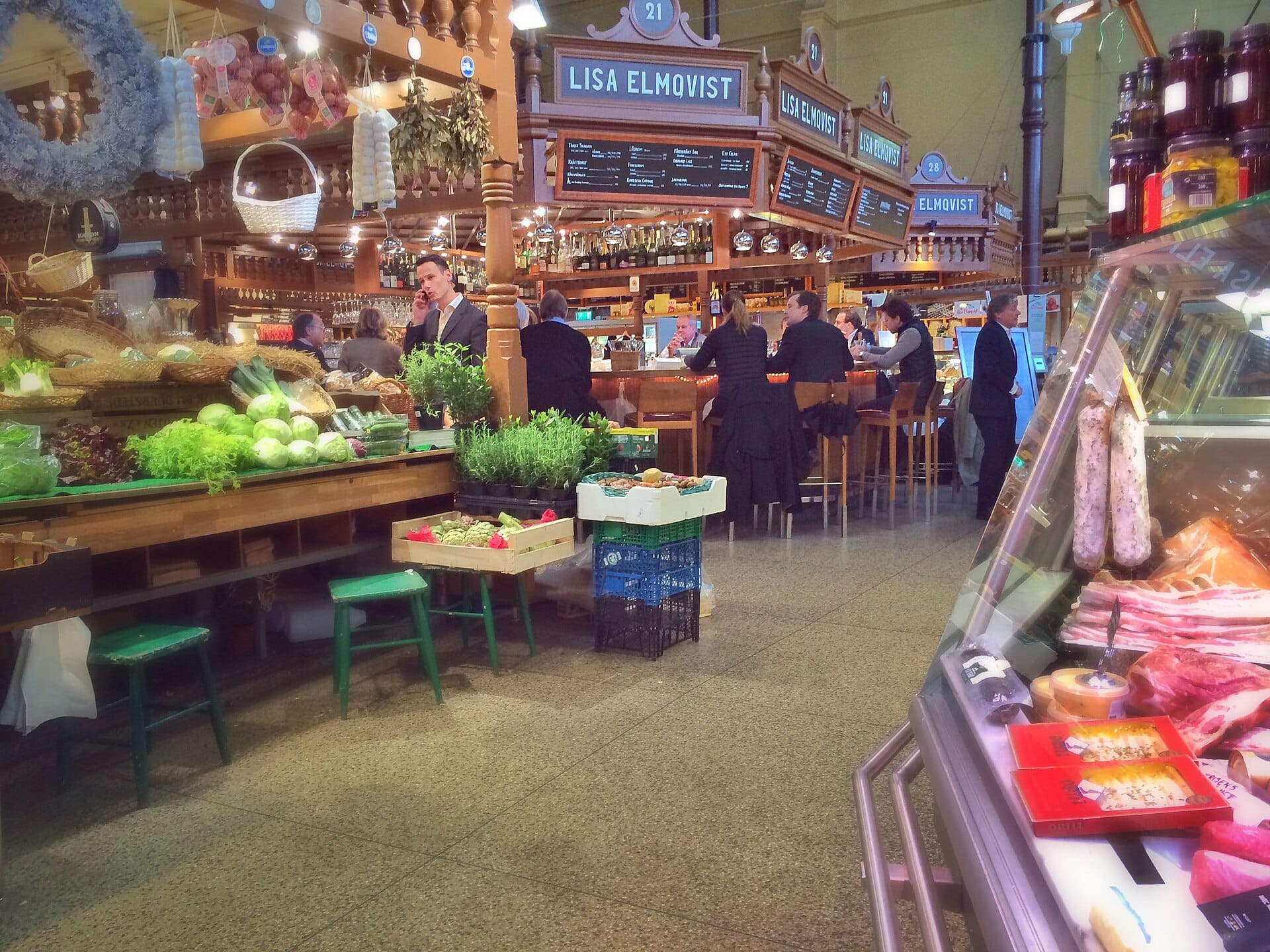
Östermalms Saluhall, known in English as the Östermalm Food Hall, is a late-19th-century covered market hall on Östermalmstorg square in one of Stockholm's most affluent neighborhoods. It is not a tourist market selling souvenirs, and it is not a food court in the modern sense. It is a working food market where Stockholmers have bought their smoked salmon, aged cheese, and specialty charcuterie for well over a century.
The hall opened in 1888, inaugurated by King Oscar II after a period of construction. The brick building with its distinctive towers and arched windows has anchored the eastern end of Östermalm ever since. After a major renovation, the hall reopened on 5 March 2020, with the original star-shaped floor plan restored and the interior reconfigured across three accessible floors.
ℹ️ Good to know
Entry is free. There is no ticket, no pass required, and no need to book. The hall is open Monday to Friday 09:30–19:00 and Saturday 09:30–17:00. It is closed on Sundays.
The Architecture: What You See Before You Even Enter
Stepping out of Östermalmstorg metro station, the hall announces itself before you reach it. The facade is red brick with elaborate decorative brickwork, pointed towers at each corner, and tall arched windows that let daylight pour into the interior. It belongs to a tradition of 19th-century market hall architecture that treated food retail as a civic monument, comparable in spirit to the great covered markets of Paris or Barcelona, though considerably more restrained in scale.
The 2020 renovation prioritized the original proportions rather than modernizing them out of existence. The restored star-shaped floor plan means that from the center of the hall, you can see the perimeter stalls in all directions. The ironwork, the vaulted ceiling, and the tiled floors feel consistent with the building's age without being frozen in museum amber. It is a living market inside a heritage shell.
For a broader look at how Stockholm's architecture ties into its identity, the Stockholm design guide is worth reading before or after your visit.
Tickets & tours
Live prices and dates from our booking partner. If you book, we may earn a commission at no extra cost to you.
Guided culinary food tour through Stockholm
From 85 €Instant confirmationFree cancellationStockholm city hall canal guided boat tour
From 26 €Instant confirmationFree cancellationStockholm self-guided food tour with four tasting stops
From 28 €Instant confirmationFree cancellationPrivate guided Ostermalm city walk
From 138 €Instant confirmationFree cancellation
What You'll Find Inside: The Vendors and the Food
The hall's vendors skew toward quality rather than variety. You will find specialist fishmongers with whole fish on ice alongside carefully portioned fillets of Arctic char and gravlax. Cheesemakers and delicatessen counters display Scandinavian and European produce at prices that reflect the neighborhood. Butchers, bakers selling sourdough and rye, and shops with Swedish pantry staples like lingonberry preserves and dried mushrooms fill out the ground floor.
The in-hall restaurants and lunch counters are what draw many visitors at midday. These range from traditional Swedish husmanskost (home cooking) to seafood bars where you can eat oysters standing at a counter. Lunch service tends to be busy from around 11:30 onward, with the crowd thinning noticeably after 13:30. If you want a seat at one of the more popular spots without waiting, arriving before noon on a weekday works well.
Östermalm Food Hall fits naturally into a wider exploration of Stockholm's food culture. For context on what and where Stockholmers eat, the guide to Stockholm's food scene covers the broader picture.
💡 Local tip
Saturday mornings between 10:00 and 12:00 are the most atmospheric time to visit. Local shoppers are doing their weekly food run, the stalls are fully stocked, and the hall feels purposeful rather than touristy. Avoid Saturday afternoons, when stock is depleted and the atmosphere winds down before the 17:00 close.
How the Experience Changes by Time of Day
Arrive at opening on a weekday morning, around 09:30 to 10:30, and the hall belongs to the neighborhood. Older residents from Östermalm's apartment blocks work through the stalls with baskets, the vendors are restocking and arranging displays, and the light through the arched windows is at its softest. The smell at this hour is a combination of fresh bread, cold fish counters, and the faint beeswax polish of the wooden stall fronts.
By midday on any weekday, the energy shifts. Office workers from the surrounding streets arrive for lunch, the restaurant counters fill up, and the noise level rises considerably. This is the least relaxed time to browse the stalls, but it is genuinely lively and worth experiencing at least once to understand that this is a place Stockholmers use rather than merely photograph.
Late afternoon on weekdays, between 16:00 and 17:30, brings a quieter wave of after-work shoppers. This is a good moment to speak with vendors without the midday rush, and some stalls reduce prices on perishables toward closing. The atmosphere is unhurried. On Saturday, the window between 10:00 and 12:30 is the sweet spot. After that the hall gradually empties as the city's social energy shifts elsewhere.
Getting There and Getting Around Once Inside
The metro to Östermalmstorg is the simplest approach. Take the Östermalmstorg exit and then the Nybrogatan exit, and the hall's red-brick facade is visible within seconds of reaching street level. No navigation required. Buses 54, 69, and 76 stop close to Östermalmstorg or Nybroplan, which is roughly two blocks away along Nybrokajen.
Inside, the three-floor layout from the 2020 renovation is well-signposted. The main market stalls and food counters are concentrated on the ground floor, with the restaurants and more formal dining spaces accessible on the upper levels. The hall is step-free at street-level entrances, and the renovation brought the building's accessibility up to a significantly higher standard than the original 1888 layout offered. For specific step-free routes and facilities, check directly with the hall before visiting.
Östermalm itself is worth spending time in beyond the hall. The neighborhood around Östermalm has a distinct character compared to the rest of central Stockholm, and the streets between the food hall and Stureplan reward a slow walk.
Honest Appraisal: Who This Is For, and Who Might Be Disappointed
Östermalm Food Hall is not a budget stop. The vendors cater to an affluent local clientele, and prices reflect that. A small portion of smoked salmon, a wedge of good cheese, or a glass of wine at a lunch counter will cost noticeably more here than at a supermarket or a casual restaurant elsewhere in the city. If your main concern is eating cheaply in Stockholm, this is not the right stop.
Visitors expecting a sprawling market with dozens of stalls, street-food energy, or the sensory overload of a large Asian wet market will also find Östermalm Food Hall quieter and more curated than they imagined. It has roughly a dozen permanent traders rather than hundreds of vendors. The appeal is in the quality of what they sell and the setting in which they sell it, not in quantity or chaos.
For travelers who are genuinely interested in Scandinavian food traditions, in the craft of specialist food retail, or in the experience of a functioning 19th-century market hall, it is one of the most rewarding stops in Stockholm. The renovation has been careful enough that the building feels historic without feeling abandoned to nostalgia.
If you are building a broader itinerary around food and experience in Stockholm, the Stockholm fika guide and a visit to Fotografiska pair well with an Östermalm Food Hall morning.
⚠️ What to skip
The hall is closed on Sundays. If you are visiting Stockholm on a Sunday, plan your food market visit for a different day or explore alternatives elsewhere in the city.
Insider Tips
- The fishmonger stalls near the center of the ground floor often have gravlax and cured herring in smaller portions sold as take-away. These make better picnic food than most of what you'll find in Stockholm's convenience stores, and the price per portion is more reasonable than a sit-down meal.
- If you want to eat at one of the more established in-hall restaurants for lunch on a weekday, arrive by 11:45. By 12:30, waits are common and the atmosphere is noticeably more crowded. There is no general reservation system for counter seating.
- The hall's architecture is easiest to photograph in the first hour after opening, when natural light enters through the arched windows at a low angle and the floor is not yet crowded. From above on the second floor, the star-shaped layout becomes visible.
- Saturday is the last day of the week the hall is open. Stock up on specialty items you want to take home on Saturday morning rather than leaving it to the end of your trip, since the hall is closed Sunday and some vendors sell out of premium items by early afternoon on Saturday.
- The neighborhood surrounding the hall has several quality bakeries and coffee shops within a short walk. If the in-hall lunch counters are full, Östermalm's side streets offer alternatives that also reflect the area's food standards without the weekend rush.
Who Is Östermalm Food Hall For?
- Food travelers who want to understand Swedish culinary culture at a serious level, not just taste it on a tour
- Architecture and design enthusiasts interested in 19th-century civic market buildings and how a major renovation can respect rather than erase original fabric
- Solo visitors or couples looking for a quality weekday lunch without committing to a full restaurant booking
- Travelers wanting to buy high-quality Swedish food products, preserved fish, cheese, or pantry items to bring home
- Photographers interested in interior light, ironwork, and the texture of a working market
Nearby Attractions
Other things to see while in Östermalm:
- Swedish History Museum
The Swedish History Museum (Historiska museet) in Östermalm holds one of Scandinavia's most significant collections, from prehistoric artifacts to Viking gold and medieval religious art. Housed in a striking 1930s building on Narvavägen, it rewards visitors who want more than surface-level history.
- Stureplan & Sturegallerian
Stureplan is the symbolic center of Stockholm's most affluent neighborhood, anchored by the concrete Svampen canopy and the Sturegallerian galleria. With 60-plus shops, historic Sturebadet spa, and some of the city's most popular nightlife, it draws everyone from lunch crowds to late-night revelers.
Planning a trip? Discover personalized activities with the Nomado app.