Olympic Park Seoul: Green Space, Public Art, and Olympic History in Songpa-gu
Built for the 1988 Seoul Summer Olympics and opened in 1986, Olympic Park is one of Seoul's largest and most varied green spaces. Free to enter, it draws joggers at dawn, families on weekends, and concert-goers at night, all within a sprawling park that blends sports history, public sculpture, and quiet walking paths.
Quick Facts
- Location
- 424 Olympic-ro, Songpa-gu, Seoul (05540)
- Getting There
- Olympic Park Station (Lines 5 & 9), Exit 4; also Mongchontoseong Station (Line 8) and Hanseong Baekje Station (Line 9)
- Time Needed
- 2 to 4 hours for a relaxed visit; a full day if attending an event or exploring every zone
- Cost
- Free admission
- Best for
- Families, joggers, history buffs, photography, picnics, and outdoor concerts
- Official website
- www.kspo.or.kr/olympicpark/main.do
What Olympic Park Actually Is
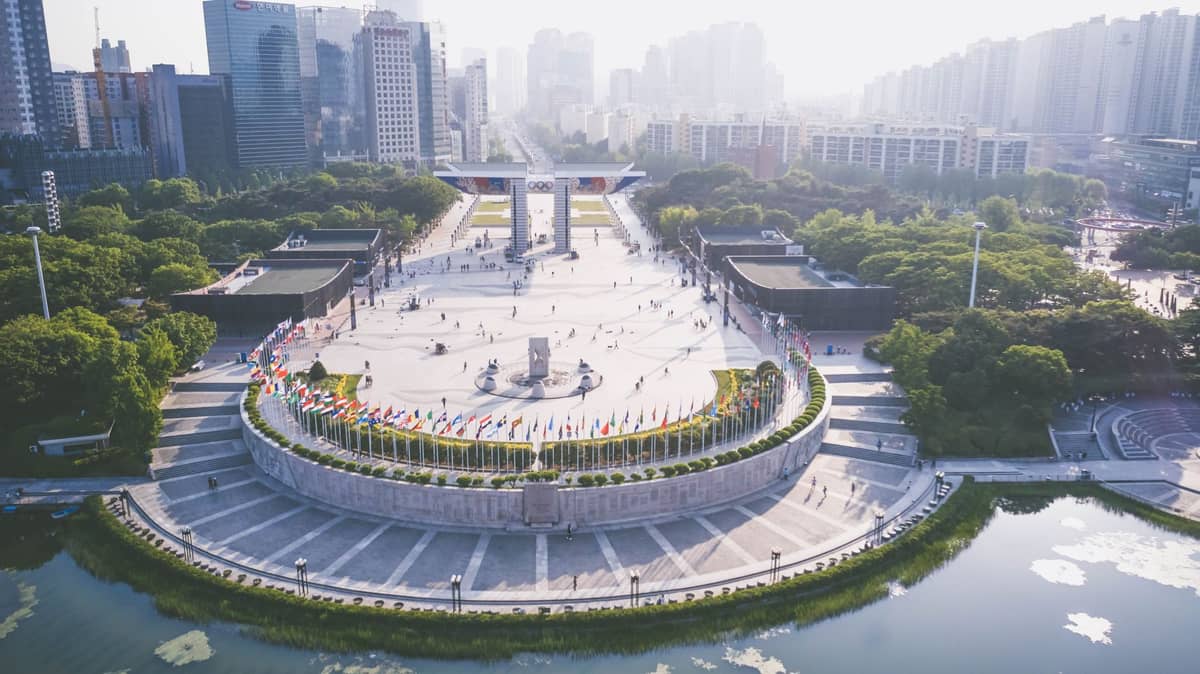
Olympic Park (올림픽공원) is a 1.51 square kilometer public park in Songpa-gu, on Seoul's southeastern side. It was constructed as part of South Korea's preparations for the 1988 Summer Olympics and opened on May 28, 1986. When the Games ended, the park was preserved and expanded into a permanent public space rather than left to decay as post-Olympic facilities so often are.
Today it functions simultaneously as a sports complex, outdoor sculpture museum, concert venue, and neighborhood park. The site holds several Olympic-era sports halls that still host professional events, a well-maintained network of walking and cycling paths, a large open meadow called Hanul Meadow, and an outdoor collection of more than 200 sculptures spread across the landscaped paths. Admission is free for the general park area, which makes it one of the most accessible large green spaces in the city.
ℹ️ Good to know
Opening hours: The park is accessible daily from 05:00 to 22:00 for walking and cycling. Some square areas remain open until 24:00. Vehicle access runs 06:00 to 22:00. Entry after 22:00 is generally prohibited for visitor safety and facility protection. Verify hours before visiting as they may be adjusted seasonally.
The Olympic Legacy: History You Can Walk Through
The 1988 Seoul Olympics marked a turning point for South Korea on the world stage, arriving at a moment when the country was emerging from decades of military government and rapid industrialization. Hosting the Games was a signal of arrival, and the infrastructure built for them reflects that ambition. Olympic Park was not a temporary installation, it was designed as a civic monument.
Within the park boundaries, several of the original Olympic venues remain standing and in active use, including the gymnastics hall and the velodrome. The Olympic Museum on the grounds traces the history of the Games and Korea's participation in the Olympic movement more broadly. It is a low-key space rather than a grand institution, but it provides useful context for understanding why the park carries the significance it does in Korean national memory.
The park also sits adjacent to the site of Mongchon Fortress (몽촌토성), an earthen fortification from the Baekje Kingdom period. The fortress walls are preserved within the park and are walkable. This means that a visit to Olympic Park offers an unexpected layering of history: ancient Korean earthworks beneath an infrastructure built for a Cold War-era global sporting event. For visitors already interested in Seoul's longer history, the combination is worth noting. The nearby and are also in the Songpa area and pair naturally with a visit here. The fortress walls are preserved within the park and are walkable. This means that a visit to Olympic Park offers an unexpected layering of history: ancient Korean earthworks beneath an infrastructure built for a Cold War-era global sporting event. For visitors already interested in Seoul's longer history, the combination is worth noting. The nearby Lotte World Tower and Seokchon Lake are also in the Songpa area and pair naturally with a visit here.
Tickets & tours
Hand-picked options from our booking partner. Prices are indicative; availability and final rates are confirmed when you complete your booking.
DMZ and Lake Majang Suspension Bridge Tour from Seoul
From 57 €Instant confirmationFree cancellationHalf Day DMZ Tour from Seoul, 3rd Tunnel, Observatory and More
From 47 €Instant confirmationFree cancellationSeoul zombie city exploration game and private tour
From 10 €Instant confirmationFree cancellationLuggage Storage in Seoul
From 7 €Instant confirmationFree cancellation
The Sculpture Collection: 200 Works, No Ticket Required
One of the least-anticipated aspects of Olympic Park is the quality of its outdoor art. The 1988 Seoul Olympic World Sculpture Symposium brought artists from dozens of countries to create works directly on-site, and those pieces remain installed throughout the park. The collection includes over 200 sculptures, ranging from large abstract steel forms to figurative bronze work, spread across the landscaped paths in a way that rewards slow walking rather than rushing.
The works vary significantly in quality and in how well they have aged, as you would expect from any large group show. But the overall effect of encountering unexpected sculpture around each bend in the path is genuinely pleasurable. In morning light, some of the metal pieces cast long shadows across the grass in ways that photographers find worth planning for. There is no guided tour of the collection on a fixed schedule, so picking up a map at the entrance and exploring at your own pace is the standard approach.
How the Park Changes by Time of Day
Early mornings from around 05:30 to 08:00 belong almost entirely to local residents. Older men and women walk the perimeter paths in measured, deliberate laps. Joggers circle the meadow. The air is noticeably cooler in spring and autumn, and the park is quiet enough that birdsong is audible near the tree lines. If you want the park largely to yourself, this is the window.
Midday on weekdays is calm and manageable, with students, office workers on lunch breaks, and tourists exploring at a relaxed pace. Weekends between 10:00 and 15:00 see a significant increase in families: children on rental bikes, groups setting up picnics on Hanul Meadow, and couples walking among the sculptures. The park is large enough that it never feels oppressively crowded, but the main meadow and central pathways do get busy.
Evenings bring a different atmosphere, particularly in warm months. The lighting along major paths is adequate for safe walking, and the park takes on a softer, more social character. When concerts or events are scheduled at the KSPO Arena or the Olympic Hall within the grounds, the surrounding areas fill with attendees before and after shows. On non-event evenings, the park is peaceful until closing.
💡 Local tip
Best overall timing: Weekday mornings in April, May, September, or October give you mild temperatures, low crowds, and good natural light for the sculpture collection. Summer visits are manageable early in the day but can become uncomfortably humid by midmorning.
Getting There and Moving Around Inside
The most direct subway access is The most direct subway access is Olympic Park Station on Lines 5 and 9, Exit 4. This brings you to the main entrance near the central plaza. Mongchontoseong Station on Line 8 provides access to the northwestern section of the park near the ancient fortress walls, which is useful if your priority is the historical earthworks rather than the main sculptural areas. Hanseong Baekje Station on Line 9 serves the southern side.
Multiple bus routes also serve the park, and taxis drop off directly at the main entrance without difficulty. For getting around Seoul more broadly, including choosing the right transport card for subway use, the getting around Seoul guide covers the practical details.
Inside the park, bicycle rental is available, which is a practical choice given the size of the grounds. Walking the full perimeter comfortably takes around 50 to 70 minutes at a moderate pace without stopping, and the terrain is largely flat. Visitors with limited mobility will find the main paths paved and accessible, though some sections near the fortress earthworks involve uneven or unpaved terrain.
Events, Concerts, and Seasonal Highlights
Olympic Park hosts a significant number of concerts and large-scale events throughout the year. The KSPO Arena (formerly Olympic Gymnastics Arena) is a major indoor concert venue and regularly attracts both Korean and international acts. The Olympic Hall is a smaller attached venue used for mid-scale performances. If you are visiting Seoul with any interest in live music, checking the current schedule at the park is worth doing before you finalize your itinerary.
The park's seasonal character changes noticeably. In spring, cherry and plum blossoms bloom along several of the internal paths, drawing larger crowds in late March through early April. Autumn brings yellow ginkgo and red maple foliage that frames the sculpture collection particularly well. For broader context on timing a trip, the and offer useful detail. For broader context on timing a trip, the Seoul in autumn guide and Seoul in spring guide offer useful detail.
Summer weekends during the peak of the rainy season (typically late June through July) can make extended outdoor visits uncomfortable. Rain, high humidity, and heat combine in ways that diminish the experience of walking an outdoor sculpture park. A light rain jacket is worth carrying any time between May and September.
Food, Facilities, and What to Bring
Convenience stores and snack vendors operate within and immediately outside the park entrances. For a proper meal, the commercial area near Olympic Park Station has restaurants covering Korean staples, cafes, and fast food. The park itself is large enough that carrying water is genuinely recommended, particularly in summer. Shade from trees is plentiful along the perimeter paths but thinner in the central meadow areas.
Restrooms are distributed at regular intervals throughout the park and are maintained to a reasonable standard. Picnicking on the grass is common and accepted, so bringing food from nearby shops or the station area is a completely viable approach. Rental bicycles are available near the main entrance. Parking exists for those arriving by car, with vehicle access running from 06:00 to 22:00.
⚠️ What to skip
Photography note: While the park and sculpture collection are publicly accessible, some individual sculptures may carry artist copyright considerations for commercial use. For personal travel photography, the entire park is fair territory and the sculptures photograph best in the soft light of early morning or late afternoon.
Insider Tips
- The western section near Mongchontoseong Station receives significantly fewer visitors than the main entrance area. If you want the fortress earthworks and some of the quieter sculpture placements almost to yourself, enter from that side and work inward.
- Concert nights at KSPO Arena mean the area around Exit 4 of Olympic Park Station can become very congested after 22:00. If you are visiting on a non-event day, check the KSPO schedule in advance so you know what to expect on public transit heading home.
- The park's large open meadow is one of the few places in Seoul where kite-flying is genuinely feasible. On breezy spring and autumn afternoons, you will see locals doing exactly this. It is also a good spot to spread out and take a break from the city without paying anything.
- If you visit in late September or early October, the ginkgo trees along the internal paths turn a sharp yellow and frame several of the larger sculptures in a way that is worth photographing. The timing overlaps with slightly cooler, clearer weather than the summer months.
- There are multiple park entrances, and using different exits for arrival and departure makes it easier to cover more ground. The southern entrance near Hanseong Baekje Station puts you close to sections of the park that many first-time visitors miss entirely.
Who Is Olympic Park For?
- Families with children looking for open space, cycling, and outdoor activity without entrance fees
- Runners and walkers who want a flat, scenic route away from Seoul's heavier traffic
- Travelers interested in Korea's modern history and the cultural legacy of the 1988 Olympics
- Photography enthusiasts who want to work through an outdoor sculpture collection in natural light
- Concert and live music attendees using the KSPO Arena or Olympic Hall as their primary destination
Nearby Attractions
Other things to see while in Jamsil & Songpa:
- Lotte World Adventure
Lotte World Adventure is a massive theme park complex in Jamsil, Seoul, combining one of the world's largest indoor amusement parks with an outdoor section built around Seokchon Lake. Open 365 days a year and steps from the subway, it draws families, couples, and thrill-seekers in every season.
- Lotte World Tower & Seoul Sky
At 555 meters and 123 stories, Lotte World Tower is the tallest building in South Korea and the sixth tallest in the world. Its Seoul Sky observatory spans floors 117 to 123, offering a glass-floored skywalk, open-air terraces, and views that stretch across the entire Han River basin on clear days. Here is what to expect before you go.
- Seokchon Lake
Seokchon Lake, officially part of Songpa Naru Park in Jamsil, is a 200,000+ square meter artificial lake with a 2.6 km walking path. Free to enter at any hour, it draws cherry blossom crowds in spring, joggers at dawn, and families on weekends — all with Lotte World Tower as an unlikely but photogenic backdrop.