Seokchon Lake: Seoul's Most Scenic Free Park (Songpa Naru Park Guide)
Seokchon Lake, officially part of Songpa Naru Park in Jamsil, is a 200,000+ square meter artificial lake with a 2.6 km walking path. Free to enter at any hour, it draws cherry blossom crowds in spring, joggers at dawn, and families on weekends — all with Lotte World Tower as an unlikely but photogenic backdrop.
Quick Facts
- Location
- 136 Samhaksa-ro, Songpa-gu, Seoul (Jamsil-dong)
- Getting There
- Subway Line 2/8, Jamsil Station Exit 3; or Seokchon Station Exit 8
- Time Needed
- 1–2 hours for a full lake loop; longer if you linger at cafes
- Cost
- Free, open 24 hours year-round
- Best for
- Cherry blossom season, morning walks, family outings, photography
What Is Seokchon Lake?
Seokchon Lake, known in Korean as Seokchonhosu and situated within Songpa Naru Park (송파나루공원), is one of Seoul's largest and most visited urban parks. The lake itself is an artificial body of water born from the Hangang River reclamation project, completed on June 28, 1978. Its total park area spans 217,850 square meters, with the lake covering over 200,000 square meters split into east and west sections. The surrounding 2.6 km walking path is flat, paved, and genuinely pleasant — no hills, no scrambling, just a smooth loop around open water.
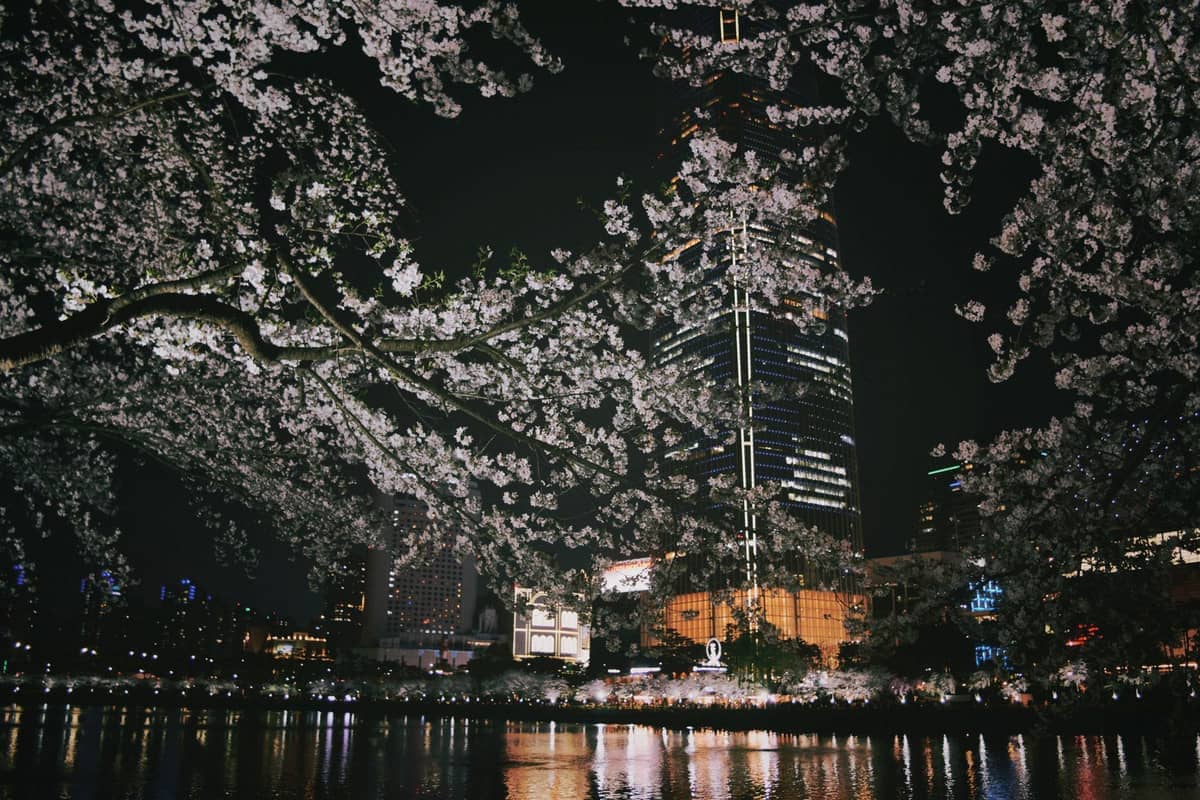
The lake sits in Jamsil, Songpa-gu, in southeastern Seoul. Nearby is Lotte World Tower, South Korea's tallest skyscraper at 555 meters, which provides a striking architectural counterpoint to the willows and cherry trees lining the water's edge. This contrast — glassy tower reflected in a calm urban lake — is what makes Seokchon photogenic in a way that is genuinely difficult to replicate elsewhere in the city.
ℹ️ Good to know
Admission is completely free and the park is open 24 hours, year-round. There are no gates, no ticket booths, and no reservation systems required.
The Lake Through the Day: How the Experience Changes
Early mornings at Seokchon Lake are as calm as any place you will find in a city of nearly 10 million people. By 6:00 am, the path already has regulars: older residents power-walking in light tracksuits, younger joggers with earphones in, and the occasional fisherman sitting in perfect stillness along the bank. The light across the water is soft and cool, particularly in spring and autumn, and the Lotte Tower reflection holds clearly on the glassy surface before the day's foot traffic disturbs the shore.
Midday on weekdays is the quietest window for those who want the path with minimal company. Office workers sometimes eat lunch on the benches near the southeastern edge, and small children from nearby nurseries occasionally appear in groups, but the crowd is thin enough that you can set your own pace comfortably. Weekends change the equation significantly: by late morning, families with strollers, couples on bikes, and teenagers sprawled on the grass fill out the banks. This is not an intrusive crowd — the park is large enough to absorb it — but it is noticeably different from weekday solitude.
At dusk, the tower lights up and its reflection doubles in the southern basin. This is the most photographed hour at Seokchon Lake, and for good reason. If you are visiting primarily for photography, position yourself on the western bank of the south lake between 6:00 and 7:30 pm during spring or autumn for the best combination of warm ambient light and tower illumination. Winter evenings work too, and the bare branches actually clear the sightlines.
Tickets & tours
Hand-picked options from our booking partner. Prices are indicative; availability and final rates are confirmed when you complete your booking.
DMZ and Lake Majang Suspension Bridge Tour from Seoul
From 57 €Instant confirmationFree cancellationHalf Day DMZ Tour from Seoul, 3rd Tunnel, Observatory and More
From 47 €Instant confirmationFree cancellationSeoul zombie city exploration game and private tour
From 10 €Instant confirmationFree cancellationLuggage Storage in Seoul
From 7 €Instant confirmationFree cancellation
Cherry Blossom Season: Worth the Crowds?
Each spring, typically in late March through early April depending on the year's temperatures, Seokchon Lake transforms into one of the most visited cherry blossom spots in Seoul. The path is lined with hundreds of Yoshino cherry trees, and when they peak, the canopy closes over the walkway in a corridor of pale pink. The petals drift across the water's surface and collect in soft drifts along the edges — it is as visually intense as the photographs suggest.
The honest caveat: during peak bloom on a weekend, the path becomes genuinely dense with visitors. Street food vendors set up along the perimeter, music plays from temporary stalls, and moving quickly around the loop is not really possible. If you want the blossoms without the crowd compression, aim for weekday mornings before 9:00 am, or visit in the late evening when many day visitors have left and the trees are lit from below. The Songpa Naru Park area also hosts an official cherry blossom festival, with additional performances, exhibitions, and hands-on activities; check the Songpa-gu Office website for current year dates and programming.
For context on Seoul's wider spring calendar and other flowering spots, the Seoul in spring guide covers timing strategies and alternative blossom locations across the city.
Walking the Loop: What to Actually Notice
The lake is divided into two basins: a slightly larger northern section and a southern section, connected by a short walkway near the park's center. Most visitors complete the full outer loop, which takes roughly 30 to 40 minutes at a leisurely pace without stops. The path is suitable for strollers and accessible for most mobility levels, though the source materials do not confirm specific accessibility infrastructure such as ramps or accessible restrooms at every point — verify on-site or with the Songpa-gu Office before visiting with specific accessibility requirements.
Along the northern bank, weeping willows trail into the water and benches face directly toward the Lotte complex. The southern bank is more open and grassy, and is where most families set down blankets on weekends. Near the western edge, small cafes and snack vendors operate outside the park boundary along the adjacent street — you can step out, grab a coffee, and return to the path in under five minutes. Inside and around the park, there are basic restroom facilities and nearby cafes and snack options along adjacent streets.
💡 Local tip
Wear comfortable flat shoes. The 2.6 km loop is entirely flat and paved, but if you plan to sit on the grass banks, a light layer or picnic mat helps — the ground stays damp near the water's edge in spring and autumn mornings.
Seokchon Lake sits close to several other worthwhile destinations in Jamsil. The Lotte World Adventure indoor theme park is a short walk north, and the Lotte World Tower observation deck offers aerial views of the lake itself — seeing the two basins from above is a completely different and worthwhile perspective.
Historical and Ecological Context
Seokchon Lake's origins lie in Seoul's postwar urban development. The Hangang River once branched through this area, and the reclamation and road construction in the 1970s left behind what became the lake. Rather than fill it in, the city converted the area into public green space, completing Songpa Naru Park in 1978.
The lake supports a modest urban ecosystem, with birds commonly seen along the banks and mature trees and willows giving the park its established character today.
Getting There and Nearby
The most straightforward approach is Jamsil Station (Lines 2 and 8), Exit 3, which deposits you a short walk from the lake's northern edge. Seokchon Station Exit 8 brings you to the southern side and is slightly less congested during peak cherry blossom weekends. Both stations are well-served, and the walk to the lake from either exit is flat and clearly signposted. Buses also stop along Samhaksa-ro, the road running adjacent to the park.
If you are planning a full day in the area, the Jamsil-Songpa neighborhood has enough to justify staying from morning to evening. The Olympic Park — one of Seoul's largest green spaces — is reachable by subway in under 15 minutes and makes a logical second stop.
For those building a wider Seoul itinerary, the 3-day Seoul itinerary places Jamsil as a natural half-day anchor on the eastern side of the city, pairing well with Gangnam across the river.
Who Should Skip This, and When
Travelers who measure attractions by historical depth or cultural programming will find Seokchon Lake thin. There are no exhibitions, no guided tours, no entry structures, and no formal interpretation of the site's history. It is a park. If your Seoul trip is short and focused on palaces, museums, or street food markets, this will not compete with those priorities.
Midsummer visits — particularly during and after the jangma rainy season (typically June to July) — can be uncomfortable. The humidity near open water on a 30°C afternoon is significant, and the tree cover on the path is partial rather than complete. The park does not lose its character in summer, but it requires more planning: early morning or evening visits, hydration, and realistic expectations about comfort levels.
⚠️ What to skip
During cherry blossom peak weekends, the area around Jamsil Station and the park perimeter becomes extremely crowded. Expect slower subway exits, limited seating, and some street closure for pedestrian management. Budget extra time if connecting to Lotte World or other nearby venues on the same day.
Insider Tips
- The south lake's western bank at dusk gives you the best unobstructed Lotte Tower reflection. Arrive 30 minutes before sunset and stay for the tower's evening illumination — the two-stage transition from natural to artificial light is worth the wait.
- During cherry blossom season, the crowds thin noticeably after 8:00 pm when families head home for dinner. The trees are lit and the path is far quieter — this is the best window to walk the loop and actually photograph without crowds in every frame.
- Seokchon Station Exit 8 is less chaotic than Jamsil's Exit 2 during festival weekends because it deposits you on the south lake's edge, away from the main vendor stalls and food crowds that cluster near the northern entrance.
- The ducks near the willow benches on the northern bank are perpetually fed by visitors. If you want to observe them naturally rather than in a feeding frenzy, the southeastern corner of the lake near the connector path tends to be quieter and the birds are calmer there.
- For the clearest reflection photography, come on a calm day with low wind — even a light breeze breaks the mirror effect on the lake surface. Autumn weekday mornings after a still night reliably produce the best conditions.
Who Is Seokchon Lake For?
- Cherry blossom season visitors wanting an alternative to the packed crowds at Yeouido
- Families with young children who need open, flat, free outdoor space with easy transit access
- Photographers targeting the Lotte Tower reflection and blossom canopy compositions
- Joggers and walkers who want a measured, pleasant urban loop with consistent surface quality
- Travelers with a half-day in Jamsil looking to bookend a theme park or tower visit with some green space
Nearby Attractions
Other things to see while in Jamsil & Songpa:
- Lotte World Adventure
Lotte World Adventure is a massive theme park complex in Jamsil, Seoul, combining one of the world's largest indoor amusement parks with an outdoor section built around Seokchon Lake. Open 365 days a year and steps from the subway, it draws families, couples, and thrill-seekers in every season.
- Lotte World Tower & Seoul Sky
At 555 meters and 123 stories, Lotte World Tower is the tallest building in South Korea and the sixth tallest in the world. Its Seoul Sky observatory spans floors 117 to 123, offering a glass-floored skywalk, open-air terraces, and views that stretch across the entire Han River basin on clear days. Here is what to expect before you go.
- Olympic Park
Built for the 1988 Seoul Summer Olympics and opened in 1986, Olympic Park is one of Seoul's largest and most varied green spaces. Free to enter, it draws joggers at dawn, families on weekends, and concert-goers at night, all within a sprawling park that blends sports history, public sculpture, and quiet walking paths.