Lotte World Tower & Seoul Sky: The Complete Visitor's Guide
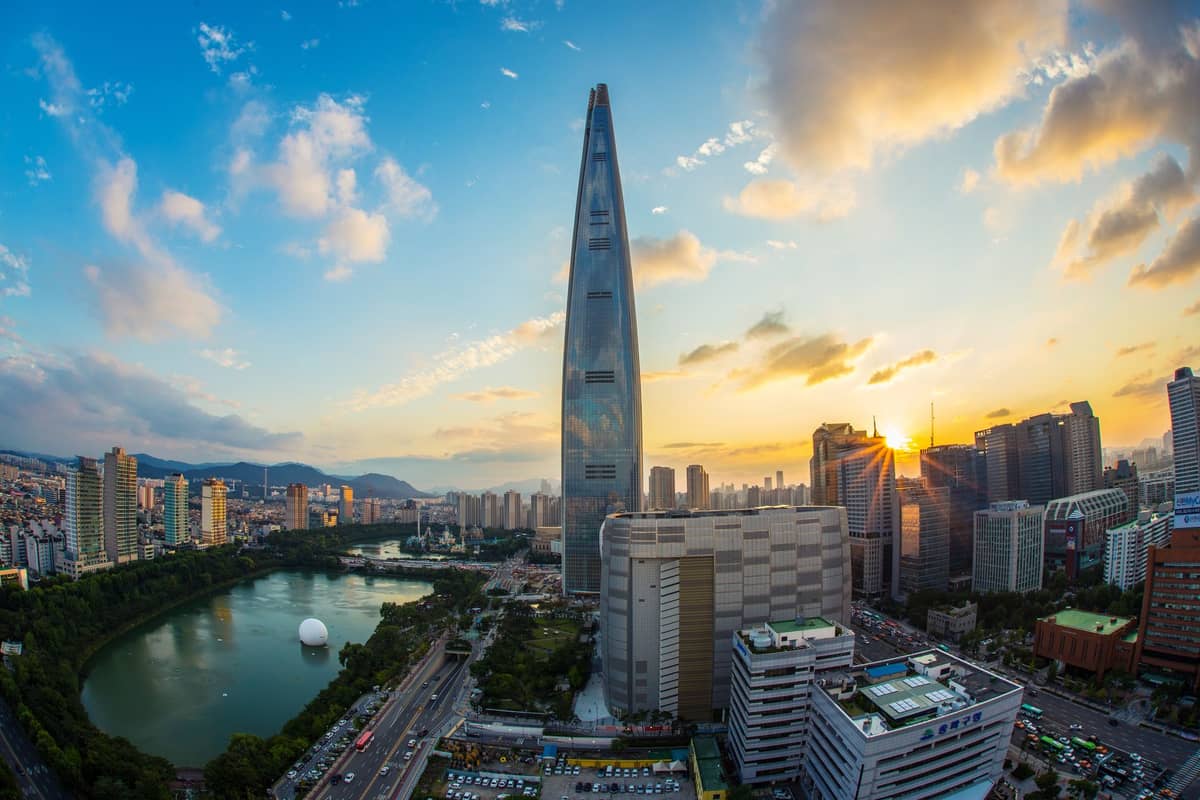
At 555 meters and 123 stories, Lotte World Tower is the tallest building in South Korea and the sixth tallest in the world. Its Seoul Sky observatory spans floors 117 to 123, offering a glass-floored skywalk, open-air terraces, and views that stretch across the entire Han River basin on clear days. Here is what to expect before you go.
Quick Facts
- Location
- 300 Olympic-ro, Songpa-gu, Seoul
- Getting There
- Jamsil Station (Lines 2 & 8), Exit 2 — 5-minute walk
- Time Needed
- 1.5 to 2.5 hours for the full observatory experience
- Cost
- Approx. ₩31,000 adults / ₩27,000 children (verify current prices at official site)
- Best for
- City views, architecture, couples, families with older children
- Official website
- www.lwt.co.kr/en/entertainment/seoulsky.do
What Seoul Sky Actually Is
Lotte World Tower completed construction in 2017 after roughly a decade of planning and build. Standing at exactly 555 meters across 123 floors, it is the tallest structure in South Korea and ranks among the ten tallest buildings ever completed globally. The tower is not purely an observation deck: it houses offices, a luxury hotel, residences, and retail floors below the skyline experience. Seoul Sky, the observatory component, occupies the top seven floors (117 through 123) and is the only section that requires a separate admission ticket.
The design, led by Kohn Pedersen Fox Associates, draws on traditional Korean celadon pottery and calligraphy brushstroke forms. From a distance, the tower tapers into a smooth, slightly curved silhouette that avoids the blocky aggression of many supertall skyscrapers. Up close, the glass curtain wall reflects the sky in tones that shift through the day from pale blue in morning to deep amber at sunset. It is a genuinely striking piece of architecture by any measure, not just by Seoul standards.
ℹ️ Good to know
Seoul Sky hours: Sunday to Thursday 10:30–22:00, Friday, Saturday, and the day before public holidays 10:30–23:00. Last ticket sales and admission are typically 1 hour before closing.
The Observatory Experience, Floor by Floor
Elevators from the lower lobby carry visitors to the 117th floor quickly. The ride itself is worth noting: Otis designed the high-speed elevator system specifically for the tower, and the ascent is smooth enough that you register the speed more through the pressure in your ears than through any sensation of movement. A small multimedia display inside the elevator cabin uses projection to show the tower's height relative to other global landmarks as you rise.
Floor 117 is the main indoor observatory. The full circumference of the floor is glass, and the first thing that registers is the sheer flatness of eastern Seoul spreading beneath you. Jamsil Olympic Stadium sits almost directly below. The Han River cuts a wide, grey-green diagonal across the southern half of the panorama. On a clear autumn day you can pick out Namsan Mountain and N Seoul Tower to the northwest, and the ridgeline of Bukhansan National Park further north. The distance and altitude lend the city a strange stillness: the Han River looks like a painted surface, not flowing water.
Floors 118 to 122 hold a mix of exhibitions, a sky café, a lounge bar, and retail space selling observatory-branded merchandise. The content of temporary exhibitions changes, so it is worth checking the official site before your visit if this matters to you. Floor 118 is the glass skywalk level.
💡 Local tip
The glass skywalk on floor 118 uses transparent flooring panels set directly over the drop. Vertigo-prone visitors should test their comfort at floor 117 first before committing to the full circuit above.
Tickets & tours
Hand-picked options from our booking partner. Prices are indicative; availability and final rates are confirmed when you complete your booking.
DMZ and Lake Majang Suspension Bridge Tour from Seoul
From 57 €Instant confirmationFree cancellationHalf Day DMZ Tour from Seoul, 3rd Tunnel, Observatory and More
From 47 €Instant confirmationFree cancellationSeoul zombie city exploration game and private tour
From 10 €Instant confirmationFree cancellationLuggage Storage in Seoul
From 7 €Instant confirmationFree cancellation
How the Experience Changes by Time of Day
Morning visits (opening at 10:30) are the least crowded, and the light quality is workable for photography, especially looking west toward the city core. The haze that builds through the day has not yet accumulated, and the shadows from low-angle sun give the city's topography more visible texture.
Sunset visits are the most photographed, and the reason is simple: Seoul's western orientation from this vantage means you watch the sun descend toward the Namsan ridge and the city skyline. Colors shift quickly from golden orange to deep red in a span of about 20 minutes, and on especially clear evenings the Han River catches the last light as a bright ribbon. The trade-off is that this is peak crowd time. Families, couples, and tour groups all converge from roughly one hour before sunset, and queuing for the elevator can extend significantly.
Night visits, particularly on Friday and Saturday when closing extends to 23:00, offer a genuinely different experience. The city transitions into a circuit board of orange and white light. The Han River bridges and the apartment blocks of Gangnam and Songpa create a dense, layered luminosity. For night photography, bring or rent a tripod if possible; the long exposures required at this height mean camera shake will ruin handheld shots.
Getting There and Buying Tickets
Take Seoul Metropolitan Subway Line 2 (Green) or Line 8 (Pink) to Jamsil Station and use Exit 2. The tower entrance is a short walk through a connecting mall corridor. The area around Jamsil Station is one of Seoul's major commercial hubs, so there is no shortage of food and convenience options before or after your visit. For a broader orientation to the neighborhood, see our guide to Jamsil and Songpa.
Tickets can be purchased in advance through the official website and select ticketing platforms. A Fast Pass tier is available on some ticketing channels, which is worth considering on weekend evenings. These prices should be verified against the official site before your visit, as they are subject to change. Children, seniors, and groups may qualify for reduced rates.
⚠️ What to skip
On weekends and public holidays, especially during autumn (September–October) and cherry blossom season (late March–April), queues for elevator access can reach 45–60 minutes without a Fast Pass. Plan accordingly or arrive at opening time.
Photography, Visibility, and What Might Disappoint You
Visibility is the single biggest variable in the Seoul Sky experience. Seoul sits in a basin influenced by both its own urban emissions and seasonal yellow dust (hwangsa) blowing in from the Chinese mainland, typically peaking in spring. On a clear October afternoon, the views are genuinely spectacular and extend well beyond the city limits. On a grey spring day with haze, the city fades out at a much shorter distance and the experience feels significantly more limited. Check the air quality index for Seoul before you go. For seasonal context, the best time to visit Seoul guide covers visibility conditions across different months.
Shooting through the glass on floors 117 to 122 will pick up reflections from interior lighting, particularly in the evening when the ambient light inside the room is brighter than the exterior. Press your lens directly against the glass and use a lens hood or your hand as a shield to eliminate most of the ghosting. The outdoor terrace (where available and weather-permitting) solves this entirely and produces cleaner results.
On the question of hype: Seoul Sky is a legitimate, high-quality observatory experience that competes comfortably with comparable facilities in Tokyo, Shanghai, and New York. It is not a quiet or particularly intimate experience at peak times. If your primary interest is a contemplative city view rather than a full commercial attraction package, the crowds and in-observatory retail presence may feel incongruous. For a less commercial high-up view, Namsan Seoul Tower offers a different kind of experience, though at a far lower altitude.
Practical Notes: Accessibility, What to Bring, and Nearby
The tower has elevator access to the observatory floors, and the internal layout is navigable at ground level. That said, no specific official wheelchair-accessibility statement has been confirmed for all observatory sections, including the glass skywalk level. Visitors with specific mobility requirements should contact the attraction directly before visiting.
Wear layers. The indoor observatory is climate-controlled, but any outdoor terrace access at 500-plus meters can be significantly colder and windier than ground level, even in mild seasons. In winter, the wind chill on exposed observation areas can be severe. Comfortable walking shoes are sufficient; there is no significant walking distance required.
The Lotte World complex directly below the tower includes Lotte World Adventure, one of Seoul's major indoor theme parks, as well as Seokchon Lake, a pleasant recreational lake immediately to the west of the tower that becomes one of Seoul's best cherry blossom spots each spring. Combining the lake walk with an observatory visit makes for a well-rounded half-day.
For a contrasting perspective on Seoul's skyline, Namsan Seoul Tower looks directly across the Han River toward the Lotte World Tower at night and provides one of the best exterior photographs of the supertall in the city. The best views in Seoul guide covers both towers in full comparison context.
Insider Tips
- The 10:30 opening slot on weekday mornings is the least crowded window by a significant margin. If you visit within the first 30 minutes of opening, you will often have the main observation floor nearly to yourself.
- The glass floor panels on level 118 are not all the same. Some sections overhang more dramatically than others. Walk the full circuit and find the panels that look directly down onto the street-level plaza for the most disorienting drop perspective.
- Seoul Sky sometimes offers night photography events with dedicated tripod areas. Check the official website's events calendar; these sell out but are worth the extra coordination.
- Seokchon Lake immediately to the west of the tower gives you the best ground-level photograph of the full tower silhouette. Walk around the southern bank of the lake about 20 minutes before sunset to frame the tower against the sky with water in the foreground.
- The sky café on the upper floors charges a premium, but ordering a single drink buys you a seat with an unobstructed window view for as long as you want to stay. If crowds on the main observation floor are heavy, this is a useful alternative.
Who Is Lotte World Tower & Seoul Sky For?
- Couples and first-time visitors to Seoul wanting the definitive aerial overview of the city
- Architecture and design enthusiasts interested in contemporary supertall construction
- Photographers planning a sunset or night cityscape shoot
- Families with older children comfortable with heights
- Travelers visiting during autumn for maximum visibility conditions
Nearby Attractions
Other things to see while in Jamsil & Songpa:
- Lotte World Adventure
Lotte World Adventure is a massive theme park complex in Jamsil, Seoul, combining one of the world's largest indoor amusement parks with an outdoor section built around Seokchon Lake. Open 365 days a year and steps from the subway, it draws families, couples, and thrill-seekers in every season.
- Olympic Park
Built for the 1988 Seoul Summer Olympics and opened in 1986, Olympic Park is one of Seoul's largest and most varied green spaces. Free to enter, it draws joggers at dawn, families on weekends, and concert-goers at night, all within a sprawling park that blends sports history, public sculpture, and quiet walking paths.
- Seokchon Lake
Seokchon Lake, officially part of Songpa Naru Park in Jamsil, is a 200,000+ square meter artificial lake with a 2.6 km walking path. Free to enter at any hour, it draws cherry blossom crowds in spring, joggers at dawn, and families on weekends — all with Lotte World Tower as an unlikely but photogenic backdrop.