Helsinki Old Church (Vanha Kirkko): Engel's Quiet Neoclassical Landmark
Completed in 1826 and designed by Carl Ludvig Engel, the Helsinki Old Church (Vanha Kirkko) is one of the city’s oldest surviving churches. Set inside a tranquil park in the Design District, it offers a rare moment of stillness just minutes from the city centre, with a neoclassical interior that rewards those who step inside.
Quick Facts
- Location
- Lönnrotinkatu 6, 00120 Helsinki – Old Church Park (Vanha kirkkopuisto), Kamppi / Design District
- Getting There
- Trams 1, 2, 3 – stop Erottaja; approx. 10–15 min walk south from Helsinki Central Railway Station
- Time Needed
- 30–60 minutes (church + park)
- Cost
- €6 / €5 (standard / reduced) from 1 June–31 August 2026; combined ticket options also available. Verify current hours and fees before visiting.
- Best for
- Architecture lovers, history seekers, anyone needing a quiet pause in the city centre
- Official website
- www.helsinginseurakunnat.fi/vanhakirkko.html.stx
What Is the Old Church and Why Does It Matter?
The Helsinki Old Church (Finnish: Helsingin vanha kirkko) is an Evangelical Lutheran church completed in 1826, making it one of the oldest surviving church buildings in the Finnish capital. It was designed by Carl Ludvig Engel, the German-Finnish architect whose neoclassical vision shaped much of central Helsinki's appearance, including Senate Square and the Cathedral. Long before Helsinki Cathedral was consecrated in 1852, this was the main Lutheran parish church while the earlier Ulrika Eleonora Church was being replaced.
The church sits inside Vanha kirkkopuisto, the Old Church Park, a green rectangle in the Kamppi area that feels considerably quieter than the surrounding streets. Office workers eat lunch on its benches, dog walkers cut through its paths, and tourists often pass by without realising the building is open to visitors. That low-key status is part of what makes it worthwhile.
For context on how this church fits into Helsinki's broader religious and architectural landscape, see the guide to Helsinki Cathedral and the surrounding Senate Square, both also designed by Engel.
ℹ️ Good to know
Opening hours vary by day and season. The city service map lists Mon–Wed & Fri 12:00–15:00 and Thu 12:00–20:30, while the parish site currently notes Mon–Fri 10:00–15:00. Hours can also change around church services and events. Always check the official parish page before visiting: helsinginseurakunnat.fi.
The Architecture: Engel's Wooden Neoclassicism
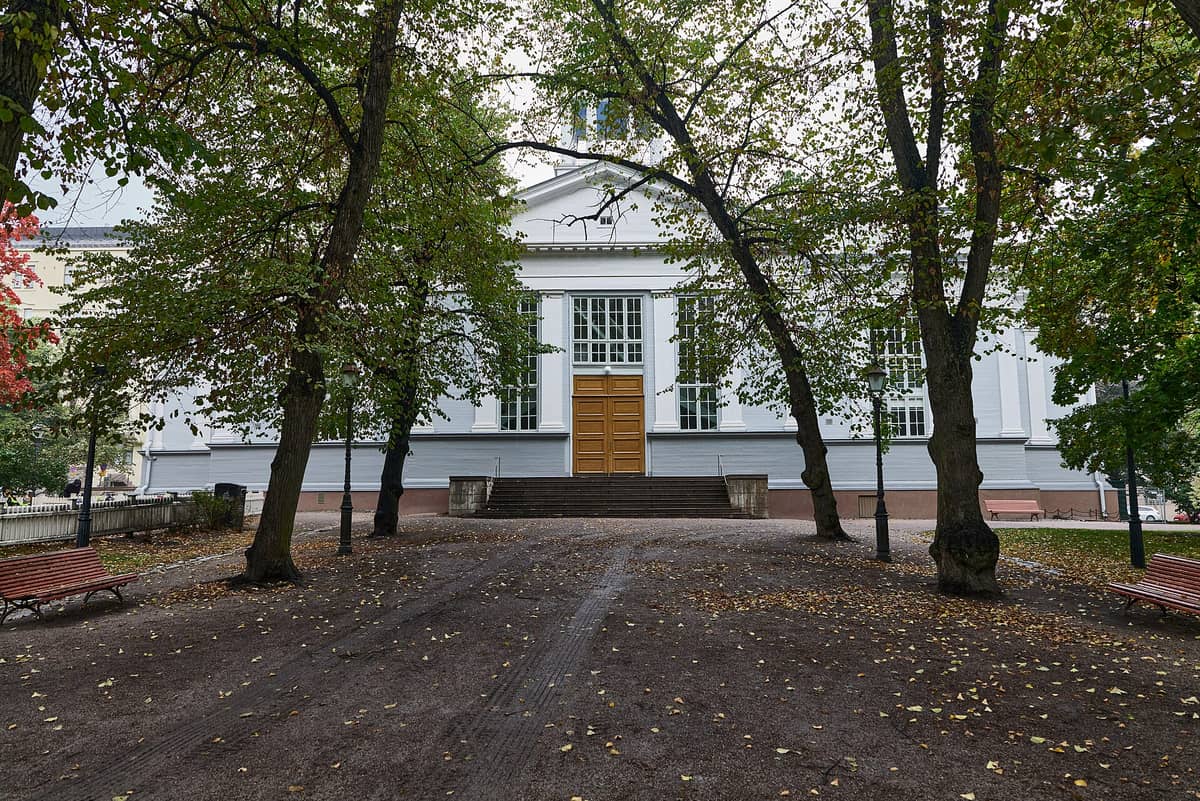
From across the park, the Old Church reads as a modest white-painted wooden structure beneath a grey roof. That modesty is deceptive. Engel designed it in a restrained neoclassical style that mirrors the stone buildings he was simultaneously planning for Senate Square, but adapted here for timber construction. The result is a building that has more presence than its timber construction suggests: clean pilasters frame the facades, and a small tower rises from the entrance end with a quiet authority.
Inside, the space seats approximately 1,200 people, a number that underlines how significant this building was for the young city of Helsinki in the early nineteenth century. The interior follows a longitudinal plan with a gallery running around three sides, supported by slender columns. Light enters through tall windows and falls evenly across white-painted surfaces. There is very little decorative noise — the architecture relies on proportion rather than ornamentation, which gives the space an almost meditative calm even when other visitors are present.
Visitors interested in Finnish architecture often overlook this church in favour of the more famous Temppeliaukio rock church, but the Old Church offers something different: a complete early nineteenth-century interior that has survived largely intact, and a direct connection to the architect who defined Helsinki's neoclassical identity.
If Engel's architectural legacy interests you, the Museum of Finnish Architecture is a short walk away in the Design District and provides deeper context on how Helsinki's built environment developed.
Tickets & tours
Hand-picked options from our booking partner. Prices are indicative; availability and final rates are confirmed when you complete your booking.
Helsinki Beautiful Canal Route, archipelago cruise
From 26 €Instant confirmationFree cancellationHelsinki Panorama Sightseeing Bus Tour With Audio Guide
From 35 €Instant confirmationFree cancellationHelsinki Pasila Street art district tour with a local
From 99 €Instant confirmationFree cancellationSurvival suit floating experience
From 125 €Instant confirmationFree cancellation
The Park: A Neighbourhood Green That History Made
Vanha kirkkopuisto, the park surrounding the church, carries a history most visitors do not expect. From the early 18th century it served as a burial ground, officially designated as a new cemetery in 1790 and largely discontinued when the much larger Hietaniemi Cemetery opened in 1829, before burials ceased entirely in 1919. The park's old trees and relatively uneven ground reflect that past, even though it has long since been converted to public green space. Some sources note that this history is why the park has a slightly different character from Helsinki's other central green spaces: quieter, slightly more contemplative.
In warmer months the park fills with a cross-section of neighbourhood life. Families with small children use the benches near the paths. In summer, when daylight extends well into the evening, people linger here long after office hours. In winter, when Helsinki sits under low grey skies and temperatures drop well below zero, the park takes on a different quality: snow collects on the church roof, the bare trees frame the white facade starkly, and the whole scene is genuinely photogenic in a way that requires no filter.
💡 Local tip
For photography, the church looks best in early morning light from the south-east corner of the park, or in winter when snow is on the ground. The wooden facade and the tree canopy frame each other well from that angle.
What to Expect When You Visit
Arriving at the church involves no queue and no ticket booth during most of the year. During the summer ticketed period (1 June to 31 August 2026), a €6 / €5 admission fee applies. You walk up to the entrance, push open a heavy door, and step into the interior. The transition from street noise to interior quiet is immediate and pronounced. The building is still an active parish church, so if a service is in progress the nave may be closed to sightseers. The Thursday extended hours until 20:30 make this one of the few Helsinki churches accessible in the early evening, which is worth noting if your daytime schedule is packed.
Dress code is informal by Finnish standards, but as with any functioning church, respectful clothing is appropriate. There are no formal restrictions, but the space is in active religious use and that atmosphere is noticeable. Voices naturally lower and movement slows. It is not a space where you will want to rush.
Accessibility is straightforward. The church sits on level ground within a park that has paved paths. The building itself is on the Helsinki city service map with accessibility information. The surrounding streets are well served by trams, and the walk from the Erottaja tram stop takes only a few minutes along flat terrain.
⚠️ What to skip
During summer 2026, a €6 / €5 admission fee applies (1 June–31 August), in line with the parish’s current visitor arrangements. Check the parish website for confirmation before visiting, as the arrangement may evolve in subsequent years.
How It Fits Into a Day in This Part of Helsinki
The Old Church makes most sense as part of a walk through the Design District and Punavuori rather than as a standalone destination. From the Erottaja tram stop you are also within easy reach of Esplanadi Park to the north-east and the Design Museum a few blocks south. A logical itinerary combines all three without significant backtracking.
The Design District and Punavuori neighbourhood is a coherent area for a half-day walk: independent design shops, small galleries, and the Design Museum Helsinki are all within ten minutes of the church on foot.
If you are visiting Helsinki in winter, the Old Church and its park are among the more atmospheric spots in the city centre during snowfall. The quietness of the park contrasts with the busier streets two blocks away, and the church's white wooden facade against a grey winter sky is one of those Helsinki images that stays with you.
Honest Assessment: Is It Worth Your Time?
The Old Church is not a spectacle. It will not take your breath away the way the rock-hewn Temppeliaukio Church does. It is not surrounded by cafes or gift shops. There is no audioguide, no exhibition, no interactive element. What it offers is something more specific: a well-preserved early nineteenth-century Lutheran interior designed by one of Finland's most important architects, set inside a park with genuine historical depth, and almost entirely free of crowds at most hours.
Travellers who are primarily interested in Instagram-ready interiors, modern design, or Helsinki's contemporary food and nightlife scene can reasonably skip it. But for anyone with an interest in how Helsinki developed as a city, in neoclassical architecture, or simply in finding a few minutes of quiet in a central location, the Old Church is one of the most rewarding stops in this part of the city.
For a broader picture of Helsinki's architectural and cultural heritage, the best museums in Helsinki guide covers institutions that complement a visit here.
Insider Tips
- Thursday is the one weekday when the church stays open until 20:30 according to the current city service map. If you are visiting in summer and want to avoid the midday crowds in the park, a late-afternoon Thursday visit gives you the interior in quieter light and the park in the long Nordic evening.
- The park benches on the south side of the church face the facade directly and are almost always less occupied than those near the main paths. Good spot to sit and look at the building without interruption.
- The wooden construction is easy to miss if you approach from the street. Walk fully around the building before going in. The side and rear elevations show the timber structure more clearly than the main entrance facade.
- If you are visiting in winter, come after fresh snowfall. The combination of white paint, white snow, and dark tree trunks makes this one of the most photographically rewarding spots in the Design District at that time of year.
- The church is an active parish, not a museum. If you arrive during a service, the nave will be closed, but the park is always accessible. Check the parish calendar on the official website if you have a specific visit time in mind.
Who Is Old Church (Vanha Kirkko) For?
- Architecture and design travellers interested in Carl Ludvig Engel's neoclassical legacy
- Visitors wanting a quiet, unhurried stop in the middle of a busy city itinerary
- Photographers looking for Helsinki's most atmospheric winter exterior
- History-minded travellers exploring the early development of Helsinki as a capital city
- Anyone doing a Design District walking tour who wants to add genuine historical depth
Nearby Attractions
Other things to see while in Design District & Punavuori:
- Design Museum
Housed in a late 19th-century neogothic building in the heart of Helsinki's Design District, Design Museum Helsinki (Designmuseo) is Finland's national specialist museum for design. It traces the history of Finnish design from craft traditions to contemporary practice, with rotating international exhibitions alongside a permanent collection.
- Helsinki Design District
Design District Helsinki is a network of nearly 200 design-forward shops, galleries, studios and museums spread across more than 25 streets in the Punavuori and Ullanlinna neighborhoods. Founded in 2005 during Finland's official Year of Design, it remains the country's most concentrated patch of Finnish design culture. Walking it costs nothing — and rewards slow, curious visitors who take time to look past the obvious storefronts.
- Hietalahti Market Hall
Hietalahti Market Hall (Hietalahden kauppahalli) is a historic indoor market at the end of Bulevardi in Punavuori. Free to enter, it draws a mix of local shoppers, food vendors, and café-goers, making it one of Helsinki's more relaxed and authentic market experiences.
- Museum of Finnish Architecture
The Museum of Finnish Architecture, now part of the Architecture and Design Museum on Korkeavuorenkatu, is one of the few institutions in the world dedicated entirely to the culture of building design. Whether you arrive for a specific exhibition or simply to understand how a small Nordic nation shaped 20th-century architecture globally, it rewards a deliberate visit.