Noryangjin Fish Market: Seoul's Round-the-Clock Seafood World
Noryangjin Fisheries Wholesale Market is Seoul's largest and most active seafood trading floor, open around the clock every day of the year except major holidays. From pre-dawn wholesale auctions to late-night sashimi dinners eaten directly above the tanks, it offers an experience that blends raw commerce with genuine culinary culture.
Quick Facts
- Location
- 674 Node-ro, Dongjak-gu, Seoul 06900
- Getting There
- Noryangjin Station (Line 1 or Line 9), Exit 9 — approx. 209 m walk
- Time Needed
- 1.5 to 3 hours depending on whether you eat on-site
- Cost
- Free admission; seafood prices vary by vendor and season
- Best for
- Food lovers, early risers, curious travelers, seafood enthusiasts
- Official website
- http://www.susansijang.co.kr
What Noryangjin Fish Market Actually Is
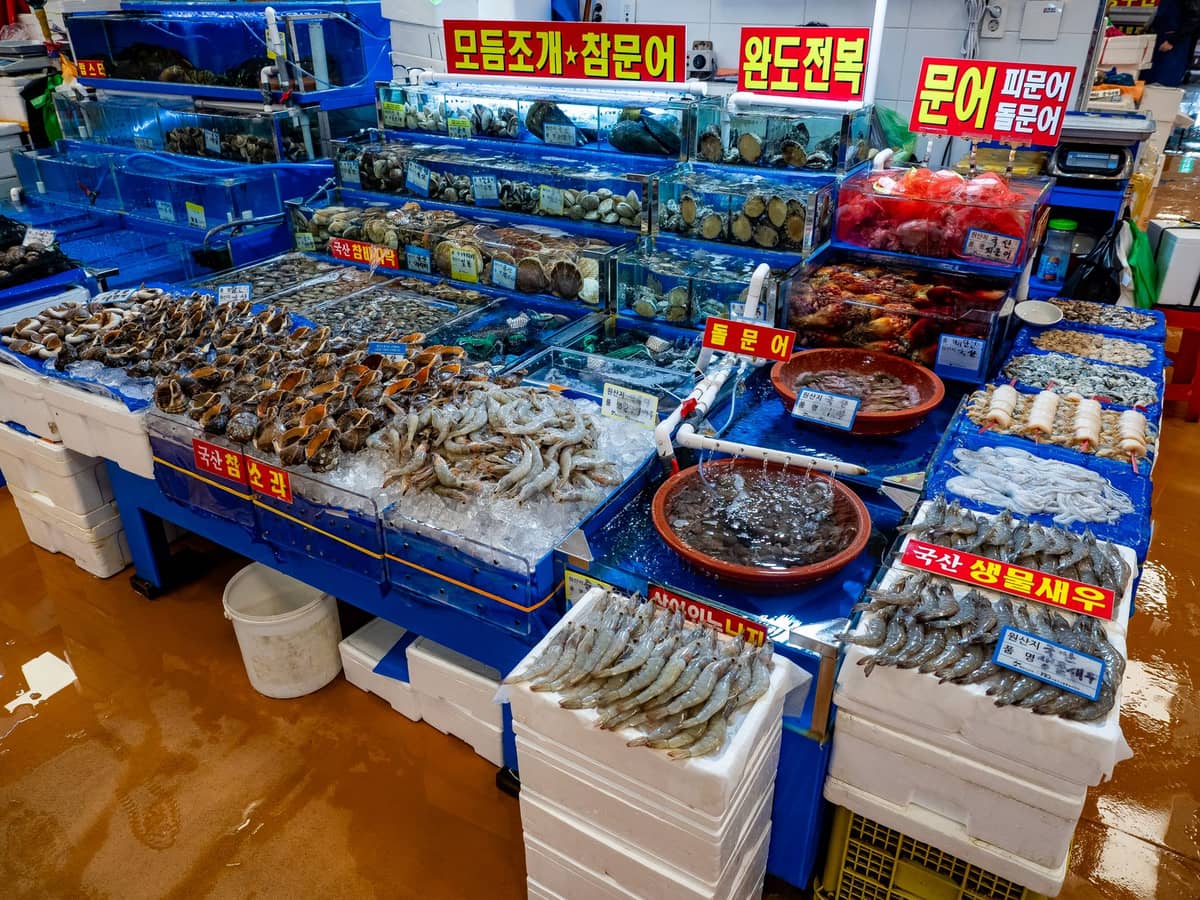
The Noryangjin Fisheries Wholesale Market (노량진수산물도매시장) is Seoul's primary seafood trading hub, sitting on the south bank of the Han River in Dongjak-gu. It is not a tourist market dressed up for visitors. It is a functioning wholesale operation that also welcomes the public, and that distinction shapes everything about the experience. The scale is immediately apparent when you step inside: row after row of wide concrete tanks hold live flounder, abalone, sea cucumber, crab, octopus, and dozens of species most visitors have never encountered in a market context.
The building divides roughly into two zones. The ground-level wholesale and retail floor is where vendors sell directly from tanks, and it operates 24 hours a day. Above or adjacent to the vendor stalls, most sellers have small upstairs restaurants where you can take your fresh purchase and have it sliced as sashimi (hoe, 회), grilled, or prepared as a stew, usually for a modest preparation fee. This buy-below, eat-above model is central to the Noryangjin experience and sets it apart from a standard food hall.
ℹ️ Good to know
Hours: The wholesale and retail area is open 24 hours daily. The auction floor operates from midnight but is closed on Sundays. The entire market is closed on January 1, Lunar New Year, and Chuseok. Admission is free.
The Pre-Dawn Auction: Worth the Early Start
The most dramatic way to visit Noryangjin is to arrive between 1:00 and 3:00 AM, when the wholesale fish auction is in full swing. Trucks unload crates of iced fish across the loading bays, and licensed buyers move fast between lots with practiced efficiency. The noise is specific: the thud of polystyrene boxes, the mechanical rhythm of an auctioneer's voice moving through bids in seconds, and the constant hiss of water over tanks. The overhead lighting at that hour is harsh and industrial, which makes the whole scene feel more authentic than any curated food market experience could.
Visitors are permitted to observe the auction area, though the working floor is controlled and crowded with traders. The best approach is to stay on the walkways, move deliberately, and avoid blocking the paths of workers carrying crates. Arriving before 2:00 AM gives you the clearest view of the full auction process. By 4:00 AM, the pace begins to shift as wholesale buyers clear out and retail vendors start arranging their stalls for the regular daytime trade.
💡 Local tip
If you plan to visit for the auction, take Line 1 or Line 9 to Noryangjin Station (Exit 9). Both lines run late-night and early-morning services, but check the last train times for your return journey before committing to an overnight visit.
Tickets & tours
Hand-picked options from our booking partner. Prices are indicative; availability and final rates are confirmed when you complete your booking.
DMZ and Lake Majang Suspension Bridge Tour from Seoul
From 57 €Instant confirmationFree cancellationHalf Day DMZ Tour from Seoul, 3rd Tunnel, Observatory and More
From 47 €Instant confirmationFree cancellationSeoul zombie city exploration game and private tour
From 10 €Instant confirmationFree cancellationLuggage Storage in Seoul
From 7 €Instant confirmationFree cancellation
Daytime Noryangjin: Slower Pace, Easier Navigation
By 9:00 AM the wholesale rush has settled and the retail section takes over as the market's main activity. This is when the experience becomes more approachable for first-time visitors. Vendors are less harried, English menus and laminated price boards appear more commonly, and the overhead lighting feels less aggressive as daylight filters into the building's upper sections. The smell is strong throughout, a sharp, saline mix of seawater, fresh fish, and the faint diesel note from delivery vehicles near the loading areas, but it is not unpleasant if you are comfortable in fish markets.
Navigating the stalls takes some orientation. The layout is dense and the signage is primarily in Korean. The practical approach is to walk the full length of one row before committing to a vendor, because prices and quality vary. Vendors near the main entrance tend to quote higher prices to tourists. Moving further into the market typically brings better value. If you want live crab, abalone, or sea urchin, vendors will often display the price per 100 grams on a small card next to the tank.
For travelers who want context before visiting, the guide to what to eat in Seoul covers Korean seafood vocabulary and eating customs that will make the market easier to navigate and more rewarding to eat through.
Buying and Eating: How the System Works
The standard process is straightforward once you understand it. Choose your seafood from a vendor's tank, agree on a quantity and price, and the vendor will bag or box it for you. You then take your purchase to the affiliated restaurant upstairs, usually indicated by a numbered sign or a direct staircase behind the stall. The restaurant will prepare it for a service fee that typically covers slicing, accompaniments like sesame oil and salt, and basic side dishes (banchan). The preparation fee varies by vendor and dish, so it is worth confirming before you hand over your seafood.
Raw flounder (광어, gwangeo) is the most commonly ordered preparation and is considered a benchmark dish at Noryangjin. Sea cucumber, live octopus (sannakji), and snow crab are also popular orders. Sannakji, served still moving after slicing, is a dish specific to Korean raw seafood culture and is offered here in its most direct form. Travelers who are uncertain about raw or moving seafood should not feel any pressure to order it. Grilled and stewed preparations are available from most upstairs restaurants and are equally authentic.
⚠️ What to skip
Sannakji (live octopus) carries a real choking risk if not chewed thoroughly. This is not a dramatization — it is a documented medical risk. Order it only if you understand what it involves and chew carefully.
Photography, Atmosphere, and Practical Details
Noryangjin photographs well at almost any hour, but the strongest images come either during the pre-dawn auction or in the mid-morning when vendors are actively arranging their tanks. The color contrast between the dark water, the vivid orange and red of crabs, and the silver of fresh fish against ice is visually dense. Most vendors do not object to photography of their stalls, but it is respectful to ask or gesture before pointing a camera directly at someone working. Do not photograph price negotiations or auctions in a way that disrupts the flow of trading.
Wear shoes that can handle wet floors. The entire market ground level stays damp from tank water and ice runoff, and the surfaces near loading areas can be slippery. A light jacket or layer is useful even in summer because the building's interior temperature is kept low for the fish. Avoid bringing large bags if you are visiting during peak wholesale hours, when the aisles are narrow and congested.
Accessibility information for the market is not fully documented in official tourism sources. The station at Noryangjin has some elevator access, but the market building itself involves wet, uneven floors and narrow aisles. Visitors with mobility limitations should be aware that on-site conditions may present challenges that are not flagged in standard listings.
Context: Noryangjin in Seoul's Food Culture
Noryangjin has operated as a major seafood distribution point for the Seoul region for decades, though its current building replaced an older structure that stood nearby. The market's role in the city's food supply chain is practical and central: much of the fresh seafood served at Seoul's restaurants passes through here before reaching the table. Visiting it alongside a place like Gwangjang Market gives a useful sense of how different categories of food culture operate in Seoul, from prepared street food to raw wholesale trade.
The market sits in Dongjak-gu, a residential and working district on the south side of the Han River, away from the high-tourism corridors of Jongno, Myeongdong, and Gangnam. That location is part of why the market retains its working character. It is not surrounded by souvenir shops or Instagram installations. The nearest major cultural draw is the Hangang Park, accessible along the river embankment and worth combining with a morning market visit, especially in spring or autumn when the riverbank is at its most pleasant.
For travelers building a Seoul itinerary that takes food seriously, the Seoul markets guide covers Noryangjin alongside the city's other major markets and explains how to plan an efficient route between them.
Who Should Think Twice
Noryangjin is not for everyone, and it is worth being direct about that. If strong smells in enclosed spaces cause discomfort, the ground floor in warm weather will be challenging regardless of the hour. Travelers who prefer curated, photogenic food experiences in clean, well-lit settings will likely find the reality of a working wholesale market more abrasive than appealing. The market also requires some tolerance for negotiation, language barriers, and the basic conditions of a place that prioritizes trade over visitor comfort.
Families with very young children can visit but should plan for wet floors, narrow aisles, and the presence of live animals in tanks. The auction hours are genuinely not suitable for children given the pace, darkness, and industrial environment.
Insider Tips
- Vendors near the main entrance consistently quote higher prices. Walk at least four or five rows in before stopping at a stall, and you will usually find the same quality for meaningfully less.
- The upstairs preparation fee is not always posted. Ask what it covers before handing over your seafood. Some vendors include basic banchan; others charge separately for soy sauce accompaniments.
- If you visit for the early-morning auction, eat afterwards rather than before. The combination of cold air, fish smells, and a full stomach at 2:00 AM is not ideal. Most of the upstairs restaurants open by 5:00 or 6:00 AM.
- Line 9 from the city center can be convenient for reaching Noryangjin Station. If you are coming from Gangnam or Yeouido, compare transfer options and last-train times before deciding which line is faster.
- Sunday closures apply to the auction floor only. The retail and restaurant sections remain open on Sundays, making it a reasonable day to visit if you want a calmer version of the market without the wholesale traffic.
Who Is Noryangjin Fish Market For?
- Food-focused travelers who want to see how Seoul's restaurant industry sources its seafood
- Early risers or night owls willing to visit between 1:00 and 4:00 AM for the wholesale auction
- Travelers interested in Korean raw seafood culture, particularly hweh (Korean sashimi)
- Budget-conscious visitors who want a full fresh seafood meal without restaurant markup
- Photographers looking for genuine working-market atmosphere rather than staged food scenes
Nearby Attractions
Combine your visit with:
- Banpo Bridge Rainbow Fountain
The Banpo Bridge Rainbow Fountain holds the Guinness record as the world's longest bridge fountain, stretching 1,140 metres along the Han River. Running April through October, the free nightly shows combine 380 water jets, colour-changing LEDs, and the open Seoul skyline into one of the city's most photogenic spectacles.
- Bukhansan National Park
Bukhansan National Park sits on Seoul's northern edge, offering granite ridgelines, forested valleys, and ancient fortress walls within the city limits. Free to enter and accessible by subway and bus, it is one of the most visited national parks in the world relative to its size, attracting seasoned trekkers and casual walkers alike., attracting seasoned trekkers and casual walkers alike.
- Seoul Grand Park & Zoo
Seoul Grand Park (서울대공원) is a vast leisure complex in Gwacheon that houses Korea's first zoo, a theme garden, and kilometers of forested paths along a reservoir. It rewards families and nature-seekers willing to leave the city center for a full-day escape that most tourists overlook.