Banpo Bridge Rainbow Fountain: Seoul's Free Riverside Light Show
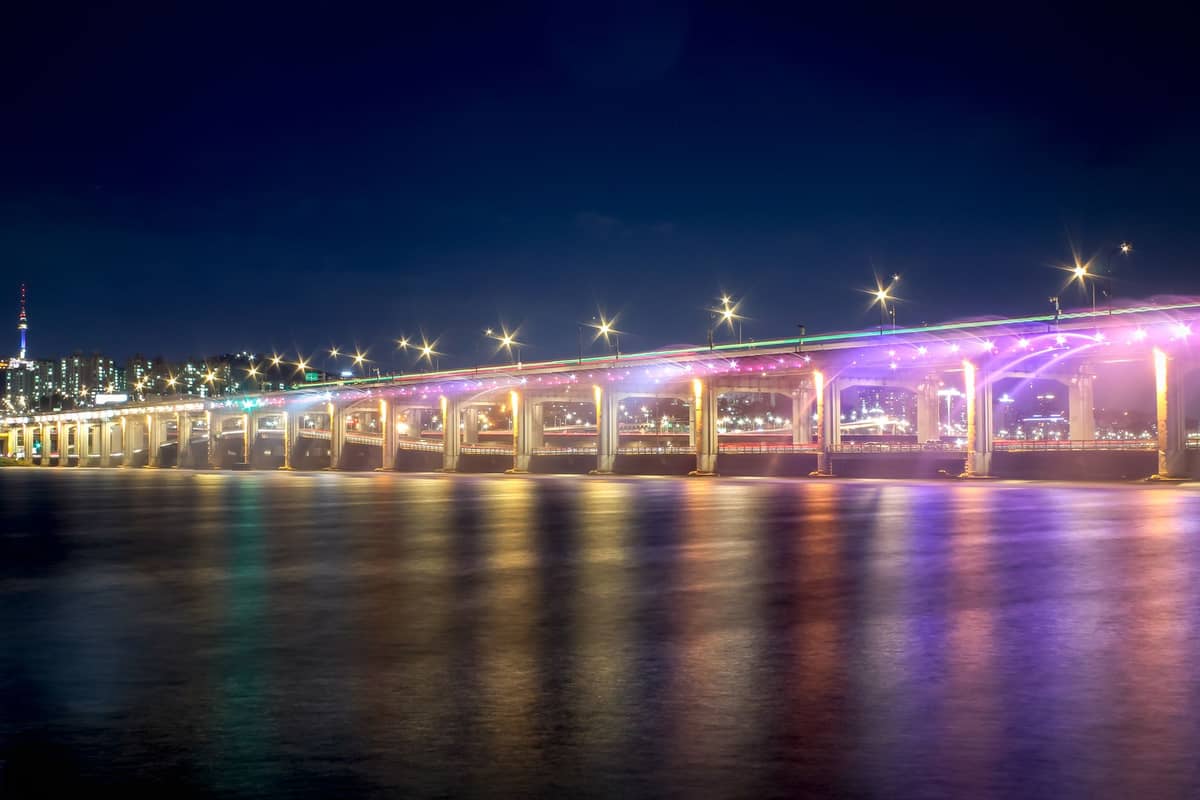
The Banpo Bridge Rainbow Fountain holds the Guinness record as the world's longest bridge fountain, stretching 1,140 metres along the Han River. Running April through October, the free nightly shows combine 380 water jets, colour-changing LEDs, and the open Seoul skyline into one of the city's most photogenic spectacles.
Quick Facts
- Location
- Banpo Hangang Park, Seocho-gu, Seoul (Banpo Bridge over the Han River)
- Getting There
- Lines 3/7/9, Express Bus Terminal Station, Exit 8-1 or 8-2 — approx. 1.1 km walk (18 min)
- Time Needed
- 45–90 minutes, including the 20-minute fountain show
- Cost
- Free — no ticket required
- Best for
- Evening walks, couples, photography, families with older children
What Is the Banpo Bridge Rainbow Fountain?
The Banpo Bridge Rainbow Fountain (반포대교 달빛무지개분수) is a water and light installation built along the side rails of Banpo Bridge, which carries traffic across the Han River in Seocho-gu. Since its debut in April 2009, it has held the Guinness World Record for the longest bridge fountain on earth, with 380 water jets installed across a combined span of 1,140 metres.
The fountain runs seasonally from April through October, with scheduled shows running 20 minutes each. During each show, the jets arc water up to 20 metres outward from the bridge railing in choreographed sequences, while LED lighting creates shifting colour effects. The effect is best appreciated from the riverside path below, where the water curtain is close enough to feel a faint mist on warm nights.
ℹ️ Good to know
Show schedule: April–June and September–October shows run at 12:00, 19:30, 20:00, 20:30, and 21:00 daily, with an additional 19:30 show on weekends and holidays. July–August adds a 21:30 showing. Each performance lasts 20 minutes. The fountain does not operate November through March.
The Experience: What You Actually See and Feel
Arriving at Banpo Hangang Park well before the evening show means walking through the kind of unhurried riverside atmosphere Seoul does exceptionally well. The path alongside the Han River is wide and flat, lined with benches and occasional food stalls. On weekends, families spread out on the grass with takeaway chicken and convenience store drinks — a deeply local ritual that says as much about Seoul as any monument.
When the fountain starts, it announces itself with sound before you see it fully: a collective murmur from the crowd nearest the water, then the hiss of pressurised jets cutting the air. From the riverbank path directly beneath the bridge, the scale is immediate. Water sheets outward and downward in long parabolic arcs, backlit in colour against the dark river surface. The reflections double the visual reach of the display.
The 12:00 noon show runs with daylight, and while you can see the jets clearly, the colours wash out without darkness to anchor them. The daytime showing is worth watching if you happen to be nearby, but the evening showings from 19:30 onward are a different experience altogether. By 20:00, the sky is dimming and the LED colours register with full intensity. The 21:00 show under a fully dark sky, particularly in summer, tends to draw the largest crowds.
💡 Local tip
For the best combination of crowd size and visual impact, the 20:00 or 20:30 show in July or August is the sweet spot: dark enough for the lights to pop, early enough that you avoid the peak 21:00 congestion on the riverside path.
Tickets & tours
Hand-picked options from our booking partner. Prices are indicative; availability and final rates are confirmed when you complete your booking.
DMZ and Lake Majang Suspension Bridge Tour from Seoul
From 57 €Instant confirmationFree cancellationDMZ and Mt. Gamaksan Red Suspension Bridge Tour from Seoul
From 57 €Instant confirmationFree cancellationHalf Day DMZ Tour from Seoul, 3rd Tunnel, Observatory and More
From 47 €Instant confirmationFree cancellationSeoul zombie city exploration game and private tour
From 10 €Instant confirmationFree cancellation
Viewing Positions: Where to Stand
The most direct vantage point is the riverbank path inside Banpo Hangang Park, directly beneath the southern edge of the bridge. From here, the fountain arcs outward toward you and overhead, and the noise and mist are strongest. This is where most first-time visitors gravitate, and it rewards them.
For photography, the north bank of the Han River offers a wider compositional angle: you can frame the full length of the illuminated bridge in a single shot, with the water jets visible as soft curtains along its length. Getting to the north bank requires crossing via another bridge; plan this ahead if it is your priority.
A third option is watching from a Han River cruise. Several operators run evening boat routes along the Han that time their passes near Banpo Bridge to coincide with the show schedule. The view from the water is striking, though the experience depends heavily on your boat's position when the fountain runs.
Getting There Without the Guesswork
The closest subway access is Express Bus Terminal Station, served by Lines 3, 7, and 9. From Exit 8-1 or 8-2, it is approximately 1.1 kilometres to Banpo Hangang Park, a walk of about 18 minutes.
Taxis via Kakao T are a practical alternative for evening arrival, when the walk from the subway in summer heat can be tiring. Taxis via Kakao T are a practical alternative for evening arrival when the walk from the subway in summer heat can be tiring. The nearest practical drop-off is around Banpo Hangang Park.
If you are combining this with a broader Han River day, note that Hangang Park If you are combining this with a broader Han River day, note that Hangang Park extends along both banks and includes multiple sections accessible from different stations — Banpo is one of several areas worth exploring along the river.
⚠️ What to skip
The walk from Express Bus Terminal Station is mostly unshaded. In July and August, come prepared with water and sun protection if you are arriving early for the 19:30 show. The park itself has no covered waiting areas near the primary viewing path.
Historical and Technical Context
Banpo Bridge itself carries six lanes of traffic above the Han River and opened in 1982, part of Seoul's major infrastructure expansion era., part of Seoul's major infrastructure expansion era. The fountain was added in 2009 as part of the city's investment in Han River park amenities, building on the Hangang Renaissance project that redesigned public access along the riverbanks.
The Guinness record designation as the world's longest bridge fountain covers the combined 1,140 metres of nozzle installation on the bridge's twin road levels. The system uses LED lights alongside the 190 nozzles to create the coordinated colour sequences seen during performances. The engineering is designed to project water at different angles and pressures during a single show, which is why the patterns shift between wide arcs, columnar jets, and fanned curtain shapes.
Seoul's investment in its riverside parks is visible across the city. The broader story of how public space functions in the capital comes through in places like Cheonggyecheon StreamThe broader story of how public space functions in the capital comes through in places like Cheonggyecheon in the city center, where an elevated highway was demolished in 2005 to make way for a landscaped waterway — a comparable project in its blending of infrastructure and public green space.
Practical Considerations: Seasons, Weather, and What to Bring
The fountain only operates from April to October, so any visit must be timed accordingly. Within that window, conditions vary considerably. Spring evenings in April and May are cool and clear, and the shorter show schedule means fewer overall visitors on weeknights. Autumn, particularly late September and October, brings the same mild temperatures with the added bonus of the surrounding parkland taking on richer colours.
Summer performances in July and August add the extra 21:30 show and attract the highest foot traffic, particularly on weekends. The riverside in midsummer is warm, often humid, and crowded along the primary viewing path by the time the 21:00 show begins. If crowds reduce your enjoyment, opt for a weeknight show in late September or early October, when the spectacle is unchanged but the audience is smaller.
Rain does not automatically cancel shows, but strong wind or lightning weather will. Seoul's rainy season runs from approximately June through July, and an evening show can be disrupted on short notice. Rain does not automatically cancel shows, but strong wind or lightning weather will. Seoul's rainy season runs from approximately June through July, so an evening show can be disrupted on short notice. Building flexibility into your itinerary is sensible. so if the weather looks uncertain, building flexibility into your itinerary is sensible.
For broader seasonal planning around your Seoul visit, the best time to visit Seoul guide covers how spring and autumn differ from the summer and winter extremes in practical terms.
Honest Assessment: Is It Worth Your Time?
The Banpo Bridge Rainbow Fountain is a legitimate evening set piece that costs nothing and sits inside a pleasant riverside park. For a first-time visitor to Seoul with a free evening between April and October, it is an easy addition to a Han River outing — particularly if you combine it with dinner at one of the park's riverside food areas or a cycling session along the riverbank path.
That said, it is not an immersive cultural experience or a window into Seoul's deeper character. The show is visually impressive for its scale but technically straightforward: coloured water arcing from a bridge. Visitors who prioritise historical depth, traditional culture, or neighbourhood exploration over spectacle will get more out of a longer evening in Insadong, Bukchon, or around the palaces. The fountain rewards the traveller who arrives with the right expectations: a free, photogenic, outdoors 20 minutes on a warm Seoul night.
Those with limited time in Seoul might weigh this against other free evening options. Free things to do in Seoul covers a broader range of no-cost experiences across the city, from palace grounds to neighbourhood walks.
💡 Local tip
Photography tip: Shoot from as low as possible along the riverbank to capture the water arcs against the lit bridge structure. A slow shutter (1–3 seconds) turns the jets into continuous ribbons of light. A tripod or a stable ledge is worth the effort.
Insider Tips
- The 20:30 show on a weeknight in September is a reliable choice: temperatures drop to comfortable levels, the sky is fully dark, and weekend crowds have dispersed.
- Convenience stores inside Banpo Hangang Park (CU and GS25 locations are usually present) sell beer, soju, and snacks. Buy before the show starts — the path near the fountain fills up quickly once the 20:00 crowd settles in.
- If you want an unobstructed seated position, arrive at least 20 minutes before the show you intend to watch and claim a spot on the low riverside wall or a grass patch with a clear sightline to the south side of the bridge.
- The fountain runs on both sides of the bridge simultaneously, but the southern-facing jets (visible from the Seocho-gu bank below) are the most accessible for most visitors arriving via Express Bus Terminal Station.
- Bicycles are available for hire inside Banpo Hangang Park and along other Han River park sections. A short cycle along the riverside before the evening show is one of the more enjoyable ways to use the time before the 20:00 or 20:30 showings.
Who Is Banpo Bridge Rainbow Fountain For?
- Couples looking for a scenic and low-cost Seoul evening out
- Families with children who appreciate a visual outdoor spectacle
- Photographers wanting long-exposure night shots near water and artificial light
- Visitors who want a relaxed Han River park experience combined with a timed event
- Travellers building a broader Han River itinerary across parks and cycle paths
Nearby Attractions
Combine your visit with:
- Bukhansan National Park
Bukhansan National Park sits on Seoul's northern edge, offering granite ridgelines, forested valleys, and ancient fortress walls within the city limits. Free to enter and accessible by subway and bus, it is one of the most visited national parks in the world relative to its size, attracting seasoned trekkers and casual walkers alike., attracting seasoned trekkers and casual walkers alike.
- Noryangjin Fish Market
Noryangjin Fisheries Wholesale Market is Seoul's largest and most active seafood trading floor, open around the clock every day of the year except major holidays. From pre-dawn wholesale auctions to late-night sashimi dinners eaten directly above the tanks, it offers an experience that blends raw commerce with genuine culinary culture.
- Seoul Grand Park & Zoo
Seoul Grand Park (서울대공원) is a vast leisure complex in Gwacheon that houses Korea's first zoo, a theme garden, and kilometers of forested paths along a reservoir. It rewards families and nature-seekers willing to leave the city center for a full-day escape that most tourists overlook.