National Technical Museum Prague: What to Expect Inside the Czech Republic's Largest Tech Museum
The National Technical Museum in Prague's Holešovice-Letná area is the Czech Republic's largest technical museum, housing more than a century of engineering history across seven floors. From vintage automobiles and early aircraft to printing presses and astronomical instruments, the collection rewards careful visitors with a half-day's worth of serious looking.
Quick Facts
- Location
- Kostelní 42, Prague 7 (Letná, near Holešovice)
- Getting There
- Tram to Letenské náměstí; metro Hradčanská (Line A) or Vltavská (Line C) with tram transfer
- Time Needed
- 2.5 to 4 hours for a thorough visit
- Cost
- 280 CZK adult / 150 CZK reduced / 60 CZK children 6–15 / 560 CZK family (verify before visiting)
- Best for
- Families, engineering and design enthusiasts, anyone seeking a serious indoor attraction away from Old Town crowds
- Official website
- www.ntm.cz/en/for-visitors
What the National Technical Museum Actually Is
The National Technical Museum, known in Czech as Národní technické muzeum, was founded in 1908 and has grown into the largest institution of its kind in the Czech Republic. Its main building in the Letná neighbourhood of Prague 7 runs to seven floors and covers everything from transport and aviation to photography, astronomy, printing, and architecture. This is not a modest science-centre with touchscreens and pop-quiz panels. It is a collection-driven museum in the European tradition, heavy on original objects and long on historical depth.
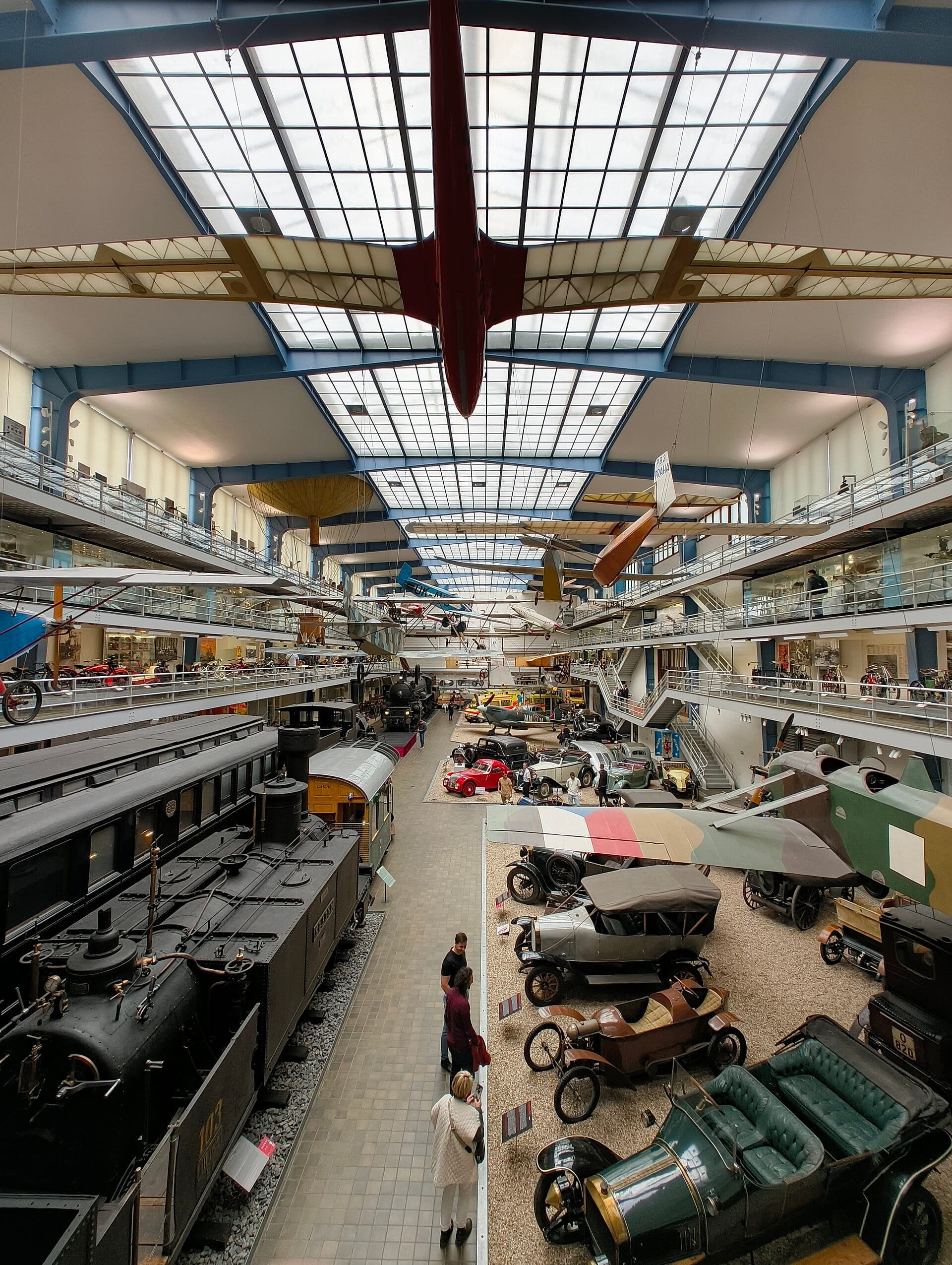
The centrepiece is the vast Transport Hall on the ground floor, where full-size historic vehicles, motorcycles, aircraft, and locomotives are displayed in a dramatic atrium space with natural light filtering through a glazed roof. The scale of the room is genuinely surprising on first entry: the ceiling is high enough to suspend a biplane, and the floor holds cars that date from the earliest decades of motorised travel. Visitors arriving without expectations often stop at the entrance and recalibrate their plans entirely.
💡 Local tip
Buy tickets at the main entrance on Kostelní 42. No advance booking is required for general admission on most days, but school group visits can fill the ground floor on weekday mornings. Arriving after 11:00 on weekdays or at opening time on weekends gives the best experience of the main hall without organised groups.
The Transport Hall: The Reason Most Visitors Come
The atrium hall is the museum's most photographed space, and justifiably so. Suspended aircraft hang overhead while vintage cars, motorcycles, and a full-size steam locomotive occupy the floor below. Czech automotive and engineering history is well represented: Tatra, Škoda, and other manufacturers whose names are less familiar outside Central Europe appear here in original condition, alongside European and international models that provide context for how Czechoslovak industry compared with its neighbours at each moment in the 20th century.
The arrangement is roughly chronological as you move through the space, though the hall is large enough that it rewards wandering rather than following a strict path. Get close to the vehicles. The detailing on older coachwork, the instrument panels of early aircraft, and the engineering of pre-war motorcycles reward close inspection in a way that reproductions or photographs simply cannot.
Photography is permitted throughout the museum without flash restrictions on most exhibits. The natural light in the transport hall is best in the morning hours on clear days, when it angles through the roof glazing and hits the metalwork at a useful angle. Afternoon light is flatter, though the hall remains well lit by the building's artificial lighting.
Tickets & tours
Hand-picked options from our booking partner. Prices are indicative; availability and final rates are confirmed when you complete your booking.
Self guided tour with interactive city game of Prague
From 5 €Instant confirmationFree cancellationPrague by night city tour
From 27 €Instant confirmationFree cancellationPrague city tour with Vltava River cruise
From 38 €Instant confirmationFree cancellationPrague Castle online audio guide
From 5 €Instant confirmationFree cancellation
Upper Floors: What Else the Building Holds
Above the transport hall, the museum spreads across multiple floors covering subject areas that many visitors underestimate or skip. The mining and metallurgy section contains equipment and models that document the industrial basis of Bohemian prosperity across several centuries. The printing and typography collection traces the development of the press from movable type through to offset printing, and includes working examples of equipment that is increasingly rare to see in operational condition.
The photography and cinematography section is particularly strong. The collection traces the history of image-making from early daguerreotypes through to 20th-century cinema technology, with original cameras, projectors, and technical apparatus displayed alongside the historical context that explains why each development mattered. For visitors with an interest in design history or visual media, this section alone justifies the admission price.
The astronomical instruments and architecture collections occupy quieter parts of the building and tend to be less crowded even when the ground floor is busy. Allow time for them if the subjects interest you. The architecture section, in particular, is well curated and gives useful context for the building traditions that produced so much of what you see walking around Prague itself.
If you are planning a broader exploration of Prague's architectural heritage, the Prague architecture guide offers useful background on the styles and periods that shaped the city.
Practical Walkthrough: Getting There and Moving Around Inside
The museum sits on Kostelní 42 in Prague 7, at the edge of Letenské sady (Letná Park). From the city centre, the easiest approach is tram to Letenské náměstí, from which the museum entrance is a short, flat walk. If you are using the metro, Hradčanská on Line A or Vltavská on Line C both connect to tram lines that stop at Letenské náměstí. The walk from Vltavská is manageable but involves a moderate uphill stretch along the edge of the park.
The museum is open Tuesday through Sunday, 9:00 to 18:00, and is closed on Mondays. An exception applies when Monday falls on a public holiday, in which case the museum opens 9:00 to 18:00. Admission as listed by the museum: 280 CZK adult, 150 CZK reduced, 60 CZK for children aged 6 to 15, 560 CZK for a family ticket, and 60 CZK per student for school groups. Verify current prices at ntm.cz before your visit, as these may change.
ℹ️ Good to know
Accessibility: The museum states that ZTP cardholders (Czech disability card) receive the reduced admission fee, and ZTP/P cardholders enter free with accompaniment. The building has lift access to multiple floors. Contact the museum directly if you have specific accessibility requirements.
There is a cloakroom near the entrance for large bags and coats. The museum café sits within the building and provides a reasonable place to pause mid-visit without having to exit and re-enter. Allow at least two and a half hours for a thorough visit covering the main hall and two or three additional floors. Four hours would not feel wasted if you read the displays carefully.
How the Experience Changes by Time of Day
Weekday mornings, particularly Tuesday through Thursday, bring organised school groups that can make the ground floor transport hall loud and crowded between roughly 9:30 and 11:30. If you prefer a quieter experience in the atrium, arrive at opening time and move upstairs while the groups occupy the ground floor, then return to the transport hall after late morning when groups typically leave for lunch.
Weekend mornings from 9:00 to 11:00 tend to be relatively calm. By early afternoon on Saturdays and Sundays, families arrive in larger numbers and the ground floor becomes more animated. This is not necessarily a negative: watching children encounter full-size historic aircraft for the first time adds its own energy to the space. But if quiet contemplation of the vehicles is what you want, come early.
Late afternoon, the hour before closing, sees visitor numbers drop again across all floors. The upper-level collections are particularly peaceful in this window. The museum does not feel rushed at closing: staff begin moving through galleries without pressure, and there is no sense of being hurried out.
Context: The Holešovice-Letná Setting
The museum sits at the boundary between the Letná plateau and the district of Holešovice, an area of Prague that developed as an industrial and residential district in the late 19th and early 20th centuries. The Letná Park immediately adjacent to the museum is a useful resource before or after your visit: the park's paths offer clear views across the city and connect easily to the Letná beer garden, a concrete terrace with one of Prague's more honest panoramic views of the river and bridges below.
The wider Holešovice district contains the DOX Centre for Contemporary Art and the Holešovice Market Halls, making it possible to combine a visit to the technical museum with other stops in the neighbourhood without returning to the centre. The area is well connected by tram and has its own character distinct from the tourist density of Old Town.
For visitors planning a fuller day in this part of the city, the Letná Park itself is worth walking through: it is large, well maintained, and connects the museum area to the river embankment without requiring transport.
Who Should Reconsider
The National Technical Museum is a text-heavy, object-dense institution. Visitors looking for interactive exhibits, immersive digital experiences, or entertainment-led museum formats will find this collection demanding rather than immediately engaging. Children under six are unlikely to find the upper floors interesting, though the transport hall with its large vehicles tends to capture attention across age groups.
Visitors with very limited time in Prague, say a single day, might find it difficult to justify the half-day commitment this museum rewards when weighed against the historic centre. But for anyone staying three days or more, or anyone with a serious interest in industrial history, design, or engineering, this is among the most substantive museum experiences the city offers.
⚠️ What to skip
The museum is closed every Monday (unless Monday is a Czech public holiday). Arriving on a Monday without checking this in advance is the most common visitor mistake. Confirm current opening hours at ntm.cz before your visit.
Insider Tips
- The upper floors — particularly the photography and printing sections — are rarely crowded even when the transport hall below is busy with school groups. Head upstairs first on weekday mornings and work your way back down.
- The museum sits directly alongside Letenské sady. Entering the park after your visit and walking west along the plateau takes you to views across the Charles Bridge and Old Town that most visitors in the centre never find from this angle.
- The family ticket (560 CZK) covers two adults and up to four children aged 6–15, making it significantly cheaper than buying individual tickets for a family of four. Children under six enter free.
- The museum's café is a reasonable stopping point mid-visit and is less expensive than the cafés closer to the tourist centre in Old Town. You do not need to exit and re-enter if you use it.
- If you are combining the museum with other Holešovice stops, the Vltavská metro station (Line C) provides the fastest return connection to the city centre and links directly to the southern metro network.
Who Is National Technical Museum For?
- Families with children aged 6 and older who have an interest in vehicles, machinery, or science
- Visitors with a background in engineering, industrial history, or design
- Travellers spending three or more days in Prague who want depth beyond the historic centre
- Photography enthusiasts interested in the history of image-making technology
- Anyone seeking a substantial indoor attraction that is not weather-dependent and is away from the main tourist circuit
Nearby Attractions
Other things to see while in Holešovice:
- DOX Centre for Contemporary Art
Opened in 2008 inside a converted 19th-century factory in Holešovice, DOX Centre for Contemporary Art is a major venue for international contemporary art, architecture, and design. With around 3,000 m² of exhibition space across renovated industrial halls, it stages politically engaged, visually demanding shows that rarely play it safe.
- Holešovice Market Halls (Pražská tržnice)
The Holešovice Market Halls, officially known as Pražská tržnice, The Holešovice Market Halls, officially known as Pražská tržnice, occupy a large heritage complex in Prague 7 that began life as the city's central slaughterhouse in 1895.. Today the red-brick halls host a year-round farmers market, street food vendors, pop-up events, and independent businesses, offering a slice of everyday Prague that most tourists never reach.
- Letná Beer Garden
Perched on the edge of Letná Park above the Vltava River, the Letná Beer Garden is where Prague locals actually drink in summer. No admission charge, plastic cups of cold Pilsner, and a sweeping view across the city's rooftops — it is one of the most genuinely local outdoor experiences in the Czech capital.
- Letná Park
Letná Park occupies a broad plateau above the Vltava in Prague's Holešovice district, offering panoramic views over the Old Town, a famous open-air beer garden, and kilometers of tree-lined paths. Entry is free and the park is open around the clock.