Mount Qingcheng: Chengdu's Ancient Taoist Mountain
Mount Qingcheng (青城山) is where Chinese Taoism took root nearly 2,000 years ago. A UNESCO World Heritage site paired with the Dujiangyan Irrigation System, it draws visitors with dense forest trails, ancient temple complexes, and a sensory atmosphere unlike any urban attraction in the region. This guide covers both Front Mountain and Back Mountain, with transit directions, ticket prices, and practical notes on what to expect.
Quick Facts
- Location
- Qingchengshan Town, Dujiangyan City, Sichuan Province (approx. 60 km northwest of central Chengdu)
- Getting There
- High-speed train from Xipu Station (犀浦站) to Qingchengshan Station (青城山站), approx. 30–40 min; then local bus Route 101 or short taxi to scenic area entrance
- Time Needed
- Front Mountain: about 4 hours. Front + Back Mountain: a full day
- Cost
- Front Mountain: CNY ¥80/adult; Back Mountain: CNY ¥20/adult. Cable car extra. Confirm current prices before visiting.
- Best for
- Taoist history, forest hiking, temple photography, escape from city heat
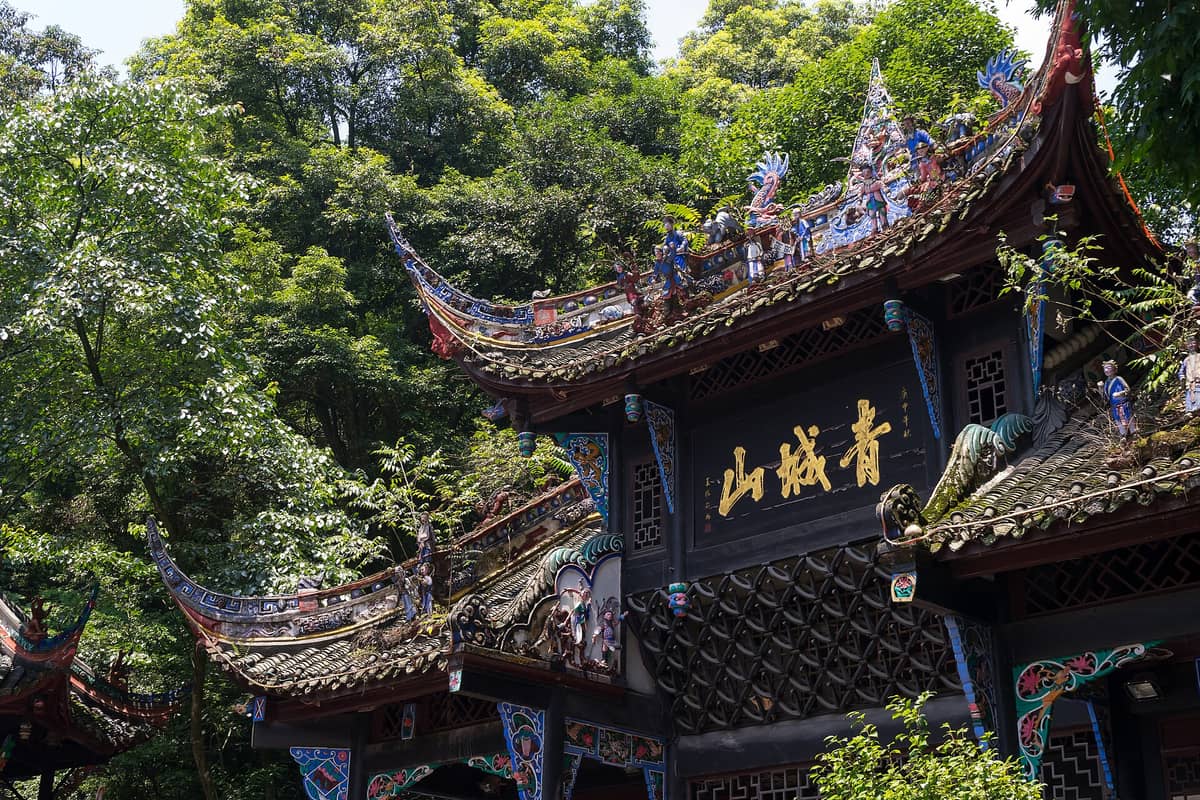
What Mount Qingcheng Actually Is
Mount Qingcheng (青城山, Qīngchéng Shān) is one of China's most significant Taoist mountains and, together with the nearby Dujiangyan Irrigation System, a UNESCO World Heritage Site inscribed in 2000. The mountain's name translates loosely as 'Green City Mountain,' a reference to the circle of densely forested peaks that form a natural enclosure around the summit area. Walking the trails, you can understand why: the canopy overhead is so continuous that even on overcast days the light has a greenish, filtered quality.
The mountain divides into two distinct sections. Front Mountain (青城前山, Qīngchéng Qián Shān) is the main cultural and historical area, with restored temples, paved stone stairways, and the bulk of foot traffic. Back Mountain (青城后山, Qīngchéng Hòu Shān) is larger, wilder, and far less visited, offering more demanding trails through waterfalls and bamboo gorges with minimal infrastructure. Most first-time visitors choose Front Mountain. Back Mountain suits those who prioritize scenery over history and have a full day to spare.
ℹ️ Good to know
Front Mountain hours: generally 08:00–17:30, with entry or ticket sales ending earlier; hours may change by season and on public holidays.
Historical and Cultural Weight
In 142 CE, a religious leader named Zhang Ling is said to have established the foundational doctrine that became Chinese Taoism at this mountain. That moment gives Mount Qingcheng a spiritual status that visitors can feel even without knowing the history: the incense smoke drifting through temple courtyards, the practitioners performing quiet morning rituals on stone platforms, the faded inscriptions carved into cliff faces along the paths. These are not recreations for tourism. The Taoist community here has maintained continuity for nearly two millennia.
The temples on Front Mountain form a loose chain up the hillside. Jianfu Palace (建福宫), near the base, is typically the first stop: a working Taoist temple with active clergy, incense halls, and a courtyard where visitors are expected to be quiet and respectful. Higher up, Tianshi Cave (天师洞) is the mountain's most important religious site and one of its oldest. Dress modestly for both. For more context on Chengdu's broader temple landscape, the guide to Chengdu's best temples puts Qingchengshan in useful perspective against urban options like Qingyang Palace and Wenshu Monastery.
The UNESCO designation in 2000 covered both Mount Qingcheng and the Dujiangyan Irrigation System as a combined property, recognizing the interlocking relationship between the mountain's religious landscape and the ancient engineering works on the Minjiang River below. The two sites are about 15 kilometers apart and are frequently visited on the same day trip.
Tickets & tours
Hand-picked options from our booking partner. Prices are indicative; availability and final rates are confirmed when you complete your booking.
Panda Base and city highlights private day tour in Chengdu
From 302 €Instant confirmationFree cancellationFull day private tour Giant Panda Base and city highlights
From 365 €Instant confirmationFree cancellationChengdu to Yibin private tour with Wuliangye Liquor Museum visit
From 300 €Instant confirmationChengdu private evening tour with hot pot dinner
From 247 €Instant confirmationFree cancellation
The Front Mountain Experience: What to Expect on the Trail
The main path up Front Mountain starts just inside the scenic area gate and follows a combination of stone-paved staircases, covered wooden walkways, and natural forest paths. The ascent to Tianshi Cave takes roughly 90 minutes at a moderate pace, though many visitors spend considerably longer exploring temple interiors and stopping at viewpoints. The final stretch to Shangqing Palace (上清宫), the highest accessible point on Front Mountain, adds another 45 minutes on top of that.
A cable car runs between Jianfu Palace and Tianshi Cave, and another section connects higher up. These significantly cut the physical effort but remove much of the atmospheric forest experience. If you are reasonably fit and the weather is dry, the walk up is worth it: the path passes streams, bridges, dense bamboo, and several small shrines where incense sticks burn in stone holders worn smooth by centuries of use. The smell of burning incense mingles with damp forest soil and pine resin in a way that photographs simply cannot convey.
The wooden walkway sections, which snake along steep cliffs above a narrow gorge, are genuinely impressive pieces of construction. The boards are well-maintained, but the passages are narrow and can create bottlenecks when tour groups move through. Patience helps more than rushing.
💡 Local tip
Wear proper walking shoes with grip. Many staircase sections are smooth stone, and water runoff from the forest keeps them damp even after rain stops. Sandals and flat-soled shoes are genuinely risky on the steeper descents.
How the Mountain Changes Through the Day
Arriving at opening time, between 08:00 and 08:30, puts you on the trail ahead of tour buses, which typically arrive mid-morning from Chengdu. In the early hours, mist frequently clings to the lower paths and the forest is noticeably quiet. Temple attendants are conducting morning ceremonies, birds are audible, and the light filtering through the canopy has a cool, grey-green quality that disappears once the sun rises higher.
By 10:30 to 11:00, the main trail gets considerably more congested, particularly on weekends and Chinese public holidays, when the wooden walkways become genuinely crowded. The atmosphere shifts from contemplative to social. This is not necessarily bad, but it is a different experience.
Afternoons in summer bring the risk of sudden rain. The mountain generates its own localized weather, and showers can appear with little warning. A compact rain poncho takes up no space and matters a great deal if you are halfway up the mountain when clouds close in. The descent in wet conditions on stone stairs requires full attention.
⚠️ What to skip
Do not underestimate the last cable car or bus back to the station. If you plan to visit both Front and Back Mountain in one day, start no later than 08:00 and confirm the final transport times at the scenic area entrance before you begin.
Back Mountain: The Quieter, Wilder Alternative
Back Mountain costs only CNY ¥20 to enter, a fraction of Front Mountain's admission, and the contrast in atmosphere is significant. The trails here are less developed, the signage less frequent, and the primary draw is natural scenery: waterfalls, narrow gorges carved by the Weijiang River, and bamboo forests that block almost all sunlight at certain points on the path.
Back Mountain is best suited to experienced hikers or those willing to commit to a full day. Getting lost is possible, the terrain is demanding, and facilities are sparse. However, for travelers who find Front Mountain too polished or too crowded, Back Mountain offers a genuinely different character. The two sections are not directly connected by path; you would need to descend to the base and travel between entrances to visit both.
Getting There from Chengdu
The most practical route from central Chengdu is to take Metro Line 2 or Line 6 to Xipu Station (犀浦站), then board a high-speed intercity train to Qingchengshan Station (青城山站). The train journey takes approximately 30 to 40 minutes and runs frequently throughout the day. From Qingchengshan Station, local bus Route 101 or a short taxi ride covers the remaining distance to the scenic area entrance. This route is also the logical way to combine the visit with the nearby Dujiangyan Irrigation System, which has its own station one stop earlier on the same line.
The entire day trip from Chengdu to Mount Qingcheng and back is a well-established itinerary that fits neatly into a broader day trip from Chengdu. If you are planning multiple days, pairing Qingchengshan with Dujiangyan on one day is far more efficient than making two separate journeys.
Photography, Weather, and Practical Logistics
Mount Qingcheng photographs well under overcast conditions, which is fortunate because clear skies are not the norm. Chengdu's basin climate means overcast, hazy, or misty days are common, particularly from November through March. Mist on the mountain trails is atmospheric and often improves forest photography by softening harsh contrasts. Direct sunlight breaking through canopy gaps creates dramatic shafts of light but is unpredictable.
The mountain's interiors, including temple halls and covered walkways, are dark. A phone with a capable low-light camera handles most situations, but a mirrorless camera with a fast lens will produce noticeably better results in dim temple corridors. Tripods are impractical on crowded paths.
For travelers combining Qingchengshan with a broader Chengdu trip, the 3-day Chengdu itinerary and the first-timer's guide to Chengdu both offer structured frameworks for fitting the mountain into a realistic schedule alongside urban attractions.
Accessibility is limited. The Front Mountain trail involves hundreds of stone steps and sections of steep gradient. The cable cars reduce the physical demand significantly but do not eliminate it entirely. Visitors with significant mobility limitations should contact the scenic area operator in advance to confirm what, if any, accessible routes currently exist.
Who Should Reconsider This Trip
Mount Qingcheng is not for everyone. Travelers who are looking primarily for dramatic mountain panoramas or sweeping summit views will likely be disappointed: the densely forested landscape means visibility across the range is limited except at a few specific points. The appeal is intimate, green, and atmospheric rather than grand and expansive.
Those with serious mobility issues, a dislike of crowds on weekends, or a tight Chengdu itinerary of only one or two days may find the travel time disproportionate relative to what they see. For visitors short on time, the urban temples and parks of central Chengdu offer cultural depth with far less logistical effort.
Insider Tips
- Buy train tickets between Xipu and Qingchengshan Station in advance through the 12306 app or a booking platform, particularly on weekends and Chinese public holidays. Trains do sell out on peak days.
- The small restaurants and teahouses just outside the scenic area gate serve Qingcheng-style pickled vegetables and local mountain dishes at honest prices. The food inside the scenic area is considerably more expensive and less interesting.
- If you want to photograph the morning mist without crowds, aim to be on the lower trails no later than 08:15. By 09:30 the atmosphere has already shifted as tour groups arrive.
- There are cloakrooms near the entrance where you can leave a large bag before ascending. Carrying a heavy backpack on steep stone stairs for three or four hours is avoidable.
- Tianshi Cave has a small courtyard where Taoist practitioners may be visible in early morning ceremonies. This is a functioning religious space, not a performance. Photograph respectfully and without flash if at all.
Who Is Mount Qingcheng For?
- History-focused travelers interested in the origins of Chinese Taoism
- Hikers and nature walkers who want forest trails within a day trip of a major city
- Photographers drawn to misty, atmospheric forest and temple settings
- Travelers pairing the visit with the Dujiangyan Irrigation System on the same day
- Anyone looking for a calm, contemplative contrast to Chengdu's urban pace
Nearby Attractions
Other things to see while in Dujiangyan:
- Dujiangyan Irrigation System
Built around 256 BC and still functioning today, the Dujiangyan Irrigation System is one of the oldest and most significant hydraulic engineering projects in the world. Inscribed as part of the Mount Qingcheng and Dujiangyan Irrigation System World Heritage property in 2000, it sits about an hour from central Chengdu and rewards visitors with river landscapes, ancient stonework, and a surprisingly moving sense of continuity between past and present., it sits about an hour from central Chengdu and rewards visitors with river landscapes, ancient stonework, and a surprisingly moving sense of continuity between past and present.
- Panda Valley
Panda Valley, officially the Dujiangyan Field Research and Breeding Center, sits in the forested hills outside Dujiangyan city. With far smaller crowds than Chengdu's main panda base, it offers a calmer, more naturalistic encounter with giant pandas and a landscape that feels genuinely removed from urban Chengdu.