Dujiangyan Irrigation System: The Ancient Engineering Marvel Still Feeding Sichuan
Built around 256 BC and still functioning today, the Dujiangyan Irrigation System is one of the oldest and most significant hydraulic engineering projects in the world. Inscribed as part of the Mount Qingcheng and Dujiangyan Irrigation System World Heritage property in 2000, it sits about an hour from central Chengdu and rewards visitors with river landscapes, ancient stonework, and a surprisingly moving sense of continuity between past and present., it sits about an hour from central Chengdu and rewards visitors with river landscapes, ancient stonework, and a surprisingly moving sense of continuity between past and present.
Quick Facts
- Location
- Dujiangyan City, Sichuan Province
- Getting There
- Intercity rail from Chengdu to Dujiangyan Station or Lidui Park Station, then taxi or local bus
- Time Needed
- 3 to 4 hours for the core site; allow a full day if combining with Mount Qingcheng
- Cost
- Ticket prices vary; verify current prices before visiting
- Best for
- History enthusiasts, architecture and engineering fans, day-trippers from Chengdu
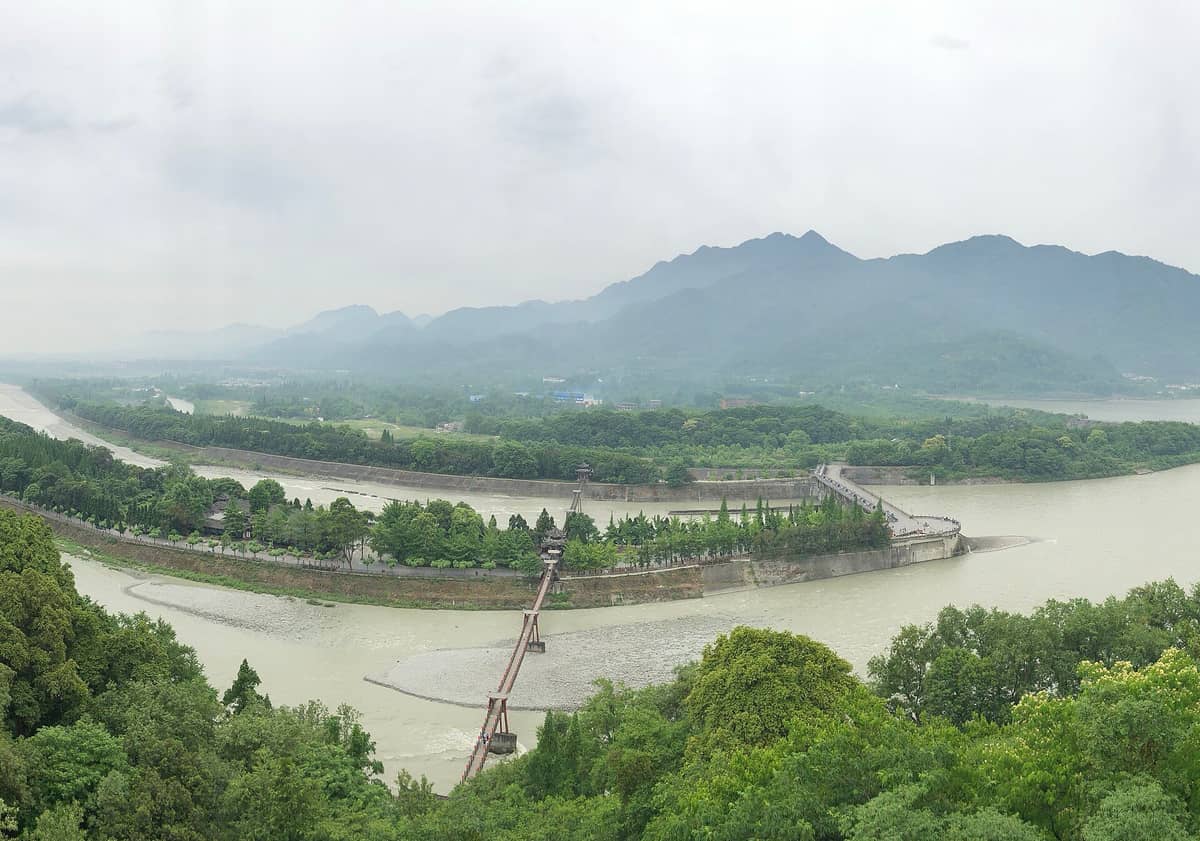
What the Dujiangyan Irrigation System Actually Is
The Dujiangyan Irrigation System is not a ruin. That is the first thing to understand before you arrive. Built around 256 BC during the Warring States period under the direction of the Qin-appointed Shu magistrate Li Bing, this network of weirs, channels, and levees has been diverting the Min River continuously for over 2,200 years. It still irrigates roughly 668,700 hectares of Sichuan farmland today, including much of the Chengdu Plain., including much of the Chengdu Plain. No dam was ever built. No reservoir was ever dug. The system works entirely through the logic of water physics: fish-mouth levees split the current, overflow weirs regulate water levels seasonally, and a central channel carries the controlled flow into the agricultural plain.
UNESCO inscribed the site in 2000 as part of the joint World Heritage property covering both Mount Qingcheng and the Dujiangyan Irrigation System. The official Chinese name is 都江堰 (Dujiangyan), which translates loosely as the Dujiang Weir. The core visitor area centers on Lidui Park and the structures immediately upstream, where the three principal components of the ancient system — the Yuzui fish-mouth levee, the Feishayan spillway, and the Baopingkou bottle-neck channel — are still visible, still active, and still doing exactly what Li Bing designed them to do.
ℹ️ Good to know
The site combines engineering infrastructure with a working river environment. Expect moving water, suspension bridges over fast-flowing channels, and substantial walking on stone paths. Good footwear with grip is strongly recommended, especially after rain.
Getting There from Chengdu
Dujiangyan City sits northwest of central Chengdu, roughly an hour away by intercity rail. The most direct public transport option is the Chengdu–Dujiangyan intercity railway, which stops at both Dujiangyan Station and, more conveniently, Lidui Park Station, which places you within easier reach of the entrance. From either station, a taxi or local bus covers the remaining distance to the site gate on Gongyuan Road.
Driving or booking a private car via Didi Chuxing is also common and gives you more flexibility, especially if you plan to continue to Mount Qingcheng in the same day. The road journey from central Chengdu takes roughly 60 to 90 minutes depending on traffic. Avoid Saturday mornings in peak tourist season if you are driving: the access roads through Dujiangyan City can queue noticeably on weekends.
If you are planning a broader itinerary, this site pairs naturally with Mount Qingcheng, located about 15 km further west. Combining both on a single day is feasible for fit travelers who start early, though it makes for a long and tiring outing. A more relaxed approach is to spend a full day at Dujiangyan and leave Qingcheng for a separate trip.
Tickets & tours
Hand-picked options from our booking partner. Prices are indicative; availability and final rates are confirmed when you complete your booking.
Dujiangyan half- day tour and blue tears night view
From 327 €Instant confirmationFree cancellationRed panda and Dujiangyan private tour
From 335 €Instant confirmationFree cancellationPanda Base and city highlights private day tour in Chengdu
From 302 €Instant confirmationFree cancellationFull day private tour Giant Panda Base and city highlights
From 365 €Instant confirmationFree cancellation
Walking the Site: What You Will See
The entrance brings you into Lidui Park, a green riverside area that frames the lower end of the engineering works. The air here carries moisture even in dry weather, drawn off the fast-moving Min River. Stone paths lead up through the park toward the main viewing platforms, passing memorial halls and stone inscriptions dedicated to Li Bing. The statues and shrines feel proportionate to the setting rather than overwhelming it: this is a working piece of infrastructure with historical reverence layered on top, not the other way around.
The Anlan Suspension Bridge is one of the most photographed elements on the site. It stretches across the Min River at a height that makes the force of the water below immediately legible. The bridge sways under foot traffic, and on busy weekends there can be a queue to cross. In the morning light, looking upstream from the bridge, you can see the Yuzui levee splitting the current into its inner and outer channels: a simple wedge of stone and compacted brushwood against millennia of river force, and it still holds. The visual clarity of that moment — one structure, two rivers, 2,200 years — is what makes this site worth the journey.
The Feishayan spillway and Baopingkou channel can be viewed from elevated walkways and platforms along the western bank. Interpretive signage exists in both Chinese and English, though the English translations vary in quality. The most useful context comes from the scale models in the on-site exhibition halls, which show how the three components work together as a system. Spend time here before or after walking the river bank: the models make the outdoor engineering structures significantly easier to read.
💡 Local tip
Visit the indoor exhibition hall near the main entrance before walking the river structures. The scale models and diagrams explain how the three-part system functions, which makes the outdoor infrastructure much more legible when you encounter it.
Time of Day and Crowd Patterns
Arriving early gives you the best combination of light and space. Morning mist off the Min River is common in cooler months, softening the landscape and muffling the sound of the water into something almost meditative. By mid-morning on weekends and during national holidays, tour groups arrive in volume and the suspension bridge area becomes slow-moving and loud.
Weekday visits between 09:00 and 11:00 are noticeably quieter. If you are visiting during Golden Week in early October or the Lunar New Year period, expect the site to be genuinely crowded throughout the day. The park has enough spatial spread that it rarely feels claustrophobic away from the bridge crossing, but the viewing platforms at the Yuzui levee can fill up quickly. Confirm the current schedule when purchasing tickets.
Historical and Cultural Context
Li Bing was appointed governor of Shu (the ancient name for the Sichuan region) around 256 BC by the Qin state. The Chengdu Plain at the time was prone to severe flooding from the Min River, followed by drought when the floodwaters receded. Rather than constructing a dam, which would have blocked the river entirely and cut off the natural sediment flow, Li Bing designed a system that split the current, controlled its velocity, and channeled a measured flow into an irrigation network without obstructing the river's natural course.
The genius of the design lies in its self-regulating character. During high water in summer, the Feishayan spillway naturally diverts excess water into the outer channel, protecting the farmland from flooding. In the dry season, the geometry of the channels draws proportionally more water into the inner channel, maintaining irrigation. No human intervention is required to switch between modes. This is not a piece of ancient engineering that worked for a few generations and then needed to be replaced. The same principles have kept it functioning through wars, earthquakes, and two millennia of Chinese history.
For travelers who want to understand the broader historical and cultural landscape of this part of Sichuan, the Sanxingdui Museum near Guanghan offers a complementary perspective on ancient Sichuan civilization, predating even Li Bing's era. Combining both on a multi-day itinerary gives a sense of the extraordinary depth of human settlement on the Chengdu Plain.
Weather, Seasons, and What to Bring
The site is almost entirely outdoors. Weather has a direct effect on the quality and comfort of a visit. Spring (March to May) and autumn (September to November) are the most comfortable seasons. Temperatures are moderate, and the river levels in spring can be dramatic as snowmelt from the mountains feeds the Min. Summer visits (June to August) are warm and often humid, with a higher chance of afternoon rain. The stone paths become slippery when wet. Winter visits are possible and the site is uncrowded, but some facilities may operate reduced hours.
Bring water and sunscreen for summer and autumn visits: the riverside paths are exposed. A lightweight rain layer is worth carrying in spring and summer regardless of the forecast. Comfortable, closed-toe shoes with grip are a practical necessity rather than a suggestion. The path surfaces range from polished stone paving to rougher riverside tracks, and some sections near the water involve steps without handrails.
⚠️ What to skip
Accessibility information for wheelchair users and visitors with mobility limitations is not currently verifiable from official sources. Contact the site directly before visiting if step-free access is a requirement.
Photography and Practical Notes
The most compelling photographic subjects here are not the memorial halls or the statues of Li Bing, though both photograph cleanly in morning light. The real subjects are the water itself: the clean split of the current at the Yuzui, the controlled pour over the Feishayan weir, the narrowing of the Baopingkou channel. A zoom lens lets you compress the distance between the bridge and the levee structures upstream. Wide-angle shooting from the suspension bridge captures the full width of the river, but the railing interrupts clean compositions.
If you are building a day-trip itinerary around this site, day trips from Chengdu covers the logistics in more detail, including how to sequence Dujiangyan with other destinations in the western Chengdu region. The trip pairs particularly well with a half-day at Mount Qingcheng if you have the energy for both.
For travelers spending multiple days in the region, the 3-day Chengdu itinerary suggests how to slot Dujiangyan into a wider trip without feeling rushed.
Insider Tips
- Buy your ticket online or at the gate early. The ticket queue on busy weekends can run 20 to 30 minutes at peak times, eating into your morning window before tour groups arrive.
- The indoor scale-model exhibition near the entrance is worth 20 minutes of your time before you walk the site. The three-component system is not immediately intuitive from ground level, and the models make the outdoor structures dramatically more legible.
- The Anlan Suspension Bridge can have a queue on weekend afternoons. Cross it early in your visit rather than saving it for last, when groups from Chengdu tend to peak in the site.
- The area immediately north of Lidui Park along the river bank is quieter than the main tourist circuit and still offers good views of the channel structures. Walking this section after the main loop gives you a calmer perspective on the same engineering without the crowd density.
- If you are visiting in spring (March to April), water levels in the Min River are rising with mountain snowmelt and the current at the Yuzui split is at its most visually dramatic. Autumn (late September to October) brings clearer skies and lower water, which can make the engineering structures more visible from the viewing platforms.
Who Is Dujiangyan Irrigation System For?
- History and archaeology travelers who want to understand how ancient China actually worked at a practical, infrastructural level
- Architecture and engineering enthusiasts drawn to elegant functional design
- Day-trippers from Chengdu looking for a substantive half-day or full-day destination beyond the city center
- Travelers combining the Chengdu–Dujiangyan corridor with a hike on Mount Qingcheng
- Photographers interested in landscape, water, and working heritage infrastructure
Nearby Attractions
Other things to see while in Dujiangyan:
- Mount Qingcheng
Mount Qingcheng (青城山) is where Chinese Taoism took root nearly 2,000 years ago. A UNESCO World Heritage site paired with the Dujiangyan Irrigation System, it draws visitors with dense forest trails, ancient temple complexes, and a sensory atmosphere unlike any urban attraction in the region. This guide covers both Front Mountain and Back Mountain, with transit directions, ticket prices, and practical notes on what to expect.
- Panda Valley
Panda Valley, officially the Dujiangyan Field Research and Breeding Center, sits in the forested hills outside Dujiangyan city. With far smaller crowds than Chengdu's main panda base, it offers a calmer, more naturalistic encounter with giant pandas and a landscape that feels genuinely removed from urban Chengdu.