Møns Klint: The Chalk Cliffs That Make the Journey Worth It
Møns Klint is a 6-kilometre stretch of dramatic white chalk cliffs on the island of Møn, rising up to 128 metres above the Baltic Sea. Formed roughly 70 million years ago, these cliffs are one of the most geologically striking landscapes in Scandinavia and a popular day trip from Copenhagen for anyone who wants to trade the city for raw coastline.
Quick Facts
- Location
- Stengårdsvej 8, 4791 Borre, Møn, Denmark — approx. 130 km south of Copenhagen
- Getting There
- By car via E47/55 (exit 41 from Zealand, exit 42 from Falster), then follow signs to Møns Klint. Paid parking at GeoCenter (check current DKK rate). No direct public transport to the cliffs.
- Time Needed
- 3–5 hours including GeoCenter visit, cliff walk, and beach descent
- Cost
- GeoCenter admission applies; check current DKK pricing at moensklint.dk before visiting. Cliff trails are free to walk.
- Best for
- Geology enthusiasts, hikers, families, photographers, nature day-trippers
- Official website
- moensklint.dk/en
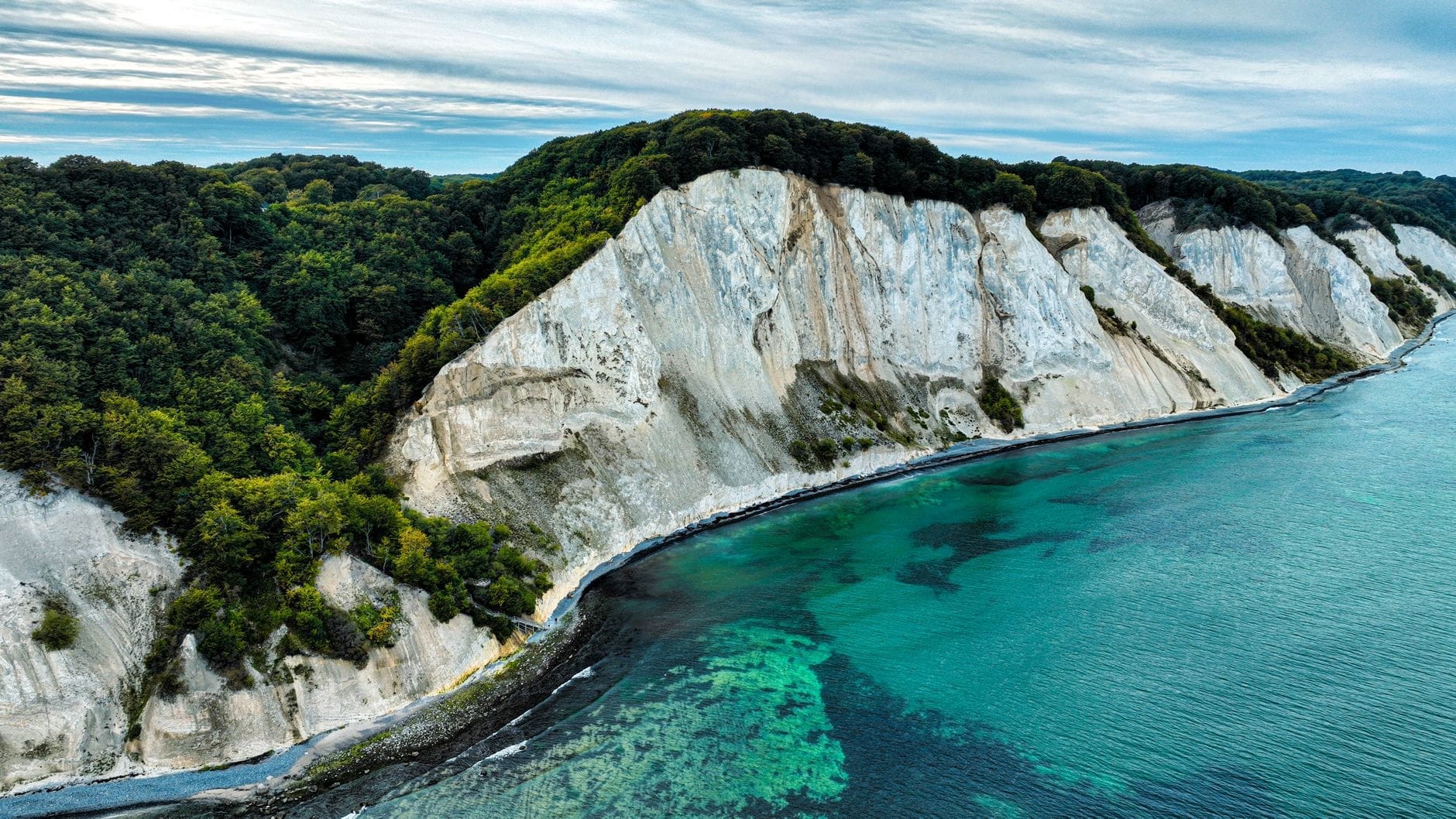
What Møns Klint Actually Looks Like
The cliffs at Møns Klint are not subtle. Stretching roughly 6 kilometres along the eastern edge of the island of Møn, the sheer white chalk faces drop up to 128 metres into the Baltic Sea below. The contrast is stark: brilliant white rock against dark green forest at the top, turquoise-tinted water at the base, and a pebbly beach scattered with flint and fossil fragments. On clear days, the Swedish coastline is faintly visible across the water.
The chalk itself has a texture that surprises people up close. It is not smooth like limestone. It is dense but crumbly in places, streaked with dark flint bands laid down millions of years ago when this part of northern Europe sat beneath a warm, shallow sea. The fossils embedded in the beach pebbles, mostly sea urchins, belemnites, and shell fragments, are not rare. They wash out of the eroding cliff face regularly, and finding them is part of the beach experience for most visitors.
⚠️ What to skip
The northern section of the Maglevandstrappen staircase is currently closed. Beach access remains available via the lower section where the stairs split to the right. Always check trail status on moensklint.dk before visiting, as cliff erosion can affect access routes with little notice.
The Geology Behind the Drama
The chalk that forms Møns Klint accumulated approximately 70 million years ago during the Cretaceous period, when microscopic marine organisms called coccolithophores settled to the seafloor in enormous quantities. Over tens of millions of years, their calcium carbonate skeletons compressed into chalk. The dramatic cliff faces visible today are the result of glacial pressure during the last Ice Age, which pushed and folded these chalk layers upward, tilting the strata at angles that give the cliffs their characteristic layered, almost architectural appearance.
The area is part of the Møns Klint UNESCO World Heritage listing, recognized for its exceptional record of the Cretaceous-Paleogene boundary and the geological evidence it provides of the mass extinction event that ended the age of dinosaurs. The GeoCenter Møns Klint, situated directly at the main car park, makes this geological backstory accessible through well-produced exhibits that are genuinely worth the admission fee, especially for families traveling with children.
Tickets & tours
Hand-picked options from our booking partner. Prices are indicative; availability and final rates are confirmed when you complete your booking.
Full-day tour to Mons Klint and The Forest tower from Copenhagen
From 187 €Instant confirmationFree cancellation1-hour boat harbour tour in Copenhagen
From 26 €Instant confirmationFree cancellationSmall group 3-hour walking tour in Copenhagen
From 45 €Instant confirmationFree cancellationCopenhagen to Malmo one-day tour
From 56 €Instant confirmationFree cancellation
Walking the Cliffs: What the Experience Is Like
The cliff-top trail winds through beech forest before opening to viewpoints that drop sharply to the sea. The path itself is uneven in places, rooted and narrow near some of the viewpoints, with a few spots where the edge is closer than it looks. The forest canopy in late spring and summer filters light into the trail and keeps conditions cool even on warm days. In autumn, the same forest turns gold and orange against the white cliff faces, which is arguably the most photogenic time of year to visit.
The descent to the beach via the Maglevandstrappen staircase is steep. Count several hundred steps going down, and the same number coming back up. It is manageable for most adults and older children, but it is not accessible for strollers or anyone with mobility limitations. At the base, the beach is narrow, rocky underfoot with chalk and flint pebbles rather than sand, and can become slippery when wet. Wear shoes with grip.
On the beach itself, the scale of the cliffs only becomes real. Looking up at 128 metres of white chalk above you, with the occasional chunk of cliff fall visible at the base, gives a sense of geological time that the GeoCenter interprets but the beach makes visceral. Pieces of chalk wash along the shoreline and break easily in your hands. The water is cold even in summer, but some visitors swim.
💡 Local tip
Arrive before 10am on summer weekends to secure a parking spot and have the cliff-top trail largely to yourself. By midday in July and August, the main viewpoints become noticeably congested.
How to Get There from Copenhagen
Møns Klint is not reachable by direct public transport from Copenhagen. The practical reality is that a car is the most efficient way to visit. The drive takes roughly 1.5 to 2 hours depending on traffic, heading south via the E47/E55, taking exit 41 from Zealand or exit 42 from Falster, then following signage to Møns Klint. Parking at the GeoCenter is paid (check current DKK rate).
Visitors without a car can reach the town of Vordingborg by regional train from Copenhagen, then take a local bus toward Borre, but the connection requires checking current schedules carefully and involves additional walking. Organized day tours from Copenhagen that include Møns Klint also exist and are worth considering if driving is not an option. For more on navigating the broader region, see day trips from Copenhagen.
Time of Day and Seasonal Differences
Morning visits reward patience with quieter paths and lower-angle light that catches the white cliff faces dramatically from the north. By mid-morning on weekends between June and August, the car park fills and the main staircase becomes a two-way pedestrian flow with delays. Weekday mornings are significantly calmer year-round.
Late afternoon light in summer hits the cliffs from the west, creating warm tones on the chalk faces from viewpoints along the trail. Sunset is not directly visible from the cliff face, which faces roughly east, but the evening sky over the Baltic from the higher viewpoints can be striking. In winter, the cliffs are genuinely deserted except on clear weekends, and the forest is leafless enough to open sightlines that do not exist in summer. Snow on the chalk cliffs is rare but occurs occasionally and makes for unusual photographs.
Spring, specifically May and early June, is when the beech forest at the cliff edge comes into leaf and wildflowers appear along the trail verges. This is a strong case for visiting just before peak summer. September offers similar benefits with thinning crowds and the first autumn colour beginning to show.
If you are timing a broader trip around weather, the best time to visit Copenhagen guide covers seasonal patterns across the region, which apply equally to day trips south toward Møn.
The GeoCenter: Worth Visiting or Skip It?
The GeoCenter Møns Klint sits at the entrance to the main trail and functions as both a museum and a gateway to the cliffs. It is well-funded and professionally designed, with interactive geology exhibits aimed at a broad audience. Families with children will find it genuinely useful in framing what they are about to see. Adults with an existing interest in geology or natural history will also get value from it. Those who simply want to walk the cliff trail and reach the beach can skip it without losing much of the core experience.
The GeoCenter also houses a cafe and visitor facilities, which are the only food and toilet options at the site. There are no kiosks or facilities on the beach or along the cliff trail itself. Factor this in when planning a longer visit, particularly with children.
Who Should Reconsider the Trip
Møns Klint is genuinely impressive, but it requires honest expectations. Travelers who cannot manage steep stair descents or uneven forest paths will not reach the beach and may find the cliff-top viewpoints alone worth only a brief stop. Anyone relying on public transport will need to plan carefully and accept a longer travel day. Visitors who have already seen the white cliffs of southern England at Dover or Rügen Island in Germany may find Møns Klint familiar rather than revelatory, though its relative quietness and attached geology museum give it a different character. The trip is also a full day commitment from Copenhagen, so it competes directly with other substantial day trips like Kronborg Castle in Helsingør or Louisiana Museum of Modern Art on the Øresund coast.
Insider Tips
- Pack a small bag and bring drinking water. The trail can take 2 hours at a comfortable pace, and there are no refreshment points once you leave the GeoCenter.
- Fossil hunting on the beach is legal and encouraged. Look for flint pebbles with circular patterns (sea urchins) or cylindrical bullet-shaped stones (belemnites), which fall from the cliff face regularly and wash along the shoreline.
- The cliff-top trail extends beyond the main GeoCenter viewpoints in both directions. Walking north or south past the crowded central section brings noticeably fewer people and different perspectives on the cliff faces.
- Møns Klint is designated a Dark Sky area, and the island of Møn has almost no light pollution. If you are staying overnight on the island, the stargazing on clear nights is exceptional by Danish standards.
- Wet chalk is extremely slippery. If rain has fallen recently, treat the staircase and any exposed chalk sections near the beach with extra care, and avoid walking near the cliff edge on the trail above.
Who Is Møns Klint For?
- Geology and natural history enthusiasts who want to read a landscape in physical form
- Families with older children who can manage the staircase descent and are engaged by fossil hunting
- Photographers, particularly in early morning light or autumn when foliage colour contrasts with the white chalk
- Day-trippers from Copenhagen with a car who want a complete change of scenery from the city
- Hikers looking for a coastal trail with genuine vertical drama rather than flat shoreline walking
Nearby Attractions
Combine your visit with:
- Amager Strandpark
Amager Strandpark (Amager Beach Park) is Copenhagen's largest beach, offering a total of 4.6 km of sandy shoreline along the city's southeastern coast. Free to enter and easily reached by metro, it combines a natural shoreline with a 2 km artificial island and sheltered lagoon opened in 2005, making it a genuine summer destination for locals and a quiet surprise for visitors expecting a landlocked Scandinavian capital.
- Arken Museum of Modern Art
Located on the Ishøj coastline south of Copenhagen, ARKEN Museum of Modern Art combines a dramatically sculptural building with a serious contemporary art program. The journey out of the city is part of the experience, and the landscape setting changes everything about how you engage with the art.
- Bakken
Dyrehavsbakken, known simply as Bakken, has been drawing visitors to the forests north of Copenhagen since 1583, making it the oldest operating amusement park on earth. Unlike polished theme parks, it mixes rickety roller coasters, carnival stalls, and open-air restaurants inside a UNESCO-recognized deer park, with free entry to the grounds.
- The Blue Planet – National Aquarium Denmark
The Blue Planet, Denmark's National Aquarium, sits in Kastrup on the Øresund coast with 7 million liters of water, 450 species, and a striking spiral building that's worth examining before you even step inside. This guide covers what to expect from the exhibits, the best times to visit, and how to get there without confusion.