Micropia: Amsterdam's World-First Museum of the Invisible
ARTIS-Micropia, opened in 2014, is the only museum in the world dedicated exclusively to microorganisms. Housed within Amsterdam's historic ARTIS complex in the Plantage district, it transforms bacteria, fungi, algae, and viruses into something genuinely fascinating — and occasionally unsettling.
Quick Facts
- Location
- Plantage Kerklaan 38–40, 1018 CZ Amsterdam (inside ARTIS Zoo entrance)
- Getting There
- Weesperplein metro (~9 min walk) or Waterlooplein metro (~10 min walk)
- Time Needed
- 1.5 to 2.5 hours
- Cost
- Age 13+ approx. €19.00; under 13 free. Annual museum pass holders (Museumkaart) free. Verify current rates before visiting.
- Best for
- Curious adults, families with school-age children, science enthusiasts, rainy-day visits
- Official website
- www.artis.nl/en/artis-micropia
What Is Micropia, Exactly?
ARTIS-Micropia opened on 30 September 2014, and it remains the first museum in the world dedicated entirely to the invisible world of microorganisms. That is not marketing language: no other institution on the planet has attempted to build an entire museum experience around bacteria, viruses, algae, fungi, archaea, and everything else too small to see with the naked eye. It sits within the grounds of ARTIS, Amsterdam's 19th-century zoo, which gives the surrounding context an appropriately scientific, natural-history feel.
The premise sounds niche, but the execution is ambitious. Micropia uses live cultures, electron microscope imagery, interactive displays, and large-format projections to close the gap between what the human eye perceives and the dense microbial world coating every surface of the planet, including you. By the time you leave, the hand sanitizer near the exit has a very different meaning.
💡 Local tip
Book tickets online in advance. Micropia controls visitor flow with timed entry, and walk-in availability can be limited, particularly on school holidays and wet-weather weekends when indoor attractions fill quickly.
The Museum Experience: What You Actually See
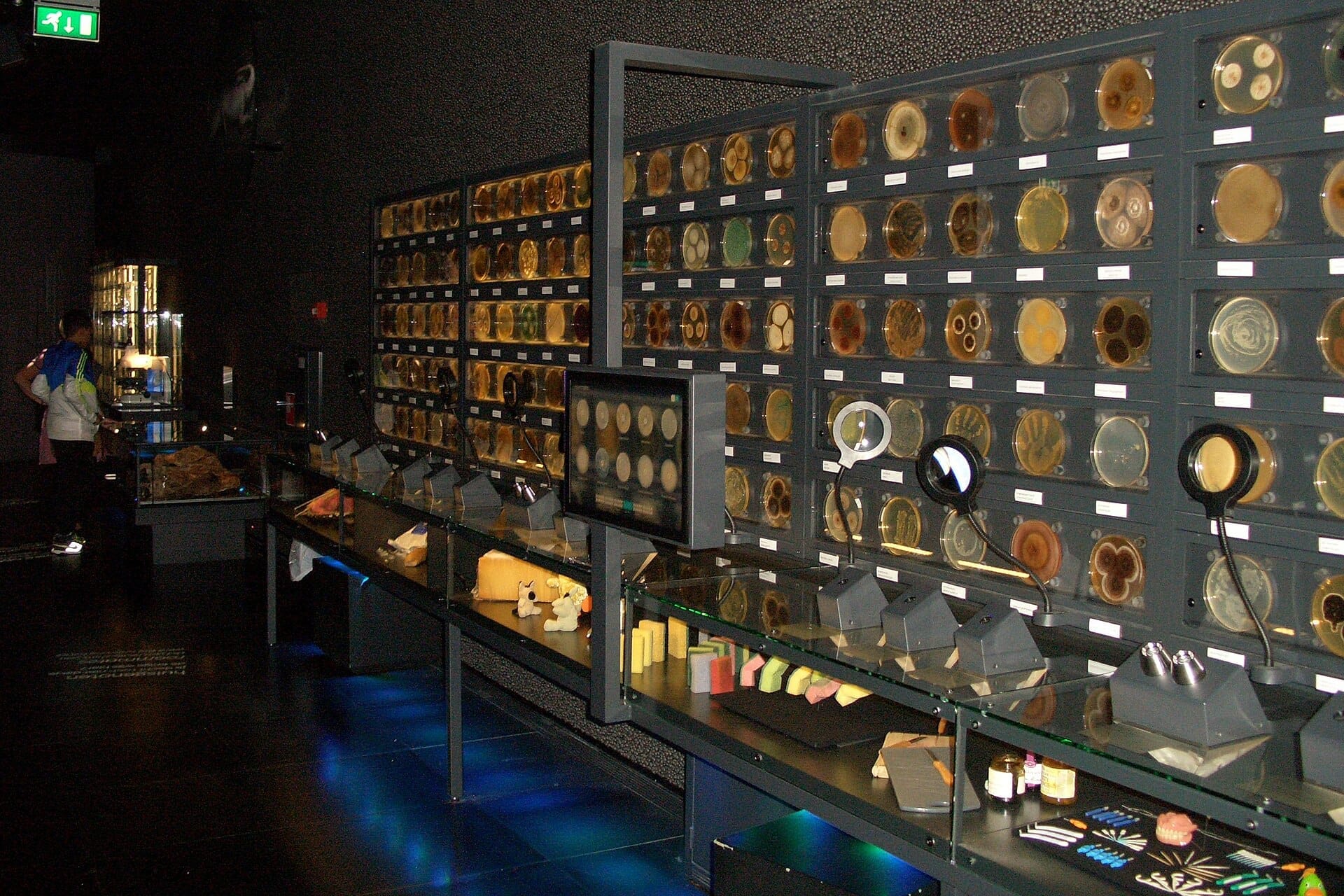
Entry is through the ARTIS zoo grounds, so you pass bird enclosures and old iron fencing before reaching a purpose-built, relatively compact building. Inside, the design is clean and deliberately clinical without feeling cold. The main floor is organized around active, living displays: glass containers housing real microbial cultures are lit from beneath or behind, with explanatory panels translating what you are looking at from near-invisible to comprehensible.
The standout installation for most visitors is the Kiss-O-Meter, a screen near the entrance that calculates how many microorganisms two people exchange during a kiss. It is slightly absurd and entirely effective at hooking visitors in immediately. From there, the experience deepens considerably. A wall of electron microscope portraits shows microbes at magnifications that reveal them as architecturally complex — some look like geometric spacecraft, others like coral, others like nothing you have seen before.
Upper levels use floor-to-ceiling displays showing live microorganism samples alongside video explanations of how they function in the human body, in soil, in fermented food, in ocean water. The focus is not on disease or fear, which is a deliberate choice. The curators have worked to present microbes as largely neutral or beneficial forces, contextualizing the 1% of species that cause illness within the vastly larger ecosystem of microbial life that makes all other life possible.
Tickets & tours
Live prices and dates from our booking partner. If you book, we may earn a commission at no extra cost to you.
Admission ticket for Artis Royal Zoo and Micropia
From 39 €Instant confirmationFree cancellationAmsterdam Micropia entrance ticket
From 18 €Instant confirmationFree cancellationGray Line Canal Cruise with snackbox & Heineken Experience
From 48 €Instant confirmationFree cancellationAmsterdam evening canal cruise
From 18 €Instant confirmationFree cancellation
How the Experience Changes by Time of Day
Micropia opens at 10:00 and closes at 17:00 every day of the week. The building is compact enough that crowd density matters. Morning visits before 11:30 tend to be quieter and better suited to reading exhibits carefully. Midday draws school groups, and the interactive stations can become congested. Afternoons after 14:30 often see a second wave of families, but the flow tends to ease again by 15:30 as timed-entry slots near the end of the day are less popular.
The interior lighting is dim by design, which makes the illuminated culture displays far more dramatic, but it also means the experience does not change much based on natural light outside. Rain or shine, the museum feels the same inside. That makes it an excellent choice when Amsterdam's notoriously changeable weather turns wet in the afternoon. If you are planning a day in the Plantage neighborhood, pairing Micropia with an outdoor morning at ARTIS or the nearby Hortus Botanicus and retreating indoors at Micropia after lunch is a practical structure.
Historical and Cultural Context
ARTIS, the parent organization, was founded in 1838, making it one of the oldest zoos in Europe. The zoo's formal name is Natura Artis Magistra, a Latin phrase roughly translating to "Nature is the teacher of art." Micropia fits directly into that intellectual tradition: it is explicitly a science education institution, not an entertainment venue. The museum took decades to conceive and required significant investment in both content development and live specimen infrastructure before opening.
The Plantage district itself has deep historical associations with Amsterdam's scientific and cultural institutions. Within a few hundred meters of Micropia, you have the Hortus Botanicus (founded 1638), one of the oldest botanical gardens in the world, and the Dutch Resistance Museum. The area has been a hub for civic learning for nearly four centuries, and Micropia slots into that lineage more naturally than it might in another part of the city.
If you are building a full day in this neighborhood, the Hortus Botanicus is a ten-minute walk from Micropia and offers a sharp contrast: plant life at a scale the human eye can appreciate comfortably. Together, they make for a coherent day organized around natural science.
Practical Walkthrough: Getting There and Getting In
The museum address is Plantage Kerklaan 38–40. Micropia is accessed through the ARTIS zoo entrance, not via a separate gate, so look for ARTIS signage when approaching. From Weesperplein metro station, the walk is approximately nine minutes through quiet streets lined with period architecture. From Waterlooplein metro, allow about ten minutes. Neither route involves complicated navigation.
If you are arriving from the city center on foot, the walk from Rembrandtplein or Waterlooplein through the Plantage neighborhood is straightforward and passes through a pleasant residential area with wide pavements and tree-lined streets. Cycling is another option: Amsterdam's cycling infrastructure extends through this area without difficulty, and ARTIS has bike parking outside the entrance.
Admission for visitors aged 13 and above is approximately €19.00, though prices should be confirmed on the official website before you visit since they are subject to change. Children under 13 enter free. Holders of the Museumkaart (annual museum pass) also enter free, which makes Micropia a straightforward inclusion if you hold that card. It is worth noting that the Museumkaart is not the same as the Amsterdam City Card, so check your pass type carefully.
If you are trying to maximize museum coverage across your trip, the Amsterdam City Card and guide to Amsterdam's best museums can help you assess whether individual tickets or a pass structure makes more financial sense for your itinerary.
ℹ️ Good to know
Museumkaart holders enter Micropia free. If you plan to visit multiple museums over several days, the Museumkaart frequently pays for itself on the second or third museum. Verify eligibility at artis.nl before purchasing tickets.
Who Will Love It, and Who Might Not
Micropia works best for visitors who arrive with at least a passing interest in science, biology, or the natural world. The content rewards attention: exhibits are dense with information, and the most rewarding way to experience the museum is to slow down and actually read the panels rather than drifting past the lit displays. Children who enjoy science classes at school will likely find it engaging; very young children who are not yet reading independently may struggle to connect with the content.
Adults visiting Amsterdam primarily for nightlife, shopping, or canal-focused leisure should not expect the same kind of experience as, say, a visit to the Van Gogh Museum or the Rijksmuseum. Micropia is a science institution, and while it is well-designed, it does not have the visual impact of a world-class art collection. It is also a small building: the floor space is modest, and visitors who need a half-day of walking to feel satisfied with a cultural stop may find the footprint too compact.
People with a strong aversion to thinking about germs or parasites should approach with mild caution. The museum does not dwell on the horrifying end of the microbial spectrum, but it does not entirely avoid it either. The content is frank, and a few displays directly address human pathogens. This is accurate science communication, not sensationalism, but it is worth knowing in advance.
For visitors prioritizing art over science, the nearby Dutch Resistance Museum and the Plantage neighborhood offer a richer set of alternatives within easy walking distance.
Photography and Accessibility Notes
The illuminated culture displays photograph well with a smartphone in portrait mode, but the low ambient light can cause blur if you are moving. Most displays are stationary, so a steady hand or a brief pause against a wall is usually enough to get a clean shot. Flash photography is not appropriate here and should be avoided around the live specimens. The largest projections on the upper level are impressive in photographs but difficult to capture in their full scale with a phone lens.
For visitors with mobility needs, specific details on step-free access, lifts, and facilities are best confirmed directly with ARTIS-Micropia via their official website before visiting, as published third-party information is not consistently detailed on this point. The ARTIS grounds generally accommodate a range of visitors, but the multi-level layout inside Micropia warrants a direct check if step-free access is a requirement.
Insider Tips
- Visit on a weekday morning if you can. School groups tend to arrive mid-morning and fill the interactive stations. Getting there at opening at 10:00 gives you thirty to forty minutes of relative quiet before the first group visits arrive.
- If you hold a Museumkaart, entry is free — but you still need to book a timed-entry slot online. Do not assume you can walk in on the day without a reservation.
- Combine Micropia with the Hortus Botanicus next door for a coherent natural science day. Both institutions reward slow, attentive visitors, and a combined ticket offered via ARTIS can provide savings depending on current pricing.
- The Kiss-O-Meter near the entrance is intentionally designed to create a shareable moment. If you are visiting with children or a partner, it makes for a memorable (and slightly gross) introduction to the experience.
- The museum shop near the exit stocks genuinely unusual gifts with a science-education angle, including items related to fermentation and microbiology. It is one of the more distinctive gift shops in Amsterdam and worth a few minutes on the way out.
Who Is Micropia For?
- Science-curious adults looking for something genuinely different from Amsterdam's standard museum circuit
- Families with school-age children who engage with biology or natural history
- Rainy afternoons when outdoor options in the Plantage neighborhood become less appealing
- Museumkaart holders who want to maximize free entry stops across a multi-day visit
- Travelers already visiting ARTIS Zoo or the Hortus Botanicus and looking to complete a full day in the neighborhood
Nearby Attractions
Other things to see while in Plantage & Jewish Quarter:
- ARTIS Amsterdam Royal Zoo
Founded in 1838, ARTIS Amsterdam Royal Zoo is the oldest zoo in the Netherlands and the fifth oldest zoo in the world still in operation. Set across landscaped grounds in the Plantage neighborhood, it blends wildlife, botanical gardens, and 19th-century heritage architecture into a single half-day destination that works for families, history enthusiasts, and curious solo travelers alike.
- Brouwerij 't IJ
Brouwerij 't IJ is Amsterdam's most distinctive craft brewery, operating inside an early-20th-century bathhouse at the foot of the De Gooyer windmill. The tasting room is free to enter, pours a rotating lineup of house-brewed beers, and offers short brewery tours on weekends. It is one of the few places in the city where industrial heritage, local brewing culture, and canal-side atmosphere converge in a single address.
- De Gooyer Windmill
Standing 26.6 metres tall on the eastern edge of the city, De Gooyer is widely described as the tallest wooden windmill in the Netherlands and one of Amsterdam's most photogenic historic structures. The mill itself is private, but the exterior is free to visit, and the craft brewery in the former bathhouse beside it is reason enough to linger.
- Dutch Resistance Museum
The Dutch Resistance Museum (Verzetsmuseum Amsterdam) tells the story of the Nazi occupation of the Netherlands through the choices ordinary people made: those who resisted, those who complied, and those who stood between. Located in the Plantage district, it is one of the most thoughtfully curated war museums in Europe.
Planning a trip? Discover personalized activities with the Nomado app.