Maximilianeum: Munich's Most Photographed Parliament Building
Rising from the eastern bank of the Isar at the end of Maximilianstraße, the Maximilianeum is a 19th-century palatial landmark that serves as both the seat of the Bavarian State Parliament and a foundation for gifted students. Its Neo-Gothic and Historicist façade dominates one of Munich's great axial views, and its story spans royal ambition, wartime destruction, and democratic rebirth.
Quick Facts
- Location
- Max-Planck-Straße 1, 81675 München (Haidhausen, eastern Isar bank)
- Getting There
- Max-Weber-Platz (U4/U5), approx. 5-min walk; Tram 19 stop Maximilianeum, approx. 2–3-min walk
- Time Needed
- 15–20 min for exterior and views; 60–90 min for a guided interior tour
- Cost
- Exterior: free. Interior: guided tours by prior registration with the Bavarian State Parliament visitor service (verify current conditions directly)
- Best for
- Architecture enthusiasts, history buffs, photography, and anyone tracing Munich's royal boulevards
- Official website
- www.bayern.landtag.de/maximilianeum/landtagsgebaeude
What the Maximilianeum Actually Is
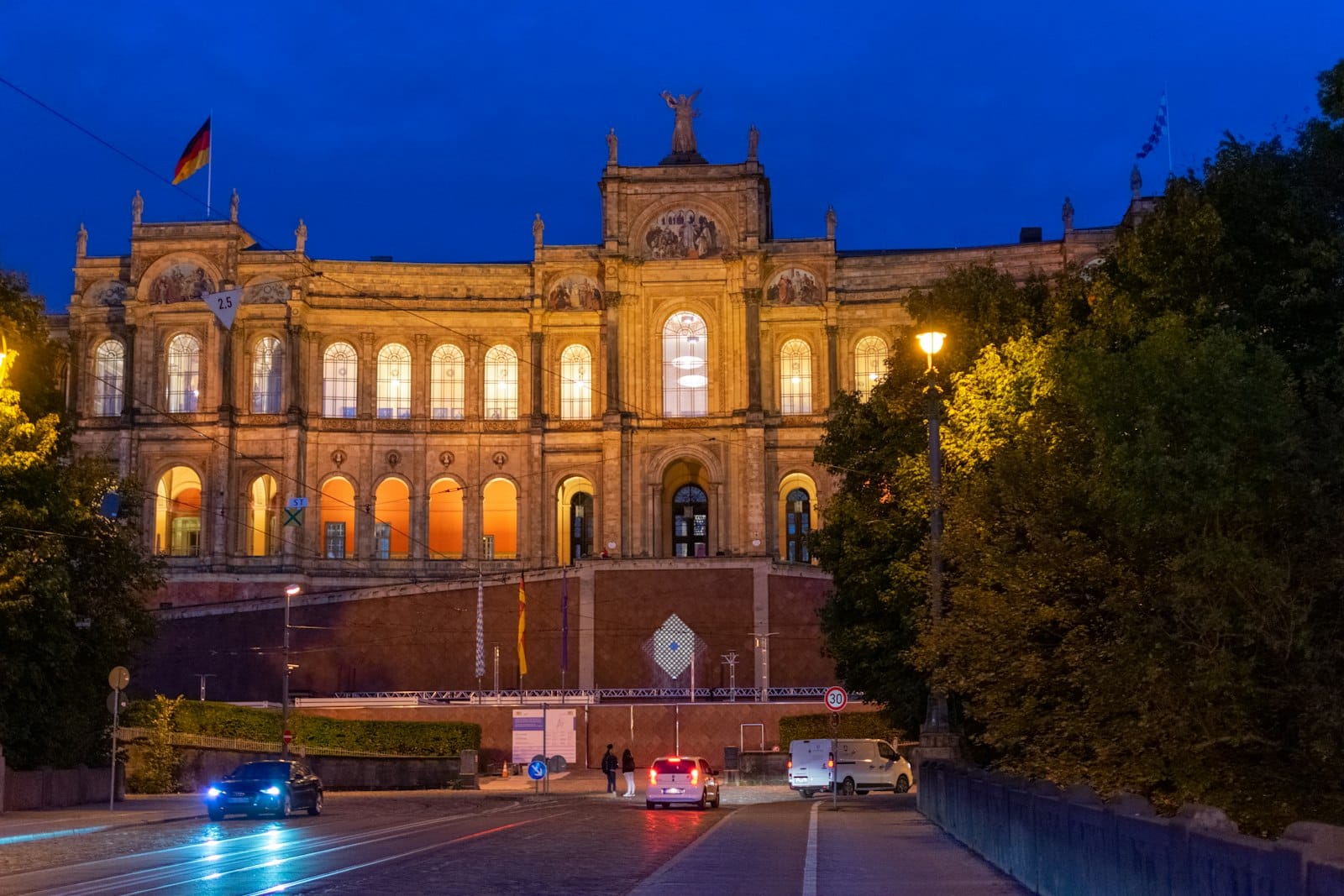
The Maximilianeum is one of those buildings that rewards people who stop walking and actually look up. Sitting on a low ridge on the eastern bank of the Isar, it closes the long perspective of Maximilianstraße like a painted backdrop, its cream-and-ochre façade punctuated by turrets, arcaded galleries, and mosaic panels glinting in afternoon light. The building serves two distinct functions under one roof: it is the official seat of the Bayerischer Landtag (Bavarian State Parliament), where Bavaria's elected representatives debate and legislate, and it houses the Stiftung Maximilianeum, a foundation that provides free accommodation for academically gifted students from Bavaria and the Palatinate.
Most visitors encounter it from the bridge or the western bank of the Isar, framing a photograph rather than entering. That is not a failure of curiosity — the exterior is genuinely the main event for casual visitors. But the interior, accessible via pre-arranged guided tours organized by the parliament's visitor service, offers a different dimension entirely: grand staircases, committee rooms lined with historical paintings, and the semicircular plenary chamber where Bavarian democracy operates.
ℹ️ Good to know
Interior visits for sightseeing or group programmes generally require advance registration with the Bavarian State Parliament's visitor service; spontaneous access is very limited and usually restricted to exhibitions or public committee meetings when places are available. Check the official site (www.bayern.landtag.de) for current visit formats, schedules, and booking procedures before you travel.
The View from the Bridge: What You See From Outside
Cross the Maximiliansbrücke from the city's western bank and the building fills your field of view progressively as you approach. The central block is flanked by symmetrical wings, and the entire composition sits on a terrace above street level, giving it a slightly elevated, ceremonial weight. The style is often described as Historicist or Maximilianstil, a distinctive 19th-century Bavarian hybrid that King Maximilian II championed: Gothic verticality blended with Romanesque arcading and English Perpendicular details, softened by warm local stone tones.
The mosaic panels between the upper arcade arches are worth the close look they rarely receive. They depict allegorical scenes referencing Bavarian history and virtues, executed in the kind of saturated colour that catches midday sun unexpectedly well. From the terrace in front of the building, looking back westward across the bridge, you get one of Munich's canonical urban views: Maximilianstraße running arrow-straight toward the Altstadt, with the Alps occasionally visible beyond the city's roofline on clear winter days.
The Isar embankment below the Maximilianeum connects north to the Englischer Garten and south toward the Isar River recreational corridors — making it easy to build the building into a longer walk along the riverbank.
Tickets & tours
Live prices and dates from our booking partner. If you book, we may earn a commission at no extra cost to you.
Luggage Storage in Munich
From 6 €Instant confirmationFree cancellationOne hour city sightseeing bus tour in Munich
From 21 €Instant confirmationFree cancellationMunich Third Reich walking tour
From 32 €Instant confirmationFree cancellationRomantic Road Day Trip to Rothenburg and Harburg
From 74 €Instant confirmationFree cancellation
How the Light Changes Through the Day
Photographers and architecture watchers will find the Maximilianeum behaves differently depending on when they arrive. Early morning, before the commuter traffic builds on Maximilianstraße, the facade catches soft eastern light directly — the pale stone registers as almost white, and the mosaics are less prominent, giving the building a more austere, formal character. The footpath along the Isar's eastern bank is nearly empty at this hour, and the sound is mostly water and birds rather than tram bells.
By mid-afternoon, especially from October through March when the sun stays low, the western-facing approach across the bridge produces strong, raking light across the building's horizontal cornices and arcade columns. This is when the depth of the facade reads best photographically. In summer, the terrace gets long shadows from the flanking wings from around 17:00 onward, and the temperature under the arcade colonnade drops noticeably — useful if you have walked from the Altstadt in July heat.
Evening is underrated. The parliament building is lit subtly after dark, and the reflection in the Isar (visible from the bridge) makes for a cleaner composition than the daytime view, which contends with tram wires overhead. The surrounding Haidhausen streets fill with locals heading to the neighborhood's restaurants and bars, giving the short walk back to the U-Bahn a more lived-in atmosphere than the tourist-heavy city center.
History: From Royal Vision to Democratic Institution
The story of the Maximilianeum begins with an idea and a boulevard. King Maximilian II of Bavaria wanted a monumental street to rival the Ludwigstraße his father Ludwig I had created to the north. He commissioned Maximilianstraße in the 1850s and envisioned a landmark building to anchor its eastern terminus. The foundation for the student scholarship program, the Stiftung Maximilianeum, was established in 1852. The foundation stone for the building itself was laid in October 1857, and construction was completed in 1874, by which point Maximilian II had been dead for a decade.
The building's early decades were defined entirely by the foundation's educational mission. From 1876 onward, it housed gifted students from Bavaria and the Palatinate under a scholarship arrangement that still operates today. Then came the Second World War. Bombing raids destroyed roughly two thirds of the building. The postwar reconstruction, carried out under architect Karl Kergl, rebuilt the structure closely following the original design, a considered decision that preserved the building's visual continuity with the pre-war street even as much of Munich was rebuilt differently.
In 1949, the Bavarian State Parliament chose the rebuilt Maximilianeum as its seat — a decision that merged royal architectural ambition with the mechanics of postwar democratic governance. The building has served that dual role ever since. For visitors interested in how Bavaria's political history intersects with its urban fabric, the nearby NS-Dokumentationszentrum provides a deeper examination of the city's 20th-century political past.
Getting There and Navigating the Area
The Maximilianeum sits in Haidhausen, one of Munich's inner eastern districts, on Max-Planck-Straße 1. The most direct transit approach is Max-Weber-Platz station (U4 and U5 lines), approximately a five-minute walk east of the building along Maximilianstraße, or the Tram 19 stop Maximilianeum, about 2–3 minutes on foot. Lehel station on the western bank of the Isar is another possible approach via the Maximiliansbrücke, though it is not the primary access recommended by the parliament.
Trams also run along Maximilianstraße, and cycling is practical given the dedicated lanes along the Isar. The Munich cycling guide covers the Isar riverside routes in detail. From Marienplatz, the building is around 1.5 km by foot along Maximilianstraße, a pleasant flat walk that also passes the Theatinerkirche and Odeonsplatz if you take a slight northern detour at the start.
💡 Local tip
Walk the full length of Maximilianstraße from the Altstadt side for the best approach. The axial perspective builds slowly over nearly a kilometer and the building appears to grow as you near the bridge. This is the route Maximilian II intended when he commissioned the boulevard.
Visiting the Interior: What to Expect
Interior access to the Maximilianeum is not a typical drop-in sightseeing experience. Because it is an active working parliament, public access is handled through the Bavarian State Parliament's visitor service and generally requires advance arrangements, whether for plenary or committee observation or for group visits. The parliament's official website (www.bayern.landtag.de) publishes current options, booking procedures, and any access restrictions related to parliamentary sessions, and visitors without prior registration will usually not be able to enter beyond exhibition areas when these are open.
For those who do arrange a visit through the visitor service, the programme may include the main hall, historical paintings, and, depending on the format and parliamentary schedule, access to the plenary chamber. The interior retains significant decorative elements from the 19th-century design alongside postwar restoration, and the student residential floors occupy sections of the building that reinforce its unusual dual-function character. The parliament's visitor service also notes that the building is largely accessible by wheelchair, and a video tour is available on the parliament website for those who want to assess access in advance.
⚠️ What to skip
Tours may not be available during active parliamentary sessions or certain public holidays. Check the official Bavarian State Parliament website for the current schedule before planning your visit.
Photography and Practical Notes
The exterior is freely photographable from any public vantage point, including the bridge and the Isar embankment. For the classic straight-on façade shot, position yourself at the foot of the bridge on the western side: a telephoto or standard lens (50–85mm equivalent) compresses the perspective of the boulevard leading to the building satisfactorily. For a wider composition that shows the Isar banks and the building together, move to the small green area along the eastern bank, slightly north of the bridge approach.
Interior photography policy during guided tours should be confirmed with the visitor service when booking. Rules inside active government buildings vary and can change.
Wear comfortable walking shoes if you are combining this stop with a walk along Maximilianstraße or the Isar embankment. The terrace area in front of the building has some steps; the accessible entrance route for wheelchair users should be confirmed with the parliament visitor service in advance.
Insider Tips
- The best photograph of the full Maximilianeum façade is taken from the pedestrian path on the western bank of the Isar, slightly south of the Maximiliansbrücke, where you can frame the bridge arches in the foreground with the building behind them.
- On clear days from late October through February, the Alps are occasionally visible above the Munich roofline from the Maximilianeum terrace. Early morning after overnight rain typically gives the clearest conditions.
- The Haidhausen neighborhood directly east of the building has a concentration of independent cafés and restaurants along Wörthstraße and Pariser Platz, a five-minute walk from the building. It is significantly less crowded and less expensive than the Altstadt side of the river.
- If you want to see the parliament chamber in session, check the Bavarian State Parliament website for plenary session dates — observation of live debates may be possible via the visitor service, which is a different and more limited experience than the standard building tour.
- The Maximiliansbrücke itself has bronze lion sculptures at each end of the span. They are easy to miss when you are focused on the building, but worth a pause on the crossing.
Who Is Maximilianeum For?
- Architecture enthusiasts drawn to 19th-century Historicist and Maximilianstil design
- History-focused travelers interested in Bavarian royal history and postwar reconstruction
- Photographers looking for one of Munich's most satisfying urban axial compositions
- Visitors combining a riverside walk along the Isar with cultural sightseeing
- Travelers who want to understand how Munich's royal boulevard network was conceived and built
Nearby Attractions
Other things to see while in Haidhausen:
- Isar River & Isarauen
The Isar River flows through the heart of Munich for nearly 14 km, flanked by gravel banks and floodplain meadows that function as the city's great outdoor living room. Entry is free, the water is swift and cold, and on warm weekends it draws tens of thousands of locals. This guide tells you where to go, when to arrive, and what to expect.
Planning a trip? Discover personalized activities with the Nomado app.