Liechtenstein Garden Palace: Vienna's Most Exclusive Baroque Interior
The Gartenpalais Liechtenstein is one of Vienna's most remarkable Baroque palaces, set in the quiet 9th district with a princely art collection still in private hands. Access is limited to guided tours and special exhibitions, making every visit feel genuinely rare.
Quick Facts
- Location
- Fürstengasse 1, 1090 Vienna (Alsergrund, 9th District)
- Getting There
- Tram D to Bauernfeldplatz or Seegasse; U4 Roßauer Lände (approx. 8 min walk)
- Time Needed
- 1.5 to 2.5 hours for a guided tour; 30 min for the garden alone
- Cost
- Varies by tour or exhibition; some annual exhibitions have been free (verify before visiting)
- Best for
- Baroque art lovers, architecture enthusiasts, and travelers who want to see Vienna beyond the tourist circuit
- Official website
- www.palaisliechtenstein.com/en/home.html
What the Gartenpalais Liechtenstein Actually Is
The Liechtenstein Garden Palace, known in German as the Gartenpalais Liechtenstein, is a privately owned Baroque palace sitting at the northern edge of Vienna's Alsergrund district. It is not a public museum in the conventional sense. You cannot simply walk up, buy a ticket, and wander through the rooms. Access is by guided tour, group arrangement, or during special exhibitions organized by the palace itself. That restriction is precisely what gives it its character: the interiors have not been softened into museum-grade accessibility, and what you see feels closer to a private residence than a cultural institution.
The palace formerly housed the Liechtenstein Museum from 2004 until the end of 2011. Since early 2012, it has operated primarily as an event and exhibition venue while continuing to display portions of the Princely Collections of the House of Liechtenstein, one of the oldest and most significant private art collections in the world. This is a working princely estate, not a preserved relic.
⚠️ What to skip
The Gartenpalais Liechtenstein is not open for walk-in visits. All access is through guided tours or special exhibitions with advance registration. Always check the official website before planning your visit, as schedules change seasonally.
A Palace Built for Display, Not Defence
The Gartenpalais was constructed in the late 17th and early 18th century, making it over 300 years old. Unlike Vienna's fortified inner-city palaces, this was always a garden palace, a Gartenpalais, designed to impress through elegance rather than military posture. The building sits behind a formal garden and presents a restrained facade that gives little indication of the density of decoration inside.
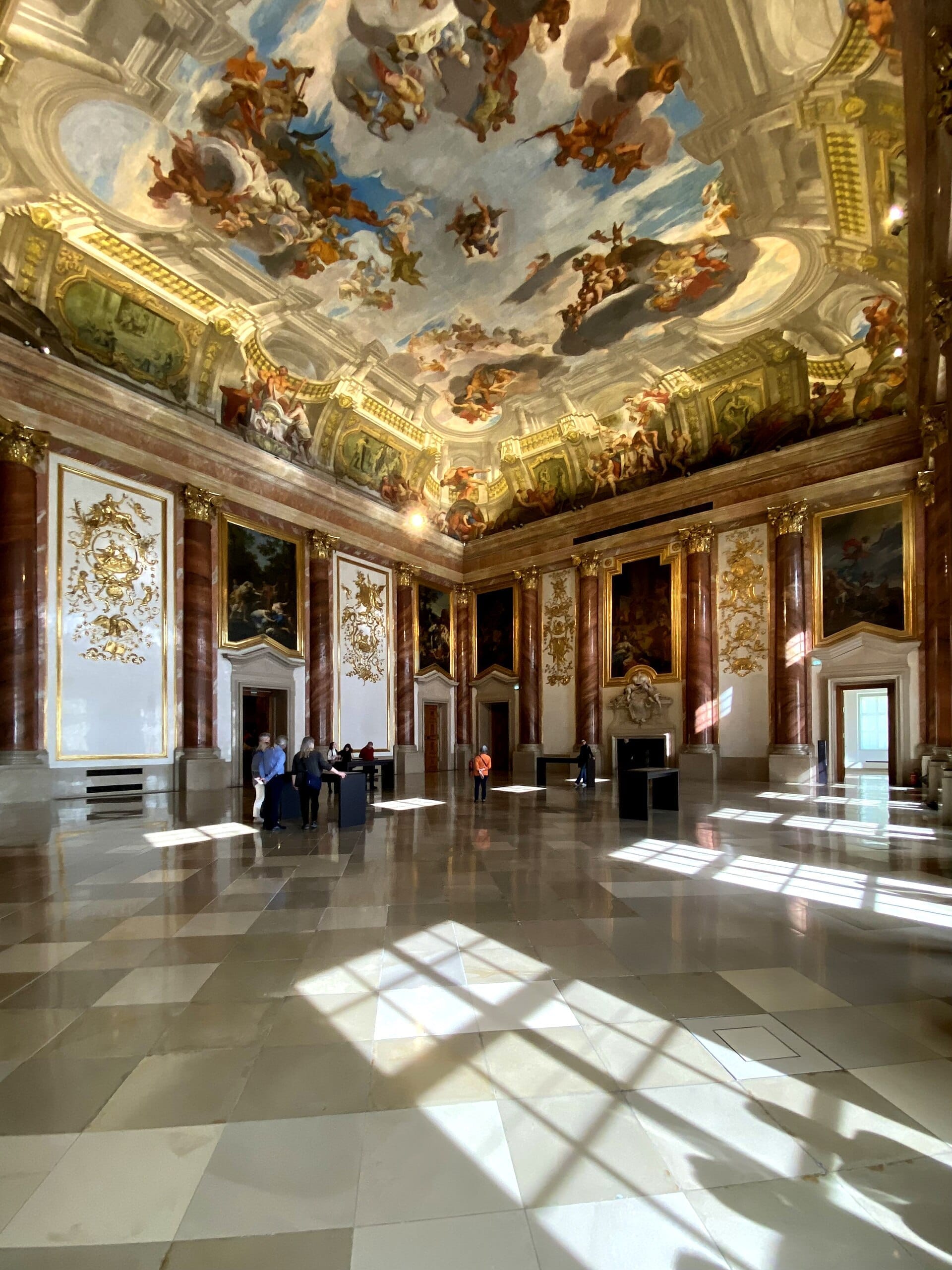
The interior is where the architecture becomes genuinely extraordinary. The frescoed ceilings in the principal state rooms are among the finest Baroque examples in Central Europe, painted by Johann Michael Rottmayr and others working in the grand illusionistic tradition of the period. The Hercules Hall, the palace's largest ceremonial room, has a ceiling fresco that forces the eye upward and holds it there. The effect is not subtle. It was designed to communicate the wealth and cultural authority of the House of Liechtenstein at a moment when aristocratic patronage was at its peak in Vienna.
The Liechtenstein family were among the most consequential patrons of the Habsburg era, and the collections they assembled reflect that position. For deeper context on how aristocratic families shaped Vienna's built environment, the Habsburg imperial history guide provides useful background on the patronage culture that produced palaces like this one.
Tickets & tours
Hand-picked options from our booking partner. Prices are indicative; availability and final rates are confirmed when you complete your booking.
Skip-the-Line Entrance with Guide to Schonbrunn Palace and Gardens
From 45 €Instant confirmationFree cancellationSchonbrunn Palace and gardens guided tour
From 43 €Instant confirmationFree cancellationBelvedere Palace and Garden Skip-the-Line Ticket and Guided Tour
From 49 €Instant confirmationFree cancellationSkip-the-Line Sisi Museum, Hofburg and Gardens Tour Vienna in French
From 52 €Instant confirmationFree cancellation
What a Visit Looks and Feels Like
Arriving at Fürstengasse 1 by tram, you step off into a residential street that feels entirely unlike the tourist-dense first district. The 9th district has a different rhythm: university buildings, quiet cafes, and apartment blocks with ornate but worn facades. The palace gate appears almost without announcement.
The Liechtensteinpark adjacent to the palace is publicly accessible during the day and worth a few minutes on its own. It is a formal garden in the French style, with clipped hedgerows and gravel paths that frame the palace's garden front. In warmer months, the contrast between the green geometry of the garden and the pale stone of the facade is quite striking. In winter, the bare branches and grey stone create a more severe impression that is not without its own appeal.
Inside, during a guided tour, the scale of the state rooms registers immediately. The floors are original inlaid parquet, and the furniture, where present, belongs to the collection rather than being placed for effect. The smell is particular: old wood, cool stone, and faintly the neutrality of conservation work. Sound behaves differently in rooms this large, and a tour group of even moderate size can fill the space acoustically. Morning tours, when groups tend to be smaller, feel quieter and more considered.
💡 Local tip
If a morning tour slot is available, take it. The light enters the state rooms from the garden side in the morning, and the frescoed ceilings catch it at angles that afternoon visits simply do not replicate.
The Art Collection: What You Might Actually See
The Princely Collections span painting, sculpture, and decorative arts from the 15th century through the 19th. Depending on which exhibitions are active at the time of your visit, you may encounter Old Master paintings, including works by Rubens, who was one of the most significant artists the Liechtenstein family patronized. The collection also includes pieces by Lucas Cranach the Elder and significant holdings of Biedermeier painting, a period in which Austrian domestic art produced some of its most quietly powerful work.
It is worth noting that not all of the collection is on display at any given time. The Princely Collections are partially shown at the City Palace (Stadtpalais Liechtenstein) in the first district, and what you encounter at the Garden Palace depends on the current exhibition programme. Treat the visit as an encounter with whatever is currently presented rather than expecting a fixed permanent collection in the way a national museum operates.
Vienna's concentration of exceptional art across multiple institutions is genuinely unusual. If you are planning to cover the major collections during your trip, the guide to the best museums in Vienna helps map out the full picture, including how the Gartenpalais fits relative to the Kunsthistorisches Museum and the Albertina.
Getting There and Practical Logistics
The palace is at Fürstengasse 1 in the 9th district. Tram line D stops at Bauernfeldplatz and Seegasse, both within comfortable walking distance. From the U4 line, Roßauer Lände station is approximately eight minutes on foot through the residential streets of Alsergrund. The walk itself is pleasant and gives a sense of how the 9th district functions as a neighborhood rather than a tourist zone.
There is barrier-free access and an accessible toilet on the premises. Assistance dogs are permitted. Limited on-site parking is available by prior arrangement, and additional paid parking can be found on Liechtensteinstraße. Vienna's tram network in this area is reliable enough that driving is rarely the most convenient option.
If this is your first time navigating Vienna by public transport, the guide to getting around Vienna covers tram, U-Bahn, and walking routes across the city's districts.
Who This Suits and Who Should Look Elsewhere
The Gartenpalais Liechtenstein works best for travelers who come with a specific interest: Baroque architecture, Old Master painting, European aristocratic history, or the mechanics of private collecting. The access restrictions mean it rewards planning rather than spontaneous visits.
It is not a good fit for visitors looking for a broad, child-friendly, interactive experience. The guided format, the fragility of the interiors, and the formal atmosphere make it an adult environment. Families with young children will find the Naturhistorisches Museum or the Prater more accommodating. Similarly, anyone expecting the volume and range of a major national collection will find the experience more intimate, and more conditional on what is currently on display, than they might anticipate.
For travelers who have already covered the main imperial sights and want something that feels genuinely different, the Gartenpalais delivers. It operates outside the typical tourist infrastructure and requires a small amount of effort to access, which is also part of its character.
The surrounding Alsergrund district has its own texture worth exploring before or after a palace visit. The Sigmund Freud Museum is a short walk away, and the district's cafe culture is quieter and less theatrical than the first district.
Photography and Seasonal Considerations
Photography permissions inside the palace depend on the specific tour or exhibition in force at the time of your visit. Check before you arrive rather than assuming. The garden, being publicly accessible, is freely photographable and offers good angles on the garden facade in morning light.
Spring and early autumn are the most comfortable seasons to visit. Summer in Vienna can push temperatures above 30°C, and the interior spaces of the palace, though substantial, may not be climate-controlled to museum standards. Winter visits are possible and the garden takes on a different character, but confirm that tours are running before making the trip, as the programme can thin out during quieter months.
ℹ️ Good to know
Some annual exhibitions at the Gartenpalais have been offered free of charge, though this is not guaranteed. Guided group tours are always by arrangement. Check palaisliechtenstein.com for the current programme, as schedules are not always reflected on third-party tourism sites.
Insider Tips
- Register for tours through the official palace website rather than relying on third-party booking platforms, which may not reflect the current schedule accurately.
- The Liechtensteinpark is open to the public without any registration and is worth visiting on its own as a quiet counterpoint to the more crowded parks in the first district.
- The 9th district has several excellent cafes along Währinger Straße and Berggasse, worth factoring into your visit as a pre or post-tour stop.
- If you are visiting with a group, private group arrangements can sometimes unlock access to rooms not included in the standard public tour. Contact the palace directly to ask what is possible for your group size and date.
- The Stadtpalais Liechtenstein in the first district, a different Liechtenstein family palace, displays another portion of the Princely Collections and operates on a separate schedule. Visiting both gives a more complete picture of the collection's range.
Who Is Liechtenstein Garden Palace (Gartenpalais Liechtenstein) For?
- Baroque art and architecture enthusiasts who want to see interiors beyond the standard imperial circuit
- Travelers with a specific interest in European aristocratic collecting and patronage history
- Visitors on a second or third trip to Vienna who have covered the main sights and want less-trodden ground
- Small group tours where the guided format suits the pace of the visit
- Photography visitors focused on the garden facade and formal garden geometry
Nearby Attractions
Other things to see while in Alsergrund & Josefstadt (8th–9th Districts):
- Sigmund Freud Museum
For 47 years, Berggasse 19 was where Sigmund Freud lived, practiced, and developed the ideas that reshaped modern thinking. Today the Sigmund Freud Museum preserves that address as one of Vienna's most intellectually charged cultural spaces, reopened after major renovation in 2020 with expanded exhibitions and sharper curatorial focus.
- Volksoper Vienna
The Volksoper Wien is Vienna's most accessible opera house, staging opera, operetta, dance, and musical theatre in a historic building in the 9th district. Less formal than the State Opera, it offers serious artistic quality at a broader range of price points, making it one of the most rewarding evening experiences in the city.