Lalla Takerkoust Lake: The Reservoir Retreat Near Marrakech
Built in the 1930s as a dam on the Oued N'Fis river, Lalla Takerkoust Lake sits roughly 35 km southwest of Marrakech, offering a rare stretch of open water, Atlas Mountain backdrops, and an easy half-day escape from the city. Activities range from jet skiing and quad biking to simply sitting on a terrace with a mint tea and watching the light change over the water.
Quick Facts
- Location
- Lalla Takerkoust village, Al Haouz province, ~35–40 km southwest of Marrakech
- Getting There
- Car or taxi (~40–60 min from city centre); local bus toward Amizmiz from Sidi Mimoun stop near Koutoubia
- Time Needed
- Half day (3–5 hours) is typical; full day if combining with a meal and activities
- Cost
- Free to access the lake; activities extra (jet ski 300–500 MAD/15 min, boat 50–150 MAD/person, quad 400–900 MAD/hr)
- Best for
- Families, outdoor enthusiasts, and anyone needing a break from the medina
What Lalla Takerkoust Lake Actually Is
Lalla Takerkoust Lake is a reservoir, not a natural lake. The dam that created it, originally named Barrage Cavagnac and constructed between 1929 and 1935 during the French Protectorate, was built across the Oued N'Fis river to supply irrigation water to the Haouz plain and electricity to the surrounding region. The resulting reservoir stretches roughly 7 km in length, with a dam standing approximately 71 metres high. Its useful storage capacity is reported at about 69 million cubic metres.
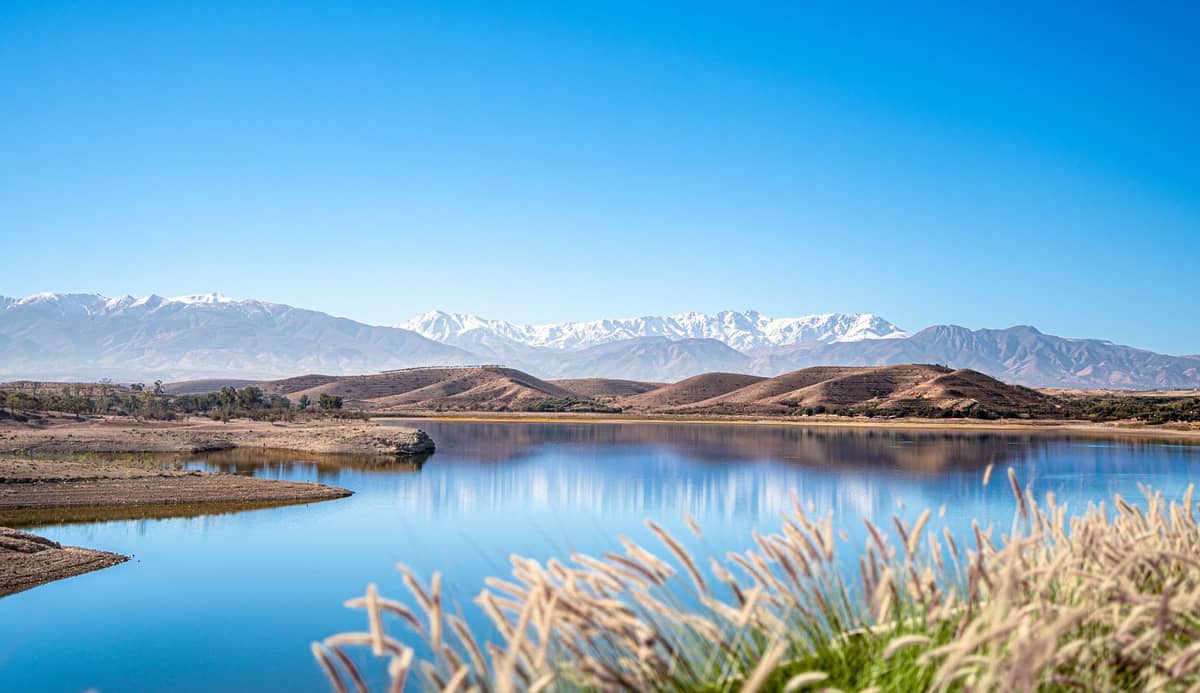
That engineering history is visible in the dam wall itself, a solid, utilitarian structure that frames one end of the lake. The water beyond it, however, feels anything but industrial. On clear days, the High Atlas mountains rise directly behind the far shore, their ridges reflected in water that shifts from pale silver in the morning to deep green-blue by midday. It is one of the more striking natural scenes within easy reach of Marrakech, and for a city surrounded largely by arid plains, the presence of this much open water feels refreshing.
ℹ️ Good to know
Access to the lake shoreline is free. Individual lakeside clubs and activity operators charge separately for their facilities and watersports. Always confirm current prices directly with providers on arrival, as rates fluctuate by season.
The Journey from Marrakech: Setting Expectations
The drive from central Marrakech takes roughly 40 to 60 minutes depending on traffic and your exact starting point. The route heads southwest on the road toward Amizmiz, passing through Tamesloht and gradually leaving the city's flat outskirts behind. The landscape opens up considerably once you clear the agricultural edges of the city, and the first glimpse of the Atlas foothills signals you are getting close.
A local ALSA bus (line 45 on the Sidi Mimoun–Amizmiz route) toward Amizmiz departs approximately every 20–30 minutes from the Sidi Mimoun stop near the Koutoubia, stopping at Lalla Takerkoust. This is the budget option, but journey times by bus are longer and schedules should be verified locally before you rely on them. Most visitors arrive by hired car or grand taxi, which gives you the flexibility to leave when you want rather than hunting for a return bus. If you are combining the lake with other stops in the area, a private car makes significantly more sense.
The lake pairs well with other day excursions in the Atlas foothills region. Some travellers combine it with a stop in the Ourika Valley or use it as a cooling break on the way back from a longer trip. For route ideas, the day trips from Marrakech guide covers the surrounding region in detail.
Tickets & tours
Live prices and dates from our booking partner. If you book, we may earn a commission at no extra cost to you.
Lalla Takerkoust high-performance 4x4 self-drive experience
From 650 €Instant confirmationFree cancellationFull day tour of Ouarzazate from Marrakech
From 51 €Instant confirmationFree cancellationEvening Quad Bike at Palmeraie Area with Tea Tasting from Marrakech
From 49 €Instant confirmationFree cancellationFull Day Economic Tour in Essaouira from Marrakech
From 29 €Instant confirmationFree cancellation
What to Expect at the Lake: Time of Day Matters
Early morning arrivals, before 9am, find the lake at its quietest and most photogenic. The light is low and angled, the Atlas peaks catch colour before the sky turns flat, and the surface of the water is often glassy. There are almost no other visitors at this hour. The air carries a faint coolness that disappears quickly once the sun rises above the surrounding hills.
By mid-morning, the lakeside clubs begin to open and the first activity operators set up their equipment. This is when the tone shifts: jet skis start up, music arrives from restaurant terraces, and the atmosphere becomes social rather than tranquil. Moroccan families tend to arrive in numbers from late morning onward, particularly on Fridays and weekends, bringing picnic setups and spending most of the day. If you want calm, arrive early or on a weekday. If you want atmosphere and activity, a weekend afternoon delivers both.
By early afternoon in summer, the heat can be significant. There is limited shade along the open shoreline, so unless you have secured a terrace spot at one of the lakeside establishments, the midday hours are uncomfortable for extended outdoor time. Late afternoon brings the light back to a workable angle and temperatures drop to something more reasonable. Sunset over the reservoir, with the Atlas range turning amber behind the water, is a good reason to linger.
⚠️ What to skip
At least one source notes that open bathing in the reservoir is officially prohibited, though some operators advertise swimming in designated areas. Check current local rules when you arrive and do not swim without confirming it is permitted at your specific location.
Activities and What They Cost
The lake's main draw for active visitors is watersports. Jet ski rentals run approximately 300 to 500 MAD for 15 minutes, depending on the operator and the season. Boat rides, typically pedal boats or small motorboats, are available for roughly 50 to 150 MAD per person. Neither activity is especially cheap by local standards, but the experience of being out on the water with the Atlas directly ahead of you is different from anything available in the city.
Quad biking is offered by several operators along the access road and around the lake's perimeter. Prices range from around 400 to 900 MAD for approximately one hour. The terrain is dusty and open, more suited to people who enjoy off-road riding for its own sake than to those expecting dramatic scenery. Some lakeside clubs also charge a general entry fee of 100 to 300 MAD depending on the facilities included, which may cover use of sun loungers, a pool, or access to a beach area.
For visitors who prefer a passive experience, the lakeside restaurants are a legitimate reason to come. Several establishments offer terraces directly overlooking the water, serving grilled fish, tajines, and the standard spread of Moroccan salads. Quality varies between venues, but the setting compensates for inconsistency in most cases. Arriving for a late lunch, sitting through the afternoon, and leaving before sunset is a common and comfortable pattern.
Practical Details: Getting There, What to Bring, Accessibility
There are no official opening hours for the lake itself as an outdoor public site. The shoreline is accessible at any time, though activity operators and restaurants typically run from mid-morning until early evening. There is no entrance fee to visit the lake.
The terrain along most of the shoreline is unpaved, consisting of dirt and stone tracks with uneven ground. This makes access difficult for visitors with mobility impairments. Some lakeside clubs have more structured access with terraces and designated seating areas, but step-free access is not guaranteed and varies significantly by venue. It is worth contacting specific establishments in advance if this is a concern.
For clothing, the lake is more relaxed than the medina in terms of dress expectations, particularly at the tourist-facing clubs and restaurants. That said, modest clothing remains appropriate when moving through the surrounding village. Bring sunscreen, a hat, and plenty of water for the summer months. The open terrain around the lake provides almost no natural shade outside of restaurant terraces. Closed-toe shoes or sandals with grip are useful if you plan to walk along the informal shoreline paths.
If you are planning a longer visit to the region or want to understand how this fits into a broader Marrakech trip, see the best time to visit Marrakech for seasonal guidance on timing your visit to the surrounding areas.
Who Will Enjoy This, and Who Might Not
Lalla Takerkoust is well suited to families who want an outdoor day with activity options, to travellers who have spent several days in the medina and need open air and space, and to anyone curious about the Atlas foothills without committing to a full trekking excursion. The combination of water, mountains, and a functional terrace for lunch covers a broad range of expectations.
Travellers expecting a pristine natural lake will need to adjust their expectations. This is a working reservoir surrounded by a small village and several informal commercial operations. The shoreline is not manicured. The atmosphere on busy weekends is social and occasionally noisy. If your priority is undisturbed natural scenery, the Ourika Valley or a guided walk in the Atlas foothills might be a better fit.
Solo travellers and couples on a tight schedule may find the journey time disproportionate to the experience unless they are specifically drawn to the watersports or to an unhurried meal with Atlas views. As a half-day addition to a longer Marrakech itinerary rather than a standalone destination, it works well. As the centrepiece of a day trip for visitors who have already seen the city's main attractions, it earns its place.
💡 Local tip
Go on a weekday if possible. Weekend crowds, particularly on Friday afternoons, are substantial and parking near the popular lakeside spots can become chaotic. A Tuesday or Wednesday morning visit is a markedly calmer experience.
Insider Tips
- Negotiate taxi fares to the lake in advance at a fixed price before departing Marrakech. Grand taxis from the city to Lalla Takerkoust are a standard route and drivers know it well, but agreeing on a round-trip price including a wait time of two to three hours gives you flexibility without the hassle of finding return transport.
- The restaurants closest to the main parking areas charge more and deliver inconsistently. Walk a few hundred metres further along the shore and you will find smaller, family-run establishments with better food and lower prices.
- Photography is best in the first two hours after sunrise and in the final hour before sunset. Midday light flattens the Atlas backdrop and the water loses its depth of colour entirely.
- If you want to use jet skis or rent boats, arrive before 11am on a weekend. Popular operators sell out their available slots by early afternoon during summer and public holidays.
- The road to the lake passes through Tamesloht, a small town with a weekly souk. If your timing aligns, it is worth a brief stop on the way back toward Marrakech.
Who Is Lalla Takerkoust Lake For?
- Families with children who want outdoor activities and space to move
- Travellers three or more days into a medina-heavy itinerary who need an open-air reset
- Watersports enthusiasts looking for jet skiing or boating within an hour of the city
- Photographers chasing Atlas Mountain reflections and golden-hour light over open water
- Groups wanting a relaxed lunch setting with scenery rather than a city restaurant
Nearby Attractions
Combine your visit with:
- Agafay Desert
Just 30 to 40 kilometres southwest of Marrakech, the Agafay Desert is a rocky plateau of roughly 300 to 400 square kilometres that delivers dramatic open-sky landscapes without a multi-day Sahara expedition. It is not the sand-dune desert many visitors picture, but that distinction is part of its appeal: a raw, mineral terrain framed by the snow-capped peaks of the High Atlas, accessible within an hour of the city.
- Aït Benhaddou
Rising from the southern slopes of the High Atlas, the Ksar of Aït Benhaddou is a UNESCO World Heritage Site and one of Morocco's most architecturally striking places. Built from pisé earth and palm wood, this fortified village has stood at the crossroads of trans-Saharan trade for centuries — and remains partly inhabited today.
- Anima Garden
Set along the Ourika road 27 km south of Marrakech, Anima Garden is a three-hectare art-and-nature space created by Austrian artist André Heller. Sculptures, water features, and carefully curated plantings coexist in a setting that feels both otherworldly and deeply rooted in Moroccan landscape. It rewards slow exploration and offers a genuine contrast to the pace of the medina.
- Essaouira
Essaouira is a UNESCO-listed fortified coastal city on Morocco's Atlantic coast, roughly 2.5 to 3 hours from Marrakech by road. Its 18th-century medina, ocean-facing ramparts, and salt-aired souks offer a complete change of pace from the heat and intensity of the inland city. Entry to the medina is free.
Planning a trip? Discover personalized activities with the Nomado app.