Kulturhuset Stadsteatern: Stockholm's Living Room at Sergels Torg
Kulturhuset Stadsteatern is Stockholm's flagship cultural center, occupying a landmark modernist glass building on Sergels torg since 1974. It combines free public spaces, libraries, and galleries with a major city theatre, making it one of the few venues where you can walk in off the street and spend hours without buying a ticket.
Quick Facts
- Location
- Sergels torg, 111 57 Stockholm (Norrmalm)
- Getting There
- T-Centralen metro (~4 min walk) or Hötorget metro (~5 min walk)
- Time Needed
- 1–3 hours for public areas; full evening for theatre
- Cost
- Public areas and many exhibitions free; theatre and events ticketed (prices vary in SEK)
- Best for
- Culture seekers, rainy day escapes, theatre-goers, design enthusiasts
- Official website
- kulturhusetstadsteatern.se
What Kulturhuset Stadsteatern Actually Is
Kulturhuset Stadsteatern is not a single museum with a single collection. It is a stacked cultural complex where a public library sits above a theatre, galleries occupy multiple floors, and a cafe terrace looks out over the square below. The name reflects a 2013 merger between Kulturhuset (the building and its public programming) and Stockholms stadsteater (the city theatre), bringing the full operation under one roof and one identity. What you get is a place that operates simultaneously as a civic resource and a serious performing arts venue.
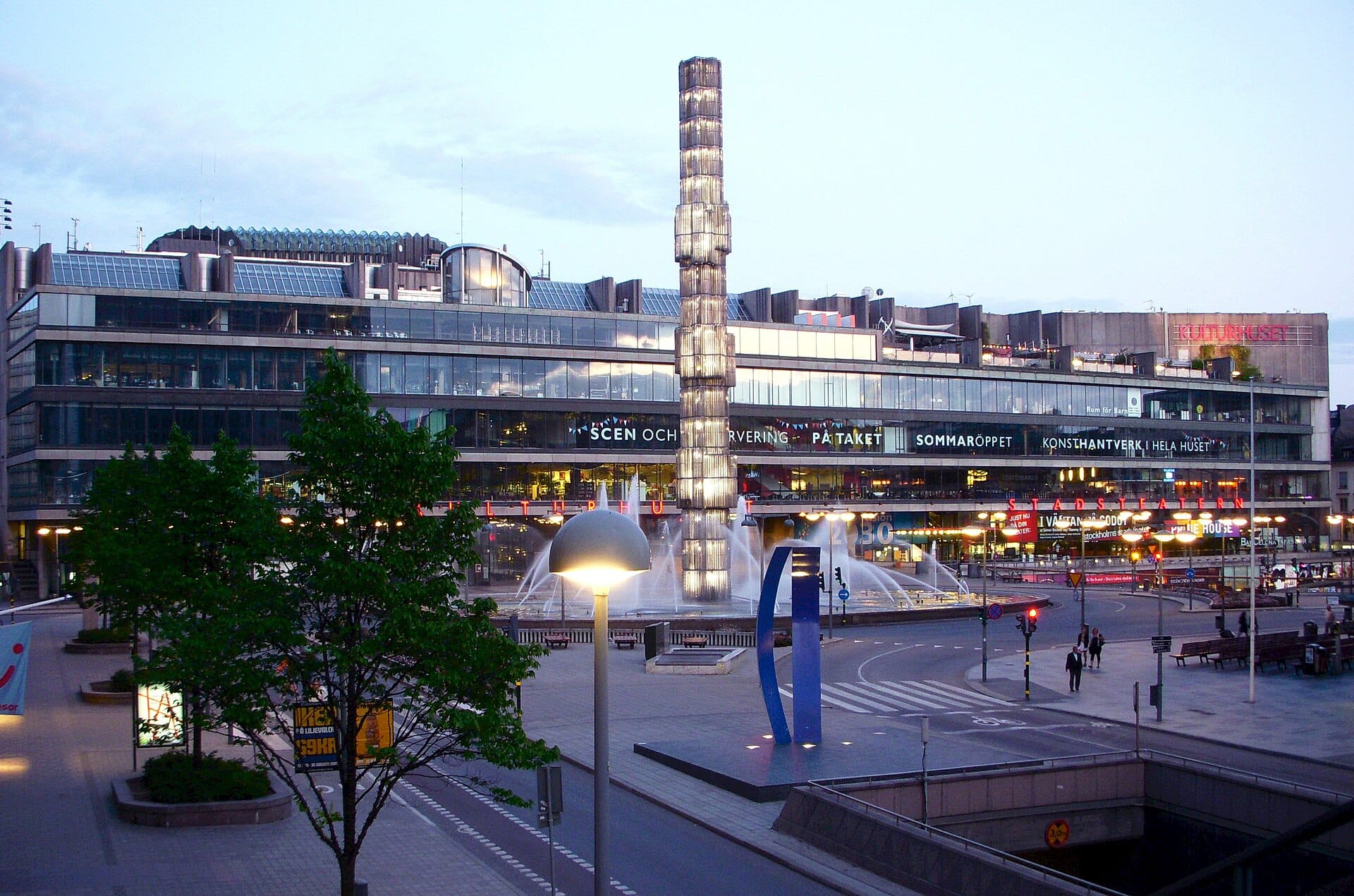
The building itself was inaugurated in 1974, designed by Swedish architect Peter Celsing. Its most distinctive feature is a sweeping glass facade facing Sergels torg that gives the interior a constant relationship with the square outside. On a grey November afternoon, the interior is warm and filled with ambient noise from people reading, waiting, and moving between floors. On a summer evening before a performance, the whole building hums differently. Celsing's design reads as restrained Swedish modernism with a civic ambition that still feels relevant.
ℹ️ Good to know
It is blue-marked by the Stockholm City Museum, a designation indicating particularly high cultural-historical values. Parts of the building housed the Swedish Parliament until 1983 while it simultaneously functioned as a cultural center, making it the only current venue of its kind in Stockholm with that footnote in its history.
The Building: Glass, Levels, and Sergels Torg
Sergels torg is Stockholm's most central public square, and Kulturhuset occupies its entire southern face. From the square, the building presents as a five-story glass wall, transparent enough that you can see people moving between floors before you even step inside. The plaza level connects directly to the underground walkways of T-Centralen, meaning foot traffic flows through the area constantly throughout the day.
The building sits in the heart of Norrmalm, Stockholm's central commercial and administrative district. This positioning is deliberate: Kulturhuset was conceived as a democratic cultural space accessible to everyone passing through the city center, not a destination requiring a special trip to a museum island. You pass it on the way to Central Station. You pass it on the way to the shops on Drottninggatan.
Inside, the levels are connected by escalators and elevators, and the layout rewards wandering. The theatre entrance is accessed from Drottninggatan, while the main public areas open toward the square. Each floor has its own atmosphere: lower levels tend toward busier common spaces, while upper floors are quieter and more gallery-like. The rooftop cafe, when open seasonally, offers one of the more understated elevated views over the city center.
Tickets & tours
Live prices and dates from our booking partner. If you book, we may earn a commission at no extra cost to you.
2-hour archipelago tour on a RIB speedboat
From 122 €Instant confirmationFree cancellationHaunted Stockholm exploration game and tour
From 12 €Instant confirmationFree cancellationFotografiska Stockholm entrance tickets
From 0 €Instant confirmationFree cancellationStockholm: Nature Reserve Hiking Tour with Campfire Lunch
From 102 €Instant confirmationFree cancellation
What to Do Inside: Free Floors and Ticketed Stages
The core public offer is substantial without spending anything. The building contains libraries, reading rooms, exhibition spaces, and areas specifically designed for children. The library collections are available to browse, and curated exhibitions on art, design, and social themes rotate through the gallery spaces throughout the year. On weekday afternoons, the reading areas fill with students and regulars who treat the place as a second workspace.
If you are already planning a broader cultural itinerary, it is worth noting that Kulturhuset complements rather than duplicates what you find at dedicated art institutions like Moderna Museet or Nationalmuseum. Kulturhuset leans toward living culture: performance, debate, children's programming, and topical exhibitions rather than permanent historical collections.
The theatrical side of the operation runs across multiple stages of varying sizes, presenting Swedish-language productions ranging from contemporary drama to dance to experimental work. Ticket prices vary by production and seating category and are sold in Swedish kronor via the official website and the box office on site. If you are interested in attending a performance, checking the program several weeks in advance is advisable, particularly for popular runs.
💡 Local tip
Entry to the building and most public areas is free. You do not need a ticket to browse the exhibitions, use the library spaces, or visit the cafe. Only specific performances and special events require tickets.
How It Changes by Time of Day
Mornings at Kulturhuset are calm. The square outside is still transitioning from night-city quiet to daytime activity, and the interior spaces fill gradually. This is one of the better times to look at exhibitions without competition for space, or to sit with a coffee and take in the glass facade from the inside looking out toward the square.
By early afternoon, especially on weekdays, the building picks up noticeably. School groups arrive for children's programming, and the common areas become animated with movement and sound. The sound level in the public spaces reflects this: it is not a hushed museum environment but a civic building with an open-door policy, and it feels that way.
Evenings before performances are the most charged. The theatre lobby fills with Stockholm's theatregoing crowd, a mix of regulars and first-timers, and the atmosphere shifts toward focused anticipation. If you are not attending a show, arriving around 6pm on a performance night just to observe the building in this mode is worthwhile. The glass facade lit from within at dusk, with Sergels torg visible beyond, is one of the more distinctive images the city center produces.
Historical Context: From Folkets Hus to the Present
The cultural operations that eventually became Kulturhuset Stadsteatern began in 1960 at Folkets hus on Norra Bantorget. The move to the current building at Sergels torg happened in 1990, once the complex had been operating for some years following its 1974 inauguration. Between 1974 and 1983, the building also temporarily housed the Swedish Parliament while the Riksdag's permanent home was being renovated, an unusual chapter that underscores how central the building was considered to civic life.
The formal institutional merger creating Kulturhuset Stadsteatern occurred on 1 July 2013, bringing the cultural center's public programming and the city theatre together under a single administrative structure. The merger was intended to deepen integration between the building's public offer and its performing arts programming, though the two strands retain distinct identities in practice.
This history fits into a broader pattern of mid-twentieth century Scandinavian civic investment in public culture, related to the same political tradition that produced institutions across Stockholm. If Swedish cultural history interests you, the Viking history of Stockholm and the city's long relationship with civic institution-building are worth reading alongside a visit here.
Practical Information: Getting There and Getting Around
The location is genuinely central. T-Centralen, Stockholm's main metro interchange, is roughly four minutes on foot, making Kulturhuset reachable from almost any point in the city on the Tunnelbana. Hötorget metro station is approximately five minutes in the other direction. Bus routes along Klarabergsgatan and Drottninggatan stop nearby.
If you are orienting yourself around Stockholm's public transport system, the guide to getting around Stockholm covers SL ticketing and route planning in detail. A single SL ticket covers both metro stations serving this area.
Opening hours vary by space and day. The building operates on different schedules for its library functions, galleries, and theatre. Checking the official website before visiting is not optional advice: specific opening times, event schedules, and any temporary closures are updated there. Arriving without checking and finding a particular floor or program closed for a private event is a realistic possibility.
⚠️ What to skip
Hours for individual spaces within the building differ from each other and change seasonally. Always check kulturhusetstadsteatern.se before visiting, especially if you are coming specifically for an exhibition or children's program.
Accessibility is well-considered for a building of this age. Elevators connect all public levels, and step-free access is available throughout the main public areas. For specific accessibility requirements, contacting the venue in advance via their official site is recommended to confirm current arrangements.
Who Should Skip This
Travelers with only a day or two in Stockholm and a list of major sights to cover may find Kulturhuset hard to justify ahead of the Vasa Museum, Gamla Stan, or Skansen. It is not a conventional tourist attraction with a single defining exhibit or view. Its value accumulates through time spent inside, and it rewards visitors who are prepared to wander, sit, and respond to whatever is currently showing.
If Swedish-language theatre is the draw, non-Swedish speakers should check whether a production has English surtitles before booking. Not all performances are subtitled, and the main theatrical programming is produced in Swedish.
Insider Tips
- The rooftop cafe, when open, is one of the quieter elevated spots in central Stockholm and far less crowded than formal observation decks. Check whether it is operating during your visit before making it a plan.
- Weekday mornings before noon are the calmest time to visit the public galleries. Weekday afternoons bring school groups to the children's floors, which changes the atmosphere considerably on those levels.
- The building's glass facade is best photographed from the far end of Sergels torg in the late afternoon, when the angle of light catches the transparency of the structure. At dusk on a performance evening, interior lighting makes the facade glow.
- The theatre box office can advise on last-minute availability for productions. Some performances open unsold seats close to curtain time at reduced prices, though this is not a guaranteed policy.
- The children's cultural programming floors are thoughtfully designed and worth visiting even for adults who appreciate Swedish approaches to children's education and design. It is not a conventional soft-play area.
Who Is Kulturhuset Stadsteatern For?
- Architecture and design travelers drawn to Swedish modernism and Peter Celsing's civic buildings
- Rainy day visitors wanting free indoor cultural space in the city center
- Theatre-goers interested in contemporary Swedish performing arts
- Families with children looking for culturally engaged programming beyond conventional museums
- Travelers who want to observe everyday Stockholm life rather than only tourist-facing attractions
Nearby Attractions
Other things to see while in Norrmalm:
- Museum of Mediterranean and Near East Antiquities
Housed in a striking 1905 neo-classical building near Gustav Adolfs Torg, the Museum of Mediterranean and Near Eastern Antiquities (Medelhavsmuseet) brings together one of Scandinavia's most significant collections of Egyptian, Cypriot, Greek, Roman, and Islamic art and artifacts. It is a serious museum for curious travelers, not a tourist spectacle, and it rewards those who give it proper time.
Planning a trip? Discover personalized activities with the Nomado app.