Kifune Shrine (Kibune Shrine): Ancient Water Deity in Kyoto's Mountain Valley
Kifune Shrine is one of the oldest and most atmospheric shrines in the Kyoto region, tucked into a narrow cedar-forested valley north of the city. Dedicated to the deity of water, it draws visitors with its famous stone staircase flanked by red lanterns, its summer kawadoko riverside dining platforms, and a quiet that feels genuinely removed from central Kyoto. Entry to the grounds is free.
Quick Facts
- Location
- 180 Kuramakibune-cho, Sakyo-ku, Kyoto — Kurama-Kibune valley, northern Kyoto
- Getting There
- Eizan Railway to Kibuneguchi Station, then Kyoto Bus No. 33 to Kibune bus stop, 5-minute walk to shrine
- Time Needed
- 45 minutes to 2 hours on-site; allow a half-day including travel from central Kyoto
- Cost
- Free entry to shrine grounds; transport from Kyoto city costs extra
- Best for
- Nature lovers, spiritual seekers, autumn foliage, couples, photography
- Official website
- kifunejinja.jp/en
What Kifune Shrine Actually Is
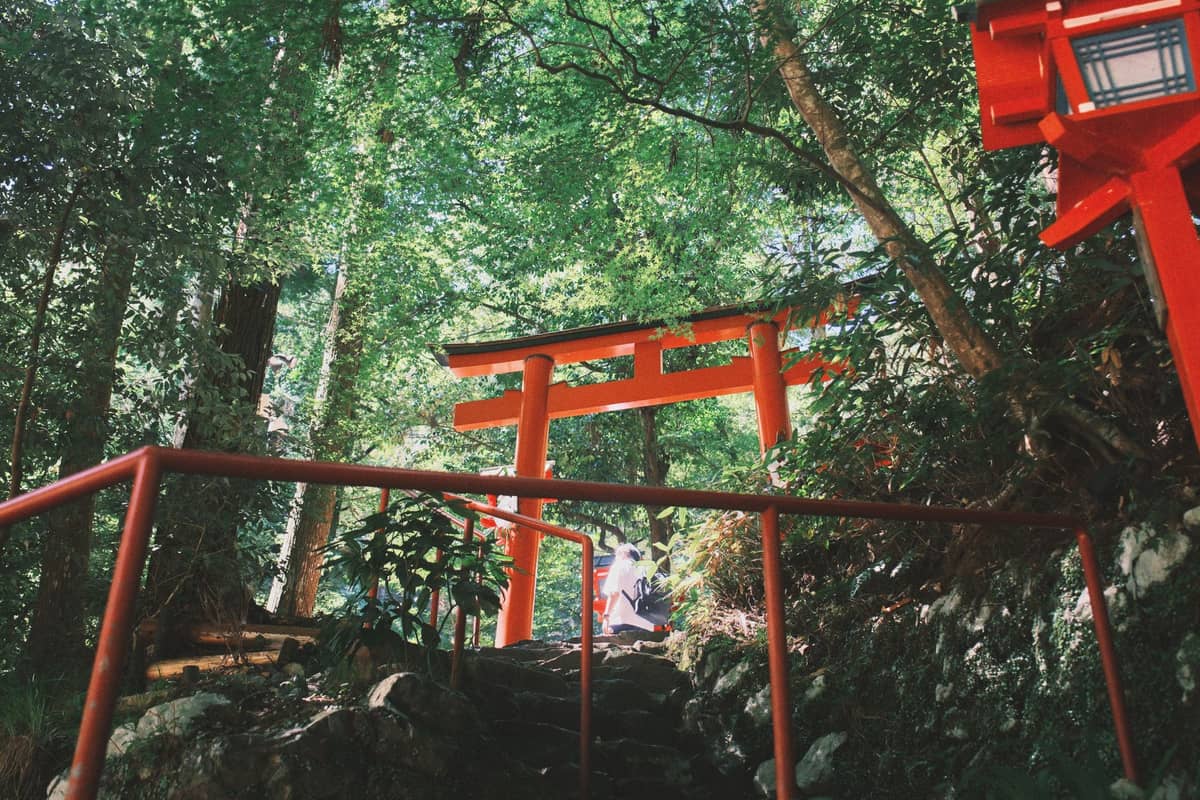
Kifune Shrine, formally romanized as Kifune Jinja (貴船神社), sits at the top of a narrow mountain valley roughly 30 kilometers north of central Kyoto. It is dedicated to Takaokami no Kami, a deity associated with water and rainfall, and it has long been visited by farmers, merchants, and ordinary citizens seeking divine intervention in matters of water supply and weather. The shrine complex is split into three sections spread along the valley road: the main shrine (Hon-miya), the middle shrine (Yui-no-yashiro), and the inner shrine (Oku-miya). Most visitors spend their time at the main shrine, drawn by the steep stone staircase lined with pairs of red stone lanterns that has become one of the most photographed approaches in Kansai.
The surrounding valley is narrow enough that the mountains feel close on both sides. A stream runs along the base of the valley floor, and the sound of moving water is nearly constant throughout your visit. In summer, the restaurants lining the approach road suspend wooden platforms directly over the stream for kawadoko dining, a tradition unique to this valley. The combination of running water, cedar canopy, and shrine vermilion makes Kibune feel unlike anywhere else in the Kyoto region.
ℹ️ Good to know
Opening hours: 6:00–20:00 from May 1 to November 30; 6:00–18:00 from December 1 to April 30. Entry to the shrine grounds is free year-round.
The Approach: Stone Steps, Lanterns, and First Impressions
From the Kibune bus stop, a short walk along the valley road brings you to the main shrine entrance. The approach staircase at the Hon-miya is the visual centerpiece of the entire complex: around 50 stone steps flanked on both sides by evenly spaced stone lanterns painted a deep red-orange. The lanterns sit low and compact, almost architectural in their repetition, and they create a tunnel-like corridor that frames the main hall above.
Early morning is when this approach is most effective. Before 9:00, foot traffic is minimal, the forest canopy holds the morning mist, and the lanterns cast a warm glow against the grey stone. By mid-morning on weekends, school groups and tour parties begin arriving, and the staircase becomes more of a photography queue than a contemplative approach. If you arrive in the afternoon, the light shifts and softens, which makes for reasonable photography but a livelier crowd.
The steps themselves are uneven in places, worn smooth from centuries of foot traffic. Wear shoes with grip rather than sandals, especially after rain when the stone becomes slick. The handrail is present but not continuous.
💡 Local tip
Arrive before 9:00 on weekdays for the quietest experience at the main staircase. On autumn foliage weekends, the valley road can become extremely congested by mid-morning.
Tickets & tours
Hand-picked options from our booking partner. Prices are indicative; availability and final rates are confirmed when you complete your booking.
Kyoto temples, shrines, and Kimonos guided day tour
From 8.800 €Instant confirmationFree cancellationShiga Day Trip with Miho Museum, Lake Biwa and Waterbird Shrine
From 70 €Instant confirmationFree cancellationKyoto Coast, Amanohashidate and Ine Bay 1-Day Trip from Osaka or Kyoto
From 46 €Instant confirmationFree cancellationKyoto Sanzen-in, Arashiyama and Bamboo Grove Full Day Tour
From 47 €Instant confirmationFree cancellation
How the Experience Changes by Season
Kibune is one of those places where the season defines the visit more than the monument itself. In summer (June through August), the valley is noticeably cooler than central Kyoto, sometimes by 5 to 10 degrees Celsius, which is why it has historically been a summer retreat for Kyoto residents. The kawadoko dining platforms extend out over the stream from late May through September, and if you eat at one of the valley restaurants you hear the water rushing beneath your feet through the entire meal. The thick cedar canopy filters the light into moving patterns on the ground.
Autumn, typically mid-November in this valley, turns the surrounding hillsides vivid orange and yellow. The contrast between the red lanterns and autumn leaves draws large numbers of visitors, particularly on weekends. This is arguably the most photogenic time to visit, but also the busiest. If you come during peak autumn foliage, plan to arrive early or use the Eizan Railway from Demachiyanagi before 8:30 to get ahead of the crowds.
Winter brings genuine snow to the valley, and the combination of white snowfall, red lanterns, and silent forest is striking. The shrine holds a special illumination during parts of winter when snowfall is expected. The tradeoff is cold temperatures and reduced opening hours from December through April. Spring is pleasant and green without the summer crowds, though cherry blossoms are limited at this elevation compared to city shrines.
If you are planning your trip around seasonal highlights, thebest time to visit Kyotoguide covers how to balance crowd levels with seasonal appeal across the city.
The Three Shrine Sections: What to See Beyond the Main Hall
Most visitors photograph the main staircase and move on. That covers perhaps a quarter of what the shrine complex offers. After the Hon-miya (main shrine), continue along the valley road to the Yui-no-yashiro, the middle shrine. This sub-shrine is associated with love and marriage and is a popular destination for couples. The atmosphere here is quieter and more intimate than the main approach.
Further along the road is the Oku-miya, the inner shrine. Tradition holds that the Oku-miya is the original site of worship at Kifune, and it is the location where the deity's sacred yellow horse is said to have emerged from the ground. The inner precinct has a more austere character than the main shrine: less formal stone architecture, more moss, and a deeper sense of the forest pressing in around you. The walk between all three sections takes about 20 to 30 minutes at an easy pace.
One practical detail worth noting: the road connecting the three sections is the same road used by buses and local vehicles. There is a narrow pedestrian path, but you will share the route with passing traffic during busy periods.
Water Fortune Slips: The Misogi Mikuji
Kifune Shrine is well known for its water fortune slips, called mizu-uranai or misogi mikuji. You purchase a slip that appears blank, then place it in the water of the sacred spring basin next to the main hall. The text gradually appears as the paper absorbs the water. It is a clever presentation rooted in the shrine's identity as a water deity site, and it is the kind of small ritual that stays with you after the visit. The lines for this are short early in the morning and considerably longer from about 10:00 onward on weekends.
Fortune slips are purchased at the shrine office near the main hall. The slip and the experience are the primary souvenir most visitors take from Kifune. The text will be in Japanese, but many of the slip categories are illustrated with symbols that translate across the language barrier.
Getting There: Logistics from Central Kyoto
The official access route is the Eizan Railway from Demachiyanagi Station to Kibuneguchi Station, followed by Kyoto Bus No. 33 to the Kibune bus stop. From the bus stop it is a 5-minute walk to the main shrine entrance. Demachiyanagi Station connects to the Keihan Line, making it reachable from central Kyoto without the need for the main subway. The full journey from Demachiyanagi takes around 35 to 45 minutes depending on bus connection timing.
The bus from Kibuneguchi runs on a limited schedule, especially outside peak seasons, so check the schedule before you go rather than assuming you can catch one immediately upon leaving the train. Some visitors walk the approximately 2-kilometer path from Kibuneguchi up the valley to the shrine instead of taking the bus, which is a reasonable option in good weather and adds to the mountain atmosphere.
Kifune Shrine pairs naturally with Kurama-dera, the mountain temple on the ridge directly above the valley. Many visitors do both in a single half-day by taking the train one stop further to Kurama Station, hiking over the mountain to Kibune, and Many visitors do both in a single half-day by taking the train one stop further to Kurama Station, hiking over the mountain to Kibune, and descending toward the shrine and bus stop afterward. The hike takes 1.5 to 2 hours and is moderately strenuous. TheKurama-dera hike takes 1.5 to 2 hours and is moderately strenuous.
⚠️ What to skip
The road into Kibune valley is narrow and prone to congestion on autumn foliage weekends. Private taxis and cars are sometimes restricted during peak periods. Check current traffic and access conditions before driving in.
Who Should Skip Kibune, and Why
Kifune Shrine requires a specific kind of investment. The travel time from central Kyoto is about 35 to 45 minutes each way, and once there the actual shrine structures are modest in scale. If you are on a tight two-day itinerary focused on Kyoto's most prominent landmarks, there are shrines closer to the city center with more architectural grandeur. The journey is part of the appeal here, not just the destination.
Travelers who are mainly interested in major shrine architecture might find more concentrated content atFushimi Inari Taisha or Kamigamo Shrine, both of which are easier to reach and offer a different scale of visual impact.
Visitors with mobility limitations should note that the stone staircase at the main shrine is steep and uneven, the walk from the bus stop is unpaved in sections, and the shrine's official site does not clearly detail wheelchair access provisions. The inner shrine section of the complex requires a walk along a narrow mountain road. This is not a site suited to strollers or wheelchairs without prior inquiry.
Photography Notes
The lantern staircase photographs best either in early morning light or at dusk when the lanterns are lit against a darker sky. Midday light is flat and the stone washes out in direct sun. In autumn, the best position for foliage-plus-lanterns shots is from the lower steps looking upward, using the canopy overhead to frame the color. A wide-angle lens captures the full corridor effect; a telephoto compresses the lantern rows into a dense pattern.
If you are building a photography-focused itinerary in Kyoto's northern mountains, theKurama-Kibune areaoverview covers other visual highlights in the same valley.
Insider Tips
- The bus from Kibuneguchi to Kibune runs on a limited schedule, especially outside summer and autumn peak seasons. Check the Kyoto Bus timetable before leaving Demachiyanagi, or factor in the 2-kilometer walk as a backup.
- If you plan to do the Kurama-to-Kibune hike, do it in the Kurama-to-Kibune direction (downhill toward the shrine) rather than the reverse. You arrive at Kifune relaxed rather than sweaty, which makes the shrine visit considerably more pleasant.
- The water fortune slip basin can be crowded mid-morning. Arrive before 9:00 or revisit the basin after 16:00 when tour groups have cleared out.
- Summer kawadoko dining reservations at the valley restaurants are typically required weeks in advance for weekend evenings. Weekday lunches in July and August are easier to book last-minute and cost less than dinner.
- The valley road between the three shrine sections has no lighting at night. If you visit near the 20:00 closing time in summer, bring a flashlight for the walk between shrines.
Who Is Kibune Shrine (Kifune Shrine) For?
- Travelers who want a genuine escape from central Kyoto's crowds into mountain scenery
- Couples visiting the middle shrine (Yui-no-yashiro) dedicated to love and marriage
- Photographers targeting autumn foliage combined with iconic shrine architecture
- Hikers combining the visit with the Kurama-dera mountain trail over the ridge
- Visitors seeking a quiet, contemplative shrine atmosphere rather than a major tourist monument
Nearby Attractions
Other things to see while in Kurama & Kibune:
- Kurama-dera Temple
Founded in 770 AD and set high in the forested mountains north of Kyoto, Kurama-dera Temple rewards the climb with cedar-shaded trails, atmospheric shrines, and some of the city's most dramatic mountain scenery. This is a place of genuine spiritual weight, not a tick-box tourist stop.
- Kurama Onsen
Kurama Onsen is a natural sulfur hot spring at the foot of Mount Kurama, roughly 30 minutes north of central Kyoto by train. With an open-air bath surrounded by cedar forest and a quiet mountain village setting, it offers a genuinely restorative break from the city's more crowded temples and garden circuits.