Katara Golden Mosque: The Gold-Tiled Icon of Katara Cultural Village
The Katara Golden Mosque is one of the most photographed structures in Doha, its gold-tiled exterior catching the Gulf light in a way that stops visitors mid-stride. Set within Katara Cultural Village between West Bay and The Pearl-Qatar, it serves as both an active place of worship and a remarkable piece of contemporary Islamic architecture. Entry to the grounds and exterior is free, and the surrounding plaza is one of the more atmospheric corners of the entire cultural district.
Quick Facts
- Location
- Katara Cultural Village, Al Moasses Street, Doha, Qatar
- Getting There
- Doha Metro Red Line, Katara station; walk toward the amphitheatre area
- Time Needed
- 20–40 minutes for exterior visit; longer if exploring the full village
- Cost
- Free (exterior viewing and village entry); no ticket required
- Best for
- Architecture enthusiasts, photographers, cultural explorers, first-time visitors to Doha
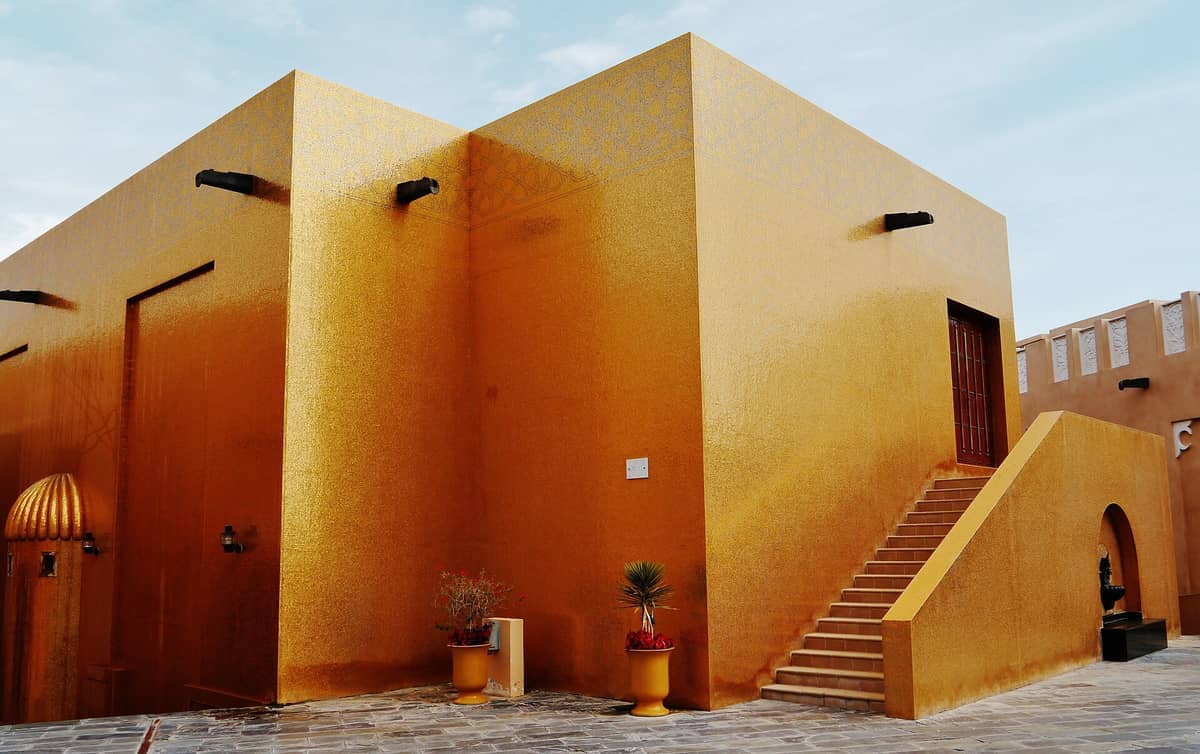
What the Katara Golden Mosque Actually Looks Like
The Katara Golden Mosque earns its name immediately. The entire exterior surface is clad in gold-coloured tiles that catch the Doha sun with an intensity that photographs cannot fully prepare you for. From across the open plaza, the effect is almost theatrical: a compact, beautifully proportioned mosque set against the blue of the Gulf sky, facing the curved sweep of the Katara Amphitheatre. At midday the tiles are almost blinding. In the softer light of late afternoon, they shift to something warmer and more amber-toned.
The mosque is not a relic. It was built as part of Katara Cultural Village's development in the 2010s, making it a piece of contemporary Islamic architecture rather than a centuries-old monument. The design is deliberate: the gold cladding is not decorative excess but a considered architectural statement about the place of religious space within a modern cultural campus. The minaret rises cleanly above the surrounding buildings, visible from most approaches to the amphitheatre.
ℹ️ Good to know
Non-Muslims are generally not permitted inside the main prayer hall. The exterior, however, is completely open to all visitors and remains the primary draw for most people. Dress modestly out of respect, especially when photographing close to the entrance.
How the Experience Changes by Time of Day
The mosque plaza has a different character depending on when you arrive. Early morning, before 9:00, the space is quiet to the point of stillness. The air carries the faint salt smell of the Gulf, and you will often have the plaza largely to yourself. The gold tiles glow softly in the low eastern light, and the amphitheatre behind you is empty. This is genuinely the best window for photography, with clean light and no competing crowds.
By late morning, organised tour groups and families begin to arrive, and the plaza around the mosque becomes a staging point for selfies and group photos. The amphitheatre fills with casual visitors moving between Katara's galleries and restaurants. The energy is sociable rather than reverent. If you find crowds disruptive to how you experience a place, arrive before 10:00 or return in the early evening.
The hour before sunset is arguably the most rewarding time of day. The gold tiles respond to the dropping sun with extraordinary warmth, shifting from yellow-gold to deep orange as the light changes. The call to prayer from the minaret at Maghrib (dusk prayer) carries across the plaza clearly, and the combination of that sound, the fading light on the tiles, and the amphitheatre lit up across the way creates the kind of atmosphere that stays with you. Katara's restaurants and promenade are also at their most pleasant at this hour, making it easy to extend the visit.
Visiting as a Place of Worship
The Katara Golden Mosque is an active mosque, not a museum. Muslim visitors are welcome to pray here, and the mosque is generally open outside prayer times for visitor access, with typical daytime visiting windows such as roughly 10:00 to 18:00, though exact hours can shift during Ramadan, on public holidays, and at the discretion of the mosque staff. Non-Muslims should not attempt to enter the prayer hall. This is a firm boundary, and respecting it is both a legal and cultural expectation in Qatar.
If you are Muslim and wish to pray here, the mosque provides a fully functioning space. For all other visitors, the experience is primarily architectural and photographic. The mosque fits naturally into a longer walk through Katara, rather than being the kind of site that warrants a standalone journey.
⚠️ What to skip
Access inside the mosque’s main prayer hall is for Muslims only. All visitors should dress modestly: shoulders and knees covered, and women may want a scarf for the immediate surroundings. Loud behaviour near the entrance during prayer times is considered disrespectful.
Getting There and Moving Around Katara
Katara Cultural Village sits between West Bay and The Pearl-Qatar on Doha's eastern coastal strip. The Doha Metro Red Line serves Katara station, from which the mosque and amphitheatre are a short walk. Taxis and ride-hailing apps (including Karwa Taxi) drop passengers directly at the village entrance; simply ask for "Katara Cultural Village" and navigate to the amphitheatre on foot. Parking is available for those arriving by car.
Once inside, the village is best explored on foot. The mosque sits near the amphitheatre at the heart of the complex. From here it is easy to walk toward the beach promenade, the galleries, or the cluster of restaurants. Katara is also a natural stopping point if you are moving between Porto Arabia at The Pearl and the West Bay area, as it sits geographically between the two.
The outdoor public areas of Katara Cultural Village are open 24 hours, though the mosque itself follows its own schedule. The walk from the village entrance to the mosque takes around five to ten minutes depending on your starting point.
Photography Practical Notes
The mosque is one of the most photographed structures in Doha, and for good reason. The challenge is that the gold tiles create significant exposure problems in midday sun: if you are shooting on a phone or basic camera, the auto-exposure will frequently blow out the highlights or leave the surroundings dark. Shooting in the hour after sunrise or the hour before sunset gives much more workable light.
Wide-angle shots from across the amphitheatre plaza work well for establishing context. Close-up detail shots of the tile work show the craftsmanship clearly. If you are working on a broader photography itinerary of Doha, this pairs naturally with the Katara Amphitheatre directly opposite, and the beach promenade running south from the village. The Doha photography guide covers optimal timing for this area in more detail.
Fitting the Mosque Into a Wider Katara Visit
The Golden Mosque works best as part of a longer afternoon or evening in Katara rather than as a standalone destination. The cultural village has genuine depth: a working amphitheatre used for concerts and film screenings, galleries showing contemporary Arab and international art, and a beach strip with restaurants and cafes. Katara Beach is a short walk from the mosque plaza and gives a completely different atmosphere to the visit.
For first-time visitors to Doha fitting Katara into a broader itinerary, the Doha first-timer guide suggests pairing an evening in Katara with a late dinner at one of the village restaurants, then continuing to the Pearl or driving along the waterfront toward the Corniche promenade. Two to three hours in Katara is enough to see the mosque, walk the beach, and eat; longer if you plan to catch a show at the amphitheatre.
Honestly, the Katara Golden Mosque is not a destination that needs hours of your time. What it offers is a specific, high-quality visual experience: the striking geometry of gold against blue sky, the sound of the call to prayer in an outdoor setting, and the architectural contrast between a traditional Islamic form and its contemporary execution. That experience can be had in twenty minutes. The reason to stay longer is Katara itself.
Weather and When to Visit
Doha has a hot desert climate. Between June and September, daytime temperatures regularly exceed 40°C, and outdoor visits to places like the mosque plaza are genuinely uncomfortable in the middle of the day. If you visit in summer, go at dusk or after dark when the worst heat has passed. The tiles lose their gold in artificial light, but the illuminated mosque against the night sky has its own quality.
The best visiting window, climate-wise, runs from November through March. Daytime temperatures in January sit around 20-22°C, humidity is low, and outdoor exploration is comfortable at any hour. This is also the period when Katara hosts the most events, so the surrounding village is at its most animated. February and March bring occasional light rain but nothing that significantly disrupts a visit.
💡 Local tip
During Ramadan, mosque visiting hours and village activity patterns change significantly. The evenings become livelier after Iftar (fast-breaking), and the mosque takes on added significance. Check current schedules with Katara Cultural Village directly if visiting during this period.
Insider Tips
- Position yourself at the far end of the amphitheatre plaza for the widest unobstructed view of the mosque facade. This vantage point also captures the architectural relationship between the mosque and the curved theatre behind you.
- The tiled surface shows its best detail in diffuse light rather than direct midday sun. An overcast morning in winter can produce better close-up photographs than a clear summer afternoon.
- If you hear the Adhan (call to prayer) while in the plaza, pause. The acoustic quality in the open amphitheatre space amplifies the minaret's speaker system in a way that is worth experiencing without distraction.
- Combine the mosque visit with Katara's Tuesday-to-Thursday evening gallery openings during the cultural season (roughly October to April) when several of the village's art spaces host events with free admission.
- The mosque is best seen as a counterpart to the nearby Imam Muhammad ibn Abd al-Wahhab Mosque, the state mosque of Qatar, which represents a very different scale and style of Islamic architecture. Seeing both on the same trip provides meaningful architectural contrast.
Who Is Katara Golden Mosque For?
- Architecture and design enthusiasts interested in contemporary Islamic building
- Photographers looking for a structurally distinctive subject in natural light
- First-time visitors to Doha building an introduction to Qatari culture
- Travellers with limited time who want a high-impact visual experience without admission fees
- Families with children exploring Katara's wider cultural village environment
Nearby Attractions
Other things to see while in Katara Cultural Village:
- Katara Amphitheatre
Built on classical Greek theatre principles and finished with Islamic architectural detail, Katara Amphitheatre is Doha's most visually distinctive open-air performance space. Free to walk through any time, it becomes a serious concert and festival venue when the sun goes down.
- Katara Beach
Katara Beach stretches along the Arabian Gulf within Katara Cultural Village, sitting between West Bay and The Pearl-Qatar. With paid entry, separate beach sections, water sports, and opening hours that extend into the evening, it offers a structured and relatively uncrowded alternative to resort beaches in Doha. With paid entry, separate beach sections, water sports, and opening hours that extend well into the evening, it offers a structured and relatively uncrowded alternative to resort beaches in Doha.