Katara Amphitheatre: Where Greek Design Meets Qatari Culture
Built on classical Greek theatre principles and finished with Islamic architectural detail, Katara Amphitheatre is Doha's most visually distinctive open-air performance space. Free to walk through any time, it becomes a serious concert and festival venue when the sun goes down.
Quick Facts
- Location
- Katara Cultural Village, between West Bay and The Pearl-Qatar, Doha
- Getting There
- Katara Station, Doha Metro Red Line, then a short walk into the village
- Time Needed
- 30–45 min to explore; 2–3 hours for an event
- Cost
- Free to enter as a landmark; ticketed events vary by show (check katara.net)
- Best for
- Architecture enthusiasts, evening strollers, live music and cultural events
- Official website
- www.katara.net
What Is the Katara Amphitheatre?
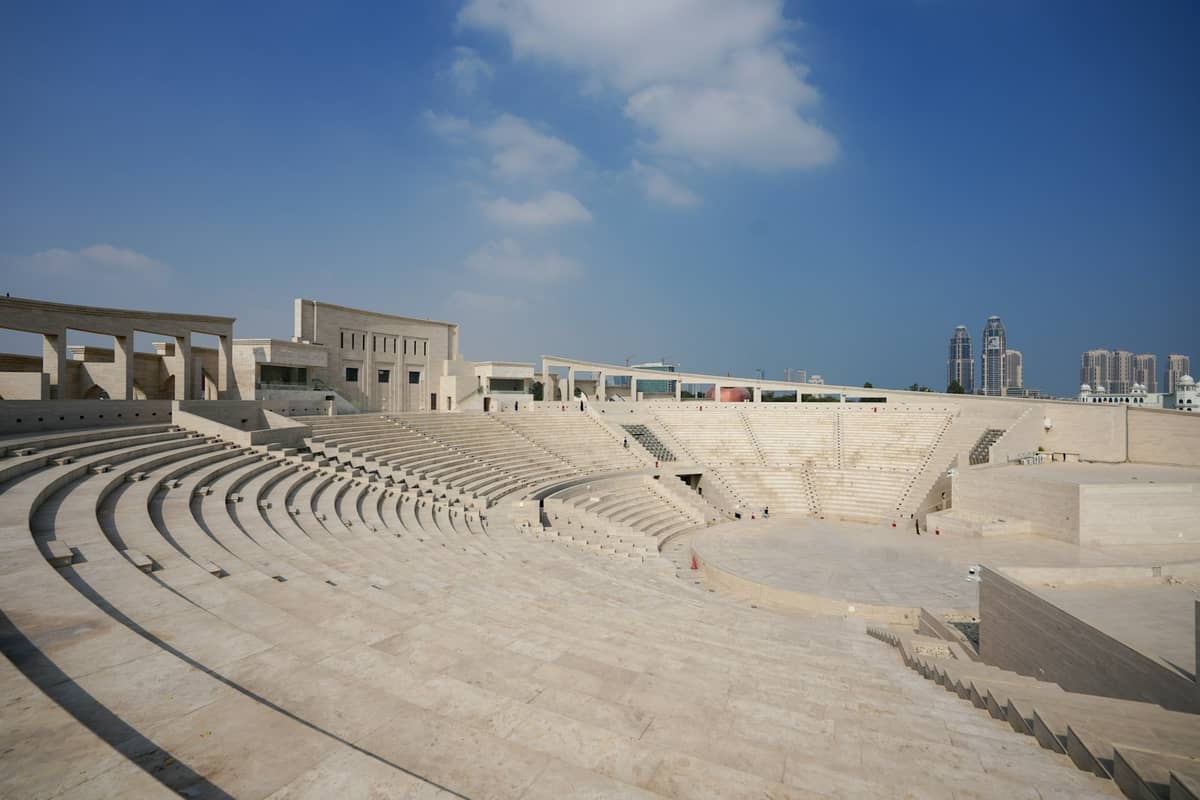
The Katara Amphitheatre sits at the heart of Katara Cultural Village on Doha's northeastern waterfront, positioned between the skyscraper corridor of West Bay and the residential island of The Pearl-Qatar. It is described by Katara's own management as the 'gem' of the cultural village, and architecturally, that claim holds up. The structure covers approximately 3,275 square metres and seats around 5,000 spectators in a tiered, semicircular arrangement drawn directly from the classical Greek theatre tradition. What sets it apart from a simple replica is the overlay of Islamic design: arched entrances with geometric patterning frame the perimeter, grounding the ancient model in the Gulf's own architectural vocabulary.
The result is a building that works on two levels simultaneously. As a landmark, it photographs beautifully at almost any hour and rewards slow examination of the stonework and archways up close. As a functioning venue, it has hosted international music acts, film screenings, cultural festivals, and public gatherings, drawing audiences from across Doha's diverse expatriate and Qatari communities.
💡 Local tip
Entry to the amphitheatre as a public landmark is free when no performance or private event is taking place. You do not need a ticket simply to walk in, look around, and take photographs. Only organised performances require admission.
The Architecture: What to Actually Look At
Most visitors do a single circuit and miss the details that make this structure worth a longer look. Start at the main arched entrances before walking to the seating bowl. The arches use pointed forms associated with Islamic construction rather than the rounded Roman arch, a deliberate choice that situates the building in its geographic context. The stone surfaces have a warm, pale tone that shifts in colour noticeably depending on the angle and quality of the light.
From the upper seating tiers, the amphitheatre opens toward the Gulf. On clear days, the water is visible beyond the stage, giving performances a natural backdrop that no indoor venue can replicate. The sightlines from even the highest rows are clean, which reflects careful attention to the geometry of the original Greek model, where acoustics and visibility were the primary engineering priorities.
The wider Katara Cultural Village surrounds the amphitheatre with galleries, restaurants, a beach, and the ornate Katara Golden Mosque, all of which are worth combining into a single visit. The mosque's gilded dome is visible from parts of the amphitheatre's upper terrace and makes for a striking compositional photograph.
How the Experience Changes by Time of Day
The amphitheatre in the morning is almost entirely quiet. Maintenance crews occasionally move through the seating bowl, and a few early visitors photograph the structure in the soft, low-angle light. The pale stonework picks up a warm, almost golden tone in the hour after sunrise, which is the most flattering light for photography of the facade and archways. Temperatures between November and March are comfortable enough at this hour to sit in the seats without any shade concerns.
Midday and early afternoon bring direct sun onto the open seating bowl. From May through September, when temperatures regularly exceed 40°C, the amphitheatre as an outdoor space becomes genuinely uncomfortable without shade. During these months, visiting in the late evening is the only practical option for an extended stay. In the cooler winter months, midday visits are perfectly manageable.
Evenings transform the space entirely. When an event is scheduled, the perimeter lighting comes on, the arched entrances are illuminated, and the surrounding Katara village fills with people moving between restaurants, the beach promenade, and the venue itself. Even on non-event evenings, the amphitheatre lit at night against a dark sky is a different visual proposition from the daytime structure. The temperature drops are significant from around 8 p.m. onward between November and February, making this one of Doha's genuinely pleasant outdoor evening destinations.
⚠️ What to skip
Avoid visiting the open seating bowl between roughly 11 a.m. and 5 p.m. from May through September. The lack of shade in the main bowl makes extended outdoor exposure in summer genuinely hazardous.
Events and Performances: What to Expect
The amphitheatre's programming calendar is varied and occasionally impressive in its scope. Katara Cultural Village functions as a state-backed cultural institution, which means the venue can attract international acts and major festival programming that smaller private venues cannot. Concerts, theatrical performances, outdoor film screenings, and cultural festivals tied to Qatar's national calendar all appear on the schedule at different points in the year.
Ticket prices are not standardised. They vary by event, and some public programming is offered free of charge. The practical approach is to check the official Katara website (katara.net) before your visit and align your trip with a scheduled event if live performance is your main interest. The venue's capacity of around 5,000 means it rarely feels impossibly crowded, but popular performances do sell out, so advance booking is advisable for anything high-profile.
If you are visiting Doha between November and February, the winter season is when the amphitheatre's outdoor event calendar is most active. The combination of comfortable evening temperatures and longer programming windows makes this the period most likely to coincide with a significant public event.
Getting There and Getting Around
The most straightforward public transit option is the Doha Metro Red Line to Katara Station. From the station, Katara Cultural Village is a short walk, and the amphitheatre is clearly signposted within the village. The metro is air-conditioned, reliable, and significantly cheaper than a taxi for solo travellers or pairs.
Taxis and ride-hailing services drop off directly at Katara's main entrance. Onsite parking is available within the cultural village for those arriving by car. During major events, parking areas can fill quickly, so the metro or a taxi drop-off is a more predictable option on busy nights.
Katara Cultural Village is positioned conveniently close to several other significant Doha attractions. Porto Arabia at The Pearl-Qatar is a short drive, and the Museum of Islamic Art is accessible via a taxi or metro connection from central Doha. Planning a half-day around Katara with an evening event at the amphitheatre is a practical way to structure a full afternoon.
Photography Notes
The amphitheatre is one of the more rewarding architectural subjects in Doha for photography. The arched entrances create strong framing elements and work particularly well in the hour after sunrise or the hour before sunset. At night, the combination of venue lighting and the surrounding Katara lanterns gives the structure a warm, layered quality that differs completely from the daytime appearance.
The upper seating tiers provide elevated angles over the stage and the Gulf beyond. If you are visiting specifically to photograph the building rather than attend an event, a weekday morning during the cooler months gives you the best combination of light, empty seats, and minimal other visitors in the frame.
For a broader Doha photography itinerary that includes the amphitheatre alongside other strong architectural and urban subjects, the Doha photography guide covers timing, locations, and practical logistics across the city.
Accessibility and Practical Considerations
The amphitheatre's tiered seating design, drawn from the Greek tradition of hillside construction, means steps are an inherent part of the structure. Specific information about ramps, lifts, or designated wheelchair seating is not publicly documented in available sources. Visitors with mobility requirements should contact Katara directly before attending an event to confirm current accessibility arrangements.
Conservative dress norms apply across Qatar as a whole, and Katara Cultural Village, as a formal cultural institution, falls into the category of public space where modest clothing is expected. Shoulders and knees covered is the practical standard for both men and women. Evening events tend to attract a well-dressed audience, and smart-casual is appropriate for most performances.
ℹ️ Good to know
Qatar observes Arabia Standard Time (UTC+3) year-round with no daylight saving adjustment. Event times listed on katara.net are in local time. Keep this in mind when booking if you are coordinating from a different time zone.
Insider Tips
- Check the Katara website in the weeks before your visit. Some of the most interesting programming, including free public concerts tied to Qatar National Day in December, is not widely advertised outside the official site.
- The best unobstructed photograph of the amphitheatre's facade is taken from the small open plaza directly in front of the main entrance, roughly 30 metres back. Get there before 8 a.m. on a weekday and you will likely have it to yourself.
- During Ramadan, Katara's event programming intensifies significantly in the evenings after iftar. The amphitheatre often hosts special performances during this period, and the atmosphere across the entire cultural village is notably different from the rest of the year.
- The seating bowl stays warm well into the evening in spring and autumn because the stone retains heat from the day. A light layer for winter evenings (December through February) is worth carrying, as temperatures can drop noticeably after 9 p.m.
- Katara's beachfront is a short walk from the amphitheatre and is one of the quieter beaches in central Doha. Combining an afternoon at the beach with an evening event at the amphitheatre makes efficient use of a single trip to the cultural village.
Who Is Katara Amphitheatre For?
- Architecture and design enthusiasts who want to see classical and Islamic styles in direct dialogue
- Couples and groups looking for evening entertainment in an outdoor setting during the cooler months
- Cultural event visitors wanting to catch concerts, film screenings, or festivals in an outdoor venue
- Photographers interested in distinctive architectural subjects with strong light in morning and evening
- Families visiting Katara Cultural Village who want to include a landmark stop alongside the beach and restaurants
Nearby Attractions
Other things to see while in Katara Cultural Village:
- Katara Beach
Katara Beach stretches along the Arabian Gulf within Katara Cultural Village, sitting between West Bay and The Pearl-Qatar. With paid entry, separate beach sections, water sports, and opening hours that extend into the evening, it offers a structured and relatively uncrowded alternative to resort beaches in Doha. With paid entry, separate beach sections, water sports, and opening hours that extend well into the evening, it offers a structured and relatively uncrowded alternative to resort beaches in Doha.
- Katara Golden Mosque
The Katara Golden Mosque is one of the most photographed structures in Doha, its gold-tiled exterior catching the Gulf light in a way that stops visitors mid-stride. Set within Katara Cultural Village between West Bay and The Pearl-Qatar, it serves as both an active place of worship and a remarkable piece of contemporary Islamic architecture. Entry to the grounds and exterior is free, and the surrounding plaza is one of the more atmospheric corners of the entire cultural district.