Jui Tui Shrine: Phuket's Living Heart of Chinese Taoist Devotion
Jui Tui Shrine is one of the oldest and most revered Chinese Taoist shrine in Phuket Old Town, drawing worshippers and curious visitors alike throughout the year. Free to enter and open daily, it reaches its peak intensity during the annual Vegetarian Festival, when it becomes the epicenter of one of Southeast Asia's most dramatic religious observances.
Quick Facts
- Location
- 283 Soi Phutorn, Talat Nuea, Mueang Phuket, near Ranong Road market
- Getting There
- Short walk from Phuket Old Town center; 20-30 min Grab from Patong area
- Time Needed
- 30-45 minutes (2+ hours during Vegetarian Festival)
- Cost
- Free entry
- Best for
- Cultural history, religious architecture, photography, festival tourism
What Jui Tui Shrine Actually Is
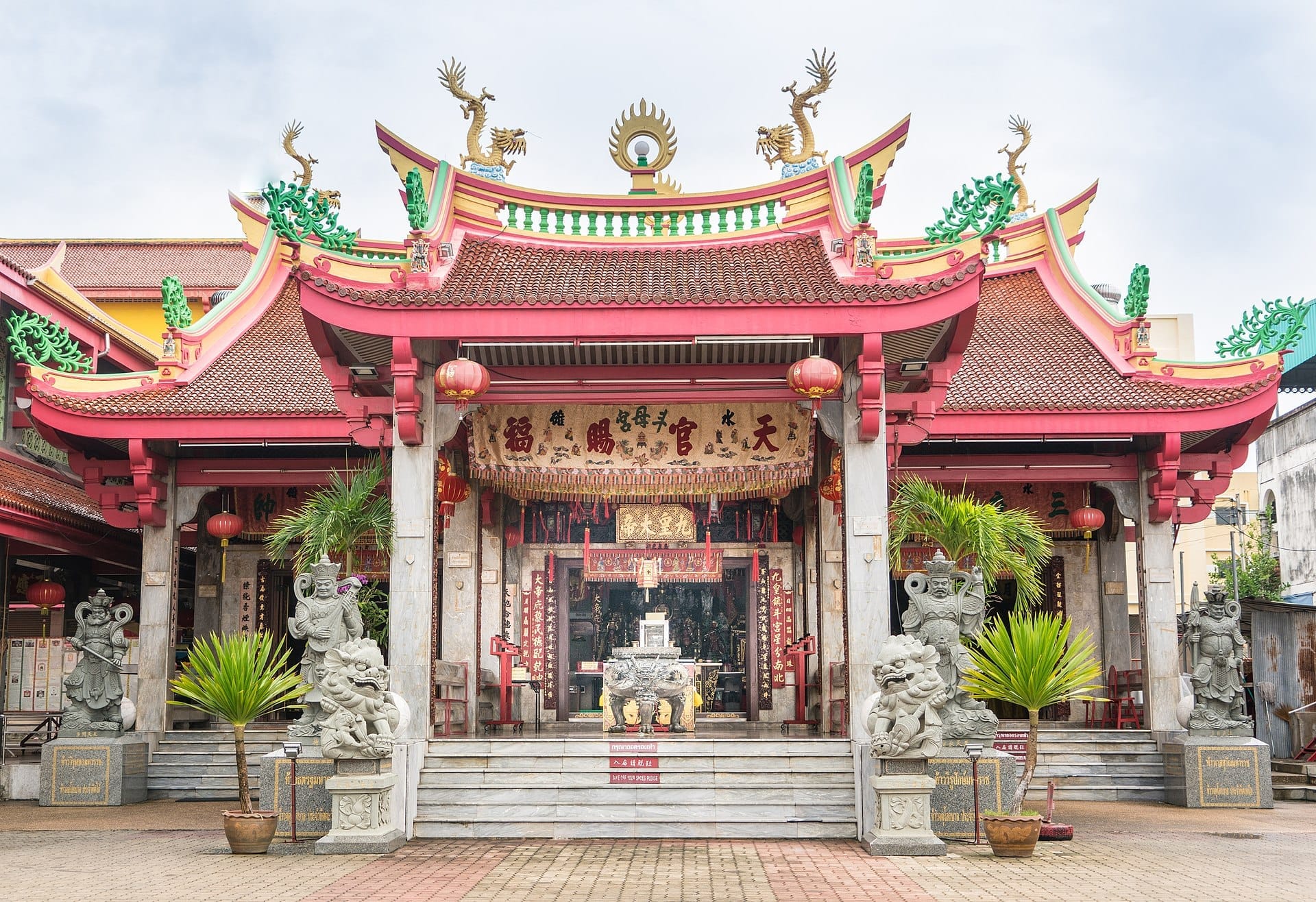
Jui Tui Shrine (ศาลเจ้าจุ้ยตุ่ย) is the most prominent Chinese Taoist shrine in Phuket and the ceremonial anchor of the annual Phuket Vegetarian Festival. It is a functioning place of worship, not a museum or a tourist attraction in the conventional sense. Worshippers arrive throughout the day to light incense, make offerings, and seek guidance from Kiu Ong Iah, the deity to whom the shrine is dedicated. The smell of incense smoke is constant; it has soaked into the red-and-gold lacquered woodwork over more than a century.
The shrine was founded in 1911, originally located on Soi Romanee in Phuket Old Town. After a fire destroyed the original structure, it was rebuilt and relocated to its current site on Soi Phutorn, close to the Ranong Road fresh market. The current building is a confident example of southern Chinese temple architecture: a tiered red roof with upturned eaves, heavy ceramic figurines along the ridge lines, and a forecourt dominated by two tall incense burner towers that are almost always smoldering.
💡 Local tip
Dress modestly before you arrive. Shorts and sleeveless tops are acceptable here more than at Buddhist temples, but covering your shoulders and knees shows respect, particularly when the shrine is busy with active worshippers.
The Architecture and Interior
The entrance gates open onto a paved forecourt where large ceramic incense urns stand permanently lit. The main hall houses the principal altar dedicated to Kiu Ong Iah, flanked by subsidiary shrines to other Taoist deities. Gilded statues, red silk banners, and hanging brass lanterns fill the interior. The ceiling is low and the space is dense with visual detail: carved panels, embroidered cloths, and tables stacked with offerings of fruit, flowers, and ceremonial paper goods.
On the exterior walls and within secondary halls, look for painted murals depicting scenes from Chinese religious mythology. The craftsmanship is genuine and old; much of the woodwork and ceramic ornamentation dates from earlier reconstructions. The structure has the slightly worn quality of a place that has been in continuous use rather than periodically restored for tourists.
The shrine sits within walking distance of Phuket Old Town's Sino-Portuguese streetscapes, making it easy to combine with a broader Old Town walk. The surrounding neighborhood still has the texture of a working urban quarter rather than a fully gentrified tourist zone.
Tickets & tours
Hand-picked options from our booking partner. Prices are indicative; availability and final rates are confirmed when you complete your booking.
Muay Thai Boxing Tickets at Patong Boxing Stadium
From 56 €Instant confirmationFree cancellationPhuket Island and Big Buddha Private Tour
From 125 €Instant confirmationFree cancellationGuided elephant nature walk tour with transfer
From 50 €Instant confirmationFree cancellationFull-day tour to the highlights of Phuket City and its surroundings
From 71 €Instant confirmationFree cancellation
How the Experience Changes by Time of Day
Arrive between 7:30 and 9:00 in the morning and you will find the shrine in its most authentic state. Local worshippers, many of them elderly, come to make their morning offerings before the day's heat sets in. The air is thick with incense, and the sound of small brass bells and murmured prayers creates a meditative atmosphere. At this hour the forecourt is not crowded, and the red and gold of the interior catches the early light in a way that afternoon visits simply cannot replicate.
By midday the shrine is quieter, though never entirely empty. This is a reasonable time for visitors who want to look around carefully without feeling they are interrupting anything. Afternoon light hits the entrance gates well for exterior photography, but the interior is darker and more atmospheric at opening hours. The shrine closes at 20:30, and an evening visit around 19:00 can be surprisingly peaceful, with incense lanterns glowing against the darkened hall.
ℹ️ Good to know
Opening hours: Daily from around 8:00–20:30. These hours apply during normal periods. During the Vegetarian Festival, the shrine effectively operates around the clock for portions of the festival period.
The Vegetarian Festival: When the Shrine Transforms
Jui Tui Shrine is best known internationally as the main ceremonial base of the Phuket Vegetarian Festival (งานเทศกาลกินเจ), a nine-day Taoist event that takes place annually in September or October according to the Chinese lunar calendar. During this period the shrine becomes the organizational and spiritual center of the festival, which draws tens of thousands of worshippers and spectators from across Thailand and beyond.
The festival includes prolonged firecracker ceremonies, elaborate street processions, and the deeply confronting practice of mah song: devotees enter trance states and pierce their bodies with skewers, swords, and other objects as acts of devotion and community protection. These processions begin and end at Jui Tui Shrine. The noise during firecracker ceremonies is genuinely extreme. Bring ear protection if you are sensitive to sudden loud sounds.
Outside of the processions, the festival transforms the surrounding streets into a vegetarian food market. Stalls wearing yellow flags line Ranong Road and nearby lanes, selling dishes that are free of meat, dairy, and strong-smelling vegetables according to Taoist dietary rules. This is one of the best periods to eat in Phuket Old Town regardless of your interest in the religious ceremonies.
⚠️ What to skip
During the Vegetarian Festival, the area around Jui Tui Shrine becomes extremely congested. Streets are closed for processions, parking is effectively impossible, and the nearest roads are packed for hours before and after ceremonies. Use Grab or arrive on foot from elsewhere in Old Town.
For full context on the festival dates and how to plan your trip around it, see the best time to visit Phuket guide.
Cultural Context: Phuket's Chinese-Thai Heritage
The shrine's existence reflects a broader historical layer of Phuket that is easy to miss if you spend most of your time at beach resorts. From the 18th century onward, large numbers of Hokkien-speaking Chinese migrants settled in Phuket, drawn by the tin mining industry. Their descendants, known locally as the Peranakan or Baba-Nyonya community, blended Chinese and Thai cultural practices over generations. The Sino-Portuguese architecture of Phuket Old Town, the local food traditions, and shrines like Jui Tui are all products of this history.
The shrine is one of several active Chinese shrines in the Old Town area, but it is the largest and most architecturally significant. Exploring the surrounding Phuket Old Town neighborhood gives the shrine's history much more texture. The Sino-Portuguese shophouses on Thalang Road and Dibuk Road are less than ten minutes on foot.
Practical Information for Visitors
The shrine is located at 283 Soi Phutorn, Talat Nuea, Mueang Phuket District, Phuket 83000. The nearest landmark most visitors recognize is the Ranong Road fresh market, which is a short walk away. There is no dedicated parking for the shrine itself; the surrounding streets have limited space, particularly on weekday mornings when the market is active.
The most convenient approach is by Grab from anywhere in Phuket Town or from the beach areas. If you are exploring the Old Town on foot, the shrine fits naturally into a half-day walking circuit. See the Phuket transport guide for advice on songthaews and ride-hailing options.
Admission is free. Visitors are welcome to enter the main hall but should not position themselves in front of worshippers during prayers or touch the altar objects. Photography inside the shrine is generally tolerated during quieter hours, but read the room: if active ceremonies are underway, put the camera away. Flash photography in the main hall is particularly intrusive.
The shrine is not well-adapted for wheelchair access. The entrance involves steps and the interior floor space is tight, particularly around the main altar. The forecourt is accessible, but the most significant areas of the shrine are not easily reached without climbing at least a few stairs.
Honest Assessment: Is It Worth Your Time?
If you are visiting Phuket primarily for beaches, Jui Tui Shrine will probably feel like a detour that rewards only the genuinely curious. The experience outside of festival season is low-key: a beautiful and authentic shrine, but not a spectacle. Spend 30 to 45 minutes, absorb the atmosphere, and move on to explore the rest of Old Town.
If you are visiting during the Vegetarian Festival, this is a different calculation entirely. The ceremonies at Jui Tui are among the most intense and visually striking religious observances in Southeast Asia, and skipping them would mean missing the defining cultural event of the Phuket calendar. Even travelers with no particular interest in religion or Chinese culture tend to find the mah song processions genuinely affecting. You can pair it with the Phuket weekend market or a meal in Old Town to make the most of the trip into town.
Visitors expecting polished tourist infrastructure, English-language signage, or a guided narrative will find the shrine understaffed for that kind of experience. There are no audio guides, no printed pamphlets in English, and no visitor center. What you get instead is a genuine place of worship that happens to be open to the public.
Insider Tips
- Arrive just before 8:00 and wait near the entrance. The morning opening sees worshippers setting up elaborate fruit offerings on the altar tables, and watching this routine is more revealing about daily religious life than anything that happens later in the day.
- The firecracker ceremonies during the Vegetarian Festival produce a smoke cloud that can linger for minutes. If you have respiratory sensitivities, position yourself upwind or step back earlier than you think you need to.
- The Ranong Road fresh market directly north of the shrine is worth walking through before or after your visit. It is a working local market, not a tourist one, and the produce and prepared food sections show a different side of Phuket Town.
- During non-festival periods, small red fortune sticks (kau cim) are available for use inside the shrine as part of a traditional divination practice. Watch how local worshippers use them before attempting it yourself.
- If you are visiting during the Vegetarian Festival, check the procession schedule in advance. Processions have specific start times and routes published locally; showing up at the wrong hour means missing the main event.
Who Is Jui Tui Shrine For?
- Travelers interested in Chinese-Thai cultural history and the Peranakan community of Phuket
- Anyone visiting Phuket during the Vegetarian Festival who wants to witness the ceremonies at their most significant location
- Photographers looking for authentic architectural and devotional subjects outside the beach resort circuit
- Old Town walkers building a half-day itinerary around Phuket's Sino-Portuguese heritage district
- Visitors curious about Taoist religious practice in a Southeast Asian context
Nearby Attractions
Other things to see while in Phuket Old Town:
- Phuket Old Town Walking Streets
Phuket Old Town's network of pedestrian-friendly streets is the island's most historically layered district. Sino-Portuguese shophouses, century-old shrines, covered five-footway walkways, and a Sunday night market make this a rare contrast to Phuket's beach-resort identity. Entry is free, the streets are compact, and the rewards are considerable for anyone willing to slow down.
- Phuket Weekend Market (Naka Market)
The Phuket Weekend Market, locally known as Naka Market or Talad Tai Rot, is Phuket's largest and most local Saturday–Sunday night market. Running from 4pm to 10pm along Wirat Hong Yok Road, it draws hundreds of stalls selling street food, clothing, handicrafts, and secondhand goods. Free to enter and far less touristy than the Old Town's walking streets, it offers a genuine look at how Phuket residents spend their weekends.