Ibn Battuta Mall: Dubai's Most Theatrical Shopping Experience
Ibn Battuta Mall in Dubai is unlike any other shopping centre in the emirate. Divided into six elaborate themed courts inspired by the travels of 14th-century Moroccan explorer Ibn Battuta, it combines retail therapy with architectural spectacle. Whether you're a serious shopper or simply curious about the design, this guide tells you exactly what to expect.
Quick Facts
- Location
- Sheikh Zayed Road, Jebel Ali, Dubai, UAE
- Getting There
- Ibn Battuta Metro Station (Red Line) — directly adjacent to the mall
- Time Needed
- 2–4 hours depending on how much you shop or explore
- Cost
- Free entry; individual venues and attractions charge separately in AED
- Best for
- Architecture lovers, families, curious visitors, shoppers in the New Dubai corridor
- Official website
- www.ibnbattutamall.com
What Makes Ibn Battuta Mall Different
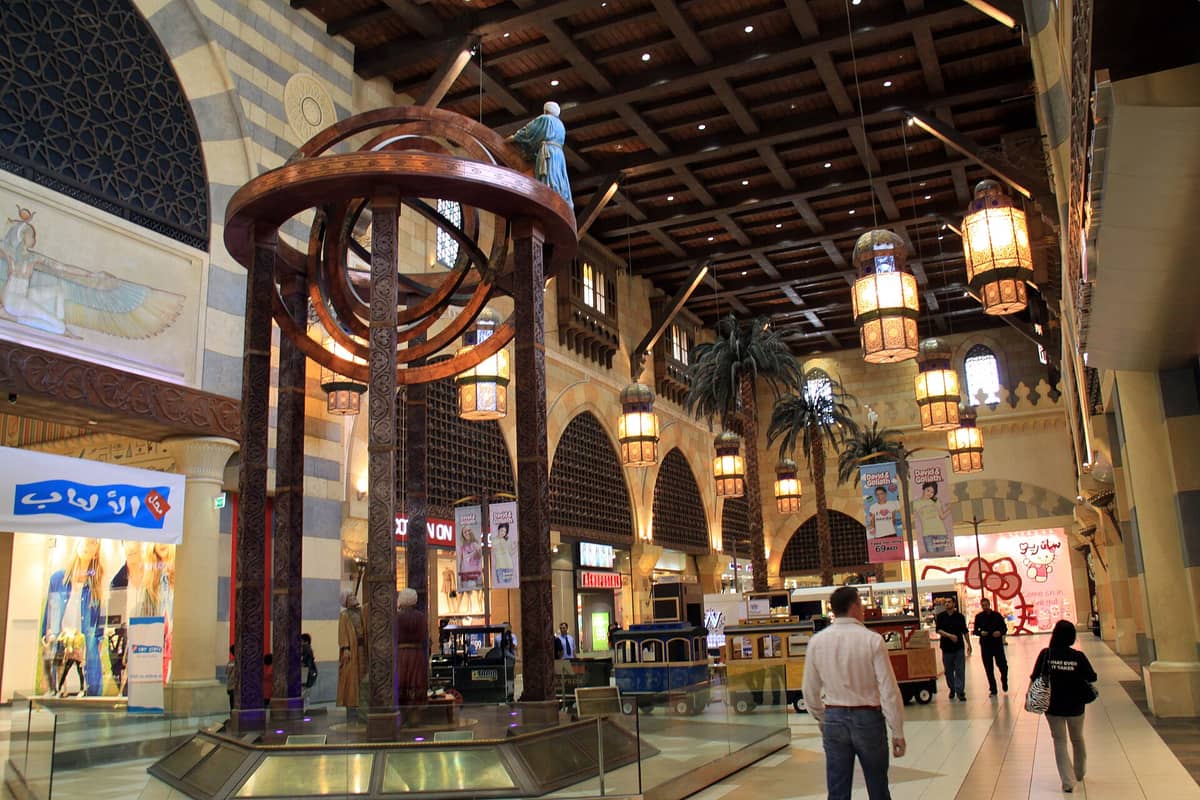
Most malls in Dubai compete on scale or luxury. Ibn Battuta Mall competes on concept. Named after the 14th-century Moroccan explorer who spent decades travelling from Morocco to China, the mall is structured as six distinct themed courts, each representing a region he visited: Andalusia, Tunisia, Egypt, Persia, India, and China. The architecture inside each court is taken seriously — painted domes, carved plasterwork, hand-painted murals, and decorative detailing that goes well beyond the typical retail backdrop.
This is not a replica of a souk or a loosely 'Arabian-themed' space. The courts are physically different from one another in colour palette, ceiling height, material choices, and ambient atmosphere. Walking from the Egypt Court, with its hieroglyphic motifs and ochre tones, into the cooler blues and intricate tilework of the Persia Court, feels like a genuine change of scene. For anyone interested in decorative architecture or Islamic art history, there is more to observe here than the typical mall visit would suggest.
💡 Local tip
The Ibn Battuta Metro Station on the Red Line is directly connected to the mall — no street crossing needed. This makes arriving without a car straightforward and convenient, even in summer heat.
The Six Courts: What Each One Looks and Feels Like
Andalusia Court
The Andalusia Court evokes the Islamic architectural tradition of southern Spain: horseshoe arches, geometric tile patterns in deep green and gold, and relatively warm, dim lighting that creates a slightly enclosed feel compared to the larger courts. It is one of the smaller sections but tends to be less crowded than the central areas, making it a reasonable choice if you want a quieter stretch.
Tunisia and Egypt Courts
The Tunisia Court is modest in scale, while Egypt Court is one of the most photographed spaces in the mall. A large sculpted elephant anchors one corner beneath a domed ceiling covered in stars and hieroglyphic-inspired imagery. The colours shift to earthy yellows and sandy tones. At midday, when natural light filters through upper windows, the textures read particularly well for photography.
Persia and India Courts
The Persia Court features one of the mall's most elaborate painted ceilings, with a large central dome decorated in traditional Persian floral and geometric motifs. The India Court is the largest section of the mall and tends to carry the heaviest foot traffic. It houses the anchor stores and the cinema complex, so it operates more like a conventional shopping mall than the decorative courts.
China Court
The China Court closes out the mall with lacquered red columns, lantern-style lighting fixtures, and a lower ceiling than most of the other courts, giving it a more intimate feel. It is often the quietest section, partly because it sits at the far end of the mall away from the metro entrance. Worth a look, but not worth rushing to if your time is short.
Opening Hours and When to Visit
Standard operating hours are 10:00 to midnight daily, Monday through Sunday. During Ramadan, hours often shift (many stores close earlier on weekdays); confirm exact timings each year as they vary. These hours apply to the mall itself; individual stores and food outlets set their own schedules within that window.
Weekday mornings, roughly 10:00 to 13:00, are the calmest period. The mall serves a residential and office population in the Jebel Ali and Discovery Gardens corridor, so it picks up noticeably around lunchtime and again after 18:00. Weekend evenings from about 19:00 onwards are the busiest, with the food court and the area around the cinema particularly crowded. If your primary interest is the architecture and decor, a Thursday morning visit allows you to move through the courts without crowds competing for the same sightlines.
ℹ️ Good to know
During Dubai's summer months (June to September), outdoor temperatures regularly exceed 40°C. Ibn Battuta Mall is entirely air-conditioned, making it a practical destination during the hottest hours of summer days regardless of whether shopping is your main goal.
Getting There and Getting Around
The most straightforward way to reach Ibn Battuta Mall is by Dubai Metro. The Red Line stops directly at Ibn Battuta Metro Station, which connects to the mall via a covered walkway. Journey time from central stations like Union or BurJuman is approximately 30 to 40 minutes depending on your starting point. From Dubai Marina or JBR, it is considerably closer, roughly 10 to 15 minutes by metro or taxi.
By car, the mall sits on Sheikh Zayed Road with clear signage from the main carriageway. Parking is extensive, though the multi-storey structure fills quickly on Friday evenings. Careem and Uber both serve the location with no complications. For context on how this part of Dubai fits into the wider city, the guide to getting around Dubai covers the Red Line and Sheikh Zayed Road corridor in detail.
Inside the mall, navigation is more intuitive than the size might suggest. The six courts are arranged in a linear sequence along a single main spine. Signage is clear in both English and Arabic. Wide corridors and flat flooring throughout make it manageable with a pushchair or wheelchair, and accessible parking bays are available near the main entrances.
Shopping, Dining, and What Else Is Inside
The retail mix leans toward mid-market brands with a broad selection of fashion, electronics, home goods, and everyday retail rather than the ultra-luxury positioning of Dubai Mall or Mall of the Emirates. For residents in the Jebel Ali and New Dubai corridor, this is a practical everyday mall. For tourists, the store selection is unlikely to be the main draw.
The food court is large and reasonably well-stocked with regional and international options. There are also sit-down restaurants scattered through the courts at varying price points. The mall includes a Novo Cinemas multiplex, which screens recent releases in English as well as Arabic and South Asian language films, reflecting the diverse local population. For a more immersive entertainment experience in the wider Dubai area, Dubai Mall and Mall of the Emirates both offer considerably more in terms of attractions and anchor tenants.
Is It Worth Going Out of Your Way For?
Honest answer: if you are staying in Downtown Dubai or near the creek, probably not unless you have a specific reason to go. Ibn Battuta Mall is a 30 to 40 minute metro ride from central Dubai, and the retail offer does not justify that journey for shopping alone. The architectural theming is genuinely impressive and different from anything else in the city, but it is still a working mall with all the noise, signage, and commercial interruptions that entails.
Where it does make strong sense is as a purposeful stop during a broader itinerary in the New Dubai corridor. If you are already visiting Marina Walk or the Dubai Marina area, Ibn Battuta is only a few metro stops away and adds something visually distinctive to the day without significant backtracking. It also works well as a practical stop during the summer months when outdoor activities are limited.
Visitors who will likely be disappointed: those expecting a heritage museum or cultural institution. The courts are themed commercial spaces, not educational exhibits. The detailing is impressive, but the experience is still fundamentally a shopping trip. Similarly, anyone looking for premium luxury retail or the spectacle of Dubai's flagship malls will find this underwhelming by comparison.
Photography and Practical Notes
The Egypt Court dome and the Persia Court ceiling are the two most photogenic spaces in the mall. Both photograph best in wide angle to capture the full dome. The lighting is consistent throughout the day as the mall is entirely interior, but morning visits give you cleaner shots without crowds in the foreground. Standard UAE mall rules apply: personal photography is fine, but commercial shoots require prior approval from mall management.
Dress code follows general UAE norms for shopping centres: modest clothing is recommended, and while the mall does not enforce a strict dress code at the door, keeping shoulders and knees covered is standard practice. For more detail on what to wear across different Dubai settings, the Dubai outfits and dress code guide covers this clearly.
Insider Tips
- The Persia Court's painted dome is best viewed from the central seating area below it, not from the walkway edges. Sit down and look directly up for the full effect.
- The China Court end of the mall has the least foot traffic at all hours. If the food court near the India Court feels overwhelming, there are quieter dining options on that end.
- Ibn Battuta Metro Station connects to the mall via a covered, air-conditioned link. If arriving by metro, use the exit marked for the mall directly rather than taking street-level exits.
- The mall's split-level layout means some stores have entrances on both floors. If a store appears closed at street level, check if it has a second entrance one floor up.
- Weekday mornings during school term time (October to June) are noticeably calmer than at any other period. This is the window for unhurried architectural exploration.
Who Is Ibn Battuta Mall For?
- Architecture and design enthusiasts who want to see themed decorative interiors done at serious scale
- Families with children who enjoy the visual variety and can use the cinema or food court as an anchor
- Visitors staying in Dubai Marina or Jebel Ali who want a nearby mall option without travelling to Downtown
- Travellers in Dubai during summer who need air-conditioned spaces for midday hours
- Photographers looking for ornate interior domes and decorative ceilings not found in other Dubai malls