Hatch Memorial Shell: Boston's Outdoor Stage on the Charles River
The Edward A. Hatch Memorial Shell is an Art Deco outdoor amphitheater on the Charles River Esplanade in Back Bay, best known for free summer concerts including the Boston Pops Fourth of July performance. The shell itself has no fixed audience seating — you bring a blanket, claim a patch of grass, and watch the city skyline fade to dark as the music starts.
Quick Facts
- Location
- 47 David G. Mugar Way, Charles River Esplanade, Boston, MA 02108
- Getting There
- Red Line to Charles/MGH, then ~10-minute walk across the Arthur Fiedler footbridge to the Esplanade
- Time Needed
- 30 minutes to walk past; 2–4 hours for a full concert evening
- Cost
- Free for most public concerts; some special events may require tickets — verify per event at hatchshell.com
- Best for
- Summer concerts, Fourth of July, picnic evenings, architecture fans, families
- Official website
- www.hatchshell.com
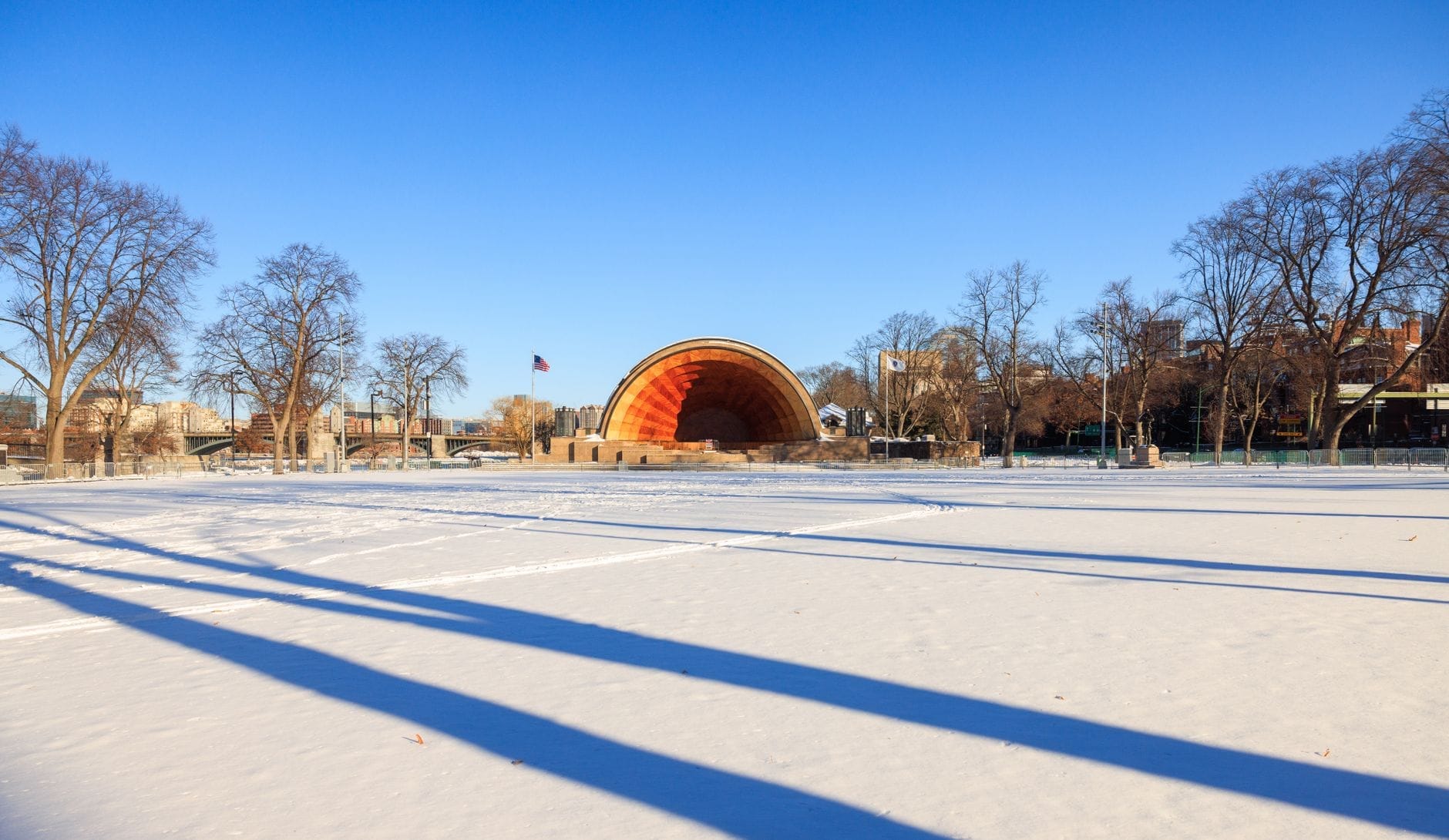
What the Hatch Shell Actually Is
The Edward A. Hatch Memorial Shell is an open-air performance venue built into the Charles River Esplanade, a narrow strip of parkland running along the Boston side of the Charles River in Back Bay. The shell itself is a fixed Art Deco stage structure, roughly 40 feet tall at its arched apex and 110 feet wide, backed by a curved acoustic reflector and flanked by concrete wings. In front of it: grass, open sky, and on the right evening, thousands of Bostonians on picnic blankets.
There are no seats, no gates, and no ticket booths for most events. You walk in off the Esplanade path, find a spot on the lawn, and settle in. That informality is the point. The shell was designed to bring orchestral music to anyone who wanted it, and the structure of a free public lawn concert has barely changed since Arthur Fiedler first conducted a makeshift ensemble here in 1929.
💡 Local tip
Arrive at least 45 minutes early for any popular evening concert. The lawn fills from the front back, and good sightlines disappear faster than you'd expect. A low folding chair or a thick blanket is worth carrying from the T.
Architecture and History
The current shell was designed by architect Richard J. Shaw and constructed between 1939 and 1940, replacing an earlier temporary structure that had served the site since the late 1920s. It was officially dedicated in 1940 and opened to the public in June 1940 and named in honor of Edward A. Hatch, a Boston civic figure who had supported public music events. The style is Art Deco: clean geometric lines, a sweeping semicircular arch, and a restrained elegance that fits the era without being showy.
The acoustic shell's shape is functional as well as aesthetic. The curved rear wall reflects sound outward toward the lawn, allowing the stage to project music across a large outdoor space without modern amplification being the only tool in play. For acoustic performances, the engineering still works remarkably well. For amplified rock or pop acts, the shell functions more as backdrop than acoustic instrument.
The shell sits within the Charles River Esplanade, a park that itself has a layered history as landfill and urban parkland. If you're interested in the broader riverfront setting, the Charles River Esplanade extends in both directions and is worth exploring before or after any event. The footbridge near the shell is named the Arthur Fiedler footbridge, honoring the conductor who made this stage famous nationally through the Boston Pops.
Tickets & tours
Hand-picked options from our booking partner. Prices are indicative; availability and final rates are confirmed when you complete your booking.
Boston Summer Night Trolley Tour and River Cruise
From 27 €Instant confirmationFree cancellationLEGOLAND Discovery Center Boston tickets
From 26 €Instant confirmationFree cancellationGhosts and Gravestones tour of Boston
From 39 €Instant confirmationFree cancellationBest of Boston tour
From 182 €Instant confirmationFree cancellation
The Fourth of July Concert: What It's Really Like
The Boston Pops Fourth of July concert at the Hatch Shell is the event most people associate with the venue, and the scale of it surprises first-time visitors. The esplanade fills with hundreds of thousands of people on July 4th, stretching far beyond the shell's immediate lawn into the wider park. The free event includes the Pops performance in the evening, followed by a fireworks display over the Charles River. The combination of music, fireworks, and the river setting makes it one of the more spectacular public celebrations in the country.
The practical reality: if you want a reasonable spot, you need to arrive very early, sometimes by midday or earlier for a prime lawn position. Storrow Drive is closed to vehicles. Crowds are dense, and getting in and out takes time. The MBTA typically runs increased service and additional trains, but they are packed. If you're visiting Boston specifically for the holiday, reading up on what to expect at Boston's Fourth of July before you go will save you significant frustration.
⚠️ What to skip
On July 4th, bag checks and security perimeters are in place. Large coolers, glass containers, and grills are typically prohibited. Check the official Hatch Shell site for the current year's rules, as they can change.
The Rest of the Season: What Else Happens Here
The Fourth of July is the marquee event, but the Hatch Shell hosts performances from spring through fall across a range of genres. Free summer concert series bring jazz, folk, pop, and classical acts to the stage on evenings throughout June, July, and August. Weekend afternoons sometimes feature family-oriented programming. Film screenings happen occasionally. The mix changes year to year.
Outside of scheduled events, the shell is an architectural landmark within an active park. Joggers pass along the Esplanade path in front of it throughout the day. Dog walkers stop near the lawn. On quiet mornings, the stage sits empty and you can walk up close and examine the Art Deco detailing at your own pace, without competing for space. The scale of the arch is more impressive up close than from the lawn during a concert.
The surrounding Esplanade connects to a wider recreational corridor. The park is part of Boston's Emerald Necklace park system, and the riverbank stretches toward the Back Bay neighborhood to the south. On warm evenings, the path between the shell and the lagoon areas fills with cyclists, families, and people watching the sailboats on the river.
How the Experience Changes by Time of Day
On a summer morning, the Hatch Shell is nearly deserted. The lawn is damp with dew, the city skyline across the water reflects in the Charles, and the stage structure casts clean shadows in the early light. It is photogenic at this hour, and you'll have the space to yourself. The smell of the river is stronger in the morning, a mix of fresh water and the faint mineral quality of the Charles.
By early afternoon on a non-event day, the Esplanade path fills with joggers and cyclists moving between the Back Bay and Cambridge bridges. The lawn near the shell stays relatively open. If there's an evening concert scheduled, crews begin setup in the afternoon, bringing equipment cases through the park gates.
Concert evenings have a distinct rhythm. The crowd builds slowly from about ninety minutes before the performance, with people staking out lawn positions and unpacking food. By the time the performance starts, the ambient noise from neighboring blankets, children, and occasional boats on the river creates a backdrop that is nothing like a concert hall. That is not a complaint. The informality is the experience. Carry a light jacket: even in July, the breeze off the Charles cools quickly once the sun goes down.
Getting There and Practical Details
The easiest approach is the MBTA Red Line to Charles/MGH station. From the station, cross the Longfellow Bridge approach or use the Arthur Fiedler footbridge and follow the Esplanade path west. The walk takes about seven to eight minutes on a clear day. On major event nights, this pedestrian route will be crowded in both directions; give yourself extra time going and coming.
Driving is not recommended for events. There is no dedicated parking at the Hatch Shell, and Storrow Drive is closed during large events like the Fourth of July. On regular concert evenings, limited metered parking exists in Back Bay, but spaces are gone well before any popular performance starts. The MBTA is the practical choice.
The venue is on flat, paved and grassed terrain, reachable via pedestrian bridges over Storrow Drive and park paths within the Esplanade. Event-specific accessibility accommodations are arranged by individual organizers, so visitors with mobility needs should check with the event producer or the Massachusetts Department of Conservation and Recreation (DCR), which operates the Hatch Shell, before attending. For context on how this site fits into Back Bay more broadly, the Back Bay neighborhood has a range of options within easy walking distance.
ℹ️ Good to know
There are no permanent restroom facilities directly at the shell. Portable facilities are brought in for major events. On non-event days, the nearest public restrooms are in the surrounding Esplanade park areas — check DCR signage on site.
Who Should and Shouldn't Prioritize This
If you are in Boston on a summer evening when a free concert is scheduled, this is a very good use of two or three hours. The combination of architecture, river setting, and live music in an open-air environment is rare in a major American city, and the free admission makes it accessible to any budget.
If you are visiting Boston with a packed itinerary and no event is scheduled, a quick walk past the shell is worth the detour from the Esplanade path, but it doesn't need more than twenty minutes on its own. Travelers who want a deeper understanding of how the city uses its outdoor spaces might combine a visit with a broader walk along the Esplanade. Those focused on indoor cultural sites would likely prioritize the Museum of Fine Arts or the Boston Public Library instead.
Visitors who dislike crowds should avoid the Fourth of July event entirely. The experience on that day is extraordinary, but it is also one of the most crowded public events in New England. If you want the shell's atmosphere without the masses, a regular-season weeknight concert with a few hundred people on the lawn is a completely different and arguably more enjoyable experience.
Insider Tips
- The area directly in front of the stage fills first, but the left and right flanks of the lawn offer good sightlines and are noticeably less crowded. Angling slightly off-center gives you more breathing room without sacrificing much of the view.
- Photography of the shell's Art Deco arch is best in the late afternoon, when low-angle light hits the curved concrete and wood-clad face from the west. Morning light works too, but you lose the warm tones.
- The Arthur Fiedler footbridge, just to the east of the shell, offers an elevated view over the lawn during concerts and lets you see the crowd scale and the city skyline simultaneously. Worth walking up for five minutes mid-performance.
- On non-event evenings in summer, the lawn near the shell is a quiet spot to watch the sun set over the Charles. Bring food from one of the Back Bay cafes, claim a patch of grass, and you have a view that most visitors never find.
- Event schedules are posted seasonally on the official site at hatchshell.com. Check about two to three weeks before your visit, as programming is often confirmed on a rolling basis rather than all at once.
Who Is Hatch Memorial Shell For?
- Travelers visiting Boston in summer who want a free evening out with local character
- Families looking for low-stress outdoor entertainment without tickets or reservations
- Architecture enthusiasts interested in Art Deco civic structures from the New Deal era
- Fourth of July visitors who want the authentic Boston Pops fireworks experience
- Budget travelers seeking quality cultural experiences at no cost
Nearby Attractions
Other things to see while in Back Bay:
- Boston Marathon Finish Line
The Boston Marathon Finish Line on Boylston Street is one of the most emotionally charged strips of pavement in American sports. Free to visit any day of the year, it carries 120-plus years of athletic history and the weight of a city's resilience. Here is everything you need to know before you go.
- Boston Public Garden
The Boston Public Garden is a 24-acre city park and National Historic Landmark between Beacon Hill and Back Bay, free to enter and generally open daily from dawn to dusk. From the famous Swan Boats on the lagoon to flowering magnolias in spring and snow-dusted statuary in winter, the garden rewards visitors in every season.
- Boston Public Library
The Boston Public Library's Central Library in Copley Square is one of the most architecturally significant buildings in New England, and it costs nothing to enter. From its Renaissance Revival McKim Building to its modern Johnson Addition, it rewards visitors who are curious about art, history, and civic ideals equally.
- Charles River Esplanade
The Charles River Esplanade is a 3-mile public park running along the south bank of the Charles River Basin in Boston's Back Bay and West End. Free to enter year-round, it draws joggers, cyclists, sailors, and concert-goers across every season. This guide covers what to expect at different times of day, how to get there, and what makes it worth your time.