The Green Planet Dubai: What to Expect Inside the City's Indoor Rainforest
The Green Planet is an indoor tropical rainforest bio-dome in City Walk, Dubai, housing thousands of plant and animal species across multiple floors. It offers a genuinely immersive nature experience that stands apart from Dubai's usual roster of glass towers and beach clubs.
Quick Facts
- Location
- City Walk, Al Wasl Road, Dubai, UAE
- Getting There
- Red Line to Burj Khalifa/Dubai Mall Station, then taxi or ~20 min walk to City Walk
- Time Needed
- 1.5 to 2.5 hours
- Cost
- From AED 175 (adults 11+), AED 150 (children 2–10), under 2 free. Verify current pricing before visiting.
- Best for
- Families, wildlife enthusiasts, visitors seeking indoor refuge from Dubai's heat
- Official website
- www.thegreenplanetdubai.com/en
What Is The Green Planet?
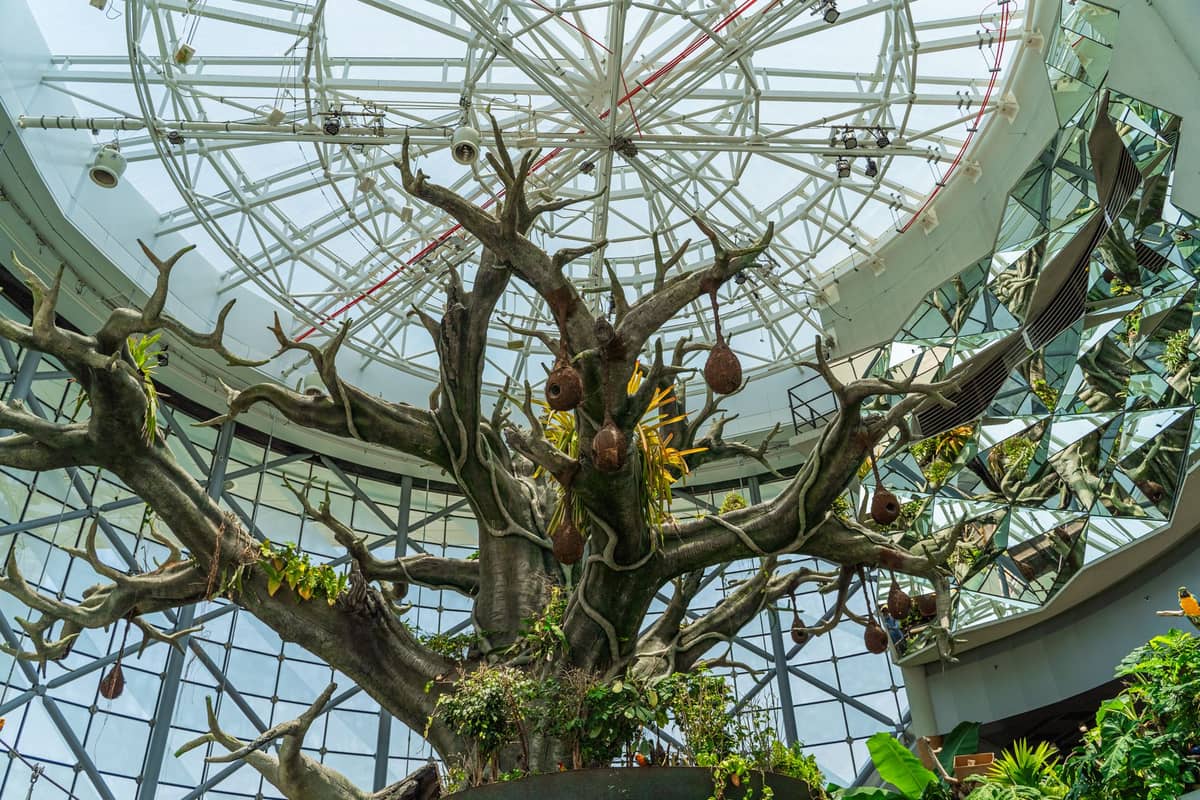
The Green Planet, Dubai is a self-contained tropical rainforest built inside a climate-controlled bio-dome in the City Walk district, at the junction of Al Wasl Road and Al Safa Road. Inside a spherical glass-and-steel structure, thousands of plant and animal species coexist across multiple levels, recreating a layered rainforest environment from the forest floor up to the canopy. This is not a zoo with cages or a botanical garden with neat labels. It is a deliberately atmospheric environment where animals move freely, the air is noticeably humid, and the light filters through dense canopy in a way that feels genuinely tropical.
For a city better known for skyscrapers and desert safaris, this kind of attraction is genuinely unusual. The bio-dome functions as both a conservation and education facility, and on weekdays especially, it draws school groups alongside tourists. The experience is unhurried and quiet compared to most of Dubai's major draws, which is either a feature or a limitation depending on what you are after.
💡 Local tip
Book tickets online before you arrive. The official information page strongly recommends advance booking to avoid queues at the entrance, and pricing can shift seasonally.
The Bio-Dome Environment: What You Are Actually Seeing
The moment you step through the entrance, the temperature and humidity shift noticeably. The air is warm and damp, carrying the scent of earth, foliage, and water. The structure is built around a central tree that rises through the full height of the dome, with pathways spiraling upward through different ecological zones. At the base level, you are on the forest floor, with dim light and slow-moving water features. As you ascend, the environment changes: more light, different plant species, and a different set of animals at each layer.
The canopy level, reached by elevator or spiraling walkway, offers an unexpected perspective. Looking down into the treetops rather than up at them reframes the experience entirely. Birds move through the upper levels freely, and reptiles and insects are encountered in enclosures throughout the different floors. Sloths, which have become one of the bio-dome's signature residents, tend to draw the largest clusters of visitors.
The lighting inside changes subtly throughout the day to simulate natural cycles, so early visitors see a softer, morning-quality light, while midday brings brighter, more even illumination. For photography, the lower levels offer more mood and contrast in the first hour after opening, while the upper levels photograph better mid-morning when light is stronger.
When to Visit and How Crowds Actually Behave
The Green Planet opens daily at 10:00 AM and operates until 6:00 PM. Arriving close to opening time on a weekday gives you the quietest possible experience. School groups arrive in organized blocks, typically late morning, and the pathways narrow noticeably when multiple groups move through simultaneously. By early afternoon on school days, the lower floors can feel congested near the more popular animal displays.
Weekends draw family visitors, and the bio-dome's contained space means crowds feel more pronounced here than they would at an outdoor attraction. If your priority is a calm, contemplative walk through the environment, a weekday morning between 10:00 and 13:00 is noticeably better. The official accessibility guide also cites this window as the recommended quieter period.
ℹ️ Good to know
Opening hours are currently listed as 10:00 AM to 6:00 PM daily, though some third-party sources cite later closing times such as 7:00 PM. Check the official website or call ahead before planning a late-afternoon visit.
Getting There from Different Parts of Dubai
City Walk is a mid-range journey from most tourist areas. From Downtown Dubai, a taxi takes roughly 10 minutes in normal traffic and costs approximately 20–30 AED. The Red Line metro stops at Burj Khalifa/Dubai Mall Station, from which City Walk is accessible by a 20–25 minute walk or a short taxi. There is no metro station directly at City Walk, so public transport alone is rarely the most convenient option for most visitors.
By car, the most direct route uses Sheikh Zayed Road (E11), exiting toward Al Wasl Road. City Walk has underground and surface parking within the complex. Bus route 29 runs along Al Wasl Road with a stop near City Walk, though bus travel requires additional planning and is slower in traffic.
Careem and Uber both operate in Dubai and cover City Walk without issue. If you are combining The Green Planet with other nearby attractions, City Walk itself has restaurants and retail options that make for a reasonable half-day itinerary.
Practical Walkthrough: What a Visit Looks Like
Entry is through a clearly marked ground-floor reception. Ticket scanning is digital, and the space transitions quickly from lobby to bio-dome. Most visitors take 90 minutes to two hours to move through all levels thoroughly, though families with younger children often spend longer at specific animal encounters.
Footwear matters more than people expect. The paths are smooth and accessible, but certain lower-level areas near water features can be slightly damp underfoot. Closed shoes are more comfortable than sandals, especially for children. The humidity inside means light, breathable clothing is worth planning for, even in winter when Dubai's outdoor temperatures are cool.
Photography is permitted throughout. Smartphones work well given the enclosed space and available light, though dedicated camera users should bring a lens that performs in lower light for the forest floor levels. Avoid flash near the animals, both as courtesy and because the bio-dome's staff will ask you to stop.
⚠️ What to skip
Do not bring large backpacks or pushchairs that cannot fit through standard doorways. The spiral pathways are accessible, but oversized items can create bottlenecks and make the ascent awkward for everyone.
Is It Worth Your Time? An Honest Assessment
The Green Planet delivers what it promises: a credible, well-maintained indoor nature experience in a city where genuine encounters with non-desert wildlife are otherwise rare. The ticket price sits at the higher end for a single attraction in Dubai, and visitors expecting a large-scale zoo or a botanical garden with extensive interpretation will find it smaller and more contained than anticipated.
Where it succeeds is in atmosphere and accessibility. The bio-dome genuinely transports you out of the surrounding city, which is a harder feat than it sounds when the city in question is Dubai. For families with younger children, the multi-level format keeps the visit dynamic without requiring long walks or exposure to outdoor heat.
Solo travelers who prioritize outdoor scale or cultural depth might find the experience too brief for the price. For those, Dubai Safari Park offers a wider range of animals across a much larger outdoor space, and Ras Al Khor Wildlife Sanctuary provides a free and genuinely wild alternative for birdwatching. Neither replicates the rainforest experience, but they are worth considering depending on what you are after.
In the summer months, when outdoor Dubai becomes genuinely difficult to navigate for extended periods, the bio-dome's indoor environment becomes a more compelling proposition. It is one of the few attractions in the city that is immune to the heat outside.
Accessibility and Family Logistics
The Green Planet is fully wheelchair accessible, with ramps and elevators connecting all levels of the bio-dome. This puts it ahead of many of Dubai's heritage and outdoor attractions, where accessibility is often an afterthought. Visitors with sensory sensitivities should note that the bio-dome can become acoustically busy with school groups; the recommended quiet window of 10:00 to 13:00 on weekdays applies here too.
For families combining the visit with other child-friendly options, Dubai with kids covers a wider itinerary across the city, including both indoor and outdoor options suited to different ages.
Insider Tips
- Arrive within the first 30 minutes of opening on a weekday. The lower forest floor, which is the most atmospheric part of the bio-dome, is almost entirely empty before school groups arrive.
- The elevator is faster, but the spiral walkway gives you a better sense of how the ecosystem layers work as you ascend. Take the walkway up and the elevator down.
- The sloth enclosure draws the longest queues during peak periods. Visit it first on arrival if you have young children who specifically want to see sloths, before groups cluster there.
- Wear closed, non-slip footwear. Certain lower-level paths near water can be damp, and flip-flops are genuinely uncomfortable on the textured surfaces.
- City Walk has multiple dining options within walking distance of the bio-dome exit. If you are visiting with children, factoring in a meal nearby turns this into a more complete half-day rather than a single-stop visit.
Who Is The Green Planet For?
- Families with children aged 3 to 12 who want an engaging, contained nature experience
- Visitors traveling during Dubai's summer months who need compelling indoor alternatives to outdoor attractions
- Wildlife and nature enthusiasts looking for something beyond desert and coast
- Travelers with limited mobility who want a fully accessible indoor attraction
- Anyone with a two-to-three hour window mid-itinerary who wants something genuinely different from Dubai's retail and architecture circuit