Goodman Theatre: Chicago's Premier Stage for Serious Drama
Founded in 1925, Goodman Theatre is Chicago's oldest and largest nonprofit theater company. Housed in a landmark Loop facility, it stages bold, ambitious productions that have shaped American theater for a century.
Quick Facts
- Location
- 170 N Dearborn St, Chicago Loop (Theater District), IL 60601
- Getting There
- CTA 'L' – Clark/Lake (Blue, Brown, Green, Orange, Pink, Purple lines) or Lake (Red)
- Time Needed
- 2–3 hours (performance); arrive 30–45 min early to explore the lobby and grab a pre-show drink
- Cost
- Ticket prices vary by production and seat; check the official site for current pricing. Group discounts available (up to 50% off select productions). Box office: (312) 443-3800.
- Best for
- Theater lovers, cultural travelers, date nights, fans of new American drama
- Official website
- www.goodmantheatre.org
Why the Goodman Matters
Goodman Theatre is not just another regional playhouse. Since its founding in 1925, it has earned a reputation as one of the most artistically serious nonprofit theaters in the United States, the kind of institution where major American playwrights have their work developed, refined, and sent out into the world. That history is tangible the moment you walk in. This is Chicago's oldest currently active nonprofit theater, and it has spent a century earning that status.
For travelers trying to understand Chicago's cultural identity beyond architecture and food, an evening at Goodman is one of the most illuminating things you can do. The city has long punched above its weight in live theater, and Goodman sits at the center of that tradition. It is worth reading about Chicago's broader theater scene before deciding which venue fits your taste, but Goodman is the natural starting point for anyone unfamiliar with the city's stages.
The Building: A Loop Landmark Repurposed
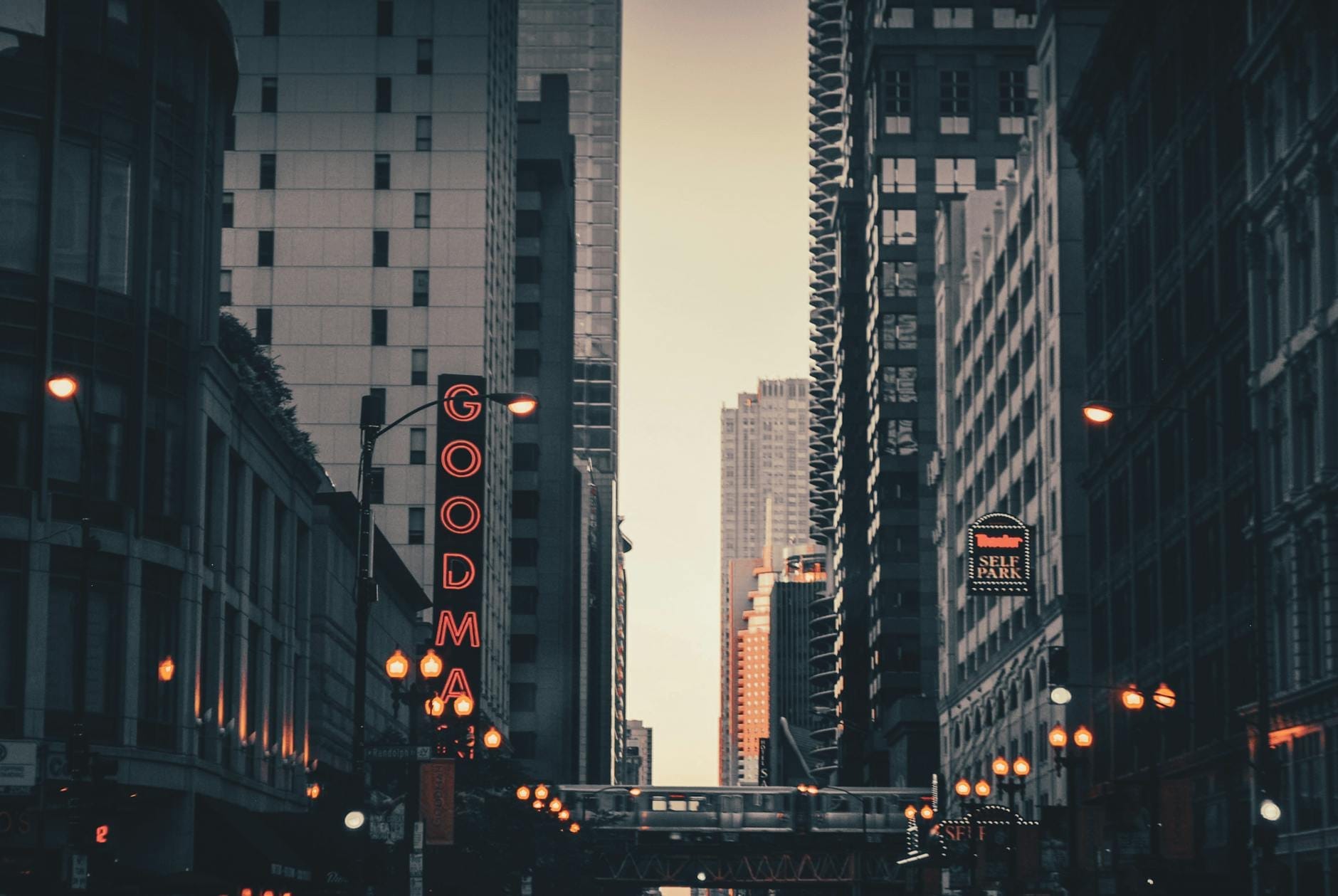
Goodman's current home at 170 North Dearborn opened in 2000 on a site with deep theatrical history. The facility incorporates the facades of the historic Harris and Selwyn Theaters, two early 20th-century playhouses that were landmarks of Chicago's original Theater District. The modern structure behind those preserved facades holds two performance spaces: the Albert Theatre (the main stage, seating roughly 850) and the more intimate Owen Theatre (seating roughly 400, depending on configuration).
Standing on Dearborn Street before a performance, you are looking at a building that threads old and new together in a way that feels very Chicago. The Loop's Theater District clusters along Dearborn and Randolph, putting Goodman in proximity to the Chicago Theatre and several other major venues within a few blocks' walk. The neighborhood rewards a slow pre-show stroll if you arrive early enough.
Inside, the lobby is spacious and well-designed for pre-show gathering. The bar area fills up quickly on weekend evenings, especially on opening nights and during blockbuster productions. The architecture feels serious without being stuffy: clean sightlines, warm lighting, enough room to hold a large crowd without feeling like a transit hub. First-timers often note how accessible it feels compared to older, more ornate theater interiors.
💡 Local tip
Arrive at least 30 minutes before curtain. The bar fills fast on busy nights, and latecomers may not be seated until an appropriate break in the performance.
Tickets & tours
Hand-picked options from our booking partner. Prices are indicative; availability and final rates are confirmed when you complete your booking.
Go City | Chicago All-Inclusive Pass
From 127 €Instant confirmationFree cancellationiFLY Chicago Lincoln Park indoor skydiving experience
From 126 €Instant confirmationFree cancellationiFLY Chicago Rosemont indoor skydiving tickets
From 117 €Instant confirmationFree cancellationChicago lakefront neighbourhood bike tour
From 18 €Instant confirmationFree cancellation
What Goodman Actually Produces
The Goodman's programming leans toward serious American drama, new commissions, and ambitious revivals. It has a long record of developing new works that later move to Broadway, and its annual production of Charles Dickens' A Christmas Carol has become a Chicago winter institution, running each December at the Albert Theatre. Beyond that seasonal anchor, a typical season includes four to six main stage productions covering a range of American and international drama, often with celebrated directors and designers.
The Owen Theatre, Goodman's smaller flex space, tends to host more experimental or emerging work. If you prefer theater that takes creative risks over polished crowd-pleasers, the Owen is worth checking specifically. Tickets for Owen productions are sometimes easier to obtain and can offer a more immediate, close-quarters experience.
If your Chicago visit coincides with late November or December, the annual A Christmas Carol production is genuinely worth attending, not as a tourist obligation but as a well-crafted piece of theater that Chicago audiences return to year after year. For broader seasonal guidance, see what to do in Chicago at Christmas.
Getting There: Practical Transit Details
Goodman Theatre sits in the heart of the Loop, which makes it one of the easiest major venues in Chicago to reach by public transit. The Clark/Lake CTA station is served by the Red, Blue, Brown, Green, Orange, Purple, and Pink lines, meaning almost every 'L' line in the city stops within a short walk of the theater. The Lake station on the Red and Green lines is another nearby option. From either, the walk to 170 North Dearborn takes under five minutes.
Driving to a Loop performance and relying on street parking is not recommended on weekday evenings or weekend nights. Parking garages are available nearby, but costs add up and traffic around curtain time is unpredictable. The CTA is genuinely the better choice here. For general orientation on getting around Chicago by transit, the guide to getting around Chicago covers the full picture.
ℹ️ Good to know
The Goodman box office can be reached by phone; current hours are listed on the official website, and the main box office line is (312) 443-3800. For access and disability assistance, contact Access@GoodmanTheatre.org or (312) 443-3800.
Buying Tickets: What You Need to Know
Tickets are purchased directly through the Goodman's website or box office. Pricing varies considerably by production, performance date, and seat location, so the most reliable approach is to check the official site for the specific show you want to see. Group bookings of 10 or more can save up to 50 percent on select productions through the group sales line.
Availability varies. Major productions, especially the December A Christmas Carol run and any high-profile world premieres, can sell out weeks in advance. If you are building a Chicago itinerary around a Goodman show, book early. For flexible visitors, last-minute rush tickets are occasionally available, but this is not something to count on for popular runs.
⚠️ What to skip
The Goodman does not publish fixed ticket prices publicly because they vary by production and seating tier. Avoid third-party resale sites charging significant markups; always buy directly from goodmantheatre.org or the box office.
The Experience: Before, During, and After the Show
A Goodman evening has a distinct rhythm. The lobby before curtain has the feel of a genuinely engaged audience, not a tourist crowd looking for a landmark experience, but Chicago theatergoers who follow the institution closely. Conversations at the bar tend to be specific: people discussing the playwright, the director, or a production they saw last season. It can feel insider-ish if you are unfamiliar with the company's history, but it is also welcoming to newcomers who bring genuine curiosity.
The Albert Theatre itself is a well-proportioned main stage with good sightlines from most sections. The acoustics are designed for spoken-word performance, and even mid-house seats carry dialogue cleanly. The Owen Theatre, when configured intimately, can feel almost uncomfortably close to the action in the best possible way. Productions in that space often benefit from proximity in ways that larger venues cannot replicate.
After the show, the surrounding Loop and nearby River North have plenty of options for a late dinner or drink. The Loop neighborhood has expanded considerably as a post-theater destination over the past decade, with restaurants along Randolph Street and Wacker Drive worth exploring before or after a performance.
Accessibility and Practical Notes
Goodman Theatre takes accessibility seriously and arranges services per production. These can include audio description, open captioning, and assistive listening devices. Wheelchair-accessible seating is available in both theaters. For specific needs, contact the access team at Access@GoodmanTheatre.org or (312) 443-3800 well in advance of your performance date, as some services require pre-arrangement.
Photography and recording are not permitted during performances, which is standard for professional theater. Most productions run between 90 minutes and two and a half hours, sometimes with an intermission. Check the production-specific page on the Goodman website for exact running times before you plan your evening.
Insider Tips
- The Owen Theatre is worth seeking out even if the main stage production does not appeal to you. Smaller-scale works staged there often take more creative risks and offer a more intimate experience at typically lower price points.
- If you are visiting in December, book the A Christmas Carol run as early as possible. It sells out most weekends and is a genuine Chicago tradition rather than a tourist add-on.
- The Goodman's website lists production-specific details including running times and content advisories. Check these before you go, especially if you are attending with younger theater-goers or have specific sensory concerns.
- Group discounts of up to 50 percent are available for parties of 10 or more on select productions. If you are organizing a larger group visit, calling the Goodman group sales line at (312) 443-3815 well in advance is worth the effort.
- Randolph Street, a block north of the theater, has become a serious restaurant corridor over the past decade. Booking a table before a weeknight performance is straightforward; weekend pre-theater reservations fill faster.
Who Is Goodman Theatre For?
- Theater enthusiasts who want to see serious American drama performed at a high level
- Cultural travelers building a Chicago itinerary around the city's arts institutions
- Couples looking for a genuinely engaging date-night experience beyond bars and restaurants
- Visitors during December who want a polished, locally beloved holiday production
- Anyone curious about how Chicago's theater scene compares to New York or London at the professional nonprofit level
Nearby Attractions
Other things to see while in The Loop:
- Art Institute of Chicago
One of the largest and most visited art museums in the United States, the Art Institute of Chicago anchors the eastern edge of the Loop with a collection of over 300,000 works spanning 5,000 years. From Georges Seurat's pointillist masterpiece to Grant Wood's American Gothic, the highlights alone demand the better part of a day.
- Buckingham Fountain
The Clarence Buckingham Memorial Fountain is one of the largest decorative fountains in the world, sitting at the heart of Grant Park since 1927. Free to visit during its seasonal run from spring through mid-October, it puts on hourly water displays and a nightly illuminated show that draws crowds from across the city.
- Chicago Architecture Center
Housed in Mies van der Rohe's One Illinois Center on the Chicago River, the Chicago Architecture Center packs nearly 10,000 square feet of exhibition space, a landmark scale model of the city, and access to some of the country's most informative architecture tours. It's the most comprehensive entry point into understanding what makes Chicago's skyline one of the world's most significant.
- Chicago Architecture Foundation River Cruise
The Chicago Architecture Center River Cruise aboard Chicago's First Lady is the most authoritative way to read the city's skyline. In 90 minutes, trained docents walk you through more than 40 landmark buildings across all three branches of the Chicago River, connecting architectural styles to the human decisions that shaped them.