Dubai Desert Conservation Reserve: The Real Desert Safari Experience
The Dubai Desert Conservation Reserve is a 225-square-kilometre protected wilderness about 65 km from the city, accessible only through licensed eco-tour operators. It is the UAE's first formally protected conservation area and one of the key places in Dubai where you can track Arabian oryx in their natural habitat.
Quick Facts
- Location
- Dubai–Al Ain Road (E66), approximately 60–65 km southeast of central Dubai
- Getting There
- Hotel pickup provided by licensed tour operators; no public transit access. Self-drive inside the reserve is not permitted.
- Time Needed
- Half-day safari: 4–6 hours. Overnight camp: 24 hours. Full conservation drive: 3–4 hours.
- Cost
- AED 275–450 for standard safaris; AED 900+ per vehicle for private drives; AED 1,350+ per person for luxury overnight camps (approx., verify with operator)
- Best for
- Wildlife enthusiasts, photographers, couples, nature-focused travellers wanting an alternative to commercial dune-bashing tours
- Official website
- www.ddcr.org
What the Dubai Desert Conservation Reserve Actually Is
The Dubai Desert Conservation Reserve (DDCR) is not a theme park or a stage-managed sand experience. It is a formally protected area covering roughly 225 square kilometres of inland Rub' al Khali-edge desert, established in the early 2000s as the first conservation zone protected under UAE environmental law. Inside, the landscape is managed specifically to support wildlife, which means no commercial dune-bashing circuits, no convoys of tourist SUVs following the same track at speed, and no DJ sets at a pop-up camp by the dunes.
That distinction matters enormously when comparing it to the generic desert safari products running nightly out of Dubai. The DDCR operates on a permit-only basis through a small number of licensed eco-tour operators, each of which must meet conservation standards set by the reserve's management and the UAE Ministry of Climate Change and Environment. The number of vehicles permitted inside at any one time is controlled, which means the experience remains quiet and the ecosystem is not degraded by the kind of traffic that characterises the open desert areas south of the city.
ℹ️ Good to know
Access is permit-only. You cannot drive yourself to a gate and pay entry. All visits must be booked in advance through a licensed operator, who will arrange hotel pickup, security clearance, and transport into the reserve.
The Landscape and What You Will See
The terrain inside the DDCR is classic Arabian interior desert: rolling red-ochre dunes interrupted by flat sabkha plains, dry riverbeds called wadis, and occasional patches of ghaf trees, the UAE's national tree. The sand here has a particular warmth of colour in the early morning and at golden hour, deepening from pale amber at midday to a saturated rust-red as the sun falls. During summer months, midday temperatures inside the reserve regularly exceed 40°C, which pushes most wildlife activity into the cooler early morning or post-sunset hours.
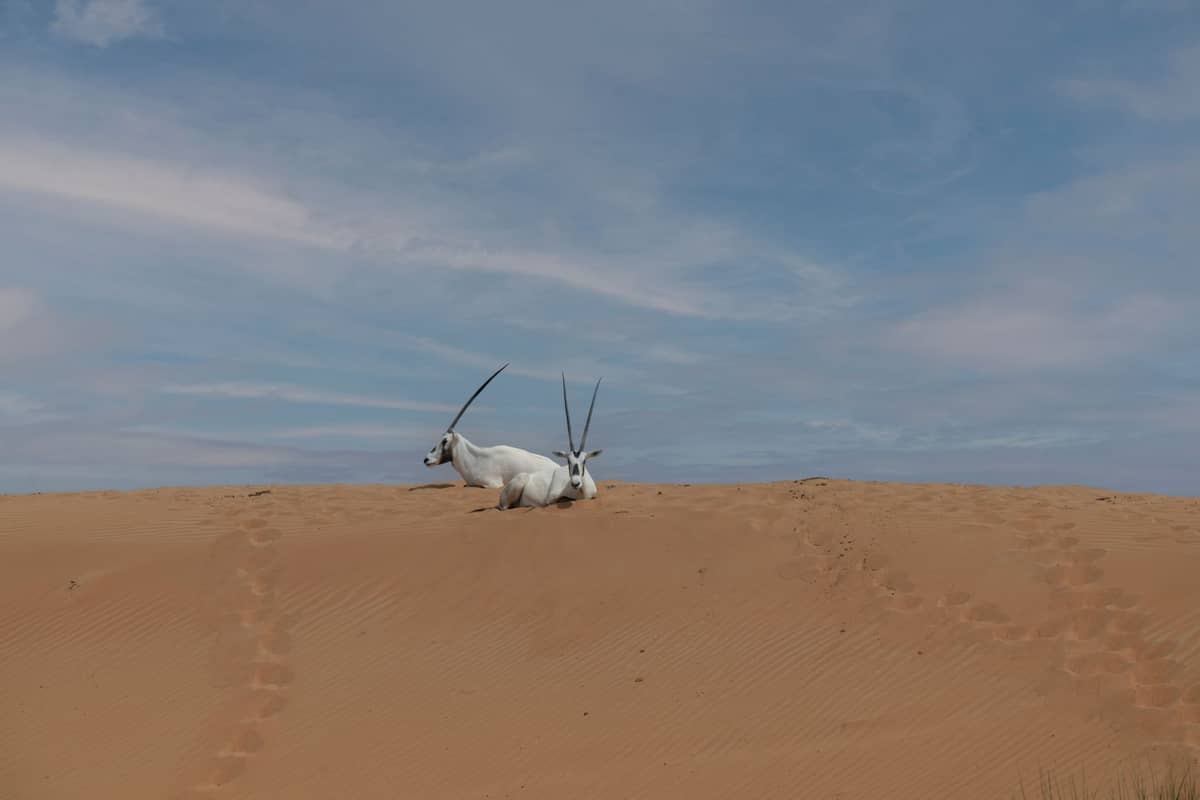
The flagship animals are the Arabian oryx, which were reintroduced to the reserve after being extinct in the wild across the UAE. Slender, almost white antelope with long straight horns, they move slowly across the plains in small herds and are reliably visible to safari vehicles throughout the morning. Arabian gazelles are also present in good numbers, along with sand gazelles. Rarer sightings include the Arabian sand cat, the Arabian red fox, and various raptor species. The reserve is managed by the Emirates Group on behalf of the Government of Dubai, which has contributed to its breeding success.
Birdwatchers will find the DDCR rewarding, particularly in winter when migratory species pass through. The contrast with more urban wildlife-watching spots like the Ras Al Khor Wildlife Sanctuary is stark: there, you watch flamingos from a hide on the edge of a city. Here, the silence is complete, and you can be genuinely alone with the landscape.
How the Experience Changes Through the Day
Morning safaris, typically departing hotels between 6:00 and 7:30 AM, offer the best combination of wildlife activity and light. The desert in the first hour after sunrise is cool enough to be comfortable (in winter months, bring a light layer), the oryx and gazelles are actively feeding, and the low-angle sun creates a shadow quality that makes photography instinctive rather than effortful. The silence is notable: no city noise reaches this far into the interior, and the only sounds are wind across the dune crests and the occasional call of a desert bird.
Evening safaris shift the atmosphere entirely. By late afternoon the heat begins to ease and the light turns golden in a way that rewards anyone with a camera and some patience. Sunset over the dunes is unhurried here, without the crowds that gather at viewpoints elsewhere in Dubai. After dark, with the city's glow reduced to a faint smear on the horizon, the stars are genuinely visible, which is a rarity for Dubai's visitors.
Overnight camp packages extend the experience further. Al Maha Desert Resort and Spa, situated within the reserve, is the most well-known accommodation option, offering standalone suites with private plunge pools overlooking the dune landscape. This is the luxury end of the spectrum, and the price reflects it. More modest overnight camp options are offered by some licensed operators, though the experience and facilities vary significantly, so verify what is actually included before booking.
💡 Local tip
For photography, the 90 minutes after sunrise and the hour before sunset produce the best light. Midday in winter is workable but flatter; midday in summer is simply brutal and best avoided outdoors.
Historical and Conservation Context
The DDCR was formally established in the early 2000s, making it the first national park-scale area in Dubai to receive dedicated protected status under local environmental law. Its creation was driven partly by the alarming decline of native desert species across the region, particularly the Arabian oryx, which had been hunted to extinction in the wild across most of its historic range by the early 1970s. The reserve's breeding programme is now considered one of the more successful oryx conservation efforts in the Arabian Peninsula.
Framing this within Dubai's broader identity requires a degree of nuance. The emirate is better known internationally for its towers than its ecology, and the DDCR sometimes feels underrepresented in mainstream tourism coverage compared with attractions like the Burj Khalifa or the Dubai Mall. But for anyone interested in what the land looked like before the construction boom, and in the animals that have inhabited this desert for thousands of years, the reserve is one of the most substantive destinations in the emirate.
It is worth noting that the reserve sits within a broader landscape that remains genuinely remote. The drive out on the E66 Dubai–Al Ain Road passes through the flat industrial outskirts of the city before the terrain opens up into the red-sand plains that characterise this part of the Arabian interior. The transition is gradual but unmistakable.
Practical Walkthrough: Booking and What to Expect
All visits must be pre-booked through a licensed operator. Most operators offer hotel pickup from central Dubai areas including Downtown, Dubai Marina, Business Bay, JBR, and Deira. The drive to the reserve takes roughly 45–60 minutes depending on traffic. Security clearance is arranged by the operator before entry; you will need to provide your passport details in advance.
Once inside, the typical format is a guided 4×4 drive through designated conservation tracks, with stops for wildlife viewing, a visit to a traditional Bedouin-style camp for refreshments, and optional camel riding. Some operators include a falconry demonstration, which is staged but historically grounded: falconry remains an active cultural practice in the UAE and was inscribed on the UNESCO Intangible Cultural Heritage list in 2010.
The DDCR Visitor Centre at Margham Gate is open daily 10:00 to 18:00, with adjusted hours during Ramadan (Tuesdays and Wednesdays may be closed; confirm with your operator). For those combining this with other nature-oriented destinations, the reserve pairs well logistically with a day trip itinerary from Dubai, and can occasionally be combined with onward travel toward Al Ain.
⚠️ What to skip
Self-drive vehicles, quad bikes, and motorcycles are strictly prohibited inside the reserve. Any tour operator offering dune-bashing within the DDCR is not operating legitimately within the conservation area. Verify your operator is licensed before booking.
What to Wear, Bring, and Know Before You Go
For morning and evening safaris between November and March, light layers are appropriate. Desert temperatures at dawn in January can drop to around 12–15°C, which feels significantly cooler after the warmth of the city. By mid-morning, that chill is gone. Closed-toe shoes or trainers are better than sandals for any walking, as the sand surface can be uneven and thorny desert plants are present near the dune margins.
Summer visits (June to September) are genuinely difficult. Daytime temperatures inside the reserve routinely exceed 45°C, and any extended time outside a vehicle is uncomfortable at best. If you visit in summer, choose sunrise or early morning departures only, carry more water than you think you need, and keep expectations calibrated: wildlife is less active in intense heat.
- Sunscreen and sunglasses: non-negotiable in any season
- Light, loose-fitting clothing that covers shoulders and knees (practical for sun protection and culturally appropriate in the UAE)
- A dust-resistant camera bag or lens cloth: fine sand gets everywhere
- Cash or card for tips to guides (discretionary, around 10% is customary)
- Any personal medication: the drive back to the city takes over an hour
For broader guidance on what to wear during outdoor activities in Dubai, the Dubai outfits and dress code guide covers practical and cultural considerations that apply here.
Honest Assessment: Is It Worth It?
The DDCR delivers something that almost no other Dubai experience can: genuine quietness and ecological authenticity. If your primary interest is the physical sensation of dune-driving or the novelty of a desert dinner with entertainment, the cheaper and more widely available commercial safaris operating outside the reserve will satisfy that at lower cost. But if you want to see Arabian oryx moving freely across open desert, to understand what this landscape actually is, and to do so without sharing it with forty other tourists, the DDCR earns its higher price point.
It should also be said that the DDCR is not the only way to experience the desert from Dubai. The Dubai desert safari guide covers the full spectrum of options, from budget group tours to conservation drives, and is worth reading before committing to a booking. The DDCR represents the premium, conservation-focused end of that spectrum.
One limitation to state clearly: the experience is entirely dependent on your operator. The reserve provides the habitat; the quality of guiding, vehicle, food, and scheduling is operator-specific. Read recent reviews on booking platforms and specifically look for operators with active wildlife interpretation rather than those treating the reserve as simply a more exclusive backdrop for a standard safari format.
Insider Tips
- Book operators that offer small-group conservation drives (6 passengers or fewer) rather than the larger format safari vehicles. Fewer vehicles means better wildlife sightings and a noticeably quieter experience inside the reserve.
- Request a sunrise departure if your operator offers it. The light between 6:00 and 7:30 AM in winter is exceptional for photography, and the oryx are at their most active before the heat builds.
- The Visitor Centre at Margham Gate has interpretive displays on the reserve's conservation history and species. Most group safaris skip it in favour of getting into the dunes faster, but asking your operator to include a brief stop adds context that makes the wildlife sightings more meaningful.
- If visiting during Ramadan, confirm current Visitor Centre hours directly with your operator before departure. Hours can change at short notice during the holy month.
- Bring a telephoto lens of at least 200mm if wildlife photography is your priority. The oryx and gazelles are approachable but not tame; the closest vehicles typically stop around 30–50 metres from a herd, and you will want reach to fill the frame.
Who Is Dubai Desert Conservation Reserve For?
- Wildlife and nature enthusiasts who want genuine conservation context, not just a backdrop
- Photographers, particularly those interested in wildlife and landscape work in desert light
- Couples seeking a quieter, more intimate desert experience than the commercial group safari circuit
- Travellers who have already done a standard dune-bashing safari and want something substantively different
- Families with older children (10+) who can engage with conservation guides and wildlife interpretation