Dapeng Ancient Fortress: Shenzhen's 600-Year-Old Ming Dynasty Fort
Dapeng Fortress (大鹏所城) is the most intact Ming Dynasty military garrison in southeastern China, sitting on Shenzhen's eastern coast with over 600 years of layered history. Free to enter and a world away from the city's glass towers, it rewards anyone willing to make the journey east.
Quick Facts
- Location
- Pengfei Road, Dapeng Subdistrict, Dapeng New District, Shenzhen
- Getting There
- Bus M457 or M471 to Dapeng Ancient City Station
- Time Needed
- 2 to 3 hours for the fortress; allow half a day if combining with the coast
- Cost
- Free admission (individual museum buildings may charge separately)
- Best for
- History lovers, architecture enthusiasts, day-trippers escaping the urban core
- Official website
- http://www.dpxq.gov.cn/english/travel/culturalattractions
What Is Dapeng Ancient Fortress?
Dapeng Fortress, known in Chinese as 大鹏所城, is the most complete Ming Dynasty military garrison surviving in southeastern China. Built over 600 years ago during the early Ming period as a coastal defense post against Japanese pirates and maritime raiders, the walled compound covers approximately 110,000 square meters and retains its original gate towers, perimeter walls, ancestral halls, and a dense web of narrow stone lanes lined with traditional Cantonese-style residences.
What makes Dapeng unusual for Shenzhen is not just its age but its continuity. Descendants of the original garrison soldiers still live inside the fortress walls. The result is a place that reads as both a living neighborhood and an open-air historical monument, with laundry hanging between ancient courtyard gates and elderly residents playing chess in the shadow of 15th-century stonework.
ℹ️ Good to know
Admission to the fortress grounds is free. Some individual ancestral halls and small museum buildings inside charge a separate entry fee. Carry small change in Chinese yuan (CNY) if you want to enter every structure.
The Fortress Walls and Gate Towers
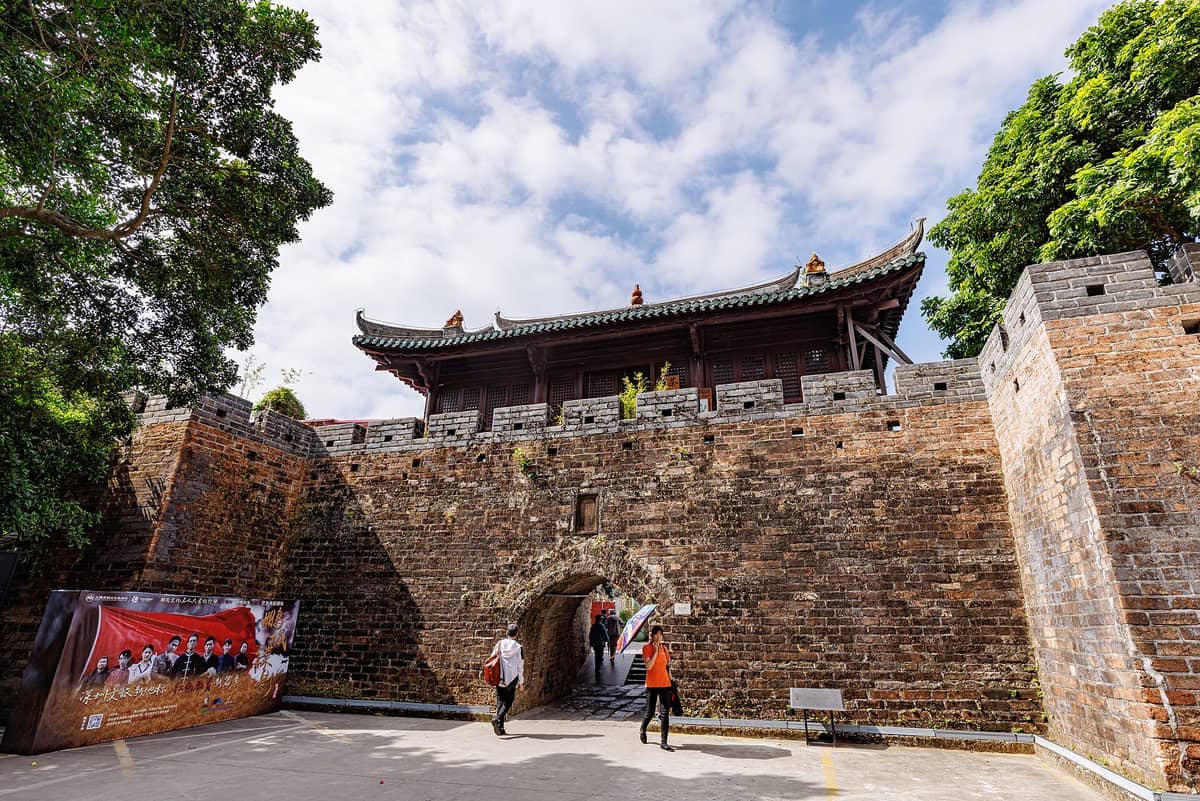
The most striking entry point is the South Gate, a thick stone archway topped by a restored gate tower with upturned eaves. The stonework at the base of the walls is original Ming-era construction, noticeably rougher in texture than the restored upper sections, and you can run your hand along granite blocks that have been in place since the 1390s. The walls themselves are not particularly tall by imperial fortress standards, but the preservation is exceptional, with the full perimeter largely intact.
Walking the lane that follows the inner wall gives a clear sense of scale. The fortress was not a palace or an administrative capital. It was a working military outpost, utilitarian in layout, designed to house soldiers and their families while controlling the coastal approaches. That pragmatic character is still readable in the architecture: compact, fortified, functional.
For visitors interested in how this fits into Shenzhen's broader architectural story, the contrast with the city's contemporary skyline is sharp. TheShenzhen architecture guidecovers both ends of that spectrum, from the Song Dynasty remnants in the west to the financial towers of Futian.
Inside the Walls: Ancestral Halls, Lanes, and Living History
Once through the gate, the lane system opens into a grid of alleyways no wider than two people walking side by side. The main axis runs roughly north to south and leads past the most prominent ancestral hall complexes, including those dedicated to the Lai and Liu families, whose descendants produced Ming and Qing Dynasty military commanders. These halls feature carved wooden beams, stone courtyards, and incense altars still in active use.
In the mornings, the lanes carry the smell of congee and fried dough from small breakfast stalls that cater to residents and early visitors alike. By midday, souvenir shops and tea houses take over the sensory landscape, and the main thoroughfare becomes noticeably more commercial. The side lanes stay quiet throughout the day, and that is where the texture of the place is most apparent: worn flagstones, crumbling plaster over brick, potted plants crowding doorways.
Several small museums occupy restored buildings within the compound, covering local military history and the biography of Lai Enjue, a Qing-era naval commander born in the fortress who became nationally significant during the First Opium War. The exhibits use a mix of artifacts, reproductions, and text panels; most primary labels are in Chinese, with limited English translations.
💡 Local tip
Arrive before 9:30 am if possible. Weekday mornings are genuinely quiet, with local residents going about daily routines and few tour groups present. Weekend afternoons bring school groups and coach tours that fill the main lane completely.
How the Atmosphere Shifts Through the Day
Early morning is the strongest time to visit. The gate towers catch the eastern light cleanly, and the stone lanes are cool in the shadow of the walls. Residents sweep courtyards, the smell of incense drifts from the halls, and the pace is unhurried. This version of the fortress is the most authentic.
By late morning, the tour groups arrive from the city center, and the main street shifts register: souvenir vendors get louder, queues form at the most photogenic spots, and the food stalls switch from breakfast items to snacks and drinks. The side lanes remain navigable and calm, but the central corridor loses some of its character.
Late afternoon, as coach tours depart, the light turns golden on the gate towers and the wall stones warm up visually. If you have the flexibility to linger past 4 pm, the crowd drops considerably. The site reportedly closes at 17:30 according to travel sources, though the outer lanes may remain accessible later given that people live inside.
Getting to Dapeng Fortress from Central Shenzhen
Dapeng New District is in the far eastern part of Shenzhen, well outside the metro network. Getting here requires a bus ride of roughly 90 minutes from the urban core, depending on your starting point. Bus routes M457 and M471 serve Dapeng Ancient City Station, which is within easy walking distance of the South Gate. Bus connections are available from several metro interchange points in Longgang and Yantian districts.
Ride-hailing via Didi is a practical alternative if you are traveling with a group or have luggage, though the cost from central Shenzhen is substantial and traffic on the eastern expressways can extend the journey significantly on weekends. Driving yourself or hiring a charter for the day is worth considering if you plan to combine the fortress with the nearby coast.
The distance from the urban core is a real commitment. Dapeng New District sits at the southeastern tip of Shenzhen, and the journey is part of what keeps the area relatively uncluttered compared to attractions closer to the metro. If you are planning a full day in the east, theDapeng New Districtis worth treating as a destination in its own right rather than a quick add-on.
⚠️ What to skip
There is no metro station serving Dapeng. Plan for a bus journey of 90 minutes or more from central Shenzhen, or arrange a ride-hailing service in advance. Check current bus schedules before travel, as routes can change.
Context: Why This Fortress Exists
The Ming Dynasty established coastal garrison towns across Guangdong from the 1390s onward to counter the threat of wokou, the Japanese and Chinese pirate fleets that raided the South China coast. Dapeng was one of these garrison settlements, positioned to monitor the approaches to what is now the eastern Pearl River Delta coastline. The soldiers stationed here were not temporary deployments. They brought families, built homes, established ancestral halls, and their descendants remained after the military function faded.
The compound survived largely intact because Dapeng remained a relatively peripheral location through the Qing Dynasty and the Republican era. The construction of Shenzhen's special economic zone from 1980 onward transformed the western and central parts of the city but left Dapeng comparatively undisturbed. That geographic marginality, so long a disadvantage, is the reason the fortress still stands.
For more historical context on how pre-modern Shenzhen has been preserved alongside rapid development, theNantou Ancient Cityin Nanshan offers a parallel case on the western side of the city, also a Ming-era settlement that has been partially restored.
Photography, Accessibility, and What to Bring
The fortress is highly photogenic in morning or late-afternoon light, when the stone walls catch directional shadows and the gate towers read clearly against the sky. The interior lanes are narrow and often shaded, so a camera that handles low-contrast, diffused light performs better than one optimized for bright conditions. The main gate and the ancestral hall courtyards are the most frequently photographed subjects.
The ground throughout the site is uneven flagstone and compacted earth paths. Comfortable walking shoes with grip are strongly recommended. There are no escalators or lifts, and several internal structures have steps at thresholds. Wheelchair access is limited in the older sections. The site has no bag storage, so travel light.
Weather matters here. Shenzhen's rainy season runs from late spring through summer, and the lanes inside the fortress become slippery when wet. The best months for this kind of open-air site are October through December, when temperatures are mild and rainfall is lower. Thebest time to visit Shenzhenguide covers the full seasonal picture if you are planning your trip around weather.
Combining Dapeng Fortress with the Surrounding Area
Since the journey to Dapeng New District is long, most visitors sensibly pair the fortress with something else. The coastline nearby includes some of the cleanest beaches in Shenzhen.Xichong BeachandDongchong Beachare both accessible from Dapeng, and theXichong-Dongchong Coastal Trailconnects the two for those who want a half-day walk after the fortress.
A practical itinerary: arrive at the fortress by 9 am, spend two to three hours inside, eat lunch at one of the restaurants near the south gate, then make your way to the coast for the afternoon. The combination makes the long bus ride feel worthwhile.
Insider Tips
- The side lanes running parallel to the main street see a fraction of the foot traffic and contain some of the best-preserved residential architecture. Spend at least 30 minutes exploring away from the central axis.
- Several of the small family-run restaurants clustered just outside the South Gate serve braised pork over rice and simple Cantonese dishes at prices aimed at locals, not tourists. Lunch here costs noticeably less than the tourist-facing stalls inside the walls.
- The ancestral hall dedicated to Lai Enjue is one of the more detailed and maintained interiors in the complex. Even with limited English labeling, the scale models and portrait paintings communicate the military history clearly.
- If you are visiting on a weekday, try to time your arrival before any organized school group tours, which typically arrive mid-morning. A 9 am entry gives you a quieter first hour before the groups fill the main lane.
- The fortress walls can be viewed from street level outside the compound, which is free and unobstructed at all hours. If you arrive outside opening times, the exterior gives a clear sense of the scale and construction quality without requiring entry.
Who Is Dapeng Ancient Fortress For?
- History and archaeology enthusiasts who want Ming Dynasty context beyond Beijing's sites
- Photographers working with architectural subjects in natural light
- Day-trippers pairing a cultural site with Dapeng's coastal beaches
- Visitors who want to see a side of Shenzhen that predates the economic zone by five centuries
- Families with older children interested in Chinese military history
Nearby Attractions
Other things to see while in Dapeng Peninsula:
- Dongchong Beach
Dongchong Beach (东冲海滩) sits at the far eastern edge of Shenzhen in Dapeng New District, offering clear water, coarse sand, and a raw coastal atmosphere that the city's more developed beaches simply don't have. It's best reached by public bus and pairs naturally with the famous coastal hiking trail to Xichong.
- Xichong Beach
Xichong Beach sits at the southern tip of the Dapeng Peninsula in Longgang District, offering some of the clearest water accessible from central Shenzhen. With dramatic rocky headlands, open sands, and a connected coastal hiking trail, it rewards the extra travel time it takes to reach it.
- Xichong–Dongchong Coastal Hiking Trail
The Dongchong–Xichong Coastal Hiking Route in Dapeng New District traces the wild southeastern edge of Shenzhen, linking two pristine bays across roughly 6 to 10 kilometres of cliff paths and granite headlands. It is free to hike, takes most walkers three to five hours, and delivers the kind of landscape that feels far removed from the city that built it.