Cuatro Torres Business Area: Madrid's Skyline in Steel and Glass
The Cuatro Torres Business Area is home to the four tallest skyscrapers in Spain, rising along the northern stretch of Paseo de la Castellana.
Quick Facts
- Location
- Paseo de la Castellana, 28046 Madrid
- Getting There
- Metro Line 10, Begoña station (5-min walk south); Chamartín rail hub nearby
- Time Needed
- 45 minutes to 1.5 hours for an exterior walk
- Cost
- Free (exterior public areas); individual tower services priced separately
- Best for
- Architecture enthusiasts, photographers, and anyone curious about modern Madrid
What the Cuatro Torres Business Area Actually Is
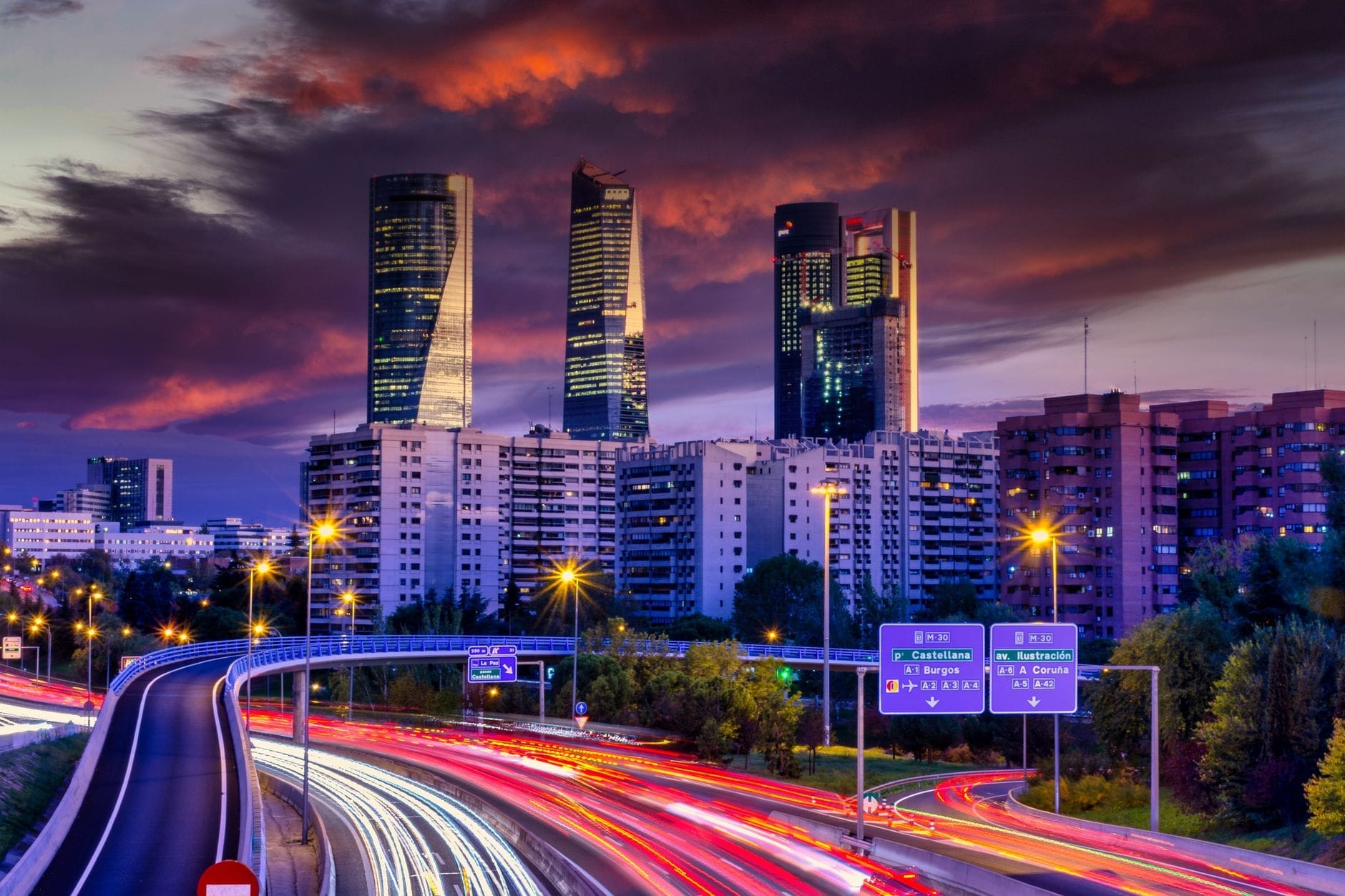
The Cuatro Torres Business Area, officially known in Spanish as the Área de Negocios de las Cuatro Torres (CTBA), is an open business district in northern Madrid anchored by five skyscrapers — four original towers completed in 2008 and a fifth, Caleido, added in 2021. The four originals remain the tallest buildings in Spain: Torre de Cristal at 249 metres, Torre Cepsa (originally Torre Foster) at 248 metres, Torre PwC at 236 metres, and Torre Espacio at 224 metres. These are not close competitors; they pull away from everything else on the Madrid skyline by a wide margin.
The site itself occupies the former Ciudad Deportiva of Real Madrid, the club's old training complex, which was sold and cleared to make way for construction starting in 2004. Construction of the four original towers finished in 2008. What replaced those training pitches is a cluster of towers surrounded by wide plazas, pedestrian paths, ornamental gardens, and reflecting pools. The area is freely accessible from the street at any hour; there are no gates, no tickets, and no visitor reception.
ℹ️ Good to know
Access to all outdoor plazas, paths, and gardens within the business district is completely free and unrestricted. The towers themselves are office buildings and a hotel; you cannot enter them as a general visitor unless you are using a specific service (restaurant, café, hotel lobby) inside.
The Architecture Up Close
Each tower was designed by a different internationally recognized architect, which gives the cluster an unusual visual tension rather than the corporate uniformity you might expect. Torre Espacio was designed by Pei Cobb Freed and Partners; Torre de Cristal by César Pelli; Torre PwC by Carlos Rubio Carvajal and Enrique Álvarez-Sala; and Torre Cepsa by Norman Foster, a fact the building still wears visibly in its smooth, curved silhouette. The fifth tower, Caleido, at around 181 metres, was designed by Fenwick Iribarren and Serrano-Suñer Arquitectura, and completed in 2021.
Walking between the towers, the scale becomes genuinely disorienting. The reflective glass surfaces of Torre de Cristal catch the sky and surrounding towers in shifting fragments, so the building changes appearance depending on cloud cover, time of day, and your angle of approach. Torre Foster's elliptical cross-section reads differently from different positions — from the south it reads as a wide slab; from the west it narrows dramatically. Torre Espacio's tapering form and the diagonal grid of its facade give it a more dynamic quality than the others.
For anyone following Madrid's architectural story, the CTBA represents a deliberate break from the city's historical fabric. The capital spent centuries defined by the horizontal Baroque of the Palacio Real and the restrained stone of its civic buildings. The Cuatro Torres are the city's clearest statement that Madrid has a contemporary skyline, even if most of the historic centre will never see it.
Tickets & tours
Hand-picked options from our booking partner. Prices are indicative; availability and final rates are confirmed when you complete your booking.
Royal Palace of Madrid guided tour and Tablao Torres Bermejas flamenco show with tapas
From 70 €Instant confirmationFree cancellationTablao Torres Bermejas flamenco show and drink
From 38 €Instant confirmationFree cancellationRoyal Monastery of El Escorial and the Valley of the Fallen trip from Madrid
From 64 €Instant confirmationFree cancellationFlexible time Real Madrid: Bernabeu Stadium & Museum Entry
From 42 €Instant confirmation
How the Experience Changes by Time of Day
Morning visits, roughly between 8 and 10 AM on weekdays, mean sharing the plazas with office workers moving quickly through to their buildings. The space feels purposeful rather than touristic, and the low morning sun from the east throws long shadows across the pavement between the towers. The glass facades of Torre de Cristal take on a pale gold tone that fades quickly once the sun rises higher.
Midday is the least atmospheric time. The plazas are exposed and Madrid's sun in summer is particularly direct at altitude (the city sits at 667 metres above sea level, which intensifies UV exposure noticeably). In July and August, the heat reflecting off the glass and paving can be uncomfortable by late morning. If you visit in summer, arrive before 9 AM or after 7 PM.
Late afternoon and early evening, especially in the golden hour before sunset, is when the CTBA is most photogenic. The westward-facing glass towers catch the light in a way that the renderings never quite predict: the buildings seem to glow from inside rather than simply reflect light. Weekday evenings see a slow dispersal of workers and a noticeable drop in foot traffic, leaving the plazas quieter than you might expect for a major city landmark.
💡 Local tip
For photography, arrive about 45 minutes before sunset. Position yourself south of the tower cluster looking north along Paseo de la Castellana for the most dramatic wide shot with all five towers in frame. A wide-angle lens and a clear day are the two things most worth planning for.
Getting There and Getting Around
The most direct metro connection is Line 10 to Begoña station, a five-minute walk south to the towers. Madrid Chamartín, the major rail interchange in the northern part of the city, is also within walking distance to the southeast. Several city bus lines serve Paseo de la Castellana along the route. If you are coming from the city centre, a taxi or ride-share to the base of the towers is straightforward; the address to give drivers is Paseo de la Castellana, in the direction of the Torres.
The CTBA is at the far northern end of the Paseo de la Castellana, Madrid's great north-south artery. If you want to combine the visit with a walk along the boulevard's art installations or stop at the Estadio Santiago Bernabéu, which is a few kilometres to the south on the same road, the two destinations sit on a logical linear path. Budget your time accordingly; it is not a short walk between them.
The paved plazas and wide pedestrian paths within the business district are generally flat and accessible for wheelchair users and those with mobility considerations. The metro station at Begoña and Chamartín have lift access, though it is worth checking current availability through Metro de Madrid before travel, as individual lifts can be out of service.
What to Bring and What to Expect Practically
There are no public amenities in the open plazas themselves — no fountains, no public toilets, and limited shade during summer months. The towers contain cafés, restaurants, and hotel services at commercial prices; these are the only reliable facilities nearby unless you cross back toward the Chamartín area. Come prepared in warm months with water and sun protection. In winter, the wind through the canyon between the towers can be sharper than the ambient temperature suggests.
The area works well as an add-on to a broader northern Madrid itinerary. The district sits far from the main museum corridor of the Paseo del Prado, so it makes most sense combined with other northern city points of interest rather than treated as part of a historic-centre day.
Is It Worth Your Time?
The Cuatro Torres Business Area is strikingly impressive at ground level in a way that photographs do not fully transmit. Standing between 249-metre towers and looking straight up produces a specific kind of vertigo that is worth experiencing once. The architectural variety between the four original towers means there is real visual interest beyond simply confirming they are tall.
That said, this is an active office district, not a designed visitor attraction. There are no interpretive panels, no audio guides, no viewing platforms open to the public, and no interactive element of any kind. If you come expecting a structured experience, you will find an open-air collection of corporate headquarters. The visit is exactly as long as you want it to be, and the depth of experience depends entirely on what you bring to it — an interest in architecture, a camera, or simply curiosity about how Madrid has grown northward over the past two decades.
Travelers whose Madrid time is short and centered on art, history, and food should probably prioritize other things. The CTBA competes for time against unique institutions like the Museo Reina Sofía and the Museo del Prado, and against neighborhoods that reward slower exploration. For architecture enthusiasts and photographers, the calculus is different: this is the only place in Spain where you can stand within a cluster of supertall buildings and examine them freely, at any hour, at no cost.
Who Should Skip the Cuatro Torres
If you have only two or three days in Madrid, the time investment is hard to justify purely on architectural grounds unless that is specifically what draws you to cities. The journey to the northern end of the Castellana from the historic centre takes meaningful time, and the return trip eats into an afternoon. Visitors traveling with young children will find little to engage them specifically — the wide plazas can be good for running around, but the experience offers nothing designed for families. Travelers who find corporate glass architecture uninteresting will find nothing here to change that view.
Insider Tips
- The best angle for capturing all five towers in a single frame is from the southern end of the cluster, looking north along Paseo de la Castellana. A clear winter day with low sun produces dramatically lit facades and eliminates the summer haze that softens the towers' edges.
- Weekday lunchtimes see an uptick in food trucks and pop-up vendors near the base of the towers serving the office population — a cheaper and more local option than the restaurants inside the buildings if you need a break.
- Torre de Cristal's glass skin changes color perceptibly across the day: pale silver in flat morning light, blue-grey under overcast skies, and warm amber in the late afternoon sun. If you only have time for one visit, late afternoon is the one.
- The Caleido tower, completed in 2021 and standing at approximately 181 metres, is slightly set back from the original four and is easy to miss as a distinct building from ground level — look for it on the northern edge of the cluster to appreciate how the group has grown since 2009.
- There are no luggage storage facilities anywhere in the district. If you are arriving from Chamartín rail station with bags, store them at Chamartín before walking over.
Who Is Cuatro Torres Business Area For?
- Architecture and design enthusiasts who want to study four radically different approaches to the skyscraper form in a single walk
- Photographers looking for Madrid's most dramatic skyline composition, particularly in golden-hour light
- Travelers on a tight budget seeking a substantial and visually striking outing with no admission cost
- Business travelers with a free hour who want to understand Madrid's contemporary commercial identity
- Anyone curious about the city's urban transformation over the past twenty years, from Franco-era Castellana to Spain's tallest skyline
Nearby Attractions
Combine your visit with:
- Riyadh Air Metropolitano
The Riyadh Air Metropolitano is the modern home of Atlético de Madrid, one of Spain's most passionate football clubs. With a capacity of 68,456, a slick stadium tour, and a dedicated metro station at the door, it is a serious football experience for visitors with or without a match ticket.
- Parque El Capricho
Commissioned in 1787 by the Duchess of Osuna, El Capricho de la Alameda de Osuna is a 17-hectare historic garden in Madrid's Barajas district. Free to enter on weekends and public holidays, it pairs Romantic-era landscape design with an unexpected Civil War bunker hidden beneath its lawns.
- Parque Quinta de los Molinos
A 25-hectare historic estate park in the San Blas-Canillejas district, Parque Quinta de los Molinos draws Madrileños every February when hundreds of almond trees erupt into pink and white bloom. Free to enter year-round, it offers eucalyptus paths, kitchen gardens, and a cultural space well away from the tourist circuit.
- Parque Warner Madrid
Parque Warner Madrid is a full-scale Warner Bros. theme park located about 25 km south of the city centre in San Martín de la Vega. Spread across roughly 700,000 m² and divided into five themed zones, it offers major roller coasters, family rides, live shows, and seasonal events. This guide covers what to expect, how to get there, and whether it's worth the trip.