Riyadh Air Metropolitano: Atlético de Madrid's Fortress in the East
The Riyadh Air Metropolitano is the modern home of Atlético de Madrid, one of Spain's most passionate football clubs. With a capacity of 68,456, a slick stadium tour, and a dedicated metro station at the door, it is a serious football experience for visitors with or without a match ticket.
Quick Facts
- Location
- Avenida de Luis Aragonés 4, 28022 Madrid (Rosas neighbourhood, San Blas–Canillejas district)
- Getting There
- Metro Line 7 (orange), Estadio Metropolitano station – directly adjacent to the stadium
- Time Needed
- 2–3 hours for the Atleti Tour & Museum; allow extra time before and after a match
- Cost
- Atleti Tour & Museum prices vary; check the official booking site. Match tickets vary by competition and seat category.
- Best for
- Football fans, architecture enthusiasts, families looking for a structured experience
- Official website
- www.atleticodemadrid.com
What Is the Riyadh Air Metropolitano?
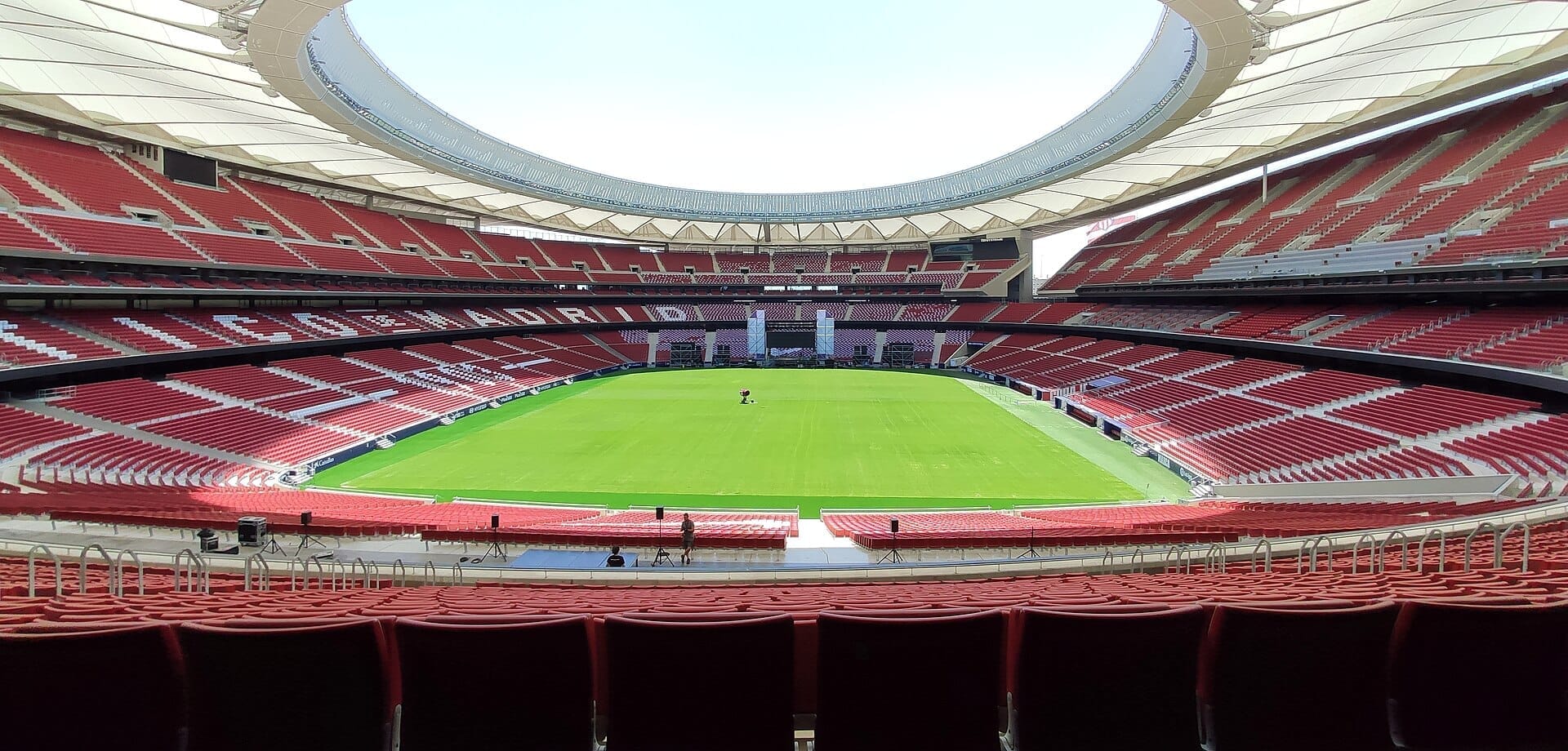
The Riyadh Air Metropolitano Stadium, officially known in Spanish as the Estadio Metropolitano, is the home ground of Atlético de Madrid and one of the largest football stadiums in Spain. With a seated capacity of 68,456 spectators, it sits in the San Blas–Canillejas district on the eastern edge of the city, about 10 kilometres from Puerta del Sol. The current commercial name, Riyadh Air Metropolitano Stadium, was adopted in 2024 following a naming-rights agreement with the Saudi airline Riyadh Air.
The original structure on this site opened on 6 September 1994, conceived initially as a multi-purpose venue linked to Madrid's bid to host the 1997 World Athletics Championships. It was significantly remodelled in the 2000s, and Atlético de Madrid moved in at the start of the 2017–18 season, leaving their long-time home at the Estadio Vicente Calderón in the south of the city. The move was not universally welcomed by older fans nostalgic for the Calderón, but the Metropolitano has since earned its own identity, shaped by some of European football's most intense atmospheres.
ℹ️ Good to know
The Atleti Tour & Museum is open Monday to Sunday 11:00–19:00, though hours can change on specific days and match days. Always confirm on the official booking platform before visiting: tour-museum.atleticodemadrid.com
The Stadium Experience: Architecture and Scale
From the outside, the Metropolitano makes an immediate impression. The exterior is defined by a continuous elliptical canopy that wraps around the entire bowl, giving the structure a cohesive, almost fortress-like silhouette when seen from the adjacent ring road. Approach it from the metro station on a clear day and the canopy catches the Madrid light in a way that feels appropriately dramatic for a club whose identity is built on defiance and emotion.
Step inside, even without a match in progress, and the scale becomes clear quickly. Every seat faces the pitch without an obstructed sightline, a deliberate design feature of the renovation. The lower and upper tiers are steeply raked, which is the reason match atmospheres here carry so much intensity: sound reflects inward rather than escaping upward. The bowl is closed on all four sides, meaning there is no open corner to bleed noise.
If architecture interests you beyond the stadium itself, the surrounding area rewards a short walk. The Metropolitano sits close to the M-40 ring road, and the contrast between the stadium's scale and the quiet residential streets behind it is notable. For a broader look at how modern construction has shaped the city, the Madrid architecture guide provides useful context.
Tickets & tours
Hand-picked options from our booking partner. Prices are indicative; availability and final rates are confirmed when you complete your booking.
Royal Monastery of El Escorial and the Valley of the Fallen trip from Madrid
From 64 €Instant confirmationFree cancellationFlexible time Real Madrid: Bernabeu Stadium & Museum Entry
From 42 €Instant confirmationMuseum of Senses Madrid entrance ticket
From 19 €Instant confirmationAvila and Segovia full-day tour from Madrid
From 50 €Instant confirmationFree cancellation
Atleti Tour and Museum: What to Expect
The Atleti Tour & Museum is the primary reason most non-match-day visitors come to the Metropolitano, and it delivers a more immersive experience than many comparable stadium tours in Europe. The tour route takes in the changing rooms, the players' tunnel, the pitch-side dugouts, and the press conference room. Standing in the tunnel before walking out to pitch level, with the empty stands rising around you, gives a concrete sense of the theatre involved in professional football.
The museum section documents Atlético de Madrid's history with match footage, trophies, and memorabilia covering more than a century of the club's existence. For fans, this is richly detailed. For casual visitors without a strong attachment to Atlético, the museum is interesting as a cultural document of Madrid's working-class football identity, distinct in tone and self-image from the more globally famous Real Madrid across the city. The audio guide, available in multiple languages, helps non-Spanish speakers navigate the content.
Tours are self-guided in parts and guided in others, depending on the package chosen. The experience typically takes around 90 minutes to two hours if you move at a reasonable pace. Allow more time if you are travelling with children who want to photograph everything, which is entirely understandable given how well-designed the photo points are.
💡 Local tip
Book your Atleti Tour & Museum slot online in advance, particularly on weekends and during school holidays. Walk-up availability exists but cannot be guaranteed, and prices are the same regardless of booking method.
Attending a Match: Atmosphere and Practicalities
Watching Atlético de Madrid play at the Metropolitano is one of the more intense live football experiences available in Europe. The club's fanbase is famously loyal and vocal, and the closed bowl design concentrates that energy. The Frente Atlético, the ultras group historically positioned in the southern lower stand, drives much of the singing throughout the match. By kick-off, the air smells of cigarette smoke and coffee from the exterior concourses, and the noise inside is not something you filter out: it hits physically.
Match tickets are sold through Atlético's official website and authorised resellers. Prices vary considerably by competition, opponent, and seat category. La Liga fixtures against smaller clubs may have tickets available at relatively short notice; Champions League knockout matches and the Madrid Derby against Real Madrid sell out rapidly and resale prices climb significantly. The club's official site is the safest source for legitimate tickets.
On match days, the area around the stadium fills from roughly two hours before kick-off. Street vendors, fan bars along Avenida de Luis Aragonés, and the official club shop create a pre-match scene worth arriving early for. Post-match, the metro queues can stretch considerably: seasoned visitors know to either wait 30 minutes inside the stadium or walk 10–15 minutes to Las Rosas or Canillejas stations on the same Line 7 to avoid the crush. For broader advice on moving around the city on busy days, the guide to getting around Madrid covers transport options clearly.
Getting There and Practical Logistics
The metro is the most straightforward way to reach the Metropolitano. Line 7, the orange line, stops at Estadio Metropolitano station, which sits directly beside the stadium's main entrance. Journey time from central areas like Sol or Gran Vía is typically around 20–30 minutes with a single connection. On match days, Metro Madrid often runs extended services and additional frequency on Line 7; check the Metro Madrid website for confirmed match-day timetables.
City buses including lines 28, 48, 140, 153, and E2 serve the stadium area from different parts of the city. Bus travel is slower than the metro on match days due to traffic, so it works better for touring visits than for timed arrivals at kick-off. Driving is not recommended on match days given limited parking and the volume of pedestrian traffic near the M-40 access points.
The surrounding neighbourhood offers little in the way of tourist infrastructure beyond the stadium itself. There are functional cafés and fast-food options near the metro station, but visitors expecting a food and bar scene comparable to what surrounds the Santiago Bernabéu will find it more modest here. That said, it is worth factoring in that the Metropolitano is primarily a purpose-built sports venue in a residential district, not a city-centre attraction.
⚠️ What to skip
On match days, strict bag-size restrictions apply at the entrance gates. Check the club's current policy on official channels before arriving, as oversized bags must be left outside or at secure storage if available. There is no left-luggage facility guaranteed on all match days.
Photography, Weather, and Who This Is For
For photography, the best light on the exterior falls in the morning, when the sun catches the canopy's white cladding from the east. Inside the stadium on a tour, artificial lighting means time of day matters less, though the pitch looks its best in natural light if you visit during a session where the roof panels allow it through. Match-night photography from the stands is rewarding but requires a phone or camera that handles low-light well, as the contrast between the bright pitch and darker stands is pronounced.
Madrid's summer heat, which regularly exceeds 35°C in July and August, makes outdoor waits in exposed queue areas uncomfortable. The area around the stadium offers limited shade. If you are visiting in summer for the tour, morning arrival is more comfortable than an afternoon slot. Winter match evenings can be genuinely cold at this elevation, so layering is sensible.
Visitors who are not football fans will find the stadium tour adequate but not as compelling as a match-day visit. The museum is notably interesting from a cultural history perspective, but if your priority is Madrid's broader sporting and architectural landmarks, you might also consider the Estadio Santiago Bernabéu across the city, which offers a different experience shaped by Real Madrid's distinct global identity. Comparing the two is itself a useful way to understand the city's dual football personality.
Families with children who are Atlético fans will find the experience well-suited to them: the tour is engaging, the museum has interactive elements, and the club shop is conveniently placed near the exit. For ideas on how to structure a wider trip with younger visitors, the Madrid with kids guide has practical suggestions beyond the football.
Insider Tips
- If you are attending a match and want to beat the post-match metro queues, walk 10–15 minutes north along Avenida de Arcentales to Las Rosas station on the same Line 7. The crowd thins significantly within a block of the stadium.
- The club shop inside the Metropolitano is notably larger than the satellite shops in central Madrid and holds the widest range of merchandise, including personalised shirt printing. It is accessible on non-match days without a tour ticket.
- On tour days without a match, you can often linger on the pitch-side level longer than the official route suggests. Staff are generally accommodating if you want additional time for photographs at the dugout.
- For the Champions League or a Madrid Derby, assume tickets will not be available at short notice. Set up alerts on Atlético's official site weeks in advance, as these fixtures sell through official channels before resale markets absorb them.
- The Metropolitano sits within the San Blas–Canillejas district, while Atlético's main training facilities are located separately in the Alcalá de Henares area. Die-hard fans sometimes visit both on the same trip, though the training ground has no public tour programme.
Who Is Riyadh Air Metropolitano For?
- Football fans with any attachment to Atlético de Madrid or Spanish football culture
- Travellers comparing the Metropolitano to the Bernabéu as part of a Madrid football experience
- Families with children who are La Liga supporters
- Architecture enthusiasts interested in large-scale modern sports venue design
- Group travellers looking for a structured, bookable experience with clear logistics
Nearby Attractions
Combine your visit with:
- Cuatro Torres Business Area
The Cuatro Torres Business Area is home to the four tallest skyscrapers in Spain, rising along the northern stretch of Paseo de la Castellana.
- Parque El Capricho
Commissioned in 1787 by the Duchess of Osuna, El Capricho de la Alameda de Osuna is a 17-hectare historic garden in Madrid's Barajas district. Free to enter on weekends and public holidays, it pairs Romantic-era landscape design with an unexpected Civil War bunker hidden beneath its lawns.
- Parque Quinta de los Molinos
A 25-hectare historic estate park in the San Blas-Canillejas district, Parque Quinta de los Molinos draws Madrileños every February when hundreds of almond trees erupt into pink and white bloom. Free to enter year-round, it offers eucalyptus paths, kitchen gardens, and a cultural space well away from the tourist circuit.
- Parque Warner Madrid
Parque Warner Madrid is a full-scale Warner Bros. theme park located about 25 km south of the city centre in San Martín de la Vega. Spread across roughly 700,000 m² and divided into five themed zones, it offers major roller coasters, family rides, live shows, and seasonal events. This guide covers what to expect, how to get there, and whether it's worth the trip.